mirror of
https://github.com/komari-monitor/komari.git
synced 2026-11-11 17:00:18 +00:00
Compare commits
12
Commits
| Author | SHA1 | Date | |
|---|---|---|---|
 Akizon |
5d26f1b18a | ||
 Akizon77 |
80cc39b02d | ||
|
Akizon77
|
11c65ddbd0 | ||
|
Akizon77
|
ad74b57ecc | ||
|
Akizon77
|
e13f79577d | ||
|
Akizon77
|
832b80054f | ||
|
Akizon77
|
09d70996d3 | ||
|
Akizon77
|
303f2bbcf5 | ||
 airium |
28ce225aa0 | ||
|
Akizon77
|
683b7f652b | ||
 guocn |
a181b22071 | ||
 Torther |
d2f9261bc2 |
No files matched your search
@@ -8,9 +8,6 @@ inputs:
|
||||
repository:
|
||||
description: komari-web repository URL.
|
||||
default: https://github.com/komari-monitor/komari-web
|
||||
ref:
|
||||
description: Optional komari-web ref to build. Uses the repository default branch when empty.
|
||||
default: ""
|
||||
artifact-name:
|
||||
description: Optional artifact name for the packed frontend theme.
|
||||
default: ""
|
||||
@@ -23,36 +20,20 @@ runs:
|
||||
with:
|
||||
node-version: ${{ inputs.node-version }}
|
||||
|
||||
- name: Install zstd
|
||||
shell: bash
|
||||
run: |
|
||||
set -euxo pipefail
|
||||
if ! command -v zstd >/dev/null 2>&1; then
|
||||
sudo apt-get update
|
||||
sudo apt-get install -y zstd
|
||||
fi
|
||||
|
||||
- name: Clone and build frontend
|
||||
shell: bash
|
||||
run: |
|
||||
set -euxo pipefail
|
||||
rm -rf komari-web
|
||||
if [ -n "${{ inputs.ref }}" ]; then
|
||||
git clone --depth=1 --branch "${{ inputs.ref }}" "${{ inputs.repository }}" komari-web
|
||||
else
|
||||
git clone --depth=1 "${{ inputs.repository }}" komari-web
|
||||
fi
|
||||
git clone --depth=1 "${{ inputs.repository }}" komari-web
|
||||
cd komari-web
|
||||
npm install
|
||||
npm run build
|
||||
cd ..
|
||||
|
||||
mkdir -p web/public/defaultTheme
|
||||
rm -rf web/public/defaultTheme/dist web/public/defaultTheme/dist.tar.zst
|
||||
test -f komari-web/dist/index.html
|
||||
tar -cf "$RUNNER_TEMP/komari-default-dist.tar" -C komari-web/dist .
|
||||
zstd -19 -T0 -q -f "$RUNNER_TEMP/komari-default-dist.tar" -o web/public/defaultTheme/dist.tar.zst
|
||||
rm -f "$RUNNER_TEMP/komari-default-dist.tar"
|
||||
mkdir -p web/public/defaultTheme/dist
|
||||
rm -rf web/public/defaultTheme/dist/*
|
||||
cp -r komari-web/dist/* web/public/defaultTheme/dist/
|
||||
cp -f komari-web/komari-theme.json web/public/defaultTheme/
|
||||
if [ -f komari-web/preview.png ]; then cp -f komari-web/preview.png web/public/defaultTheme/; fi
|
||||
if [ -f komari-web/perview.png ]; then cp -f komari-web/perview.png web/public/defaultTheme/; fi
|
||||
|
||||
@@ -22,4 +22,3 @@ runs:
|
||||
mkdir -p web/public/defaultTheme
|
||||
rm -rf web/public/defaultTheme/*
|
||||
tar -xzf "$RUNNER_TEMP/frontend-artifact/${{ inputs.artifact-name }}.tar.gz" -C web/public/defaultTheme
|
||||
test -s web/public/defaultTheme/dist.tar.zst
|
||||
@@ -59,10 +59,6 @@ jobs:
|
||||
goarch: riscv64
|
||||
zig_target_triple: riscv64-linux-musl
|
||||
binary_extension: ""
|
||||
- goos: linux
|
||||
goarch: loong64
|
||||
zig_target_triple: loongarch64-linux-musl
|
||||
binary_extension: ""
|
||||
|
||||
exclude:
|
||||
- goos: windows
|
||||
@@ -98,11 +94,7 @@ jobs:
|
||||
fi
|
||||
VERSION="${{ github.sha }}"
|
||||
VERSION_HASH="${{ github.sha }}"
|
||||
LDFLAGS="-s -w -X github.com/komari-monitor/komari/utils.CurrentVersion=${VERSION} -X github.com/komari-monitor/komari/utils.VersionHash=${VERSION_HASH}"
|
||||
if [ "${{ matrix.goos }}" = "linux" ]; then
|
||||
LDFLAGS="$LDFLAGS -extldflags=-Wl,--strip-all"
|
||||
fi
|
||||
go build -trimpath -ldflags="$LDFLAGS" -o "$BINARY_NAME"
|
||||
go build -trimpath -ldflags="-s -w -X github.com/komari-monitor/komari/utils.CurrentVersion=${VERSION} -X github.com/komari-monitor/komari/utils.VersionHash=${VERSION_HASH}" -o $BINARY_NAME
|
||||
|
||||
- name: Upload binary as artifact
|
||||
uses: actions/upload-artifact@v4
|
||||
|
||||
@@ -14,6 +14,11 @@ jobs:
|
||||
- name: Checkout code
|
||||
uses: actions/checkout@v4
|
||||
|
||||
#- name: Create dummy index.html
|
||||
# run: |
|
||||
# mkdir -p web/public/defaultTheme/dist
|
||||
# echo "<html><body><h1>This is komari development server.</h1></body></html>" > web/public/defaultTheme/dist/index.html
|
||||
|
||||
- name: Clone and build frontend
|
||||
uses: ./.github/actions/build-frontend
|
||||
|
||||
@@ -28,7 +33,7 @@ jobs:
|
||||
GOARCH: amd64
|
||||
run: |
|
||||
VERSION_SHA="${{ github.sha }}"
|
||||
go build -ldflags "-s -w -extldflags=-Wl,--strip-all -X github.com/komari-monitor/komari/utils.CurrentVersion=dev -X github.com/komari-monitor/komari/utils.VersionHash=${VERSION_SHA}" -o komari .
|
||||
go build -ldflags "-X github.com/komari-monitor/komari/utils.CurrentVersion=dev -X github.com/komari-monitor/komari/utils.VersionHash=${VERSION_SHA}" -o komari .
|
||||
|
||||
- name: Upload binary as artifact
|
||||
uses: actions/upload-artifact@v4
|
||||
|
||||
@@ -50,7 +50,7 @@ jobs:
|
||||
run: |
|
||||
VERSION="${{ github.ref_name }}"
|
||||
VERSION_HASH="${{ github.sha }}"
|
||||
LDFLAGS="-s -w -extldflags=-Wl,--strip-all -X github.com/komari-monitor/komari/utils.CurrentVersion=${VERSION} -X github.com/komari-monitor/komari/utils.VersionHash=${VERSION_HASH}"
|
||||
LDFLAGS="-s -w -X github.com/komari-monitor/komari/utils.CurrentVersion=${VERSION} -X github.com/komari-monitor/komari/utils.VersionHash=${VERSION_HASH}"
|
||||
|
||||
echo "Building for linux/amd64..."
|
||||
GOARCH=amd64 CC="zig cc -target x86_64-linux-musl" go build -trimpath -ldflags="$LDFLAGS" -o komari-linux-amd64
|
||||
|
||||
@@ -1,163 +0,0 @@
|
||||
name: Rebuild Existing Release
|
||||
|
||||
on:
|
||||
workflow_dispatch:
|
||||
inputs:
|
||||
release_tag:
|
||||
description: Existing GitHub Release tag whose assets and version image will be replaced.
|
||||
required: true
|
||||
type: string
|
||||
server_ref:
|
||||
description: Server commit, branch, or tag to build.
|
||||
required: true
|
||||
type: string
|
||||
frontend_ref:
|
||||
description: komari-web commit, branch, or tag to build.
|
||||
required: true
|
||||
type: string
|
||||
|
||||
permissions:
|
||||
contents: write
|
||||
packages: write
|
||||
|
||||
env:
|
||||
REGISTRY: ghcr.io
|
||||
IMAGE_NAME: ${{ github.repository }}
|
||||
|
||||
jobs:
|
||||
build-frontend:
|
||||
runs-on: ubuntu-latest
|
||||
|
||||
steps:
|
||||
- name: Checkout workflow source
|
||||
uses: actions/checkout@v4
|
||||
|
||||
- name: Build selected frontend artifact
|
||||
uses: ./.github/actions/build-frontend
|
||||
with:
|
||||
artifact-name: komari-frontend
|
||||
ref: ${{ inputs.frontend_ref }}
|
||||
|
||||
build-and-attach-binaries:
|
||||
needs: build-frontend
|
||||
runs-on: ubuntu-latest
|
||||
|
||||
strategy:
|
||||
matrix:
|
||||
include:
|
||||
- goos: windows
|
||||
goarch: amd64
|
||||
zig_target_triple: x86_64-windows-gnu
|
||||
binary_extension: .exe
|
||||
- goos: windows
|
||||
goarch: arm64
|
||||
zig_target_triple: aarch64-windows-gnu
|
||||
binary_extension: .exe
|
||||
- goos: windows
|
||||
goarch: 386
|
||||
zig_target_triple: x86-windows-gnu
|
||||
binary_extension: .exe
|
||||
- goos: linux
|
||||
goarch: amd64
|
||||
zig_target_triple: x86_64-linux-musl
|
||||
binary_extension: ""
|
||||
- goos: linux
|
||||
goarch: arm64
|
||||
zig_target_triple: aarch64-linux-musl
|
||||
binary_extension: ""
|
||||
- goos: linux
|
||||
goarch: 386
|
||||
zig_target_triple: x86-linux-musl
|
||||
binary_extension: ""
|
||||
- goos: linux
|
||||
goarch: riscv64
|
||||
zig_target_triple: riscv64-linux-musl
|
||||
binary_extension: ""
|
||||
|
||||
steps:
|
||||
- name: Checkout server source
|
||||
uses: actions/checkout@v4
|
||||
with:
|
||||
ref: ${{ inputs.server_ref }}
|
||||
|
||||
- name: Restore frontend artifact
|
||||
uses: komari-monitor/komari/.github/actions/restore-frontend@main
|
||||
|
||||
- name: Set up Go
|
||||
uses: actions/setup-go@v5
|
||||
with:
|
||||
go-version: "1.23"
|
||||
|
||||
- name: Install Zig cross-compiler toolchain
|
||||
uses: komari-monitor/komari/.github/actions/setup-zig@main
|
||||
|
||||
- name: Build binary
|
||||
env:
|
||||
GOOS: ${{ matrix.goos }}
|
||||
GOARCH: ${{ matrix.goarch }}
|
||||
CGO_ENABLED: 1
|
||||
CC: zig cc -target ${{ matrix.zig_target_triple }}
|
||||
GIN_MODE: release
|
||||
RELEASE_TAG: ${{ inputs.release_tag }}
|
||||
run: |
|
||||
BINARY_NAME=komari-${{ matrix.goos }}-${{ matrix.goarch }}${{ matrix.binary_extension }}
|
||||
VERSION_HASH="$(git rev-parse HEAD)"
|
||||
LDFLAGS="-s -w -X github.com/komari-monitor/komari/utils.CurrentVersion=${RELEASE_TAG} -X github.com/komari-monitor/komari/utils.VersionHash=${VERSION_HASH}"
|
||||
if [ "${{ matrix.goos }}" = "linux" ]; then
|
||||
LDFLAGS="$LDFLAGS -extldflags=-Wl,--strip-all"
|
||||
fi
|
||||
go build -trimpath -ldflags="$LDFLAGS" -o "$BINARY_NAME"
|
||||
|
||||
- name: Upload binary to release
|
||||
env:
|
||||
GH_TOKEN: ${{ github.token }}
|
||||
RELEASE_TAG: ${{ inputs.release_tag }}
|
||||
run: |
|
||||
BINARY_NAME=komari-${{ matrix.goos }}-${{ matrix.goarch }}${{ matrix.binary_extension }}
|
||||
gh release upload "$RELEASE_TAG" "$BINARY_NAME" --clobber --repo "$GITHUB_REPOSITORY"
|
||||
|
||||
- name: Upload binary as artifact
|
||||
uses: actions/upload-artifact@v4
|
||||
with:
|
||||
name: komari-${{ matrix.goos }}-${{ matrix.goarch }}
|
||||
path: komari-${{ matrix.goos }}-${{ matrix.goarch }}${{ matrix.binary_extension }}
|
||||
|
||||
build-and-push-docker:
|
||||
needs: build-and-attach-binaries
|
||||
runs-on: ubuntu-latest
|
||||
|
||||
steps:
|
||||
- name: Checkout server source
|
||||
uses: actions/checkout@v4
|
||||
with:
|
||||
ref: ${{ inputs.server_ref }}
|
||||
|
||||
- name: Download Docker binaries
|
||||
uses: actions/download-artifact@v4
|
||||
with:
|
||||
pattern: komari-linux-*
|
||||
path: .
|
||||
merge-multiple: true
|
||||
|
||||
- name: Set up QEMU
|
||||
uses: docker/setup-qemu-action@v3
|
||||
|
||||
- name: Set up Docker Buildx
|
||||
uses: docker/setup-buildx-action@v3
|
||||
|
||||
- name: Log in to the Container registry
|
||||
uses: docker/login-action@v3
|
||||
with:
|
||||
registry: ${{ env.REGISTRY }}
|
||||
username: ${{ github.actor }}
|
||||
password: ${{ github.token }}
|
||||
|
||||
- name: Build and push version Docker image
|
||||
uses: docker/build-push-action@v5
|
||||
with:
|
||||
context: .
|
||||
push: true
|
||||
platforms: linux/amd64,linux/arm64
|
||||
tags: ${{ env.REGISTRY }}/${{ env.IMAGE_NAME }}:${{ inputs.release_tag }}
|
||||
no-cache: true
|
||||
provenance: false
|
||||
@@ -56,7 +56,7 @@ jobs:
|
||||
VERSION: ${{ github.event.inputs.version }}
|
||||
run: |
|
||||
VERSION_HASH="${{ github.sha }}"
|
||||
LDFLAGS="-s -w -extldflags=-Wl,--strip-all -X github.com/komari-monitor/komari/utils.CurrentVersion=${VERSION} -X github.com/komari-monitor/komari/utils.VersionHash=${VERSION_HASH}"
|
||||
LDFLAGS="-s -w -X github.com/komari-monitor/komari/utils.CurrentVersion=${VERSION} -X github.com/komari-monitor/komari/utils.VersionHash=${VERSION_HASH}"
|
||||
|
||||
echo "Building for linux/amd64..."
|
||||
GOARCH=amd64 CC="zig cc -target x86_64-linux-musl" go build -trimpath -ldflags="$LDFLAGS" -o komari-linux-amd64
|
||||
@@ -107,6 +107,7 @@ jobs:
|
||||
images: ${{ env.REGISTRY }}/${{ env.IMAGE_NAME }}
|
||||
tags: |
|
||||
type=raw,value=${{ github.event.inputs.version }}
|
||||
type=raw,value=latest
|
||||
|
||||
- name: Build and push Docker image
|
||||
uses: docker/build-push-action@v5
|
||||
|
||||
@@ -13,24 +13,7 @@ env:
|
||||
IMAGE_NAME: ${{ github.repository }}
|
||||
|
||||
jobs:
|
||||
resolve-release:
|
||||
runs-on: ubuntu-latest
|
||||
outputs:
|
||||
frontend_ref: ${{ steps.release.outputs.frontend_ref }}
|
||||
|
||||
steps:
|
||||
- id: release
|
||||
env:
|
||||
TAG: ${{ github.event.release.tag_name }}
|
||||
run: |
|
||||
frontend_ref=""
|
||||
if [[ "$TAG" =~ ^(.+)-fix[0-9]+$ ]]; then
|
||||
frontend_ref="${BASH_REMATCH[1]}"
|
||||
fi
|
||||
echo "frontend_ref=$frontend_ref" >> "$GITHUB_OUTPUT"
|
||||
|
||||
build-frontend:
|
||||
needs: resolve-release
|
||||
runs-on: ubuntu-latest
|
||||
|
||||
steps:
|
||||
@@ -41,7 +24,6 @@ jobs:
|
||||
uses: ./.github/actions/build-frontend
|
||||
with:
|
||||
artifact-name: komari-frontend
|
||||
ref: ${{ needs.resolve-release.outputs.frontend_ref }}
|
||||
|
||||
build-and-attach-binaries:
|
||||
needs: build-frontend
|
||||
@@ -83,10 +65,6 @@ jobs:
|
||||
goarch: riscv64
|
||||
zig_target_triple: riscv64-linux-musl
|
||||
binary_extension: ""
|
||||
- goos: linux
|
||||
goarch: loong64
|
||||
zig_target_triple: loongarch64-linux-musl
|
||||
binary_extension: ""
|
||||
|
||||
exclude:
|
||||
- goos: windows
|
||||
@@ -121,11 +99,7 @@ jobs:
|
||||
fi
|
||||
VERSION="${{ github.event.release.tag_name }}"
|
||||
VERSION_HASH="${{ github.sha }}" # Use commit SHA for hash
|
||||
LDFLAGS="-s -w -X github.com/komari-monitor/komari/utils.CurrentVersion=${VERSION} -X github.com/komari-monitor/komari/utils.VersionHash=${VERSION_HASH}"
|
||||
if [ "${{ matrix.goos }}" = "linux" ]; then
|
||||
LDFLAGS="$LDFLAGS -extldflags=-Wl,--strip-all"
|
||||
fi
|
||||
go build -trimpath -ldflags="$LDFLAGS" -o "$BINARY_NAME"
|
||||
go build -trimpath -ldflags="-s -w -X github.com/komari-monitor/komari/utils.CurrentVersion=${VERSION} -X github.com/komari-monitor/komari/utils.VersionHash=${VERSION_HASH}" -o $BINARY_NAME
|
||||
|
||||
- name: Upload binary as artifact
|
||||
uses: actions/upload-artifact@v4
|
||||
@@ -177,20 +151,6 @@ jobs:
|
||||
username: ${{ github.actor }}
|
||||
password: ${{ secrets.GITHUB_TOKEN }}
|
||||
|
||||
- name: Check whether this is the latest GitHub release
|
||||
id: release
|
||||
env:
|
||||
GH_TOKEN: ${{ secrets.GITHUB_TOKEN }}
|
||||
TAG: ${{ github.event.release.tag_name }}
|
||||
run: |
|
||||
is_latest="$(gh api graphql \
|
||||
-f 'query=query($owner: String!, $name: String!, $tag: String!) { repository(owner: $owner, name: $name) { release(tagName: $tag) { isLatest } } }' \
|
||||
-F owner="${{ github.repository_owner }}" \
|
||||
-F name="${{ github.event.repository.name }}" \
|
||||
-F tag="$TAG" \
|
||||
--jq '.data.repository.release.isLatest')"
|
||||
echo "is_latest=$is_latest" >> "$GITHUB_OUTPUT"
|
||||
|
||||
- name: Extract metadata
|
||||
id: meta
|
||||
uses: docker/metadata-action@v5
|
||||
@@ -198,6 +158,7 @@ jobs:
|
||||
images: ${{ env.REGISTRY }}/${{ env.IMAGE_NAME }}
|
||||
tags: |
|
||||
type=raw,value=${{ github.event.release.tag_name }}
|
||||
type=raw,value=latest
|
||||
|
||||
- name: Build and push Docker image
|
||||
uses: docker/build-push-action@v5
|
||||
@@ -209,9 +170,3 @@ jobs:
|
||||
labels: ${{ steps.meta.outputs.labels }}
|
||||
no-cache: true
|
||||
provenance: false
|
||||
|
||||
- name: Promote Docker latest tag
|
||||
if: steps.release.outputs.is_latest == 'true'
|
||||
env:
|
||||
TAG: ${{ github.event.release.tag_name }}
|
||||
run: docker buildx imagetools create --tag "${REGISTRY}/${IMAGE_NAME}:latest" "${REGISTRY}/${IMAGE_NAME}:${TAG}"
|
||||
@@ -112,10 +112,6 @@ jobs:
|
||||
goarch: riscv64
|
||||
zig_target_triple: riscv64-linux-musl
|
||||
binary_extension: ""
|
||||
- goos: linux
|
||||
goarch: loong64
|
||||
zig_target_triple: loongarch64-linux-musl
|
||||
binary_extension: ""
|
||||
|
||||
exclude:
|
||||
- goos: windows
|
||||
@@ -150,11 +146,7 @@ jobs:
|
||||
fi
|
||||
VERSION="${{ needs.prepare.outputs.version }}"
|
||||
VERSION_HASH="${{ github.sha }}" # Use commit SHA for hash
|
||||
LDFLAGS="-s -w -X github.com/komari-monitor/komari/utils.CurrentVersion=${VERSION} -X github.com/komari-monitor/komari/utils.VersionHash=${VERSION_HASH}"
|
||||
if [ "${{ matrix.goos }}" = "linux" ]; then
|
||||
LDFLAGS="$LDFLAGS -extldflags=-Wl,--strip-all"
|
||||
fi
|
||||
go build -trimpath -ldflags="$LDFLAGS" -o "$BINARY_NAME"
|
||||
go build -trimpath -ldflags="-s -w -X github.com/komari-monitor/komari/utils.CurrentVersion=${VERSION} -X github.com/komari-monitor/komari/utils.VersionHash=${VERSION_HASH}" -o $BINARY_NAME
|
||||
|
||||
- name: Upload binary as artifact
|
||||
uses: actions/upload-artifact@v4
|
||||
|
||||
@@ -15,7 +15,6 @@ komari.db
|
||||
/utils/geoip/data
|
||||
.vscode/
|
||||
/backup
|
||||
/cache
|
||||
|
||||
# Test binary, built with `go test -c`
|
||||
*.test
|
||||
@@ -35,7 +34,4 @@ go.work.sum
|
||||
|
||||
# build
|
||||
komari
|
||||
/dist/
|
||||
.codex
|
||||
|
||||
/web/filemanager/data
|
||||
+21
-2
@@ -8,11 +8,30 @@ ARG TARGETARCH
|
||||
|
||||
RUN apk add --no-cache ca-certificates curl tzdata
|
||||
|
||||
COPY --chmod=755 komari-${TARGETOS}-${TARGETARCH} /app/komari
|
||||
RUN set -eux; \
|
||||
case "${TARGETARCH}" in \
|
||||
amd64) cloudflared_arch="amd64" ;; \
|
||||
386) cloudflared_arch="386" ;; \
|
||||
arm64) cloudflared_arch="arm64" ;; \
|
||||
arm) cloudflared_arch="arm" ;; \
|
||||
*) echo "Unsupported TARGETARCH: ${TARGETARCH}" >&2; exit 1 ;; \
|
||||
esac; \
|
||||
curl -fsSL "https://github.com/cloudflare/cloudflared/releases/latest/download/cloudflared-linux-${cloudflared_arch}" -o /usr/local/bin/cloudflared; \
|
||||
chmod +x /usr/local/bin/cloudflared
|
||||
|
||||
COPY komari-${TARGETOS}-${TARGETARCH} /app/komari
|
||||
|
||||
RUN chmod +x /app/komari
|
||||
|
||||
ENV GIN_MODE=release
|
||||
ENV KOMARI_DB_TYPE=sqlite
|
||||
ENV KOMARI_DB_FILE=/app/data/komari.db
|
||||
ENV KOMARI_DB_HOST=localhost
|
||||
ENV KOMARI_DB_PORT=3306
|
||||
ENV KOMARI_DB_USER=root
|
||||
ENV KOMARI_DB_PASS=
|
||||
ENV KOMARI_DB_NAME=komari
|
||||
ENV KOMARI_LISTEN=0.0.0.0:25774
|
||||
ENV GODEBUG=disablethp=1
|
||||
|
||||
EXPOSE 25774
|
||||
|
||||
|
||||
@@ -5,63 +5,143 @@
|
||||
|
||||
|
||||
|
||||
[English](./README.md) | [简体中文](./README_zh-cn.md)
|
||||
[简体中文](./docs/README_zh.md) | [繁體中文](./docs/README_zh-TW.md) | [日本語](./docs/README_ja.md)
|
||||
|
||||
Komari is a lightweight, self-hosted server monitoring solution. It provides a simple and efficient way to track server performance through a web interface, with metrics collected by a lightweight agent.
|
||||
Komari is a lightweight, self-hosted server monitoring tool designed to provide a simple and efficient solution for monitoring server performance. It supports viewing server status through a web interface and collects data through a lightweight agent.
|
||||
|
||||
> [!WARNING]
|
||||
> Komari is a self-hosted monitoring and control application. Deploy it only on systems you own or are authorized to manage. You are solely responsible for how you deploy and use Komari. The developers accept no liability for unauthorized access, persistence, command execution, other misuse, or any resulting consequences.
|
||||
> Komari is a self-hosted monitoring and control program intended only for systems you own or are authorized to administer. Do not weaponize Komari, deploy it without consent, or use it for unauthorized access, persistence, command execution, or other abusive activity. For context on real-world abuse risks, see Huntress' analysis: [Komari C2 agent abuse](https://www.huntress.com/blog/komari-c2-agent-abuse).
|
||||
> Users are solely responsible for how they deploy and operate Komari. The developers do not accept responsibility for unauthorized or abusive use, or for any resulting consequences.
|
||||
> On Windows, when remote control is enabled, the client displays a Windows notification at each user login to remind the user that Komari is remote control software.
|
||||
|
||||
[Documentation](https://www.komari.wiki/) | [Telegram Group](https://t.me/komari_monitor)
|
||||
[Documentation](https://komari-document.pages.dev/) | [文档(镜像站 By Geekertao)](https://www.komari.wiki) | [Telegram Group](https://t.me/komari_monitor)
|
||||
|
||||
## Features
|
||||
|
||||
- **Real-time monitoring**: Displays monitoring data at one-second intervals.
|
||||
- **Lightweight and efficient**: Uses minimal system resources and works well on servers of any size.
|
||||
- **Self-hosted**: Keeps you in control of your data and privacy.
|
||||
- **Web interface**: Provides an intuitive, easy-to-use monitoring dashboard.
|
||||
- **Extensible**: Supports custom themes and plugins.
|
||||
- **Lightweight and Efficient**: Low resource consumption, suitable for servers of all sizes.
|
||||
- **Self-hosted**: Complete control over data privacy, easy to deploy.
|
||||
- **Web Interface**: Intuitive monitoring dashboard, easy to use.
|
||||
|
||||
## Quick Start
|
||||
|
||||
| Platform | Description |
|
||||
| --------------------------------------------------------------------------------------------------------------------------------------------------------------------------------------------------------- | ----------------------------------------------------------------------------------------------------------------------------------------------------------------------------------------------------- |
|
||||
| <a href="https://app.rainyun.com/apps/rca/store/6780/NzYxNzAz_"><img src="https://rainyun-apps.cn-nb1.rains3.com/materials/deploy-on-rainyun-cn.svg" alt="Rainyun" width="180"></a> | Deploy websites, databases, and hundreds of popular apps in seconds with flexible hourly billing. [Get started for just ¥5/month. Deploy now!](https://app.rainyun.com/apps/rca/store/6780/NzYxNzAz_) |
|
||||
| <a href="https://apps.fit2cloud.com/1panel/komari"><img src="https://raw.githubusercontent.com/komari-monitor/public/refs/heads/main/images/1panel-logo-blue.png" alt="1Panel App Store" width="180"></a> | A modern, open-source Linux server management panel for websites, databases, containers, files, backups, security, and AI, with one-click deployment from its app store. |
|
||||
### 0. One-click Deployment with Cloud Hosting
|
||||
|
||||
For instructions on Docker deployment, binary installation, building from source, and updates, see the [installation guide](https://www.komari.wiki/en/install/quick-start).
|
||||
- Rainyun - CNY 4.5/month
|
||||
|
||||
## Screenshots
|
||||
[](https://app.rainyun.com/apps/rca/store/6780/NzYxNzAz_)
|
||||
|
||||
| Page | Screenshot |
|
||||
| ------------------- | ---------------------------------------------------------------------------------------------------------------------------------------------------------------------- |
|
||||
| Home Dashboard | <img src="https://b2.akz.moe/awesome-pictures/komari-screenshot/%E4%B8%BB%E9%A1%B5%E4%BB%AA%E8%A1%A8%E7%9B%98-en.webp" width="800" alt="Home Dashboard"> |
|
||||
| Admin Dashboard | <img src="https://b2.akz.moe/awesome-pictures/komari-screenshot/%E5%90%8E%E5%8F%B0%E4%BB%AA%E8%A1%A8%E7%9B%98-en.webp" width="800" alt="Admin Dashboard"> |
|
||||
| History Charts | <img src="https://b2.akz.moe/awesome-pictures/komari-screenshot/%E5%8E%86%E5%8F%B2%E5%9B%BE%E8%A1%A8-en.webp" width="800" alt="History Charts"> |
|
||||
| Web Terminal | <img src="https://b2.akz.moe/awesome-pictures/komari-screenshot/%E7%BD%91%E9%A1%B5%E7%BB%88%E7%AB%AF.webp" width="800" alt="Web Terminal"> |
|
||||
| Customizable Themes | <img src="https://b2.akz.moe/awesome-pictures/komari-screenshot/%E4%B8%BB%E9%A2%98%E5%8F%AF%E8%87%AA%E5%AE%9A%E4%B9%89-en.webp" width="800" alt="Customizable Themes"> |
|
||||
| Theme Market | <img src="https://b2.akz.moe/awesome-pictures/komari-screenshot/%E4%B8%BB%E9%A2%98%E5%B8%82%E5%9C%BA-en.webp" width="800" alt="Theme Market"> |
|
||||
- 1Panel App Store
|
||||
|
||||
## Sponsors
|
||||
Available on 1Panel App Store. Install via **App Store > Utilities > Komari**.
|
||||
|
||||
Interested in sponsoring Komari? Contact the developer via [email](mailto:komari@akz.moe) or [Telegram](https://t.me/mamomoe).
|
||||
### 1. Use the One-click Install Script
|
||||
|
||||
| Sponsor | Description |
|
||||
| ------------------------------------------------------------------------------------------------------------------------------------------------------------------------------------------------ | ----------------------------------------------------------------------------------------------------------------------------------------------------------------------------------------------------------------------------------------------------------------------------- |
|
||||
| <a href="https://axisnow.io/zh?utm=komari"><img src="https://raw.githubusercontent.com/komari-monitor/public/refs/heads/main/images/AxisNow.jpg" alt="AxisNow" width="180"></a> | [Self-Hosted Private CDN \| Subscription-Based CDN-Like Service \| A Fully Controlled, Flexible, Modular CDN Network](https://axisnow.io/zh?utm=komari) |
|
||||
| <a href="https://whmcs.as211392.com/aff.php?aff=110"><img src="https://raw.githubusercontent.com/komari-monitor/public/refs/heads/main/images/dreamcloud.png" alt="Dream Cloud" width="180"></a> | Cost-effective Asia-Pacific hosting with direct connectivity and robust DDoS protection, backed by transparent capacity claims. |
|
||||
| <a href="https://sharon.io"><img src="https://raw.githubusercontent.com/komari-monitor/public/refs/heads/main/images/sharon-networks.webp" alt="Sharon Networks" width="180"></a> | Premium China-optimized connectivity from Asia-Pacific data centers, featuring low latency, high bandwidth, and Tbps-scale local DDoS mitigation. Join the [Telegram community](https://t.me/SharonNetwork) to participate in charitable initiatives and community giveaways. |
|
||||
Suitable for distributions using systemd (Ubuntu, Debian...).
|
||||
|
||||
## Contributors
|
||||
```bash
|
||||
curl -fsSL https://raw.githubusercontent.com/komari-monitor/komari/main/install-komari.sh -o install-komari.sh
|
||||
chmod +x install-komari.sh
|
||||
sudo ./install-komari.sh
|
||||
```
|
||||
|
||||
Thanks to everyone who has contributed code, themes, plugins, documentation, translations, bug reports, or feedback to Komari.
|
||||
### 2. Docker Deployment
|
||||
|
||||
<a href="https://github.com/komari-monitor/komari/graphs/contributors"><img src="https://contributors-img.web.app/image?repo=komari-monitor/komari" alt="Komari contributors" width="600"></a>
|
||||
1. Create a data directory:
|
||||
```bash
|
||||
mkdir -p ./data
|
||||
```
|
||||
2. Run the Docker container:
|
||||
```bash
|
||||
docker run -d \
|
||||
-p 25774:25774 \
|
||||
-v $(pwd)/data:/app/data \
|
||||
--name komari \
|
||||
ghcr.io/komari-monitor/komari:latest
|
||||
```
|
||||
3. View the default username and password:
|
||||
```bash
|
||||
docker logs komari
|
||||
```
|
||||
4. Access `http://<your_server_ip>:25774` in your browser.
|
||||
|
||||
## Support the Project
|
||||
> [!NOTE]
|
||||
> You can also customize the initial username and password through the environment variables `ADMIN_USERNAME` and `ADMIN_PASSWORD`.
|
||||
|
||||
If Komari has been useful to you, consider buying me a coffee. Thank you for your support!
|
||||
### 3. Binary File Deployment
|
||||
|
||||
| WeChat Pay | TRON Network |
|
||||
| ------------------------------------------------------------------------------------------------------------ | ------------------------------------------------------------------------------------------- |
|
||||
|  |  |
|
||||
1. Visit Komari's [GitHub Release page](https://github.com/komari-monitor/komari/releases) to download the latest binary for your operating system.
|
||||
2. Run Komari:
|
||||
```bash
|
||||
./komari server -l 0.0.0.0:25774
|
||||
```
|
||||
3. Access `http://<your_server_ip>:25774` in your browser. The default port is `25774`.
|
||||
4. The default username and password can be found in the startup logs or set via the environment variables `ADMIN_USERNAME` and `ADMIN_PASSWORD`.
|
||||
|
||||
> [!NOTE]
|
||||
> Ensure the binary has execute permissions (`chmod +x komari`). Data will be saved in the `data` folder in the running directory.
|
||||
|
||||
### Manual Build
|
||||
|
||||
#### Dependencies
|
||||
|
||||
- Go 1.18+ and Node.js 20+ (for manual build)
|
||||
|
||||
1. Build the frontend static files:
|
||||
```bash
|
||||
git clone https://github.com/komari-monitor/komari-web
|
||||
cd komari-web
|
||||
npm install
|
||||
npm run build
|
||||
```
|
||||
2. Build the backend:
|
||||
```bash
|
||||
git clone https://github.com/komari-monitor/komari
|
||||
cd komari
|
||||
```
|
||||
Copy the static files generated in step 1 to the `/web/public/defaultTheme/dist` folder in the root of the `komari` project, and copy `komari-theme.json` + `preview.png`/`perview.png` to `/web/public/defaultTheme`.
|
||||
```bash
|
||||
go build -o komari
|
||||
```
|
||||
3. Run:
|
||||
```bash
|
||||
./komari server -l 0.0.0.0:25774
|
||||
```
|
||||
The default listening port is `25774`. Access `http://localhost:25774`.
|
||||
|
||||
## Frontend Development Guide
|
||||
|
||||
[Komari Theme Development Guide | Komari](https://komari-document.pages.dev/dev/theme.html)
|
||||
|
||||
## Client Agent Development Guide
|
||||
|
||||
[Komari Agent Information Reporting and Event Handling Documentation](https://komari-document.pages.dev/dev/agent.html)
|
||||
|
||||
## Contributing
|
||||
|
||||
Issues and Pull Requests are welcome!
|
||||
|
||||
## Acknowledgements
|
||||
|
||||
### 破碎工坊云
|
||||
|
||||
[破碎工坊云 - 专业云计算服务平台,提供高效、稳定、安全的高防服务器与CDN解决方案](https://www.crash.work/)
|
||||
|
||||
### DreamCloud
|
||||
|
||||
[DreamCloud - 极高性价比解锁直连亚太高防](https://as211392.com/)
|
||||
|
||||
### 🚀 Sponsored by SharonNetworks
|
||||
|
||||
[](https://sharon.io)
|
||||
|
||||
SharonNetworks 为您的业务起飞保驾护航!
|
||||
|
||||
亚太数据中心提供顶级的中国优化网络接入 · 低延时&高带宽&提供Tbps级本地清洗高防服务, 为您的业务保驾护航, 为您的客户提供极致体验. 加入社区 [Telegram群组](https://t.me/SharonNetwork) 可参与公益募捐或群内抽奖免费使用
|
||||
|
||||
### The open source software community
|
||||
|
||||
All the developers who submitted PRs and created themes
|
||||
|
||||
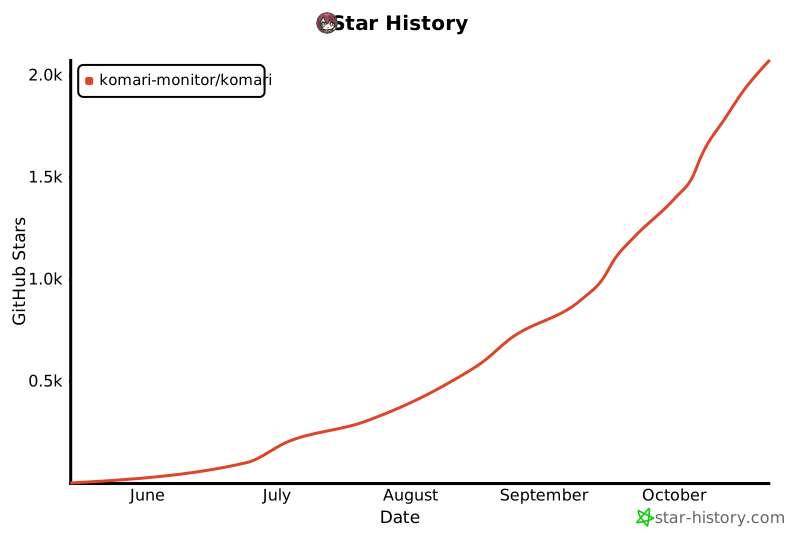
## Star History
|
||||
|
||||
[](https://www.star-history.com/#komari-monitor/komari&Date)
|
||||
@@ -1,67 +0,0 @@
|
||||
# Komari
|
||||
|
||||

|
||||
[](https://deepwiki.com/komari-monitor/komari)
|
||||
|
||||

|
||||
|
||||
[English](./README.md) | [简体中文](./README_zh-cn.md)
|
||||
|
||||
Komari 是一款轻量级的自托管服务器监控工具,旨在提供简单、高效的服务器性能监控解决方案。它支持通过 Web 界面查看服务器状态,并通过轻量级 Agent 收集数据。
|
||||
|
||||
> [!WARNING]
|
||||
> Komari 是一款自托管的监控/控制程序,仅应部署在你拥有或已获得授权管理的系统上。在未获授权的情况下部署、访问、持久化、执行命令及从事其他滥用行为,用户需要自行承担部署和使用 Komari 的责任。开发者不对未经授权或滥用行为及其后果承担责任。
|
||||
|
||||
[文档](https://www.komari.wiki/) | [Telegram 群](https://t.me/komari_monitor)
|
||||
|
||||
## 特性
|
||||
|
||||
- **实时监控**: 秒级实时数据展示。
|
||||
- **轻量高效**:低资源占用,适合各种规模的服务器。
|
||||
- **自托管**:完全掌控数据隐私,部署简单。
|
||||
- **Web 界面**:直观的监控仪表盘,易于使用。
|
||||
- **极强的可扩展性**: 支持自定义主题和插件。
|
||||
|
||||
## 快速开始
|
||||
|
||||
| 平台 | 介绍 |
|
||||
| -------------------------------------------------------------------------------------------------------------------------------------------------------------------------------------------------------- | -------------------------------------------------------------------------------------------------------------------------------------- |
|
||||
| <a href="https://app.rainyun.com/apps/rca/store/6780/NzYxNzAz_"><img src="https://rainyun-apps.cn-nb1.rains3.com/materials/deploy-on-rainyun-cn.svg" alt="Rainyun" width="180"></a> | 秒级部署网站、数据库及数百款热门 App,并采用按小时灵活计费。[每月5元,立即部署](https://app.rainyun.com/apps/rca/store/6780/NzYxNzAz_) |
|
||||
| <a href="https://apps.fit2cloud.com/1panel/komari"><img src="https://raw.githubusercontent.com/komari-monitor/public/refs/heads/main/images/1panel-logo-blue.png" alt="1Panel Appstore" width="180"></a> | 现代化、开源的Linux 服务器运维管理面板,提供网站、数据库、容器、文件、备份、安全与AI 管理能力,支持应用商店一键部署。 |
|
||||
|
||||
Docker、二进制文件、源码构建和更新说明,请参阅 [安装指南](https://www.komari.wiki/install/quick-start).
|
||||
|
||||
## 截图
|
||||
|
||||
| 页面 | 截图 |
|
||||
| ------------ | ------------------------------------------------------------------------------------------------------------------------------------------------------------ |
|
||||
| 主页仪表盘 | <img src="https://b2.akz.moe/awesome-pictures/komari-screenshot/%E4%B8%BB%E9%A1%B5%E4%BB%AA%E8%A1%A8%E7%9B%98.webp" width="800" alt="主页仪表盘"> |
|
||||
| 后台仪表盘 | <img src="https://b2.akz.moe/awesome-pictures/komari-screenshot/%E5%90%8E%E5%8F%B0%E4%BB%AA%E8%A1%A8%E7%9B%98.webp" width="800" alt="后台仪表盘"> |
|
||||
| 历史图表 | <img src="https://b2.akz.moe/awesome-pictures/komari-screenshot/%E5%8E%86%E5%8F%B2%E5%9B%BE%E8%A1%A8.webp" width="800" alt="历史图表"> |
|
||||
| 网页终端 | <img src="https://b2.akz.moe/awesome-pictures/komari-screenshot/%E7%BD%91%E9%A1%B5%E7%BB%88%E7%AB%AF.webp" width="800" alt="网页终端"> |
|
||||
| 主题可自定义 | <img src="https://b2.akz.moe/awesome-pictures/komari-screenshot/%E4%B8%BB%E9%A2%98%E5%8F%AF%E8%87%AA%E5%AE%9A%E4%B9%89.webp" width="800" alt="主题可自定义"> |
|
||||
| 主题市场 | <img src="https://b2.akz.moe/awesome-pictures/komari-screenshot/%E4%B8%BB%E9%A2%98%E5%B8%82%E5%9C%BA.webp" width="800" alt="主题市场"> |
|
||||
|
||||
## 赞助商
|
||||
|
||||
有意赞助 Komari?请通过 [电子邮箱](mailto:komari@akz.moe) 或 [Telegram](https://t.me/mamomoe) 联系开发者。
|
||||
|
||||
| 赞助商 | 描述 |
|
||||
| ------------------------------------------------------------------------------------------------------------------------------------------------------------------------------------------------ | ------------------------------------------------------------------------------------------------------------------------------------------------------------------------------------------------------------------- |
|
||||
| <a href="https://axisnow.io/zh?utm=komari"><img src="https://raw.githubusercontent.com/komari-monitor/public/refs/heads/main/images/AxisNow.jpg" alt="AxisNow" width="180"></a> | [自建私有部署CDN \| 订阅式高仿CDN \| 自主可控、灵活组合的CDN网络](https://axisnow.io/zh?utm=komari) |
|
||||
| <a href="https://whmcs.as211392.com/aff.php?aff=110"><img src="https://raw.githubusercontent.com/komari-monitor/public/refs/heads/main/images/dreamcloud.png" alt="Dream Cloud" width="180"></a> | 极高性价比解锁直连亚太高防,真高防,不虚标,打死退款 |
|
||||
| <a href="https://sharon.io"><img src="https://raw.githubusercontent.com/komari-monitor/public/refs/heads/main/images/sharon-networks.webp" alt="Sharon Networks" width="180"></a> | 亚太数据中心提供顶级的中国优化网络接入 · 低延时&高带宽&提供Tbps级本地清洗高防服务, 为您的业务保驾护航, 为您的客户提供极致体验. 加入社区 [Telegram群组](https://t.me/SharonNetwork) 可参与公益募捐或群内抽奖免费使用 |
|
||||
|
||||
## 贡献者
|
||||
|
||||
感谢所有为 Komari 贡献代码、主题、插件、文档、翻译、问题报告或反馈的朋友。
|
||||
|
||||
<a href="https://github.com/komari-monitor/komari/graphs/contributors"><img src="https://contributors-img.web.app/image?repo=komari-monitor/komari" alt="Komari 贡献者" width="600"></a>
|
||||
|
||||
## 支持项目
|
||||
|
||||
如果 Komari 对你有所帮助,欢迎请作者喝一杯奶茶。感谢你的支持!
|
||||
|
||||
| 微信赞赏码 | TRON Network |
|
||||
| ------------------------------------------------------------------------------------------------ | --------------------------------------------------------------------------- |
|
||||
|  |  |
|
||||
@@ -10,6 +10,11 @@ var (
|
||||
// 数据库配置
|
||||
DatabaseType string // 数据库类型:sqlite
|
||||
DatabaseFile string // SQLite数据库文件路径
|
||||
DatabaseHost string // 保留的兼容参数,当前未使用
|
||||
DatabasePort string // 保留的兼容参数,当前未使用
|
||||
DatabaseUser string // 保留的兼容参数,当前未使用
|
||||
DatabasePass string // 保留的兼容参数,当前未使用
|
||||
DatabaseName string // 保留的兼容参数,当前未使用
|
||||
|
||||
Listen string
|
||||
)
|
||||
|
||||
@@ -4,7 +4,7 @@ import (
|
||||
"os"
|
||||
|
||||
"github.com/komari-monitor/komari/database/dbcore"
|
||||
"github.com/komari-monitor/komari/internal/config"
|
||||
"github.com/komari-monitor/komari/pkg/config"
|
||||
"github.com/spf13/cobra"
|
||||
)
|
||||
|
||||
|
||||
+22
-2
@@ -17,6 +17,17 @@ func GetEnv(key, defaultValue string) string {
|
||||
return value
|
||||
}
|
||||
|
||||
// 从环境变量获取默认值
|
||||
var (
|
||||
dbTypeEnv = GetEnv("KOMARI_DB_TYPE", "sqlite")
|
||||
dbFileEnv = GetEnv("KOMARI_DB_FILE", "./data/komari.db")
|
||||
dbHostEnv = GetEnv("KOMARI_DB_HOST", "localhost")
|
||||
dbPortEnv = GetEnv("KOMARI_DB_PORT", "3306")
|
||||
dbUserEnv = GetEnv("KOMARI_DB_USER", "root")
|
||||
dbPassEnv = GetEnv("KOMARI_DB_PASS", "")
|
||||
dbNameEnv = GetEnv("KOMARI_DB_NAME", "komari")
|
||||
)
|
||||
|
||||
var RootCmd = &cobra.Command{
|
||||
Use: "Komari",
|
||||
Short: "Komari is a simple server monitoring tool",
|
||||
@@ -36,6 +47,15 @@ func Execute() {
|
||||
}
|
||||
|
||||
func init() {
|
||||
RootCmd.PersistentFlags().StringVarP(&flags.DatabaseType, "db-type", "t", "sqlite", "Database type (sqlite)")
|
||||
RootCmd.PersistentFlags().StringVarP(&flags.DatabaseFile, "database", "d", "./data/komari.db", "SQLite database file path")
|
||||
// 设置命令行参数,提供环境变量作为默认值
|
||||
RootCmd.PersistentFlags().StringVarP(&flags.DatabaseType, "db-type", "t", dbTypeEnv, "Database type (sqlite) [env: KOMARI_DB_TYPE]")
|
||||
RootCmd.PersistentFlags().StringVarP(&flags.DatabaseFile, "database", "d", dbFileEnv, "SQLite database file path [env: KOMARI_DB_FILE]")
|
||||
RootCmd.PersistentFlags().StringVar(&flags.DatabaseHost, "db-host", dbHostEnv, "Reserved database host parameter [env: KOMARI_DB_HOST]")
|
||||
RootCmd.PersistentFlags().StringVar(&flags.DatabasePort, "db-port", dbPortEnv, "Reserved database port parameter [env: KOMARI_DB_PORT]")
|
||||
RootCmd.PersistentFlags().StringVar(&flags.DatabaseUser, "db-user", dbUserEnv, "Reserved database username parameter [env: KOMARI_DB_USER]")
|
||||
RootCmd.PersistentFlags().StringVar(&flags.DatabasePass, "db-pass", dbPassEnv, "Reserved database password parameter [env: KOMARI_DB_PASS]")
|
||||
RootCmd.PersistentFlags().StringVar(&flags.DatabaseName, "db-name", dbNameEnv, "Reserved database name parameter [env: KOMARI_DB_NAME]")
|
||||
for _, name := range []string{"db-host", "db-port", "db-user", "db-pass", "db-name"} {
|
||||
_ = RootCmd.PersistentFlags().MarkHidden(name)
|
||||
}
|
||||
}
|
||||
+198
-88
@@ -1,14 +1,40 @@
|
||||
package cmd
|
||||
|
||||
import (
|
||||
"errors"
|
||||
"context"
|
||||
"fmt"
|
||||
"log"
|
||||
"net/http"
|
||||
"os"
|
||||
"os/signal"
|
||||
"syscall"
|
||||
"time"
|
||||
|
||||
appserver "github.com/komari-monitor/komari/internal/server"
|
||||
logger "github.com/komari-monitor/komari/utils/log"
|
||||
frontendpublic "github.com/komari-monitor/komari/web/public"
|
||||
|
||||
"github.com/gin-gonic/gin"
|
||||
"github.com/komari-monitor/komari/cmd/flags"
|
||||
"github.com/komari-monitor/komari/pkg/corn"
|
||||
"github.com/komari-monitor/komari/web/api"
|
||||
|
||||
"github.com/komari-monitor/komari/database"
|
||||
"github.com/komari-monitor/komari/database/accounts"
|
||||
"github.com/komari-monitor/komari/database/auditlog"
|
||||
"github.com/komari-monitor/komari/database/dbcore"
|
||||
"github.com/komari-monitor/komari/database/models"
|
||||
d_notification "github.com/komari-monitor/komari/database/notification"
|
||||
"github.com/komari-monitor/komari/database/records"
|
||||
"github.com/komari-monitor/komari/database/tasks"
|
||||
"github.com/komari-monitor/komari/pkg/config"
|
||||
"github.com/komari-monitor/komari/utils"
|
||||
"github.com/komari-monitor/komari/utils/cloudflared"
|
||||
"github.com/komari-monitor/komari/utils/geoip"
|
||||
logutil "github.com/komari-monitor/komari/utils/log"
|
||||
"github.com/komari-monitor/komari/utils/messageSender"
|
||||
"github.com/komari-monitor/komari/utils/notifier"
|
||||
"github.com/komari-monitor/komari/web/nezha"
|
||||
"github.com/komari-monitor/komari/web/oauth"
|
||||
report_cache "github.com/komari-monitor/komari/web/report"
|
||||
"github.com/komari-monitor/komari/web/router"
|
||||
"github.com/komari-monitor/komari/web/security"
|
||||
"github.com/spf13/cobra"
|
||||
)
|
||||
|
||||
@@ -28,100 +54,184 @@ func init() {
|
||||
RootCmd.AddCommand(ServerCmd)
|
||||
}
|
||||
|
||||
// RunServer 按显式的生命周期阶段启动服务端。
|
||||
//
|
||||
// 具体各阶段的职责与顺序见 internal/server.App。这里只负责串联:
|
||||
// 任一初始化阶段失败即中止启动,避免在半初始化状态下对外提供服务。
|
||||
func RunServer() {
|
||||
if err := frontendpublic.PrepareDefaultDist(); err != nil {
|
||||
logger.Fatalf("server", "prepare default frontend failed: %v", err)
|
||||
// #region 初始化
|
||||
if err := os.MkdirAll("./data/theme", os.ModePerm); err != nil {
|
||||
log.Fatalf("Failed to create theme directory: %v", err)
|
||||
}
|
||||
|
||||
app := appserver.New(appserver.Options{ListenAddr: flags.Listen})
|
||||
if err := app.Bootstrap(); err != nil {
|
||||
_ = app.Shutdown()
|
||||
logger.Fatalf("server", "server startup failed at %q: %v", "bootstrap", err)
|
||||
InitDatabase()
|
||||
if utils.VersionHash != "unknown" {
|
||||
gin.SetMode(gin.ReleaseMode)
|
||||
}
|
||||
|
||||
installRequired, err := app.InstallRequired()
|
||||
conf, err := config.GetManyAs[config.Settings]()
|
||||
if err != nil {
|
||||
_ = app.Shutdown()
|
||||
logger.Fatalf("server", "server startup failed at %q: %v", "detect-first-run-install", err)
|
||||
}
|
||||
if installRequired {
|
||||
completed, err := app.RunInstallGuide()
|
||||
if err != nil {
|
||||
_ = app.Shutdown()
|
||||
logger.Fatalf("server", "server startup failed at %q: %v", "run-first-run-install", err)
|
||||
}
|
||||
if !completed {
|
||||
return
|
||||
}
|
||||
log.Fatal(err)
|
||||
}
|
||||
go geoip.InitGeoIp()
|
||||
go DoScheduledWork()
|
||||
go messageSender.Initialize()
|
||||
// oidcInit
|
||||
go oauth.Initialize()
|
||||
|
||||
for {
|
||||
requirement, err := app.DatabaseMigrationRequired()
|
||||
if err != nil {
|
||||
completed, recoveryErr := app.RunMetricStoreRecovery(err)
|
||||
if recoveryErr != nil {
|
||||
_ = app.Shutdown()
|
||||
logger.Fatalf("server", "server startup failed at %q: %v", "database-migration-detection-recovery", recoveryErr)
|
||||
if conf.NezhaCompatEnabled {
|
||||
go func() {
|
||||
if err := nezha.StartNezhaCompat(conf.NezhaCompatListen); err != nil {
|
||||
log.Printf("Nezha compat server error: %v", err)
|
||||
auditlog.EventLog("error", fmt.Sprintf("Nezha compat server error: %v", err))
|
||||
}
|
||||
if !completed {
|
||||
return
|
||||
}()
|
||||
}
|
||||
|
||||
config.Subscribe(func(event config.ConfigEvent) {
|
||||
if ok, t := config.IsChangedT[string](event, config.OAuthProviderKey); ok {
|
||||
if t == "" || t == "none" {
|
||||
t = "github"
|
||||
}
|
||||
oidcProvider, err := database.GetOidcConfigByName(t)
|
||||
if err != nil {
|
||||
log.Printf("Failed to get OIDC provider config: %v", err)
|
||||
} else {
|
||||
log.Printf("Using %s as OIDC provider", oidcProvider.Name)
|
||||
}
|
||||
err = oauth.LoadProvider(oidcProvider.Name, oidcProvider.Addition)
|
||||
if err != nil {
|
||||
auditlog.EventLog("error", fmt.Sprintf("Failed to load OIDC provider: %v", err))
|
||||
}
|
||||
continue
|
||||
}
|
||||
if !requirement.Required() {
|
||||
break
|
||||
|
||||
if ok, t := config.IsChangedT[bool](event, config.NezhaCompatEnabledKey); ok {
|
||||
if t {
|
||||
l, _ := config.GetAs[string](config.NezhaCompatListenKey)
|
||||
if err := nezha.StartNezhaCompat(l); err != nil {
|
||||
log.Printf("start Nezha compat server error: %v", err)
|
||||
auditlog.EventLog("error", fmt.Sprintf("start Nezha compat server error: %v", err))
|
||||
}
|
||||
} else {
|
||||
if err := nezha.StopNezhaCompat(); err != nil {
|
||||
log.Printf("stop Nezha compat server error: %v", err)
|
||||
auditlog.EventLog("error", fmt.Sprintf("stop Nezha compat server error: %v", err))
|
||||
}
|
||||
}
|
||||
}
|
||||
completed, err := app.RunDatabaseMigration(requirement)
|
||||
|
||||
})
|
||||
// 初始化 cloudflared
|
||||
if err := cloudflared.AutoStart(GetEnv("KOMARI_CLOUDFLARED_TOKEN", "")); err != nil {
|
||||
log.Printf("failed to auto start cloudflared: %v", err)
|
||||
}
|
||||
|
||||
r := gin.New()
|
||||
r.Use(logutil.GinLogger())
|
||||
r.Use(logutil.GinRecovery())
|
||||
|
||||
config.Subscribe(func(event config.ConfigEvent) {
|
||||
if event.IsChanged(config.GeoIpProviderKey) {
|
||||
go geoip.InitGeoIp()
|
||||
}
|
||||
|
||||
if event.IsChanged(config.NotificationMethodKey) {
|
||||
go messageSender.Initialize()
|
||||
}
|
||||
|
||||
})
|
||||
r.Use(security.CorsMiddleware(conf.CorsOriginCheckEnabled, conf.CorsAllowedOrigins))
|
||||
|
||||
r.Use(api.IdentityMiddleware())
|
||||
r.Use(api.PrivateSiteMiddleware())
|
||||
|
||||
r.Use(func(c *gin.Context) {
|
||||
if len(c.Request.URL.Path) >= 4 && c.Request.URL.Path[:4] == "/api" {
|
||||
c.Header("Cache-Control", "no-store")
|
||||
}
|
||||
c.Next()
|
||||
})
|
||||
|
||||
router.Register(r)
|
||||
|
||||
srv := &http.Server{
|
||||
Addr: flags.Listen,
|
||||
Handler: r,
|
||||
}
|
||||
log.Printf("Starting server on %s ...", flags.Listen)
|
||||
go func() {
|
||||
if err := srv.ListenAndServe(); err != nil && err != http.ErrServerClosed {
|
||||
OnFatal(err)
|
||||
log.Fatalf("listen: %s\n", err)
|
||||
}
|
||||
}()
|
||||
quit := make(chan os.Signal, 1)
|
||||
signal.Notify(quit, os.Interrupt, syscall.SIGTERM)
|
||||
<-quit
|
||||
OnShutdown()
|
||||
ctx, cancel := context.WithTimeout(context.Background(), 5*time.Second)
|
||||
defer cancel()
|
||||
if err := srv.Shutdown(ctx); err != nil {
|
||||
log.Fatalf("Server forced to shutdown: %v", err)
|
||||
}
|
||||
|
||||
}
|
||||
|
||||
func InitDatabase() {
|
||||
var count int64 = 0
|
||||
if dbcore.GetDBInstance().Model(&models.User{}).Count(&count); count == 0 {
|
||||
user, passwd, err := accounts.CreateDefaultAdminAccount()
|
||||
if err != nil {
|
||||
_ = app.Shutdown()
|
||||
logger.Fatalf("server", "server startup failed at %q: %v", "run-database-migration", err)
|
||||
panic(err)
|
||||
}
|
||||
if !completed {
|
||||
return
|
||||
}
|
||||
}
|
||||
|
||||
// Metric store 是唯一允许进入恢复向导的启动阶段:主库已经在
|
||||
// Bootstrap 中就绪,因此可以保留登录能力并让管理员修正 DSN。
|
||||
if err := app.ConnectMetricStoreWithRetry(); err != nil {
|
||||
completed, recoveryErr := app.RunMetricStoreRecovery(err)
|
||||
if recoveryErr != nil {
|
||||
_ = app.Shutdown()
|
||||
logger.Fatalf("server", "server startup failed at %q: %v", "metric-store-recovery", recoveryErr)
|
||||
}
|
||||
if !completed {
|
||||
return
|
||||
}
|
||||
}
|
||||
|
||||
// 其余初始化阶段:任一步失败都不应继续对外服务。
|
||||
type stage struct {
|
||||
name string
|
||||
fn func() error
|
||||
}
|
||||
stages := []stage{
|
||||
{"init-stores", app.InitStores},
|
||||
{"init-providers", app.InitProviders},
|
||||
{"start-background", app.StartBackground},
|
||||
{"build-router", app.BuildRouter},
|
||||
}
|
||||
for _, s := range stages {
|
||||
if err := s.fn(); err != nil {
|
||||
// 已登记的资源尽力回收,再退出。
|
||||
_ = app.Shutdown()
|
||||
logger.Fatalf("server", "server startup failed at %q: %v", s.name, err)
|
||||
}
|
||||
}
|
||||
|
||||
if err := app.Run(); err != nil {
|
||||
if errors.Is(err, appserver.ErrRestartRequested) {
|
||||
logger.Infof("server", "Service stopped for restart: %v", err)
|
||||
os.Exit(1)
|
||||
}
|
||||
logger.Fatalf("server", "server exited with error: %v", err)
|
||||
log.Println("Default admin account created. Username:", user, ", Password:", passwd)
|
||||
}
|
||||
}
|
||||
|
||||
// #region 定时任务
|
||||
func DoScheduledWork() {
|
||||
if err := tasks.ReloadPingSchedule(); err != nil {
|
||||
log.Println("Failed to reload ping schedule:", err)
|
||||
}
|
||||
if err := d_notification.ReloadLoadNotificationSchedule(); err != nil {
|
||||
log.Println("Failed to reload load notification schedule:", err)
|
||||
}
|
||||
records.CompactRecord()
|
||||
|
||||
if err := corn.AddFunc("records:cleanup", "@every 30m", cleanupScheduledData); err != nil {
|
||||
log.Println("Failed to add cleanup scheduled task:", err)
|
||||
}
|
||||
if err := corn.AddFunc("records:minute", "@every 1m", minuteScheduledWork); err != nil {
|
||||
log.Println("Failed to add minute scheduled task:", err)
|
||||
}
|
||||
if err := corn.AddFunc("notifier:expire", "0 0 9 * * *", notifier.CheckExpireScheduledWork); err != nil {
|
||||
log.Println("Failed to add expire notification scheduled task:", err)
|
||||
}
|
||||
notifier.InitTrafficReportSchedule()
|
||||
}
|
||||
|
||||
func cleanupScheduledData() {
|
||||
cfg, _ := config.GetManyAs[config.Settings]()
|
||||
records.DeleteRecordBefore(time.Now().Add(-time.Hour * time.Duration(cfg.RecordPreserveTime)))
|
||||
records.CompactRecord()
|
||||
tasks.ClearTaskResultsByTimeBefore(time.Now().Add(-time.Hour * time.Duration(cfg.RecordPreserveTime)))
|
||||
tasks.DeletePingRecordsBefore(time.Now().Add(-time.Hour * time.Duration(cfg.PingRecordPreserveTime)))
|
||||
auditlog.RemoveOldLogs()
|
||||
accounts.RemoveExpiredSessions()
|
||||
}
|
||||
|
||||
func minuteScheduledWork() {
|
||||
cfg, _ := config.GetManyAs[config.Settings]()
|
||||
report_cache.SaveClientReportToDB()
|
||||
if !cfg.RecordEnabled {
|
||||
records.DeleteAll()
|
||||
tasks.DeleteAllPingRecords()
|
||||
}
|
||||
// 每分钟检查一次流量提醒
|
||||
notifier.CheckTraffic()
|
||||
}
|
||||
|
||||
func OnShutdown() {
|
||||
auditlog.Log("", "", "server is shutting down", "info")
|
||||
corn.StopAll()
|
||||
cloudflared.Shutdown()
|
||||
}
|
||||
|
||||
func OnFatal(err error) {
|
||||
auditlog.Log("", "", "server encountered a fatal error: "+err.Error(), "error")
|
||||
cloudflared.Shutdown()
|
||||
}
|
||||
@@ -4,12 +4,14 @@ import (
|
||||
"crypto/sha256"
|
||||
"encoding/base64"
|
||||
"fmt"
|
||||
"os"
|
||||
"time"
|
||||
|
||||
"github.com/google/uuid"
|
||||
"github.com/komari-monitor/komari/database/dbcore"
|
||||
"github.com/komari-monitor/komari/database/models"
|
||||
"gorm.io/gorm"
|
||||
"github.com/komari-monitor/komari/utils"
|
||||
|
||||
"github.com/google/uuid"
|
||||
)
|
||||
|
||||
const constantSalt = "06Wm4Jv1Hkxx"
|
||||
@@ -54,10 +56,7 @@ func hashPasswd(passwd string) string {
|
||||
}
|
||||
|
||||
func CreateAccount(username, passwd string) (user models.User, err error) {
|
||||
return CreateAccountWithDB(dbcore.GetDBInstance(), username, passwd)
|
||||
}
|
||||
|
||||
func CreateAccountWithDB(db *gorm.DB, username, passwd string) (user models.User, err error) {
|
||||
db := dbcore.GetDBInstance()
|
||||
hashedPassword := hashPasswd(passwd)
|
||||
user = models.User{
|
||||
UUID: uuid.New().String(),
|
||||
@@ -72,10 +71,7 @@ func CreateAccountWithDB(db *gorm.DB, username, passwd string) (user models.User
|
||||
}
|
||||
|
||||
func DeleteAccountByUsername(username string) (err error) {
|
||||
return DeleteAccountByUsernameWithDB(dbcore.GetDBInstance(), username)
|
||||
}
|
||||
|
||||
func DeleteAccountByUsernameWithDB(db *gorm.DB, username string) (err error) {
|
||||
db := dbcore.GetDBInstance()
|
||||
err = db.Where("username = ?", username).Delete(&models.User{}).Error
|
||||
if err != nil {
|
||||
return err
|
||||
@@ -83,6 +79,39 @@ func DeleteAccountByUsernameWithDB(db *gorm.DB, username string) (err error) {
|
||||
return nil
|
||||
}
|
||||
|
||||
// 创建默认管理员账户,使用环境变量 ADMIN_USERNAME 作为用户名,环境变量 ADMIN_PASSWORD 作为密码
|
||||
func CreateDefaultAdminAccount() (username, passwd string, err error) {
|
||||
db := dbcore.GetDBInstance()
|
||||
|
||||
username = os.Getenv("ADMIN_USERNAME")
|
||||
if username == "" {
|
||||
username = "admin"
|
||||
}
|
||||
|
||||
passwd = os.Getenv("ADMIN_PASSWORD")
|
||||
if passwd == "" {
|
||||
passwd = utils.GeneratePassword()
|
||||
}
|
||||
|
||||
hashedPassword := hashPasswd(passwd)
|
||||
|
||||
user := models.User{
|
||||
UUID: uuid.New().String(),
|
||||
Username: username,
|
||||
Passwd: hashedPassword,
|
||||
SSOID: "",
|
||||
CreatedAt: models.FromTime(time.Now()),
|
||||
UpdatedAt: models.FromTime(time.Now()),
|
||||
}
|
||||
|
||||
err = db.Create(&user).Error
|
||||
if err != nil {
|
||||
return "", "", err
|
||||
}
|
||||
|
||||
return username, passwd, nil
|
||||
}
|
||||
|
||||
func GetUserByUUID(uuid string) (user models.User, err error) {
|
||||
db := dbcore.GetDBInstance()
|
||||
err = db.Where("uuid = ?", uuid).First(&user).Error
|
||||
@@ -142,7 +171,7 @@ func UpdateUser(uuid string, name, password, sso_type *string) error {
|
||||
if sso_type != nil {
|
||||
updates["sso_type"] = *sso_type
|
||||
}
|
||||
updates["updated_at"] = time.Now().UTC()
|
||||
updates["updated_at"] = time.Now()
|
||||
err := db.Model(&models.User{}).Where("uuid = ?", uuid).Updates(updates).Error
|
||||
if err != nil {
|
||||
return err
|
||||
|
||||
@@ -9,7 +9,7 @@ import (
|
||||
"github.com/komari-monitor/komari/database/dbcore"
|
||||
"github.com/komari-monitor/komari/database/models"
|
||||
messageevent "github.com/komari-monitor/komari/database/models/messageEvent"
|
||||
"github.com/komari-monitor/komari/internal/config"
|
||||
"github.com/komari-monitor/komari/pkg/config"
|
||||
"github.com/komari-monitor/komari/utils"
|
||||
"github.com/komari-monitor/komari/utils/geoip"
|
||||
"github.com/komari-monitor/komari/utils/messageSender"
|
||||
@@ -33,11 +33,11 @@ func CreateSession(uuid string, expires int, userAgent, ip, login_method string)
|
||||
sessionRecord := models.Session{
|
||||
UUID: uuid,
|
||||
Session: session,
|
||||
Expires: time.Now().UTC().Add(time.Duration(expires) * time.Second),
|
||||
Expires: models.FromTime(time.Now().Add(time.Duration(expires) * time.Second)),
|
||||
UserAgent: userAgent,
|
||||
Ip: ip,
|
||||
LoginMethod: login_method,
|
||||
LatestOnline: time.Now().UTC(),
|
||||
LatestOnline: models.FromTime(time.Now()),
|
||||
}
|
||||
go func() {
|
||||
LoginNotification, _ := config.GetAs[bool](config.LoginNotificationKey, false)
|
||||
@@ -48,9 +48,9 @@ func CreateSession(uuid string, expires int, userAgent, ip, login_method string)
|
||||
if ipinfo != nil && ipinfo.Name != "" {
|
||||
loc = ipinfo.Name
|
||||
}
|
||||
_ = messageSender.SendNotification(models.EventMessage{
|
||||
messageSender.SendEvent(models.EventMessage{
|
||||
Event: messageevent.Login,
|
||||
Time: time.Now().UTC(),
|
||||
Time: time.Now(),
|
||||
Message: fmt.Sprintf("%s: %s (%s)\n%s", login_method, ip, loc, userAgent),
|
||||
Emoji: "🔑",
|
||||
})
|
||||
@@ -73,7 +73,7 @@ func GetSession(session string) (uuid string, err error) {
|
||||
return "", err
|
||||
}
|
||||
|
||||
if time.Now().UTC().After(sessionRecord.Expires) {
|
||||
if time.Now().After(sessionRecord.Expires.ToTime()) {
|
||||
// 会话已过期,删除它
|
||||
_ = DeleteSession(session)
|
||||
return "", errors.New("session expired")
|
||||
@@ -111,10 +111,24 @@ func DeleteAllSessions() error {
|
||||
return nil
|
||||
}
|
||||
|
||||
func UpdateLatestOnline(session string) error {
|
||||
db := dbcore.GetDBInstance()
|
||||
return db.Model(&models.Session{}).Where("session = ?", session).Update("latest_online", time.Now()).Error
|
||||
}
|
||||
|
||||
func UpdateLatestUserAgent(session, userAgent string) error {
|
||||
db := dbcore.GetDBInstance()
|
||||
return db.Model(&models.Session{}).Where("session = ?", session).Update("latest_user_agent", userAgent).Error
|
||||
}
|
||||
func UpdateLatestIp(session, ip string) error {
|
||||
db := dbcore.GetDBInstance()
|
||||
return db.Model(&models.Session{}).Where("session = ?", session).Update("latest_ip", ip).Error
|
||||
}
|
||||
|
||||
func UpdateLatest(session, useragent, ip string) error {
|
||||
db := dbcore.GetDBInstance()
|
||||
return db.Model(&models.Session{}).Where("session = ?", session).Updates(map[string]interface{}{
|
||||
"latest_online": time.Now().UTC(),
|
||||
"latest_online": time.Now(),
|
||||
"latest_user_agent": useragent,
|
||||
"latest_ip": ip,
|
||||
}).Error
|
||||
@@ -122,7 +136,7 @@ func UpdateLatest(session, useragent, ip string) error {
|
||||
|
||||
func RemoveExpiredSessions() error {
|
||||
db := dbcore.GetDBInstance()
|
||||
result := db.Where("expires < ?", time.Now().UTC()).Delete(&models.Session{})
|
||||
result := db.Where("expires < ?", time.Now()).Delete(&models.Session{})
|
||||
if result.Error != nil {
|
||||
return result.Error
|
||||
}
|
||||
|
||||
@@ -1,7 +1,7 @@
|
||||
package auditlog
|
||||
|
||||
import (
|
||||
logger "github.com/komari-monitor/komari/utils/log"
|
||||
"log"
|
||||
"time"
|
||||
|
||||
"github.com/komari-monitor/komari/database/dbcore"
|
||||
@@ -9,17 +9,16 @@ import (
|
||||
)
|
||||
|
||||
func Log(ip, uuid, message, msgType string) {
|
||||
now := time.Now()
|
||||
db := dbcore.GetDBInstance()
|
||||
logEntry := &models.Log{
|
||||
IP: ip,
|
||||
UUID: uuid,
|
||||
Message: message,
|
||||
MsgType: msgType,
|
||||
Time: time.Now().UTC(),
|
||||
}
|
||||
if err := db.Create(logEntry).Error; err != nil {
|
||||
logger.Error("audit", "failed to persist audit event", "error", err, "type", msgType)
|
||||
Time: models.FromTime(now),
|
||||
}
|
||||
db.Create(logEntry)
|
||||
}
|
||||
|
||||
func EventLog(eventType, message string) {
|
||||
@@ -29,8 +28,8 @@ func EventLog(eventType, message string) {
|
||||
// Delete logs older than 30 days
|
||||
func RemoveOldLogs() {
|
||||
db := dbcore.GetDBInstance()
|
||||
threshold := time.Now().UTC().AddDate(0, 0, -30)
|
||||
threshold := time.Now().AddDate(0, 0, -30)
|
||||
if err := db.Where("time < ?", threshold).Delete(&models.Log{}).Error; err != nil {
|
||||
logger.ErrorArgs("audit", "Failed to remove old logs:", err)
|
||||
log.Println("Failed to remove old logs:", err)
|
||||
}
|
||||
}
|
||||
+41
-31
@@ -3,7 +3,7 @@ package clients
|
||||
import (
|
||||
"encoding/json"
|
||||
"fmt"
|
||||
logger "github.com/komari-monitor/komari/utils/log"
|
||||
"log"
|
||||
"math"
|
||||
"time"
|
||||
|
||||
@@ -11,6 +11,7 @@ import (
|
||||
"github.com/komari-monitor/komari/database/models"
|
||||
"github.com/komari-monitor/komari/database/tasks"
|
||||
"github.com/komari-monitor/komari/utils"
|
||||
"gorm.io/gorm"
|
||||
|
||||
"github.com/google/uuid"
|
||||
)
|
||||
@@ -36,7 +37,7 @@ func SaveClientInfo(update map[string]interface{}) error {
|
||||
return fmt.Errorf("no fields to update")
|
||||
}
|
||||
|
||||
update["updated_at"] = time.Now().UTC()
|
||||
update["updated_at"] = time.Now()
|
||||
|
||||
toFloat64 := func(value interface{}) (float64, bool) {
|
||||
switch typed := value.(type) {
|
||||
@@ -121,6 +122,24 @@ func SaveClientInfo(update map[string]interface{}) error {
|
||||
return nil
|
||||
}
|
||||
|
||||
func EditClientName(clientUUID, clientName string) error {
|
||||
db := dbcore.GetDBInstance()
|
||||
err := db.Model(&models.Client{}).Where("uuid = ?", clientUUID).Update("name", clientName).Error
|
||||
if err != nil {
|
||||
return err
|
||||
}
|
||||
return nil
|
||||
}
|
||||
|
||||
func EditClientToken(clientUUID, token string) error {
|
||||
db := dbcore.GetDBInstance()
|
||||
err := db.Model(&models.Client{}).Where("uuid = ?", clientUUID).Update("token", token).Error
|
||||
if err != nil {
|
||||
return err
|
||||
}
|
||||
return nil
|
||||
}
|
||||
|
||||
// CreateClient 创建新客户端
|
||||
func CreateClient() (clientUUID, token string, err error) {
|
||||
db := dbcore.GetDBInstance()
|
||||
@@ -131,8 +150,8 @@ func CreateClient() (clientUUID, token string, err error) {
|
||||
UUID: clientUUID,
|
||||
Token: token,
|
||||
Name: "client_" + clientUUID[0:8],
|
||||
CreatedAt: time.Now().UTC(),
|
||||
UpdatedAt: time.Now().UTC(),
|
||||
CreatedAt: models.FromTime(time.Now()),
|
||||
UpdatedAt: models.FromTime(time.Now()),
|
||||
}
|
||||
|
||||
err = db.Create(&client).Error
|
||||
@@ -140,7 +159,7 @@ func CreateClient() (clientUUID, token string, err error) {
|
||||
return "", "", err
|
||||
}
|
||||
if err := tasks.AddDefaultOnClientUUID(clientUUID); err != nil {
|
||||
logger.ErrorArgs("clients", "Failed to apply default-on ping tasks to new client:", err)
|
||||
log.Println("Failed to apply default-on ping tasks to new client:", err)
|
||||
}
|
||||
return clientUUID, token, nil
|
||||
}
|
||||
@@ -156,8 +175,8 @@ func CreateClientWithName(name string) (clientUUID, token string, err error) {
|
||||
UUID: clientUUID,
|
||||
Token: token,
|
||||
Name: name,
|
||||
CreatedAt: time.Now().UTC(),
|
||||
UpdatedAt: time.Now().UTC(),
|
||||
CreatedAt: models.FromTime(time.Now()),
|
||||
UpdatedAt: models.FromTime(time.Now()),
|
||||
}
|
||||
|
||||
err = db.Create(&client).Error
|
||||
@@ -165,7 +184,7 @@ func CreateClientWithName(name string) (clientUUID, token string, err error) {
|
||||
return "", "", err
|
||||
}
|
||||
if err := tasks.AddDefaultOnClientUUID(clientUUID); err != nil {
|
||||
logger.ErrorArgs("clients", "Failed to apply default-on ping tasks to new client:", err)
|
||||
log.Println("Failed to apply default-on ping tasks to new client:", err)
|
||||
}
|
||||
return clientUUID, token, nil
|
||||
}
|
||||
@@ -191,6 +210,19 @@ func GetClientByUUID(uuid string) (client models.Client, err error) {
|
||||
return client, nil
|
||||
}
|
||||
|
||||
// GetClientBasicInfo 获取指定 UUID 的客户端基本信息
|
||||
func GetClientBasicInfo(uuid string) (client models.Client, err error) {
|
||||
db := dbcore.GetDBInstance()
|
||||
err = db.Where("uuid = ?", uuid).First(&client).Error
|
||||
if err != nil {
|
||||
if err == gorm.ErrRecordNotFound {
|
||||
return models.Client{}, fmt.Errorf("客户端不存在: %s", uuid)
|
||||
}
|
||||
return models.Client{}, err
|
||||
}
|
||||
return client, nil
|
||||
}
|
||||
|
||||
func GetClientTokenByUUID(uuid string) (token string, err error) {
|
||||
db := dbcore.GetDBInstance()
|
||||
var client models.Client
|
||||
@@ -229,30 +261,8 @@ func SaveClient(updates map[string]interface{}) error {
|
||||
}
|
||||
}
|
||||
}
|
||||
if value, exists := updates["expired_at"]; exists {
|
||||
switch typed := value.(type) {
|
||||
case nil:
|
||||
updates["expired_at"] = nil
|
||||
case time.Time:
|
||||
updates["expired_at"] = typed.UTC()
|
||||
case *time.Time:
|
||||
if typed == nil {
|
||||
updates["expired_at"] = nil
|
||||
} else {
|
||||
updates["expired_at"] = typed.UTC()
|
||||
}
|
||||
case string:
|
||||
stamp, err := time.Parse(time.RFC3339Nano, typed)
|
||||
if err != nil {
|
||||
return fmt.Errorf("expired_at must be an RFC3339 timestamp with a timezone: %w", err)
|
||||
}
|
||||
updates["expired_at"] = stamp.UTC()
|
||||
default:
|
||||
return fmt.Errorf("expired_at must be an RFC3339 timestamp with a timezone")
|
||||
}
|
||||
}
|
||||
|
||||
updates["updated_at"] = time.Now().UTC()
|
||||
updates["updated_at"] = time.Now()
|
||||
|
||||
err := db.Model(&models.Client{}).Where("uuid = ?", clientUUID).Updates(updates).Error
|
||||
if err != nil {
|
||||
|
||||
+195
-2
@@ -1,14 +1,66 @@
|
||||
package clients
|
||||
|
||||
import (
|
||||
"encoding/json"
|
||||
"errors"
|
||||
"fmt"
|
||||
"math"
|
||||
"sync"
|
||||
"time"
|
||||
|
||||
"github.com/komari-monitor/komari/database/dbcore"
|
||||
"github.com/komari-monitor/komari/database/models"
|
||||
v2 "github.com/komari-monitor/komari/protocol/v2"
|
||||
v1 "github.com/komari-monitor/komari/protocol/v1"
|
||||
"github.com/komari-monitor/komari/utils"
|
||||
|
||||
"gorm.io/gorm"
|
||||
)
|
||||
|
||||
var reportSaveLocks sync.Map
|
||||
|
||||
func getReportSaveLock(clientUUID string) *sync.Mutex {
|
||||
lock, _ := reportSaveLocks.LoadOrStore(clientUUID, &sync.Mutex{})
|
||||
return lock.(*sync.Mutex)
|
||||
}
|
||||
|
||||
func getLatestTrafficRecord(tx *gorm.DB, clientUUID string) (*models.Record, error) {
|
||||
var record models.Record
|
||||
err := tx.Where("client = ?", clientUUID).Order("time DESC").First(&record).Error
|
||||
if err == nil {
|
||||
return &record, nil
|
||||
}
|
||||
if !errors.Is(err, gorm.ErrRecordNotFound) {
|
||||
return nil, err
|
||||
}
|
||||
|
||||
err = tx.Table("records_long_term").Where("client = ?", clientUUID).Order("time DESC").First(&record).Error
|
||||
if err == nil {
|
||||
return &record, nil
|
||||
}
|
||||
if !errors.Is(err, gorm.ErrRecordNotFound) {
|
||||
return nil, err
|
||||
}
|
||||
|
||||
return nil, nil
|
||||
}
|
||||
|
||||
// Report 表示客户端报告数据
|
||||
// SaveReport 保存报告数据
|
||||
func SaveReport(uuid string, data map[string]interface{}) (err error) {
|
||||
|
||||
report, err := ParseReport(data)
|
||||
if err != nil {
|
||||
return err
|
||||
}
|
||||
err = SaveClientReport(uuid, report)
|
||||
if err != nil {
|
||||
|
||||
return err
|
||||
}
|
||||
return nil
|
||||
|
||||
}
|
||||
|
||||
func GetClientUUIDByToken(token string) (clientUUID string, err error) {
|
||||
db := dbcore.GetDBInstance()
|
||||
var client models.Client
|
||||
@@ -19,8 +71,20 @@ func GetClientUUIDByToken(token string) (clientUUID string, err error) {
|
||||
return client.UUID, nil
|
||||
}
|
||||
|
||||
func ParseReport(data map[string]interface{}) (report v1.Report, err error) {
|
||||
jsonData, err := json.Marshal(data)
|
||||
if err != nil {
|
||||
return v1.Report{}, err
|
||||
}
|
||||
err = json.Unmarshal(jsonData, &report)
|
||||
if err != nil {
|
||||
return v1.Report{}, err
|
||||
}
|
||||
return report, nil
|
||||
}
|
||||
|
||||
// 检查数据防止异常数据导致数据库损坏
|
||||
func ReportVerify(report v2.Report) error {
|
||||
func ReportVerify(report v1.Report) error {
|
||||
// 防止输入不合理范围
|
||||
if report.CPU.Usage < 0 || report.CPU.Usage > 100 {
|
||||
return fmt.Errorf("CPU.Usage must be between 0 and 100")
|
||||
@@ -102,3 +166,132 @@ func ReportVerify(report v2.Report) error {
|
||||
}
|
||||
return nil
|
||||
}
|
||||
|
||||
// SaveClientReport 保存客户端报告到 Record 表
|
||||
func SaveClientReport(clientUUID string, report v1.Report) (err error) {
|
||||
db := dbcore.GetDBInstance()
|
||||
lock := getReportSaveLock(clientUUID)
|
||||
lock.Lock()
|
||||
defer lock.Unlock()
|
||||
|
||||
if err := ReportVerify(report); err != nil {
|
||||
return fmt.Errorf("failed to save Record: %w", err)
|
||||
}
|
||||
|
||||
// 保存GPU详细记录到独立表
|
||||
currentTime := time.Now()
|
||||
if report.GPU != nil && len(report.GPU.DetailedInfo) > 0 {
|
||||
for idx, gpu := range report.GPU.DetailedInfo {
|
||||
gpuRecord := models.GPURecord{
|
||||
Client: clientUUID,
|
||||
Time: models.FromTime(currentTime),
|
||||
DeviceIndex: idx,
|
||||
DeviceName: gpu.Name,
|
||||
MemTotal: gpu.MemoryTotal,
|
||||
MemUsed: gpu.MemoryUsed,
|
||||
Utilization: float32(gpu.Utilization),
|
||||
Temperature: gpu.Temperature,
|
||||
}
|
||||
if err := db.Create(&gpuRecord).Error; err != nil {
|
||||
return fmt.Errorf("failed to save GPU record: %w", err)
|
||||
}
|
||||
}
|
||||
}
|
||||
|
||||
// 计算平均GPU使用率,用于向后兼容
|
||||
averageGPUUsage := float32(0)
|
||||
if report.GPU != nil && len(report.GPU.DetailedInfo) > 0 {
|
||||
averageGPUUsage = float32(report.GPU.AverageUsage)
|
||||
}
|
||||
|
||||
Record := models.Record{
|
||||
Client: clientUUID,
|
||||
Time: models.FromTime(currentTime),
|
||||
Cpu: float32(report.CPU.Usage),
|
||||
Gpu: averageGPUUsage, // 使用平均GPU使用率
|
||||
Ram: report.Ram.Used,
|
||||
RamTotal: report.Ram.Total,
|
||||
Swap: report.Swap.Used,
|
||||
SwapTotal: report.Swap.Total,
|
||||
Load: float32(report.Load.Load1), // 使用 Load1 作为主要负载指标
|
||||
Temp: 0, // Report 未提供 TEMP,设为 0(与原 nil 行为类似)
|
||||
Disk: report.Disk.Used,
|
||||
DiskTotal: report.Disk.Total,
|
||||
NetIn: report.Network.Down,
|
||||
NetOut: report.Network.Up,
|
||||
NetTotalUp: report.Network.TotalUp,
|
||||
NetTotalDown: report.Network.TotalDown,
|
||||
TrafficUp: 0,
|
||||
TrafficDown: 0,
|
||||
Process: report.Process,
|
||||
Connections: report.Connections.TCP,
|
||||
ConnectionsUdp: report.Connections.UDP,
|
||||
//Uptime: report.Uptime,
|
||||
}
|
||||
|
||||
// 使用事务确保 Record 和 ClientsInfo 一致性
|
||||
err = db.Transaction(func(tx *gorm.DB) error {
|
||||
previous, err := getLatestTrafficRecord(tx, clientUUID)
|
||||
if err != nil {
|
||||
return fmt.Errorf("failed to load previous Record: %w", err)
|
||||
}
|
||||
if previous != nil {
|
||||
Record.TrafficUp = utils.ComputeTrafficDelta(report.Network.TotalUp, previous.NetTotalUp)
|
||||
Record.TrafficDown = utils.ComputeTrafficDelta(report.Network.TotalDown, previous.NetTotalDown)
|
||||
}
|
||||
|
||||
// 保存 Record
|
||||
if err := tx.Create(&Record).Error; err != nil {
|
||||
return fmt.Errorf("failed to save Record: %w", err)
|
||||
}
|
||||
return nil
|
||||
})
|
||||
|
||||
if err != nil {
|
||||
return err
|
||||
}
|
||||
|
||||
return nil
|
||||
}
|
||||
|
||||
/*
|
||||
// getString 从 map 中获取字符串
|
||||
func getString(data map[string]interface{}, key string) string {
|
||||
if val, ok := data[key]; ok {
|
||||
if str, ok := val.(string); ok {
|
||||
return str
|
||||
}
|
||||
}
|
||||
return ""
|
||||
}
|
||||
|
||||
// getInt 从 map 中获取整数
|
||||
func getInt(data map[string]interface{}, key string) int {
|
||||
if val, ok := data[key]; ok {
|
||||
if num, ok := val.(float64); ok {
|
||||
return int(num)
|
||||
}
|
||||
}
|
||||
return 0
|
||||
}
|
||||
|
||||
// getInt64 从 map 中获取 int64
|
||||
func getInt64(data map[string]interface{}, key string) int64 {
|
||||
if val, ok := data[key]; ok {
|
||||
if num, ok := val.(float64); ok {
|
||||
return int64(num)
|
||||
}
|
||||
}
|
||||
return 0
|
||||
}
|
||||
|
||||
// getFloat 从 map 中获取 float64
|
||||
func getFloat(data map[string]interface{}, key string) float64 {
|
||||
if val, ok := data[key]; ok {
|
||||
if num, ok := val.(float64); ok {
|
||||
return num
|
||||
}
|
||||
}
|
||||
return 0.0
|
||||
}
|
||||
*/
|
||||
@@ -0,0 +1,83 @@
|
||||
package clients
|
||||
|
||||
import (
|
||||
"sync"
|
||||
"testing"
|
||||
"time"
|
||||
|
||||
"github.com/komari-monitor/komari/utils"
|
||||
"github.com/stretchr/testify/assert"
|
||||
)
|
||||
|
||||
func TestComputeTrafficDeltaHandlesZeroAndReset(t *testing.T) {
|
||||
tests := []struct {
|
||||
name string
|
||||
current int64
|
||||
previous int64
|
||||
want int64
|
||||
}{
|
||||
{name: "previous zero counts current delta", current: 120, previous: 0, want: 120},
|
||||
{name: "monotonic counter uses difference", current: 250, previous: 200, want: 50},
|
||||
{name: "counter reset uses current", current: 15, previous: 250, want: 15},
|
||||
{name: "negative previous remains guarded", current: 15, previous: -1, want: 0},
|
||||
}
|
||||
|
||||
for _, test := range tests {
|
||||
t.Run(test.name, func(t *testing.T) {
|
||||
assert.Equal(t, test.want, utils.ComputeTrafficDelta(test.current, test.previous))
|
||||
})
|
||||
}
|
||||
}
|
||||
|
||||
func TestReportSaveLockSerializesSameClient(t *testing.T) {
|
||||
clientUUID := "client-lock-same"
|
||||
lock := getReportSaveLock(clientUUID)
|
||||
lock.Lock()
|
||||
defer lock.Unlock()
|
||||
|
||||
acquired := make(chan struct{})
|
||||
go func() {
|
||||
secondLock := getReportSaveLock(clientUUID)
|
||||
secondLock.Lock()
|
||||
defer secondLock.Unlock()
|
||||
close(acquired)
|
||||
}()
|
||||
|
||||
select {
|
||||
case <-acquired:
|
||||
t.Fatal("same-client report save lock was acquired while already held")
|
||||
case <-time.After(20 * time.Millisecond):
|
||||
}
|
||||
|
||||
lock.Unlock()
|
||||
select {
|
||||
case <-acquired:
|
||||
case <-time.After(time.Second):
|
||||
t.Fatal("same-client report save lock was not released")
|
||||
}
|
||||
lock.Lock()
|
||||
}
|
||||
|
||||
func TestReportSaveLockAllowsDifferentClients(t *testing.T) {
|
||||
firstLock := getReportSaveLock("client-lock-a")
|
||||
firstLock.Lock()
|
||||
defer firstLock.Unlock()
|
||||
|
||||
var waitGroup sync.WaitGroup
|
||||
waitGroup.Add(1)
|
||||
acquired := make(chan struct{})
|
||||
go func() {
|
||||
defer waitGroup.Done()
|
||||
secondLock := getReportSaveLock("client-lock-b")
|
||||
secondLock.Lock()
|
||||
defer secondLock.Unlock()
|
||||
close(acquired)
|
||||
}()
|
||||
|
||||
select {
|
||||
case <-acquired:
|
||||
case <-time.After(time.Second):
|
||||
t.Fatal("different-client report save lock should not block")
|
||||
}
|
||||
waitGroup.Wait()
|
||||
}
|
||||
@@ -0,0 +1,58 @@
|
||||
package clipboard
|
||||
|
||||
import (
|
||||
"github.com/komari-monitor/komari/database/dbcore"
|
||||
"github.com/komari-monitor/komari/database/models"
|
||||
)
|
||||
|
||||
// CreateClipboard 创建剪贴板记录
|
||||
func CreateClipboard(cb *models.Clipboard) error {
|
||||
db := dbcore.GetDBInstance()
|
||||
return db.Create(cb).Error
|
||||
}
|
||||
|
||||
// GetClipboardByID 根据ID获取剪贴板记录
|
||||
func GetClipboardByID(id int) (*models.Clipboard, error) {
|
||||
var cb models.Clipboard
|
||||
db := dbcore.GetDBInstance()
|
||||
if err := db.First(&cb, id).Error; err != nil {
|
||||
return nil, err
|
||||
}
|
||||
return &cb, nil
|
||||
}
|
||||
|
||||
// UpdateClipboardFields 更新剪贴板记录
|
||||
func UpdateClipboardFields(id int, fields map[string]interface{}) error {
|
||||
db := dbcore.GetDBInstance()
|
||||
return db.Model(&models.Clipboard{}).Where("id = ?", id).Updates(fields).Error
|
||||
}
|
||||
|
||||
// DeleteClipboard 删除剪贴板记录
|
||||
func DeleteClipboard(id int) error {
|
||||
db := dbcore.GetDBInstance()
|
||||
// Check if record exists first
|
||||
var cb models.Clipboard
|
||||
if err := db.First(&cb, id).Error; err != nil {
|
||||
return err // Record not found or other error
|
||||
}
|
||||
return db.Delete(&cb).Error
|
||||
}
|
||||
|
||||
// DeleteClipboardBatch 批量删除剪贴板记录
|
||||
func DeleteClipboardBatch(ids []int) error {
|
||||
if len(ids) == 0 {
|
||||
return nil
|
||||
}
|
||||
db := dbcore.GetDBInstance()
|
||||
return db.Where("id IN ?", ids).Delete(&models.Clipboard{}).Error
|
||||
}
|
||||
|
||||
// ListClipboard 列出所有剪贴板记录
|
||||
func ListClipboard() ([]models.Clipboard, error) {
|
||||
var list []models.Clipboard
|
||||
db := dbcore.GetDBInstance()
|
||||
if err := db.Find(&list).Error; err != nil {
|
||||
return nil, err
|
||||
}
|
||||
return list, nil
|
||||
}
|
||||
+145
-281
@@ -4,6 +4,7 @@ import (
|
||||
"archive/zip"
|
||||
"fmt"
|
||||
"io"
|
||||
"log"
|
||||
"os"
|
||||
"path/filepath"
|
||||
"strings"
|
||||
@@ -12,10 +13,9 @@ import (
|
||||
|
||||
"github.com/komari-monitor/komari/cmd/flags"
|
||||
"github.com/komari-monitor/komari/database/models"
|
||||
"github.com/komari-monitor/komari/internal/config"
|
||||
"github.com/komari-monitor/komari/internal/migrations"
|
||||
"github.com/komari-monitor/komari/internal/sqlitetune"
|
||||
logger "github.com/komari-monitor/komari/utils/log"
|
||||
"github.com/komari-monitor/komari/pkg/config"
|
||||
"github.com/komari-monitor/komari/pkg/migrations"
|
||||
logutil "github.com/komari-monitor/komari/utils/log"
|
||||
"gorm.io/driver/sqlite"
|
||||
"gorm.io/gorm"
|
||||
)
|
||||
@@ -168,126 +168,14 @@ func unzipToDir(zipPath, dstDir string) error {
|
||||
var (
|
||||
instance *gorm.DB
|
||||
once sync.Once
|
||||
initErr error
|
||||
)
|
||||
|
||||
// SystemVersionKey 是记录“上次启动所用版本标识”的配置键(存于 configs 表)。
|
||||
// 取代旧的 ./data/.komari-version 文件:版本标识随配置库一起备份/恢复,
|
||||
// 也避免额外的裸文件依赖。
|
||||
const SystemVersionKey = "system_version"
|
||||
|
||||
const (
|
||||
mainSQLiteBusyTimeout = 5 * time.Second
|
||||
mainSQLiteCacheSizeKB = 8 * 1024
|
||||
mainSQLiteWALAutoCheckpoint = 256
|
||||
mainSQLiteJournalSizeLimit = 1 << 20
|
||||
)
|
||||
|
||||
// versionID 是当前构建的版本标识,由 SetVersionID 在 Initialize 前注入。
|
||||
var versionID string
|
||||
|
||||
// nil means a fresh install; an empty value means an unmarked legacy install.
|
||||
var lastRunVersion *string
|
||||
|
||||
func LastRunVersion() *string {
|
||||
return lastRunVersion
|
||||
}
|
||||
|
||||
// dbFileExistedAtStartup 记录本次进程启动、打开数据库之前 komari.db 是否已存在,
|
||||
// 用于区分“全新安装”与“从旧版升级(无版本标记)”。在 doInitialize 打开数据库
|
||||
// 之前采集。
|
||||
var dbFileExistedAtStartup bool
|
||||
|
||||
// SetVersionID 设置当前构建的版本标识(通常为 CurrentVersion+"-"+VersionHash),
|
||||
// 用于版本升级检测与自动备份。应在 Initialize() 之前调用;为空则跳过升级备份。
|
||||
func SetVersionID(id string) {
|
||||
versionID = id
|
||||
}
|
||||
|
||||
// resolveDatabaseFile 返回当前使用的 SQLite 数据库文件路径。
|
||||
func resolveDatabaseFile() string {
|
||||
dbFile := flags.DatabaseFile
|
||||
if dbFile == "" {
|
||||
dbFile = "./data/komari.db"
|
||||
}
|
||||
return dbFile
|
||||
}
|
||||
|
||||
// backupOnVersionUpgrade 在检测到版本升级时,把当前 ./data 打包到
|
||||
// ./data/backup/upgrade-{time}.zip,便于升级(含 metrics 迁移)异常时回滚。
|
||||
//
|
||||
// 版本标识存放于配置库(configs 表,键 system_version),因此本函数必须在
|
||||
// config.SetDb 之后、一次性 metrics 迁移(InitStores)之前调用。
|
||||
//
|
||||
// 触发规则:
|
||||
// - versionID 为空:跳过(未注入版本,如部分测试场景)。
|
||||
// - 配置中无版本且启动前无数据库文件:全新安装,仅写版本,不备份。
|
||||
// - 配置中无版本但启动前已有数据库文件:从无版本标记的旧稳定版升级,备份。
|
||||
// - 配置中版本与当前不同:版本升级,备份。
|
||||
// - 配置中版本与当前一致:无需备份。
|
||||
//
|
||||
// 备份失败不阻止启动,但打印明确错误;备份成功(或无需备份)后写入/更新版本。
|
||||
func backupOnVersionUpgrade() {
|
||||
prevVersion, readErr := config.GetAs[string](SystemVersionKey)
|
||||
prevVersion = strings.TrimSpace(prevVersion)
|
||||
versionRecorded := readErr == nil && prevVersion != ""
|
||||
lastRunVersion = nil
|
||||
if versionRecorded || dbFileExistedAtStartup {
|
||||
lastRunVersion = &prevVersion
|
||||
}
|
||||
|
||||
if versionID == "" {
|
||||
return
|
||||
}
|
||||
|
||||
// 版本未变化,无需备份。
|
||||
if versionRecorded && prevVersion == versionID {
|
||||
return
|
||||
}
|
||||
|
||||
// 全新安装:配置中无版本且启动前无数据库文件,直接写版本不备份。
|
||||
if !versionRecorded && !dbFileExistedAtStartup {
|
||||
writeVersionMarker()
|
||||
return
|
||||
}
|
||||
|
||||
// 需要备份(升级或从旧稳定版首次带版本标记启动)。
|
||||
// 先做一次 WAL checkpoint,确保 komari.db 主文件包含最新数据,
|
||||
// 避免备份出的库缺少仍留在 -wal 中的写入。
|
||||
if instance != nil {
|
||||
instance.Exec("PRAGMA wal_checkpoint(TRUNCATE);")
|
||||
}
|
||||
|
||||
backupDir := filepath.Join(".", "data", "backup")
|
||||
if err := os.MkdirAll(backupDir, 0755); err != nil {
|
||||
logger.Errorf("dbcore", "[upgrade-backup] failed to create backup dir: %v", err)
|
||||
return
|
||||
}
|
||||
tsName := time.Now().UTC().Format("20060102-150405")
|
||||
bakPath := filepath.Join(backupDir, fmt.Sprintf("upgrade-%s.zip", tsName))
|
||||
backupZipPath := filepath.Join(".", "data", "backup.zip")
|
||||
if zipErr := zipDirectoryExcluding("./data", bakPath, map[string]struct{}{backupZipPath: {}, backupDir: {}}); zipErr != nil {
|
||||
logger.Errorf("dbcore", "[upgrade-backup] failed to backup ./data before upgrade (from %q to %q): %v", prevVersion, versionID, zipErr)
|
||||
return
|
||||
}
|
||||
logger.Infof("dbcore", "[upgrade-backup] ./data backed up to %s before upgrade (from %q to %q)", bakPath, prevVersion, versionID)
|
||||
|
||||
writeVersionMarker()
|
||||
}
|
||||
|
||||
// writeVersionMarker 将当前 versionID 写入配置库。
|
||||
func writeVersionMarker() {
|
||||
if err := config.Set(SystemVersionKey, versionID); err != nil {
|
||||
logger.Errorf("dbcore", "[upgrade-backup] failed to persist version marker: %v", err)
|
||||
}
|
||||
}
|
||||
|
||||
func buildSQLiteDSN(databaseFile string) string {
|
||||
if databaseFile == "" {
|
||||
databaseFile = "./data/komari.db"
|
||||
}
|
||||
|
||||
params := fmt.Sprintf("_busy_timeout=%d&_txlock=immediate", mainSQLiteBusyTimeout.Milliseconds())
|
||||
params := "_busy_timeout=5000&_txlock=immediate&_journal_mode=WAL&_synchronous=NORMAL"
|
||||
separator := "?"
|
||||
if strings.Contains(databaseFile, "?") {
|
||||
separator = "&"
|
||||
@@ -304,184 +192,160 @@ func buildSQLiteDSN(databaseFile string) string {
|
||||
return "file:" + filepath.ToSlash(databaseFile) + separator + params
|
||||
}
|
||||
|
||||
func mainSQLiteOptions() sqlitetune.Options {
|
||||
return sqlitetune.Options{
|
||||
BusyTimeout: mainSQLiteBusyTimeout,
|
||||
CacheSizeKB: mainSQLiteCacheSizeKB,
|
||||
MMapSizeBytes: 0,
|
||||
TempStoreMemory: false,
|
||||
CacheSpill: true,
|
||||
WALAutoCheckpoint: mainSQLiteWALAutoCheckpoint,
|
||||
JournalSizeLimitBytes: mainSQLiteJournalSizeLimit,
|
||||
Synchronous: sqlitetune.SynchronousNormal,
|
||||
}
|
||||
}
|
||||
|
||||
// Initialize 显式初始化数据库连接与表结构,仅执行一次。
|
||||
// 与 GetDBInstance 不同,Initialize 返回错误而非直接退出进程,
|
||||
// 便于启动生命周期统一处理错误、以及在测试/CLI 命令中做隔离。
|
||||
func Initialize() error {
|
||||
once.Do(func() {
|
||||
initErr = doInitialize()
|
||||
})
|
||||
return initErr
|
||||
}
|
||||
|
||||
// GetDBInstance 返回全局数据库实例。
|
||||
// 为兼容既有大量调用点,这里保留“出错即退出”的语义;
|
||||
// 需要错误处理的启动流程应优先调用 Initialize()。
|
||||
func GetDBInstance() *gorm.DB {
|
||||
if err := Initialize(); err != nil {
|
||||
logger.Fatalf("dbcore", "Failed to initialize database: %v", err)
|
||||
}
|
||||
return instance
|
||||
}
|
||||
once.Do(func() {
|
||||
|
||||
// Close 关闭底层数据库连接,供关闭流程调用。
|
||||
func Close() error {
|
||||
if instance == nil {
|
||||
return nil
|
||||
}
|
||||
sqlDB, err := instance.DB()
|
||||
if err != nil {
|
||||
return err
|
||||
}
|
||||
return sqlDB.Close()
|
||||
}
|
||||
var err error
|
||||
|
||||
func doInitialize() error {
|
||||
var err error
|
||||
|
||||
// 在数据库初始化前执行:如果存在 ./data/backup.zip,则进行恢复逻辑
|
||||
func() {
|
||||
backupZipPath := filepath.Join(".", "data", "backup.zip")
|
||||
if _, statErr := os.Stat(backupZipPath); statErr == nil {
|
||||
// 4. 将当前数据快照保存到 ./data/backup/,并保留已有归档。
|
||||
backupDir := filepath.Join(".", "data", "backup")
|
||||
if err := os.MkdirAll(backupDir, 0755); err != nil {
|
||||
logger.Errorf("dbcore", "[restore] failed to create backup dir: %v", err)
|
||||
} else {
|
||||
tsName := time.Now().UTC().Format("20060102-150405")
|
||||
bakPath := filepath.Join(backupDir, fmt.Sprintf("pre-restore-%s.zip", tsName))
|
||||
if zipErr := zipDirectoryExcluding("./data", bakPath, map[string]struct{}{backupZipPath: {}, backupDir: {}}); zipErr != nil {
|
||||
logger.Errorf("dbcore", "[restore] failed to zip current data: %v", zipErr)
|
||||
// 在数据库初始化前执行:如果存在 ./data/backup.zip,则进行恢复逻辑
|
||||
func() {
|
||||
backupZipPath := filepath.Join(".", "data", "backup.zip")
|
||||
if _, statErr := os.Stat(backupZipPath); statErr == nil {
|
||||
// 4. 把除了 ./data/backup.zip 之外的所有文件压缩到 ./backup/{time}.zip
|
||||
if err := os.MkdirAll("./backup", 0755); err != nil {
|
||||
log.Printf("[restore] failed to create backup dir: %v", err)
|
||||
} else {
|
||||
logger.Infof("dbcore", "[restore] current data zipped to %s", bakPath)
|
||||
tsName := time.Now().Format("20060102-150405")
|
||||
bakPath := filepath.Join("./backup", fmt.Sprintf("%s.zip", tsName))
|
||||
if zipErr := zipDirectoryExcluding("./data", bakPath, map[string]struct{}{backupZipPath: {}}); zipErr != nil {
|
||||
log.Printf("[restore] failed to zip current data: %v", zipErr)
|
||||
} else {
|
||||
log.Printf("[restore] current data zipped to %s", bakPath)
|
||||
}
|
||||
}
|
||||
|
||||
// 5. 删除除了 ./data/backup.zip 之外的所有文件
|
||||
if delErr := removeAllInDirExcept("./data", map[string]struct{}{backupZipPath: {}}); delErr != nil {
|
||||
log.Printf("[restore] failed to cleanup data dir: %v", delErr)
|
||||
}
|
||||
|
||||
// 6. 解压 ./data/backup.zip 到 ./data
|
||||
if unzipErr := unzipToDir(backupZipPath, "./data"); unzipErr != nil {
|
||||
log.Printf("[restore] failed to unzip backup into data: %v", unzipErr)
|
||||
} else {
|
||||
log.Printf("[restore] backup.zip extracted to ./data")
|
||||
}
|
||||
|
||||
// 7. 删除 ./data/backup.zip
|
||||
if rmErr := os.Remove(backupZipPath); rmErr != nil {
|
||||
log.Printf("[restore] failed to remove backup.zip: %v", rmErr)
|
||||
} else {
|
||||
log.Printf("[restore] backup.zip removed")
|
||||
}
|
||||
// 8. 删除标记
|
||||
if rmErr := os.Remove("./data/komari-backup-markup"); rmErr != nil {
|
||||
log.Printf("[restore] failed to remove komari-backup-markup: %v", rmErr)
|
||||
} else {
|
||||
log.Printf("[restore] komari-backup-markup removed")
|
||||
}
|
||||
}
|
||||
}()
|
||||
|
||||
// 5. 删除数据文件,但保留归档目录和待恢复的 backup.zip。
|
||||
if delErr := removeAllInDirExcept("./data", map[string]struct{}{backupZipPath: {}, backupDir: {}}); delErr != nil {
|
||||
logger.Errorf("dbcore", "[restore] failed to cleanup data dir: %v", delErr)
|
||||
}
|
||||
|
||||
// 6. 解压 ./data/backup.zip 到 ./data
|
||||
if unzipErr := unzipToDir(backupZipPath, "./data"); unzipErr != nil {
|
||||
logger.Errorf("dbcore", "[restore] failed to unzip backup into data: %v", unzipErr)
|
||||
} else {
|
||||
logger.Infof("dbcore", "[restore] backup.zip extracted to ./data")
|
||||
}
|
||||
|
||||
// 7. 删除 ./data/backup.zip
|
||||
if rmErr := os.Remove(backupZipPath); rmErr != nil {
|
||||
logger.Errorf("dbcore", "[restore] failed to remove backup.zip: %v", rmErr)
|
||||
} else {
|
||||
logger.Infof("dbcore", "[restore] backup.zip removed")
|
||||
}
|
||||
// 8. 删除标记
|
||||
if rmErr := os.Remove("./data/komari-backup-markup"); rmErr != nil {
|
||||
logger.Errorf("dbcore", "[restore] failed to remove komari-backup-markup: %v", rmErr)
|
||||
} else {
|
||||
logger.Infof("dbcore", "[restore] komari-backup-markup removed")
|
||||
}
|
||||
logConfig := &gorm.Config{
|
||||
Logger: logutil.NewGormLogger(),
|
||||
}
|
||||
}()
|
||||
|
||||
// 记录“打开数据库之前”komari.db 是否已存在,用于区分全新安装与旧版升级。
|
||||
// 必须在(可能的)恢复逻辑之后、gorm.Open 之前采集:恢复会解压出旧库,
|
||||
// gorm.Open 会创建空库。
|
||||
if _, statErr := os.Stat(resolveDatabaseFile()); statErr == nil {
|
||||
dbFileExistedAtStartup = true
|
||||
}
|
||||
|
||||
logConfig := &gorm.Config{
|
||||
Logger: logger.NewGormLogger(),
|
||||
NowFunc: func() time.Time { return time.Now().UTC() },
|
||||
}
|
||||
|
||||
// 根据数据库类型选择不同的连接方式
|
||||
switch flags.ApplyDatabaseTypeNormalization() {
|
||||
case flags.DatabaseTypeSQLite:
|
||||
// _txlock=immediate lets writes acquire their lock before reads can
|
||||
// turn into a lock-upgrade conflict. sqlitetune applies the remaining
|
||||
// per-connection PRAGMAs whenever database/sql opens a connection.
|
||||
dsn := buildSQLiteDSN(flags.DatabaseFile)
|
||||
sqlDB, dbErr := sqlitetune.Open(dsn, mainSQLiteOptions())
|
||||
if dbErr != nil {
|
||||
return fmt.Errorf("open SQLite connection pool: %w", dbErr)
|
||||
// 根据数据库类型选择不同的连接方式
|
||||
switch flags.ApplyDatabaseTypeNormalization() {
|
||||
case flags.DatabaseTypeSQLite:
|
||||
// SQLite 连接
|
||||
// 通过 DSN 传入 _busy_timeout / _txlock 等参数,确保连接池中的每一条连接
|
||||
// 都生效:
|
||||
// - _busy_timeout=5000:遇到写锁时最多等待 5s 再返回,避免瞬时
|
||||
// "database is locked" 直接失败(仅靠后续 PRAGMA Exec 只作用于
|
||||
// 当时执行该语句的单条连接,池内其它连接不生效)。
|
||||
// - _txlock=immediate:事务一开始即获取写锁,避免「先 SELECT 后写」
|
||||
// 的锁升级在并发写入下产生死锁式的立即 SQLITE_BUSY。
|
||||
// - _journal_mode=WAL / _synchronous=NORMAL:与下方 PRAGMA 保持一致,
|
||||
// 在 DSN 层为所有连接预设。
|
||||
dsn := buildSQLiteDSN(flags.DatabaseFile)
|
||||
instance, err = gorm.Open(sqlite.Open(dsn), logConfig)
|
||||
if err != nil {
|
||||
log.Fatalf("Failed to connect to SQLite3 database: %v", err)
|
||||
}
|
||||
log.Printf("Using SQLite database file: %s", flags.DatabaseFile)
|
||||
if sqlDB, dbErr := instance.DB(); dbErr == nil {
|
||||
// SQLite 同一时刻只允许一个写者;限制连接数可避免连接池层面的写写竞争。
|
||||
// 负载历史每分钟会执行包含读和写的事务,若连接池允许多个连接,容易与
|
||||
// ping 结果等短写入撞锁并导致整批负载记录回滚。
|
||||
sqlDB.SetMaxOpenConns(1)
|
||||
sqlDB.SetMaxIdleConns(1)
|
||||
sqlDB.SetConnMaxLifetime(0)
|
||||
} else {
|
||||
log.Printf("Failed to access underlying sql.DB for SQLite tuning: %v", dbErr)
|
||||
}
|
||||
instance.Exec("PRAGMA wal = ON;")
|
||||
if err := instance.Exec("PRAGMA journal_mode = WAL;").Error; err != nil {
|
||||
log.Printf("Failed to enable WAL mode for SQLite: %v", err)
|
||||
}
|
||||
instance.Exec("PRAGMA synchronous = NORMAL;")
|
||||
instance.Exec("PRAGMA busy_timeout = 5000;")
|
||||
instance.Exec("PRAGMA cache_size = -65536;")
|
||||
instance.Exec("PRAGMA temp_store = MEMORY;")
|
||||
instance.Exec("PRAGMA wal_checkpoint(TRUNCATE);")
|
||||
default:
|
||||
log.Fatalf("Unsupported database type: %s (supported: %s)", flags.DatabaseType, flags.SupportedDatabaseTypes())
|
||||
}
|
||||
// SQLite has one writer. Keeping exactly one durable connection also
|
||||
// keeps connection-local cache and WAL limits stable for the main DB.
|
||||
sqlDB.SetMaxOpenConns(1)
|
||||
sqlDB.SetMaxIdleConns(1)
|
||||
sqlDB.SetConnMaxLifetime(0)
|
||||
sqlDB.SetConnMaxIdleTime(0)
|
||||
|
||||
instance, err = gorm.Open(sqlite.New(sqlite.Config{Conn: sqlDB}), logConfig)
|
||||
if err := migrations.Run(migrations.Context{DB: instance}); err != nil {
|
||||
log.Fatalf("Failed to run startup migrations: %v", err)
|
||||
}
|
||||
config.SetDb(instance)
|
||||
// 自动迁移模型
|
||||
err = instance.AutoMigrate(
|
||||
&models.User{},
|
||||
&models.Client{},
|
||||
&models.Record{},
|
||||
&models.GPURecord{},
|
||||
&models.Log{},
|
||||
&models.Clipboard{},
|
||||
&models.LoadNotification{},
|
||||
&models.OfflineNotification{},
|
||||
&models.TrafficReportNotification{},
|
||||
&models.PingRecord{},
|
||||
&models.PingTask{},
|
||||
&models.OidcProvider{},
|
||||
&models.MessageSenderProvider{},
|
||||
&models.ThemeConfiguration{},
|
||||
)
|
||||
if err != nil {
|
||||
_ = sqlDB.Close()
|
||||
return fmt.Errorf("failed to connect to SQLite3 database: %w", err)
|
||||
log.Fatalf("Failed to create tables: %v", err)
|
||||
}
|
||||
if err := instance.Exec("PRAGMA wal_checkpoint(TRUNCATE)").Error; err != nil {
|
||||
logger.Errorf("dbcore", "Failed to checkpoint SQLite WAL at startup: %v", err)
|
||||
err = instance.Table("records_long_term").AutoMigrate(
|
||||
&models.Record{},
|
||||
)
|
||||
if err != nil {
|
||||
log.Printf("Failed to create records_long_term table, it may already exist: %v", err)
|
||||
}
|
||||
err = instance.Table("gpu_records_long_term").AutoMigrate(
|
||||
&models.GPURecord{},
|
||||
)
|
||||
if err != nil {
|
||||
log.Printf("Failed to create gpu_records_long_term table, it may already exist: %v", err)
|
||||
}
|
||||
err = instance.AutoMigrate(
|
||||
&models.Session{},
|
||||
)
|
||||
if err != nil {
|
||||
log.Printf("Failed to create Session table, it may already exist: %v", err)
|
||||
}
|
||||
err = instance.AutoMigrate(
|
||||
&models.Task{},
|
||||
&models.TaskResult{},
|
||||
)
|
||||
if err != nil {
|
||||
log.Printf("Failed to create Task and TaskResult table, it may already exist: %v", err)
|
||||
}
|
||||
default:
|
||||
return fmt.Errorf("unsupported database type: %s (supported: %s)", flags.DatabaseType, flags.SupportedDatabaseTypes())
|
||||
}
|
||||
if err := migrations.Run(migrations.Context{DB: instance}); err != nil {
|
||||
return fmt.Errorf("failed to run startup migrations: %w", err)
|
||||
}
|
||||
config.SetDb(instance)
|
||||
|
||||
// 配置库就绪后、执行后续 AutoMigrate 之前:
|
||||
// 基于配置中的版本标记检测升级并自动备份 ./data,便于回滚。
|
||||
backupOnVersionUpgrade()
|
||||
// Manually create composite indexes
|
||||
if flags.IsSQLite() {
|
||||
instance.Exec("CREATE INDEX IF NOT EXISTS idx_record_client_time ON records(client, time)")
|
||||
instance.Exec("CREATE INDEX IF NOT EXISTS idx_record_lt_client_time ON records_long_term(client, time)")
|
||||
instance.Exec("CREATE INDEX IF NOT EXISTS idx_gpu_record_client_time ON gpu_records(client, time)")
|
||||
instance.Exec("CREATE INDEX IF NOT EXISTS idx_gpu_record_lt_client_time ON gpu_records_long_term(client, time)")
|
||||
instance.Exec("CREATE INDEX IF NOT EXISTS idx_ping_record_client_time ON ping_records(client, time)")
|
||||
}
|
||||
|
||||
// 自动迁移模型
|
||||
//
|
||||
// 注意:负载/GPU/ping 历史监控数据运行期全部走 metric store(默认 SQLite
|
||||
// ./data/metrics.db,或配置的 MySQL/PostgreSQL)。旧的 records /
|
||||
// records_long_term / gpu_records / ping_records 表不再建表、不再写入。
|
||||
// 若升级时旧表仍存在,管理员可通过升级向导显式导入并清理。
|
||||
// models.Record / models.PingRecord / models.GPURecord 结构体仍作为
|
||||
// metric store 的读写 DTO 和旧表导入 DTO 保留在 models 包中。
|
||||
// models.TrafficReportNotification 同样仅为旧数据库兼容保留,不再建表。
|
||||
})
|
||||
|
||||
err = instance.AutoMigrate(
|
||||
&models.User{},
|
||||
&models.Client{},
|
||||
&models.Log{},
|
||||
&models.OfflineNotification{},
|
||||
&models.PingTask{},
|
||||
&models.OidcProvider{},
|
||||
&models.MessageSenderProvider{},
|
||||
&models.ThemeConfiguration{},
|
||||
&models.PluginConfiguration{},
|
||||
)
|
||||
if err != nil {
|
||||
return fmt.Errorf("failed to create tables: %w", err)
|
||||
}
|
||||
if err := instance.AutoMigrate(
|
||||
&models.Session{},
|
||||
); err != nil {
|
||||
logger.Errorf("dbcore", "Failed to create Session table, it may already exist: %v", err)
|
||||
}
|
||||
if err := instance.AutoMigrate(
|
||||
&models.Task{},
|
||||
&models.TaskResult{},
|
||||
); err != nil {
|
||||
logger.Errorf("dbcore", "Failed to create Task and TaskResult table, it may already exist: %v", err)
|
||||
}
|
||||
|
||||
return nil
|
||||
return instance
|
||||
}
|
||||
@@ -1,92 +0,0 @@
|
||||
package dbcore
|
||||
|
||||
import (
|
||||
"context"
|
||||
"database/sql"
|
||||
"errors"
|
||||
"fmt"
|
||||
"os"
|
||||
"strings"
|
||||
"sync"
|
||||
|
||||
"github.com/komari-monitor/komari/cmd/flags"
|
||||
)
|
||||
|
||||
var maintenanceMu sync.Mutex
|
||||
|
||||
// StorageSize returns the bytes occupied by the main SQLite database and its
|
||||
// WAL/SHM sidecar files.
|
||||
func StorageSize() (int64, error) {
|
||||
if !flags.IsSQLite() {
|
||||
return 0, errors.New("main database size is only available for SQLite")
|
||||
}
|
||||
return sqliteFileSetSize(resolveDatabaseFile())
|
||||
}
|
||||
|
||||
// ReclaimSpace checkpoints the main database WAL and rewrites the SQLite file.
|
||||
func ReclaimSpace(ctx context.Context) error {
|
||||
if !flags.IsSQLite() {
|
||||
return errors.New("main database maintenance is only supported for SQLite")
|
||||
}
|
||||
|
||||
maintenanceMu.Lock()
|
||||
defer maintenanceMu.Unlock()
|
||||
|
||||
db, err := GetDBInstance().DB()
|
||||
if err != nil {
|
||||
return fmt.Errorf("get main database connection: %w", err)
|
||||
}
|
||||
if err := checkpointSQLiteWAL(ctx, db); err != nil {
|
||||
return err
|
||||
}
|
||||
if _, err := db.ExecContext(ctx, "VACUUM"); err != nil {
|
||||
return fmt.Errorf("vacuum main database: %w", err)
|
||||
}
|
||||
return checkpointSQLiteWAL(ctx, db)
|
||||
}
|
||||
|
||||
func checkpointSQLiteWAL(ctx context.Context, db *sql.DB) error {
|
||||
var busy, logFrames, checkpointedFrames int
|
||||
if err := db.QueryRowContext(ctx, "PRAGMA wal_checkpoint(TRUNCATE)").Scan(&busy, &logFrames, &checkpointedFrames); err != nil {
|
||||
return fmt.Errorf("checkpoint main database WAL: %w", err)
|
||||
}
|
||||
if busy != 0 {
|
||||
return fmt.Errorf(
|
||||
"checkpoint main database WAL: database is busy (%d log frames, %d checkpointed)",
|
||||
logFrames,
|
||||
checkpointedFrames,
|
||||
)
|
||||
}
|
||||
return nil
|
||||
}
|
||||
|
||||
func sqliteFileSetSize(dsn string) (int64, error) {
|
||||
path := strings.TrimPrefix(strings.TrimSpace(dsn), "file:")
|
||||
if index := strings.IndexByte(path, '?'); index >= 0 {
|
||||
path = path[:index]
|
||||
}
|
||||
if path == "" || path == ":memory:" || strings.Contains(strings.ToLower(dsn), "mode=memory") {
|
||||
return 0, errors.New("database is not backed by a local file")
|
||||
}
|
||||
|
||||
var total int64
|
||||
foundDatabase := false
|
||||
for _, suffix := range []string{"", "-wal", "-shm"} {
|
||||
info, err := os.Stat(path + suffix)
|
||||
switch {
|
||||
case err == nil:
|
||||
total += info.Size()
|
||||
if suffix == "" {
|
||||
foundDatabase = true
|
||||
}
|
||||
case errors.Is(err, os.ErrNotExist):
|
||||
continue
|
||||
default:
|
||||
return 0, fmt.Errorf("stat database file %q: %w", path+suffix, err)
|
||||
}
|
||||
}
|
||||
if !foundDatabase {
|
||||
return 0, fmt.Errorf("database file %q does not exist", path)
|
||||
}
|
||||
return total, nil
|
||||
}
|
||||
@@ -1,37 +0,0 @@
|
||||
package dbcore
|
||||
|
||||
import (
|
||||
"os"
|
||||
"path/filepath"
|
||||
"testing"
|
||||
)
|
||||
|
||||
func TestSQLiteFileSetSizeIncludesWALAndSHM(t *testing.T) {
|
||||
databasePath := filepath.Join(t.TempDir(), "komari.db")
|
||||
files := map[string]int{
|
||||
databasePath: 11,
|
||||
databasePath + "-wal": 7,
|
||||
databasePath + "-shm": 5,
|
||||
}
|
||||
for path, size := range files {
|
||||
if err := os.WriteFile(path, make([]byte, size), 0o600); err != nil {
|
||||
t.Fatalf("write fixture %s: %v", path, err)
|
||||
}
|
||||
}
|
||||
|
||||
got, err := sqliteFileSetSize("file:" + filepath.ToSlash(databasePath) + "?mode=rwc")
|
||||
if err != nil {
|
||||
t.Fatalf("sqliteFileSetSize: %v", err)
|
||||
}
|
||||
if got != 23 {
|
||||
t.Fatalf("size = %d, want 23", got)
|
||||
}
|
||||
}
|
||||
|
||||
func TestSQLiteFileSetSizeRejectsNonFileDatabase(t *testing.T) {
|
||||
for _, dsn := range []string{":memory:", "file:metrics?MODE=MEMORY&cache=shared"} {
|
||||
if _, err := sqliteFileSetSize(dsn); err == nil {
|
||||
t.Fatalf("sqliteFileSetSize(%q) should fail", dsn)
|
||||
}
|
||||
}
|
||||
}
|
||||
@@ -1,99 +0,0 @@
|
||||
package dbcore
|
||||
|
||||
import (
|
||||
"database/sql"
|
||||
"path/filepath"
|
||||
"strings"
|
||||
"testing"
|
||||
|
||||
"github.com/komari-monitor/komari/internal/sqlitetune"
|
||||
)
|
||||
|
||||
func TestMainSQLiteConnectorAppliesBoundedSettings(t *testing.T) {
|
||||
databasePath := filepath.Join(t.TempDir(), "komari.db")
|
||||
db, err := sqlitetune.Open(buildSQLiteDSN(databasePath), mainSQLiteOptions())
|
||||
if err != nil {
|
||||
t.Fatalf("open SQLite connector: %v", err)
|
||||
}
|
||||
defer db.Close()
|
||||
|
||||
db.SetMaxOpenConns(1)
|
||||
db.SetMaxIdleConns(1)
|
||||
|
||||
if got := sqlitePragmaInt(t, db, "busy_timeout"); got != mainSQLiteBusyTimeout.Milliseconds() {
|
||||
t.Fatalf("busy_timeout = %d, want %d", got, mainSQLiteBusyTimeout.Milliseconds())
|
||||
}
|
||||
if got := sqlitePragmaInt(t, db, "synchronous"); got != 1 {
|
||||
t.Fatalf("synchronous = %d, want NORMAL (1)", got)
|
||||
}
|
||||
if got := sqlitePragmaInt(t, db, "cache_size"); got != -mainSQLiteCacheSizeKB {
|
||||
t.Fatalf("cache_size = %d, want %d", got, -mainSQLiteCacheSizeKB)
|
||||
}
|
||||
if got := sqlitePragmaInt(t, db, "mmap_size"); got != 0 {
|
||||
t.Fatalf("mmap_size = %d, want 0", got)
|
||||
}
|
||||
if got := sqlitePragmaInt(t, db, "temp_store"); got != 1 {
|
||||
t.Fatalf("temp_store = %d, want FILE (1)", got)
|
||||
}
|
||||
if got := sqlitePragmaInt(t, db, "cache_spill"); got == 0 {
|
||||
t.Fatal("cache_spill is disabled")
|
||||
}
|
||||
if got := sqlitePragmaInt(t, db, "wal_autocheckpoint"); got != mainSQLiteWALAutoCheckpoint {
|
||||
t.Fatalf("wal_autocheckpoint = %d, want %d", got, mainSQLiteWALAutoCheckpoint)
|
||||
}
|
||||
if got := sqlitePragmaInt(t, db, "journal_size_limit"); got != mainSQLiteJournalSizeLimit {
|
||||
t.Fatalf("journal_size_limit = %d, want %d", got, mainSQLiteJournalSizeLimit)
|
||||
}
|
||||
|
||||
var journalMode string
|
||||
if err := db.QueryRow("PRAGMA journal_mode").Scan(&journalMode); err != nil {
|
||||
t.Fatalf("read journal_mode: %v", err)
|
||||
}
|
||||
if !strings.EqualFold(journalMode, "wal") {
|
||||
t.Fatalf("journal_mode = %q, want WAL", journalMode)
|
||||
}
|
||||
}
|
||||
|
||||
func TestMainSQLiteAutoCheckpointKeepsWALBounded(t *testing.T) {
|
||||
databasePath := filepath.Join(t.TempDir(), "komari.db")
|
||||
db, err := sqlitetune.Open(buildSQLiteDSN(databasePath), mainSQLiteOptions())
|
||||
if err != nil {
|
||||
t.Fatalf("open SQLite connector: %v", err)
|
||||
}
|
||||
defer db.Close()
|
||||
|
||||
db.SetMaxOpenConns(1)
|
||||
db.SetMaxIdleConns(1)
|
||||
if _, err := db.Exec("CREATE TABLE checkpoint_test (payload BLOB NOT NULL)"); err != nil {
|
||||
t.Fatalf("create checkpoint test table: %v", err)
|
||||
}
|
||||
|
||||
// This produces well beyond one auto-checkpoint interval. The checkpoint
|
||||
// below reports the WAL frame count observed before its own work begins.
|
||||
for range 1024 {
|
||||
if _, err := db.Exec("INSERT INTO checkpoint_test (payload) VALUES (zeroblob(4096))"); err != nil {
|
||||
t.Fatalf("insert checkpoint test row: %v", err)
|
||||
}
|
||||
}
|
||||
|
||||
var busy, logFrames, checkpointedFrames int
|
||||
if err := db.QueryRow("PRAGMA wal_checkpoint(PASSIVE)").Scan(&busy, &logFrames, &checkpointedFrames); err != nil {
|
||||
t.Fatalf("inspect automatic checkpoint: %v", err)
|
||||
}
|
||||
if busy != 0 {
|
||||
t.Fatalf("automatic checkpoint left a busy WAL: %d", busy)
|
||||
}
|
||||
if logFrames >= 2*mainSQLiteWALAutoCheckpoint {
|
||||
t.Fatalf("WAL retained %d frames after %d-frame auto-checkpoint interval", logFrames, mainSQLiteWALAutoCheckpoint)
|
||||
}
|
||||
}
|
||||
|
||||
func sqlitePragmaInt(t *testing.T, db *sql.DB, pragma string) int64 {
|
||||
t.Helper()
|
||||
|
||||
var value int64
|
||||
if err := db.QueryRow("PRAGMA " + pragma).Scan(&value); err != nil {
|
||||
t.Fatalf("read %s: %v", pragma, err)
|
||||
}
|
||||
return value
|
||||
}
|
||||
@@ -5,6 +5,15 @@ import (
|
||||
"github.com/komari-monitor/komari/database/models"
|
||||
)
|
||||
|
||||
func GetAllMessageSenderConfigs() []models.MessageSenderProvider {
|
||||
db := dbcore.GetDBInstance()
|
||||
var result []models.MessageSenderProvider
|
||||
if err := db.Find(&result).Error; err != nil {
|
||||
return nil
|
||||
}
|
||||
return result
|
||||
}
|
||||
|
||||
func GetMessageSenderConfigByName(name string) (*models.MessageSenderProvider, error) {
|
||||
db := dbcore.GetDBInstance()
|
||||
var config models.MessageSenderProvider
|
||||
|
||||
@@ -0,0 +1,121 @@
|
||||
package models
|
||||
|
||||
import (
|
||||
"database/sql/driver"
|
||||
"fmt"
|
||||
"log"
|
||||
"os"
|
||||
"strings"
|
||||
"sync"
|
||||
"time"
|
||||
)
|
||||
|
||||
// LocalTime is a custom time type for GORM to handle time.Time correctly.
|
||||
// It ensures that all times are stored and retrieved based on the application's configured timezone.
|
||||
type LocalTime time.Time
|
||||
|
||||
// Value implements the driver.Valuer interface.
|
||||
// It converts UTCTime to a TEXT format that the database understands.
|
||||
// The time is formatted as a string in the application's local timezone, without timezone information.
|
||||
func (t LocalTime) Value() (driver.Value, error) {
|
||||
if time.Time(t).IsZero() {
|
||||
return nil, nil
|
||||
}
|
||||
return time.Time(t).In(GetAppLocation()).Format("2006-01-02 15:04:05.0000000"), nil
|
||||
}
|
||||
|
||||
// Scan implements the sql.Scanner interface.
|
||||
// It scans a value from the database into a UTCTime object.
|
||||
func (t *LocalTime) Scan(v interface{}) error {
|
||||
if v == nil {
|
||||
*t = LocalTime(time.Time{})
|
||||
return nil
|
||||
}
|
||||
|
||||
loc := GetAppLocation()
|
||||
|
||||
switch val := v.(type) {
|
||||
case time.Time:
|
||||
// CRITICAL FIX: When the driver reads a timezone-less string (e.g., "16:00:00"),
|
||||
// it often incorrectly assumes it's UTC. We must correct this by re-interpreting
|
||||
// the date and clock values in the application's actual timezone.
|
||||
year, month, day := val.Date()
|
||||
hour, min, sec := val.Clock()
|
||||
nanosec := val.Nanosecond()
|
||||
*t = LocalTime(time.Date(year, month, day, hour, min, sec, nanosec, loc))
|
||||
return nil
|
||||
case []byte:
|
||||
return t.parseTime(string(val), loc)
|
||||
case string:
|
||||
return t.parseTime(val, loc)
|
||||
default:
|
||||
return fmt.Errorf("UTCTime scan source was not string, []byte or time.Time: %T (%v)", v, v)
|
||||
}
|
||||
}
|
||||
|
||||
// parseTime handles parsing a string into UTCTime.
|
||||
func (t *LocalTime) parseTime(timeStr string, loc *time.Location) error {
|
||||
timeStr = strings.TrimSpace(timeStr)
|
||||
if timeStr == "" {
|
||||
*t = LocalTime(time.Time{})
|
||||
return nil
|
||||
}
|
||||
|
||||
layouts := []string{
|
||||
time.RFC3339Nano, time.RFC3339,
|
||||
"2006-01-02 15:04:05.0000000-07:00", "2006-01-02 15:04:05-07:00",
|
||||
"2006-01-02 15:04:05.0000000", "2006-01-02 15:04:05", "2006-01-02",
|
||||
}
|
||||
|
||||
for _, layout := range layouts {
|
||||
if parsedTime, err := time.ParseInLocation(layout, timeStr, loc); err == nil {
|
||||
*t = LocalTime(parsedTime)
|
||||
return nil
|
||||
}
|
||||
}
|
||||
return fmt.Errorf("unable to parse time string '%s' into UTCTime", timeStr)
|
||||
}
|
||||
|
||||
// MarshalJSON implements the json.Marshaler interface.
|
||||
// Serializes UTCTime to JSON in RFC3339 format with the correct timezone offset.
|
||||
func (t LocalTime) MarshalJSON() ([]byte, error) {
|
||||
if time.Time(t).IsZero() {
|
||||
return []byte("null"), nil
|
||||
}
|
||||
formattedTime := time.Time(t).In(GetAppLocation()).Format(time.RFC3339)
|
||||
return []byte(fmt.Sprintf(`"%s"`, formattedTime)), nil
|
||||
}
|
||||
|
||||
// ToTime converts UTCTime to Go's native time.Time type.
|
||||
func (t LocalTime) ToTime() time.Time { return time.Time(t) }
|
||||
|
||||
// FromTime converts Go's native time.Time type to UTCTime.
|
||||
func FromTime(t time.Time) LocalTime { return LocalTime(t) }
|
||||
|
||||
// Now returns the current time in the application's configured location.
|
||||
func Now() LocalTime { return LocalTime(time.Now().In(GetAppLocation())) }
|
||||
|
||||
var (
|
||||
appLocation *time.Location
|
||||
locationOnce sync.Once
|
||||
)
|
||||
|
||||
// GetAppLocation retrieves the application's global timezone from the "TZ" environment variable.
|
||||
func GetAppLocation() *time.Location {
|
||||
locationOnce.Do(func() {
|
||||
tz := os.Getenv("TZ")
|
||||
if tz == "" {
|
||||
tz = "UTC"
|
||||
}
|
||||
loc, err := time.LoadLocation(tz)
|
||||
if err != nil {
|
||||
log.Printf("Warning: Failed to load timezone '%s', falling back to UTC. Error: %v", tz, err)
|
||||
appLocation = time.UTC
|
||||
} else {
|
||||
appLocation = loc
|
||||
}
|
||||
time.Local = appLocation
|
||||
log.Printf("Application timezone is set to '%s'.", appLocation.String())
|
||||
})
|
||||
return appLocation
|
||||
}
|
||||
@@ -0,0 +1,11 @@
|
||||
package models
|
||||
|
||||
type Clipboard struct {
|
||||
Id int `json:"id" gorm:"primaryKey;autoIncrement;unique"`
|
||||
Text string `json:"text" gorm:"type:longtext"`
|
||||
Name string `json:"name" gorm:"type:varchar(255)"`
|
||||
Weight int `json:"weight" gorm:"type:int"`
|
||||
Remark string `json:"remark" gorm:"type:text"`
|
||||
CreatedAt LocalTime `json:"created_at"`
|
||||
UpdatedAt LocalTime `json:"updated_at"`
|
||||
}
|
||||
@@ -1,12 +1,10 @@
|
||||
package models
|
||||
|
||||
import "time"
|
||||
|
||||
type Log struct {
|
||||
ID uint `json:"id,omitempty" gorm:"primaryKey;autoIncrement"`
|
||||
IP string `json:"ip" gorm:"type:varchar(45);"` // IPv4 or IPv6
|
||||
UUID string `json:"uuid" gorm:"type:varchar(36);"`
|
||||
Message string `json:"message" gorm:"type:text;not null"`
|
||||
MsgType string `json:"msg_type" gorm:"type:varchar(20);not null;index:idx_logs_msg_type_time,priority:1"`
|
||||
Time time.Time `json:"time" gorm:"autoCreateTime;not null;index:idx_logs_time;index:idx_logs_msg_type_time,priority:2"`
|
||||
MsgType string `json:"msg_type" gorm:"type:varchar(20);not null"`
|
||||
Time LocalTime `json:"time" gorm:"autoCreateTime;not null"`
|
||||
}
|
||||
@@ -8,4 +8,7 @@ const (
|
||||
Login = "Login"
|
||||
Alert = "Alert"
|
||||
Traffic = "Traffic"
|
||||
DReport = "DReport" // 日报
|
||||
WReport = "WReport" // 周报
|
||||
MReport = "MReport" // 月报
|
||||
)
|
||||
@@ -8,9 +8,9 @@ type MessageSenderProvider struct {
|
||||
}
|
||||
|
||||
type EventMessage struct {
|
||||
Event any `json:"event"`
|
||||
Event string `json:"event"`
|
||||
Clients []Client `json:"clients"`
|
||||
Time time.Time `json:"time"`
|
||||
Message any `json:"message"`
|
||||
Emoji any `json:"emoji"`
|
||||
Message string `json:"message"`
|
||||
Emoji string `json:"emoji"`
|
||||
}
|
||||
+40
-41
@@ -4,44 +4,43 @@ import (
|
||||
"database/sql/driver"
|
||||
"encoding/json"
|
||||
"fmt"
|
||||
"time"
|
||||
)
|
||||
|
||||
// Client represents a registered client device
|
||||
type Client struct {
|
||||
UUID string `json:"uuid,omitempty" gorm:"type:varchar(36);primaryKey"`
|
||||
Token string `json:"token,omitempty" gorm:"type:varchar(255);unique;not null"`
|
||||
Name string `json:"name" gorm:"type:varchar(100)"`
|
||||
CpuName string `json:"cpu_name" gorm:"type:varchar(100)"`
|
||||
Virtualization string `json:"virtualization" gorm:"type:varchar(50)"`
|
||||
Arch string `json:"arch" gorm:"type:varchar(50)"`
|
||||
CpuCores int `json:"cpu_cores" gorm:"type:int"`
|
||||
CpuPhysicalCores int `json:"cpu_physical_cores" gorm:"type:int"`
|
||||
OS string `json:"os" gorm:"type:varchar(100)"`
|
||||
KernelVersion string `json:"kernel_version" gorm:"type:varchar(100)"`
|
||||
GpuName string `json:"gpu_name" gorm:"type:varchar(100)"`
|
||||
IPv4 string `json:"ipv4,omitempty" gorm:"type:varchar(100)"`
|
||||
IPv6 string `json:"ipv6,omitempty" gorm:"type:varchar(100)"`
|
||||
Region string `json:"region" gorm:"type:varchar(100)"`
|
||||
Remark string `json:"remark,omitempty" gorm:"type:longtext"`
|
||||
PublicRemark string `json:"public_remark,omitempty" gorm:"type:longtext"`
|
||||
MemTotal int64 `json:"mem_total" gorm:"type:bigint"`
|
||||
SwapTotal int64 `json:"swap_total" gorm:"type:bigint"`
|
||||
DiskTotal int64 `json:"disk_total" gorm:"type:bigint"`
|
||||
Version string `json:"version,omitempty" gorm:"type:varchar(100)"`
|
||||
Weight int `json:"weight" gorm:"type:int"`
|
||||
Price float64 `json:"price"`
|
||||
BillingCycle int `json:"billing_cycle"`
|
||||
AutoRenewal bool `json:"auto_renewal" gorm:"default:false"` // 是否自动续费
|
||||
Currency string `json:"currency" gorm:"type:varchar(20);default:'$'"`
|
||||
ExpiredAt *time.Time `json:"expired_at" gorm:"type:timestamp"`
|
||||
Group string `json:"group" gorm:"type:varchar(100)"`
|
||||
Tags string `json:"tags" gorm:"type:text"` // split by ';'
|
||||
Hidden bool `json:"hidden" gorm:"default:false"`
|
||||
TrafficLimit int64 `json:"traffic_limit" gorm:"type:bigint"`
|
||||
TrafficLimitType string `json:"traffic_limit_type" gorm:"type:varchar(10);default:'max'"` // 流量阈值类型:sum max min up down
|
||||
CreatedAt time.Time `json:"created_at"`
|
||||
UpdatedAt time.Time `json:"updated_at"`
|
||||
UUID string `json:"uuid,omitempty" gorm:"type:varchar(36);primaryKey"`
|
||||
Token string `json:"token,omitempty" gorm:"type:varchar(255);unique;not null"`
|
||||
Name string `json:"name" gorm:"type:varchar(100)"`
|
||||
CpuName string `json:"cpu_name" gorm:"type:varchar(100)"`
|
||||
Virtualization string `json:"virtualization" gorm:"type:varchar(50)"`
|
||||
Arch string `json:"arch" gorm:"type:varchar(50)"`
|
||||
CpuCores int `json:"cpu_cores" gorm:"type:int"`
|
||||
CpuPhysicalCores int `json:"cpu_physical_cores" gorm:"type:int"`
|
||||
OS string `json:"os" gorm:"type:varchar(100)"`
|
||||
KernelVersion string `json:"kernel_version" gorm:"type:varchar(100)"`
|
||||
GpuName string `json:"gpu_name" gorm:"type:varchar(100)"`
|
||||
IPv4 string `json:"ipv4,omitempty" gorm:"type:varchar(100)"`
|
||||
IPv6 string `json:"ipv6,omitempty" gorm:"type:varchar(100)"`
|
||||
Region string `json:"region" gorm:"type:varchar(100)"`
|
||||
Remark string `json:"remark,omitempty" gorm:"type:longtext"`
|
||||
PublicRemark string `json:"public_remark,omitempty" gorm:"type:longtext"`
|
||||
MemTotal int64 `json:"mem_total" gorm:"type:bigint"`
|
||||
SwapTotal int64 `json:"swap_total" gorm:"type:bigint"`
|
||||
DiskTotal int64 `json:"disk_total" gorm:"type:bigint"`
|
||||
Version string `json:"version,omitempty" gorm:"type:varchar(100)"`
|
||||
Weight int `json:"weight" gorm:"type:int"`
|
||||
Price float64 `json:"price"`
|
||||
BillingCycle int `json:"billing_cycle"`
|
||||
AutoRenewal bool `json:"auto_renewal" gorm:"default:false"` // 是否自动续费
|
||||
Currency string `json:"currency" gorm:"type:varchar(20);default:'$'"`
|
||||
ExpiredAt LocalTime `json:"expired_at" gorm:"type:timestamp"`
|
||||
Group string `json:"group" gorm:"type:varchar(100)"`
|
||||
Tags string `json:"tags" gorm:"type:text"` // split by ';'
|
||||
Hidden bool `json:"hidden" gorm:"default:false"`
|
||||
TrafficLimit int64 `json:"traffic_limit" gorm:"type:bigint"`
|
||||
TrafficLimitType string `json:"traffic_limit_type" gorm:"type:varchar(10);default:'max'"` // 流量阈值类型:sum max min up down
|
||||
CreatedAt LocalTime `json:"created_at"`
|
||||
UpdatedAt LocalTime `json:"updated_at"`
|
||||
}
|
||||
|
||||
// User represents an authenticated user
|
||||
@@ -53,8 +52,8 @@ type User struct {
|
||||
SSOID string `json:"sso_id" gorm:"type:varchar(100)"` // OAuth provider's user ID
|
||||
TwoFactor string `json:"two_factor,omitempty" gorm:"type:varchar(255)"` // 2FA secret
|
||||
Sessions []Session `json:"sessions,omitempty" gorm:"foreignKey:UUID;references:UUID;constraint:OnDelete:CASCADE,OnUpdate:CASCADE"`
|
||||
CreatedAt time.Time `json:"created_at"`
|
||||
UpdatedAt time.Time `json:"updated_at"`
|
||||
CreatedAt LocalTime `json:"created_at"`
|
||||
UpdatedAt LocalTime `json:"updated_at"`
|
||||
}
|
||||
|
||||
// Session manages user sessions
|
||||
@@ -64,17 +63,17 @@ type Session struct {
|
||||
UserAgent string `json:"user_agent" gorm:"type:text"`
|
||||
Ip string `json:"ip" gorm:"type:varchar(100)"`
|
||||
LoginMethod string `json:"login_method" gorm:"type:varchar(50)"`
|
||||
LatestOnline time.Time `json:"latest_online" gorm:"type:timestamp"`
|
||||
LatestOnline LocalTime `json:"latest_online" gorm:"type:timestamp"`
|
||||
LatestUserAgent string `json:"latest_user_agent" gorm:"type:text"`
|
||||
LatestIp string `json:"latest_ip" gorm:"type:varchar(100)"`
|
||||
Expires time.Time `json:"expires" gorm:"not null"`
|
||||
CreatedAt time.Time `json:"created_at"`
|
||||
Expires LocalTime `json:"expires" gorm:"not null"`
|
||||
CreatedAt LocalTime `json:"created_at"`
|
||||
}
|
||||
|
||||
// Record logs client metrics over time
|
||||
type Record struct {
|
||||
Client string `json:"client" gorm:"type:varchar(36);index"`
|
||||
Time time.Time `json:"time" gorm:"index"`
|
||||
Time LocalTime `json:"time" gorm:"index"`
|
||||
Cpu float32 `json:"cpu" gorm:"type:decimal(5,2)"` // e.g., 75.50%
|
||||
Gpu float32 `json:"gpu" gorm:"type:decimal(5,2)"`
|
||||
Ram int64 `json:"ram" gorm:"type:bigint"`
|
||||
@@ -100,7 +99,7 @@ type Record struct {
|
||||
// GPURecord logs individual GPU metrics over time
|
||||
type GPURecord struct {
|
||||
Client string `json:"client" gorm:"type:varchar(36);index"` // 客户端UUID
|
||||
Time time.Time `json:"time" gorm:"index"` // 记录时间
|
||||
Time LocalTime `json:"time" gorm:"index"` // 记录时间
|
||||
DeviceIndex int `json:"device_index" gorm:"index"` // GPU设备索引 (0,1,2...)
|
||||
DeviceName string `json:"device_name" gorm:"type:varchar(100)"` // GPU型号
|
||||
MemTotal int64 `json:"mem_total" gorm:"type:bigint"` // 显存总量(字节)
|
||||
|
||||
@@ -1,15 +1,25 @@
|
||||
package models
|
||||
|
||||
import "time"
|
||||
|
||||
// Notification 定义了通知相关的数据库模型
|
||||
type OfflineNotification struct {
|
||||
Client string `json:"client" gorm:"type:varchar(36);not null;index;unique;constraint:OnDelete:CASCADE,OnUpdate:CASCADE;foreignKey:client;references:UUID"`
|
||||
ClientInfo Client `json:"client_info,omitempty" gorm:"foreignKey:Client;references:UUID"`
|
||||
Enable bool `json:"enable" gorm:"type:boolean;default:false"`
|
||||
//Cooldown int `json:"cooldown" gorm:"type:int;not null;default:1800"` // 冷却时间(秒),默认 30 分钟
|
||||
GracePeriod int `json:"grace_period" gorm:"type:int;not null;default:180"` // 宽限期(秒),默认 3 分钟
|
||||
LastNotified *time.Time `json:"last_notified"` // 上次通知时间
|
||||
GracePeriod int `json:"grace_period" gorm:"type:int;not null;default:180"` // 宽限期(秒),默认 3 分钟
|
||||
LastNotified LocalTime `json:"last_notified"` // 上次通知时间
|
||||
}
|
||||
|
||||
// LoadNotification 定义了基于资源占用达标时间比的负载通知规则
|
||||
type LoadNotification struct {
|
||||
Id uint `json:"id,omitempty" gorm:"primaryKey;autoIncrement"`
|
||||
Name string `json:"name" gorm:"type:varchar(255)"`
|
||||
Clients StringArray `json:"clients" gorm:"type:longtext"`
|
||||
Metric string `json:"metric" gorm:"type:varchar(50);not null;default:'cpu'"` // 监控指标,如 cpu, ram, load
|
||||
Threshold float32 `json:"threshold" gorm:"type:decimal(5,2);not null;default:80.00"` // 阈值百分比
|
||||
Ratio float32 `json:"ratio" gorm:"type:decimal(5,2);not null;default:0.80"` // 达标时间比
|
||||
Interval int `json:"interval" gorm:"type:int;not null;default:15"` // 监测间隔(分钟)
|
||||
LastNotified LocalTime `json:"last_notified"` // 上次通知时间
|
||||
}
|
||||
|
||||
// TrafficReportNotification 定义了流量定时报告的数据库模型
|
||||
@@ -17,7 +27,7 @@ type TrafficReportNotification struct {
|
||||
Client string `json:"client" gorm:"type:varchar(36);not null;index;unique;constraint:OnDelete:CASCADE,OnUpdate:CASCADE;foreignKey:client;references:UUID"`
|
||||
ClientInfo Client `json:"client_info,omitempty" gorm:"foreignKey:Client;references:UUID"`
|
||||
Enable bool `json:"enable" gorm:"type:boolean;default:false"`
|
||||
Daily bool `json:"daily" gorm:"type:boolean;default:false"` // 日报
|
||||
Weekly bool `json:"weekly" gorm:"type:boolean;default:false"` // 周报
|
||||
Daily bool `json:"daily" gorm:"type:boolean;default:false"` // 日报
|
||||
Weekly bool `json:"weekly" gorm:"type:boolean;default:false"` // 周报
|
||||
Monthly bool `json:"monthly" gorm:"type:boolean;default:false"` // 月报
|
||||
}
|
||||
@@ -1,13 +1,11 @@
|
||||
package models
|
||||
|
||||
import "time"
|
||||
|
||||
type PingRecord struct {
|
||||
Client string `json:"client" gorm:"type:varchar(36);not null;index"`
|
||||
ClientInfo Client `json:"client_info" gorm:"foreignKey:Client;references:UUID;constraint:OnDelete:CASCADE,OnUpdate:CASCADE"`
|
||||
TaskId uint `json:"task_id" gorm:"not null;index"`
|
||||
Task PingTask `json:"task" gorm:"foreignKey:TaskId;references:Id;constraint:OnDelete:CASCADE,OnUpdate:CASCADE;"`
|
||||
Time time.Time `json:"time" gorm:"index;not null"`
|
||||
Time LocalTime `json:"time" gorm:"index;not null"`
|
||||
Value int `json:"value" gorm:"type:int;not null"` // Ping 值,单位毫秒
|
||||
}
|
||||
|
||||
|
||||
@@ -1,86 +0,0 @@
|
||||
package models
|
||||
|
||||
// Plugin is the manifest of an installed plugin (komari-plugin.json).
|
||||
//
|
||||
// Name, Description and Author accept either a plain string or an i18n map
|
||||
// like {"zh_CN": "...", "en": "..."}, mirroring the theme manifest. The
|
||||
// backend passes the value through and the frontend resolves it against the
|
||||
// current locale.
|
||||
type Plugin struct {
|
||||
Name any `json:"name"`
|
||||
Short string `json:"short"` // directory name under data/plugin
|
||||
Description any `json:"description"`
|
||||
Author any `json:"author"`
|
||||
Version string `json:"version"`
|
||||
URL string `json:"url"`
|
||||
Icon string `json:"icon"`
|
||||
Komari string `json:"komari"` // supported server version constraint, e.g. ">=0.0.1"
|
||||
Entry string `json:"entry"` // entry script, defaults to "script.js"
|
||||
Permissions PluginPermissions `json:"permissions"`
|
||||
Configuration Configuration `json:"configuration"` // declared config items, same shape as themes
|
||||
Pages []PluginPage `json:"pages,omitempty"` // injected admin pages
|
||||
}
|
||||
|
||||
// PluginPermissions declares the plugin capabilities that require admin
|
||||
// approval. Every field defaults to its zero value: nothing is granted
|
||||
// unless declared.
|
||||
//
|
||||
// The following capabilities are always granted and never require approval:
|
||||
// reading the plugin's own configuration (server.getConfig), registering
|
||||
// plugin-owned RPC methods (server.registerRPC), and reading/writing files
|
||||
// inside the plugin directory.
|
||||
type PluginPermissions struct {
|
||||
Node bool `json:"node"` // Node.js compatibility modules (runtime setting, not approval-relevant)
|
||||
AllowSystemRPC bool `json:"allowSystemRPC"` // server.call: call system RPC methods with admin authority
|
||||
AllowRoutes bool `json:"allowRoutes"` // server.route: register HTTP routes on the host engine
|
||||
AllowHooks bool `json:"allowHooks"` // server.hook: modify HTTP requests/responses and intercept WebSocket connections/frames
|
||||
AllowHTMLInject bool `json:"allowHTMLInject"` // server.injectHTML: embed CSS/JS into every HTML response
|
||||
AllowExec bool `json:"allowExec"` // child_process: execute child processes
|
||||
AllowListen bool `json:"allowListen"` // net/http servers: listen on local ports
|
||||
AllowAllFileAccess bool `json:"allowAllFileAccess"` // access files outside the plugin directory
|
||||
MaxHTTPBodyBytes int64 `json:"maxHTTPBodyBytes"` // runtime limit, not approval-relevant
|
||||
MaxChildOutputBytes int `json:"maxChildOutputBytes"` // runtime limit, not approval-relevant
|
||||
TimeoutSeconds int `json:"timeout"` // per-turn execution timeout in seconds, not approval-relevant
|
||||
}
|
||||
|
||||
// PageVisibility controls who can reach a plugin page.
|
||||
type PageVisibility string
|
||||
|
||||
const (
|
||||
// PageVisibilityAdmin limits the page to the admin sidebar.
|
||||
PageVisibilityAdmin PageVisibility = "admin"
|
||||
// PageVisibilityPublic serves the page through the public route without
|
||||
// navigation, mirroring the theme public behavior.
|
||||
PageVisibilityPublic PageVisibility = "public"
|
||||
)
|
||||
|
||||
// PageType controls how a plugin page is presented.
|
||||
type PageType string
|
||||
|
||||
const (
|
||||
// PageTypeIframe embeds a static file from the plugin directory.
|
||||
PageTypeIframe PageType = "iframe"
|
||||
// PageTypeRedirect navigates to an internal site path, mirroring the
|
||||
// theme redirect configuration. The URL must stay on the same origin.
|
||||
PageTypeRedirect PageType = "redirect"
|
||||
)
|
||||
|
||||
// PluginPage declares a page provided by the plugin. An iframe page is served
|
||||
// from the plugin directory (File); a redirect page navigates to an internal
|
||||
// site path (URL). Visibility defaults to admin so existing packages keep
|
||||
// their current behavior.
|
||||
type PluginPage struct {
|
||||
File string `json:"file"`
|
||||
Title any `json:"title"`
|
||||
Icon string `json:"icon"`
|
||||
Type PageType `json:"type,omitempty"`
|
||||
URL string `json:"url,omitempty"`
|
||||
Visibility PageVisibility `json:"visibility,omitempty"`
|
||||
}
|
||||
|
||||
// PluginConfiguration stores the saved configuration values of one plugin,
|
||||
// mirroring ThemeConfiguration.
|
||||
type PluginConfiguration struct {
|
||||
Short string `json:"short" gorm:"primaryKey;unique;not null"`
|
||||
Data string `json:"data" gorm:"type:longtext" default:"{}"`
|
||||
}
|
||||
@@ -1,7 +1,5 @@
|
||||
package models
|
||||
|
||||
import "time"
|
||||
|
||||
type Task struct {
|
||||
TaskId string `json:"task_id" gorm:"type:varchar(36);primaryKey;unique"`
|
||||
Clients StringArray `json:"clients" gorm:"type:longtext"`
|
||||
@@ -15,6 +13,6 @@ type TaskResult struct {
|
||||
ClientInfo Client `json:"client_info" gorm:"foreignKey:Client;references:UUID;constraint:OnDelete:CASCADE,OnUpdate:CASCADE"`
|
||||
Result string `json:"result" gorm:"type:longtext"`
|
||||
ExitCode *int `json:"exit_code" gorm:"type:int"`
|
||||
FinishedAt *time.Time `json:"finished_at" gorm:"type:timestamp"`
|
||||
CreatedAt time.Time `json:"created_at" gorm:"type:timestamp"`
|
||||
FinishedAt *LocalTime `json:"finished_at" gorm:"type:timestamp"`
|
||||
CreatedAt LocalTime `json:"created_at" gorm:"type:timestamp"`
|
||||
}
|
||||
@@ -15,37 +15,16 @@ const (
|
||||
|
||||
// Theme represents a komari theme information
|
||||
type Theme struct {
|
||||
Name any `json:"name"` // 主题名称,支持字符串或多语言对象
|
||||
Name string `json:"name"` // 主题名称
|
||||
Short string `json:"short"` // 短名称,用作文件夹名
|
||||
Description any `json:"description"` // 主题描述,支持字符串或多语言对象
|
||||
Description string `json:"description"` // 主题描述
|
||||
Version string `json:"version"` // 版本号
|
||||
Author any `json:"author"` // 作者,支持字符串或多语言对象
|
||||
Author string `json:"author"` // 作者
|
||||
URL string `json:"url"` // 主题URL
|
||||
Preview string `json:"preview"` // 预览图片相对路径
|
||||
Configuration Configuration `json:"configuration"` // 声明配置项
|
||||
}
|
||||
|
||||
// IsLocalizedText reports whether a manifest text field has a usable value.
|
||||
func IsLocalizedText(value any) bool {
|
||||
switch text := value.(type) {
|
||||
case string:
|
||||
return strings.TrimSpace(text) != ""
|
||||
case map[string]any:
|
||||
for _, item := range text {
|
||||
if itemText, ok := item.(string); ok && strings.TrimSpace(itemText) != "" {
|
||||
return true
|
||||
}
|
||||
}
|
||||
case map[string]string:
|
||||
for _, item := range text {
|
||||
if strings.TrimSpace(item) != "" {
|
||||
return true
|
||||
}
|
||||
}
|
||||
}
|
||||
return false
|
||||
}
|
||||
|
||||
type Configuration struct {
|
||||
Type string `json:"type"` // managed raw redirect
|
||||
Icon string `json:"icon"` // 图标
|
||||
@@ -57,7 +36,7 @@ type ManagedThemeConfigurationItem struct {
|
||||
Key string `json:"key"`
|
||||
Name any `json:"name"`
|
||||
Required bool `json:"required"`
|
||||
Type string `json:"type"` // string number select switch title textbox richtext nodes pingtasks
|
||||
Type string `json:"type"` // string number select switch title
|
||||
Options string `json:"options"`
|
||||
Default any `json:"default"`
|
||||
Help any `json:"help"`
|
||||
|
||||
@@ -1,77 +0,0 @@
|
||||
package models
|
||||
|
||||
import (
|
||||
"encoding/json"
|
||||
"fmt"
|
||||
"strings"
|
||||
"testing"
|
||||
"time"
|
||||
|
||||
"gorm.io/driver/sqlite"
|
||||
"gorm.io/gorm"
|
||||
"gorm.io/gorm/logger"
|
||||
)
|
||||
|
||||
func TestTimeFieldsStoreAndSerializeAsUTCWithNanoseconds(t *testing.T) {
|
||||
dsn := fmt.Sprintf("file:%s?mode=memory&cache=shared", strings.ReplaceAll(t.Name(), "/", "_"))
|
||||
db, err := gorm.Open(sqlite.Open(dsn), &gorm.Config{
|
||||
Logger: logger.Default.LogMode(logger.Silent),
|
||||
NowFunc: func() time.Time { return time.Now().UTC() },
|
||||
})
|
||||
if err != nil {
|
||||
t.Fatalf("open database: %v", err)
|
||||
}
|
||||
if err := db.AutoMigrate(&Log{}); err != nil {
|
||||
t.Fatalf("migrate log: %v", err)
|
||||
}
|
||||
|
||||
stamp := time.Date(2026, 7, 17, 1, 2, 3, 123456789, time.UTC)
|
||||
entry := Log{IP: "127.0.0.1", UUID: "test", Message: "test", MsgType: "info", Time: stamp}
|
||||
if err := db.Create(&entry).Error; err != nil {
|
||||
t.Fatalf("create log: %v", err)
|
||||
}
|
||||
var loaded Log
|
||||
if err := db.First(&loaded, entry.ID).Error; err != nil {
|
||||
t.Fatalf("load log: %v", err)
|
||||
}
|
||||
if !loaded.Time.Equal(stamp) || loaded.Time.Nanosecond() != stamp.Nanosecond() {
|
||||
t.Fatalf("loaded time = %s, want %s", loaded.Time, stamp)
|
||||
}
|
||||
|
||||
encoded, err := json.Marshal(loaded)
|
||||
if err != nil {
|
||||
t.Fatalf("marshal log: %v", err)
|
||||
}
|
||||
if !strings.Contains(string(encoded), `"time":"2026-07-17T01:02:03.123456789Z"`) {
|
||||
t.Fatalf("unexpected JSON: %s", encoded)
|
||||
}
|
||||
}
|
||||
|
||||
func TestNullableTimeFieldReadsAndSerializesNull(t *testing.T) {
|
||||
dsn := fmt.Sprintf("file:%s?mode=memory&cache=shared", strings.ReplaceAll(t.Name(), "/", "_"))
|
||||
db, err := gorm.Open(sqlite.Open(dsn), &gorm.Config{Logger: logger.Default.LogMode(logger.Silent)})
|
||||
if err != nil {
|
||||
t.Fatalf("open database: %v", err)
|
||||
}
|
||||
if err := db.AutoMigrate(&Client{}); err != nil {
|
||||
t.Fatalf("migrate client: %v", err)
|
||||
}
|
||||
if err := db.Exec(`INSERT INTO clients (uuid, token, expired_at) VALUES (?, ?, NULL)`, "nullable", "token").Error; err != nil {
|
||||
t.Fatalf("insert client: %v", err)
|
||||
}
|
||||
|
||||
var client Client
|
||||
if err := db.First(&client, "uuid = ?", "nullable").Error; err != nil {
|
||||
t.Fatalf("load client: %v", err)
|
||||
}
|
||||
if client.ExpiredAt != nil {
|
||||
t.Fatalf("expired_at = %s, want nil", client.ExpiredAt)
|
||||
}
|
||||
encoded, err := json.Marshal(client)
|
||||
if err != nil {
|
||||
t.Fatalf("marshal client: %v", err)
|
||||
}
|
||||
if !strings.Contains(string(encoded), `"expired_at":null`) {
|
||||
t.Fatalf("unexpected JSON: %s", encoded)
|
||||
}
|
||||
}
|
||||
@@ -0,0 +1,68 @@
|
||||
package notification
|
||||
|
||||
import (
|
||||
"github.com/komari-monitor/komari/database/dbcore"
|
||||
"github.com/komari-monitor/komari/database/models"
|
||||
"github.com/komari-monitor/komari/utils/notifier"
|
||||
"gorm.io/gorm"
|
||||
)
|
||||
|
||||
func AddLoadNotification(clients []string, name string, metric string, threshold float32, ratio float32, interval int) (uint, error) {
|
||||
db := dbcore.GetDBInstance()
|
||||
notification := models.LoadNotification{
|
||||
Clients: clients,
|
||||
Name: name,
|
||||
Metric: metric,
|
||||
Threshold: threshold,
|
||||
Ratio: ratio,
|
||||
Interval: interval,
|
||||
}
|
||||
if err := db.Create(¬ification).Error; err != nil {
|
||||
return 0, err
|
||||
}
|
||||
|
||||
return notification.Id, ReloadLoadNotificationSchedule()
|
||||
}
|
||||
func DeleteLoadNotification(id []uint) error {
|
||||
db := dbcore.GetDBInstance()
|
||||
result := db.Where("id IN ?", id).Delete(&models.LoadNotification{})
|
||||
if result.RowsAffected == 0 {
|
||||
return gorm.ErrRecordNotFound
|
||||
}
|
||||
return ReloadLoadNotificationSchedule()
|
||||
}
|
||||
|
||||
func EditLoadNotification(notifications []*models.LoadNotification) error {
|
||||
db := dbcore.GetDBInstance()
|
||||
for _, notification := range notifications {
|
||||
result := db.Model(&models.LoadNotification{}).Where("id = ?", notification.Id).Updates(notification)
|
||||
if result.RowsAffected == 0 {
|
||||
return gorm.ErrRecordNotFound
|
||||
}
|
||||
}
|
||||
|
||||
return ReloadLoadNotificationSchedule()
|
||||
}
|
||||
|
||||
func GetAllLoadNotifications() ([]models.LoadNotification, error) {
|
||||
db := dbcore.GetDBInstance()
|
||||
var notifications []models.LoadNotification
|
||||
if err := db.Find(¬ifications).Error; err != nil {
|
||||
return nil, err
|
||||
}
|
||||
return notifications, nil
|
||||
}
|
||||
|
||||
func SaveLoadNotification(record models.LoadNotification) error {
|
||||
db := dbcore.GetDBInstance()
|
||||
return db.Create(&record).Error
|
||||
}
|
||||
|
||||
func ReloadLoadNotificationSchedule() error {
|
||||
db := dbcore.GetDBInstance()
|
||||
var loadNotifications []models.LoadNotification
|
||||
if err := db.Find(&loadNotifications).Error; err != nil {
|
||||
return err
|
||||
}
|
||||
return notifier.ReloadLoadNotificationSchedule(loadNotifications)
|
||||
}
|
||||
@@ -0,0 +1,144 @@
|
||||
package notification
|
||||
|
||||
import (
|
||||
"fmt"
|
||||
|
||||
"github.com/komari-monitor/komari/database/dbcore"
|
||||
"github.com/komari-monitor/komari/database/models"
|
||||
"gorm.io/gorm/clause"
|
||||
)
|
||||
|
||||
func validateTrafficReportNotification(notification models.TrafficReportNotification) error {
|
||||
if notification.Client == "" {
|
||||
return fmt.Errorf("client UUID cannot be empty")
|
||||
}
|
||||
if notification.Enable && !notification.Daily && !notification.Weekly && !notification.Monthly {
|
||||
return fmt.Errorf("at least one cadence must be selected when enabling traffic reports")
|
||||
}
|
||||
return nil
|
||||
}
|
||||
|
||||
func ValidateTrafficReportNotifications(notifications []models.TrafficReportNotification) error {
|
||||
for _, notification := range notifications {
|
||||
if err := validateTrafficReportNotification(notification); err != nil {
|
||||
return err
|
||||
}
|
||||
}
|
||||
return nil
|
||||
}
|
||||
|
||||
func buildEnabledTrafficReportNotifications(uuids []string, existing []models.TrafficReportNotification) ([]models.TrafficReportNotification, error) {
|
||||
if len(uuids) == 0 {
|
||||
return nil, fmt.Errorf("at least one client UUID is required")
|
||||
}
|
||||
|
||||
existingByClient := make(map[string]models.TrafficReportNotification, len(existing))
|
||||
for _, notification := range existing {
|
||||
existingByClient[notification.Client] = notification
|
||||
}
|
||||
|
||||
notifications := make([]models.TrafficReportNotification, 0, len(uuids))
|
||||
for _, uuid := range uuids {
|
||||
if uuid == "" {
|
||||
return nil, fmt.Errorf("client UUID cannot be empty")
|
||||
}
|
||||
existingNotification, ok := existingByClient[uuid]
|
||||
if !ok || (!existingNotification.Daily && !existingNotification.Weekly && !existingNotification.Monthly) {
|
||||
return nil, fmt.Errorf("at least one cadence must be selected when enabling traffic reports")
|
||||
}
|
||||
notifications = append(notifications, models.TrafficReportNotification{
|
||||
Client: uuid,
|
||||
Enable: true,
|
||||
})
|
||||
}
|
||||
|
||||
return notifications, nil
|
||||
}
|
||||
|
||||
// ListTrafficReportNotifications 获取所有流量定时报告配置(关联客户端信息)
|
||||
func ListTrafficReportNotifications() ([]models.TrafficReportNotification, error) {
|
||||
db := dbcore.GetDBInstance()
|
||||
var notifications []models.TrafficReportNotification
|
||||
err := db.Model(&models.TrafficReportNotification{}).Preload("ClientInfo").Find(¬ifications).Error
|
||||
return notifications, err
|
||||
}
|
||||
|
||||
// EditTrafficReportNotifications 批量更新流量定时报告配置
|
||||
func EditTrafficReportNotifications(notifications []models.TrafficReportNotification) error {
|
||||
if err := ValidateTrafficReportNotifications(notifications); err != nil {
|
||||
return err
|
||||
}
|
||||
db := dbcore.GetDBInstance()
|
||||
return db.Model(&models.TrafficReportNotification{}).
|
||||
Clauses(clause.OnConflict{
|
||||
Columns: []clause.Column{{Name: "client"}},
|
||||
DoUpdates: clause.AssignmentColumns([]string{"enable", "daily", "weekly", "monthly"}),
|
||||
}).
|
||||
Select("client", "enable", "daily", "weekly", "monthly").
|
||||
Create(notifications).Error
|
||||
}
|
||||
|
||||
// EnableTrafficReportNotifications 批量启用(仅更新 enable 字段)
|
||||
func EnableTrafficReportNotifications(uuids []string) error {
|
||||
if len(uuids) == 0 {
|
||||
return fmt.Errorf("at least one client UUID is required")
|
||||
}
|
||||
|
||||
db := dbcore.GetDBInstance()
|
||||
var existing []models.TrafficReportNotification
|
||||
if err := db.Where("client IN ?", uuids).Find(&existing).Error; err != nil {
|
||||
return err
|
||||
}
|
||||
notifications, err := buildEnabledTrafficReportNotifications(uuids, existing)
|
||||
if err != nil {
|
||||
return err
|
||||
}
|
||||
return db.Model(&models.TrafficReportNotification{}).
|
||||
Clauses(clause.OnConflict{
|
||||
Columns: []clause.Column{{Name: "client"}},
|
||||
DoUpdates: clause.AssignmentColumns([]string{"enable"}),
|
||||
}).
|
||||
Select("client", "enable").
|
||||
Create(notifications).Error
|
||||
}
|
||||
|
||||
// DisableTrafficReportNotifications 批量禁用
|
||||
func DisableTrafficReportNotifications(uuids []string) error {
|
||||
if len(uuids) == 0 {
|
||||
return fmt.Errorf("at least one client UUID is required")
|
||||
}
|
||||
db := dbcore.GetDBInstance()
|
||||
var notifications []models.TrafficReportNotification
|
||||
for _, uuid := range uuids {
|
||||
if uuid == "" {
|
||||
return fmt.Errorf("client UUID cannot be empty")
|
||||
}
|
||||
notifications = append(notifications, models.TrafficReportNotification{
|
||||
Client: uuid,
|
||||
Enable: false,
|
||||
})
|
||||
}
|
||||
return db.Model(&models.TrafficReportNotification{}).
|
||||
Clauses(clause.OnConflict{
|
||||
Columns: []clause.Column{{Name: "client"}},
|
||||
DoUpdates: clause.AssignmentColumns([]string{"enable"}),
|
||||
}).
|
||||
Select("client", "enable").
|
||||
Create(notifications).Error
|
||||
}
|
||||
|
||||
// GetEnabledTrafficReportByType 获取启用了指定类型报告的客户端配置
|
||||
func GetEnabledTrafficReportByType(daily, weekly, monthly bool) ([]models.TrafficReportNotification, error) {
|
||||
db := dbcore.GetDBInstance()
|
||||
var notifications []models.TrafficReportNotification
|
||||
query := db.Model(&models.TrafficReportNotification{}).Where("enable = ?", true)
|
||||
if daily {
|
||||
query = query.Where("daily = ?", true)
|
||||
} else if weekly {
|
||||
query = query.Where("weekly = ?", true)
|
||||
} else if monthly {
|
||||
query = query.Where("monthly = ?", true)
|
||||
}
|
||||
err := query.Find(¬ifications).Error
|
||||
return notifications, err
|
||||
}
|
||||
@@ -0,0 +1,36 @@
|
||||
package notification
|
||||
|
||||
import (
|
||||
"testing"
|
||||
|
||||
"github.com/stretchr/testify/assert"
|
||||
"github.com/stretchr/testify/require"
|
||||
|
||||
"github.com/komari-monitor/komari/database/models"
|
||||
)
|
||||
|
||||
func TestValidateTrafficReportNotificationsRejectsEnabledWithoutCadence(t *testing.T) {
|
||||
err := ValidateTrafficReportNotifications([]models.TrafficReportNotification{{
|
||||
Client: "client-a",
|
||||
Enable: true,
|
||||
}})
|
||||
|
||||
assert.Error(t, err)
|
||||
}
|
||||
|
||||
func TestBuildEnabledTrafficReportNotificationsRequiresExistingCadence(t *testing.T) {
|
||||
_, err := buildEnabledTrafficReportNotifications([]string{"client-a"}, nil)
|
||||
assert.Error(t, err)
|
||||
|
||||
_, err = buildEnabledTrafficReportNotifications([]string{"client-a"}, []models.TrafficReportNotification{{Client: "client-a"}})
|
||||
assert.Error(t, err)
|
||||
|
||||
notifications, err := buildEnabledTrafficReportNotifications([]string{"client-a"}, []models.TrafficReportNotification{{
|
||||
Client: "client-a",
|
||||
Daily: true,
|
||||
}})
|
||||
require.NoError(t, err)
|
||||
require.Len(t, notifications, 1)
|
||||
assert.Equal(t, "client-a", notifications[0].Client)
|
||||
assert.True(t, notifications[0].Enable)
|
||||
}
|
||||
+9
-5
@@ -5,6 +5,15 @@ import (
|
||||
"github.com/komari-monitor/komari/database/models"
|
||||
)
|
||||
|
||||
func GetAllOidcConfigs() []models.OidcProvider {
|
||||
db := dbcore.GetDBInstance()
|
||||
var result []models.OidcProvider
|
||||
if err := db.Find(&result).Error; err != nil {
|
||||
return nil
|
||||
}
|
||||
return result
|
||||
}
|
||||
|
||||
func GetOidcConfigByName(name string) (*models.OidcProvider, error) {
|
||||
db := dbcore.GetDBInstance()
|
||||
var config models.OidcProvider
|
||||
@@ -14,11 +23,6 @@ func GetOidcConfigByName(name string) (*models.OidcProvider, error) {
|
||||
return &config, nil
|
||||
}
|
||||
|
||||
func DeleteOidcConfigByName(name string) error {
|
||||
db := dbcore.GetDBInstance()
|
||||
return db.Delete(&models.OidcProvider{}, "name = ?", name).Error
|
||||
}
|
||||
|
||||
func SaveOidcConfig(config *models.OidcProvider) error {
|
||||
db := dbcore.GetDBInstance()
|
||||
if err := db.Save(config).Error; err != nil {
|
||||
|
||||
+590
-20
@@ -1,39 +1,609 @@
|
||||
package records
|
||||
|
||||
import (
|
||||
"context"
|
||||
"errors"
|
||||
"log"
|
||||
"sort"
|
||||
"strings"
|
||||
"time"
|
||||
|
||||
"github.com/komari-monitor/komari/internal/metricstore"
|
||||
"gorm.io/gorm"
|
||||
|
||||
"github.com/komari-monitor/komari/cmd/flags"
|
||||
"github.com/komari-monitor/komari/database/dbcore"
|
||||
"github.com/komari-monitor/komari/database/models"
|
||||
"github.com/komari-monitor/komari/utils"
|
||||
)
|
||||
|
||||
// 历史监控数据已完全迁移到 metric store(默认 SQLite ./data/metrics.db,或配置的
|
||||
// MySQL/PostgreSQL)。旧的 records / records_long_term / gpu_records / ping_records
|
||||
// 表仅在启动一次性迁移时作为数据源读取,运行期的读写全部走 metric store。
|
||||
//
|
||||
// 因此本文件不再保留对旧表的任何读写、压缩(rollup)与流量增量修复逻辑:
|
||||
// metric store 自行管理 rollup 与保留策略,旧表压缩已无意义。
|
||||
|
||||
func DeleteAll() error {
|
||||
return metricstore.DeleteAllRecords(context.Background())
|
||||
func RecordOne(rec models.Record) error {
|
||||
db := dbcore.GetDBInstance()
|
||||
return db.Create(&rec).Error
|
||||
}
|
||||
|
||||
// GetGPURecordsByClientAndTime 获取 GPU 记录数据。
|
||||
func RecordGPU(rec models.GPURecord) error {
|
||||
db := dbcore.GetDBInstance()
|
||||
return db.Create(&rec).Error
|
||||
}
|
||||
|
||||
func DeleteAll() error {
|
||||
db := dbcore.GetDBInstance()
|
||||
if err := db.Exec("DELETE FROM records_long_term").Error; err != nil {
|
||||
return err
|
||||
}
|
||||
if err := db.Exec("DELETE FROM gpu_records_long_term").Error; err != nil {
|
||||
return err
|
||||
}
|
||||
if err := db.Exec("DELETE FROM gpu_records").Error; err != nil {
|
||||
return err
|
||||
}
|
||||
return db.Exec("DELETE FROM records").Error
|
||||
}
|
||||
|
||||
// GetGPURecordsByClientAndTime 获取GPU记录数据
|
||||
func GetGPURecordsByClientAndTime(uuid string, start, end time.Time) ([]models.GPURecord, error) {
|
||||
return metricstore.GetGPURecordsByClientAndTime(context.Background(), uuid, start, end)
|
||||
db := dbcore.GetDBInstance()
|
||||
var records []models.GPURecord
|
||||
|
||||
fourHoursAgo := time.Now().Add(-4*time.Hour - time.Minute)
|
||||
|
||||
var recentRecords []models.GPURecord
|
||||
recentStart := start
|
||||
if end.After(fourHoursAgo) {
|
||||
if recentStart.Before(fourHoursAgo) {
|
||||
recentStart = fourHoursAgo
|
||||
}
|
||||
err := db.Where("client = ? AND time >= ? AND time <= ?", uuid, recentStart, end).
|
||||
Order("time ASC, device_index ASC").Find(&recentRecords).Error
|
||||
if err != nil {
|
||||
log.Printf("Error fetching recent GPU records for client %s between %s and %s: %v", uuid, recentStart, end, err)
|
||||
return nil, err
|
||||
}
|
||||
}
|
||||
|
||||
var longTermRecords []models.GPURecord
|
||||
err := db.Table("gpu_records_long_term").Where("client = ? AND time >= ? AND time <= ?", uuid, start, end).
|
||||
Order("time ASC, device_index ASC").Find(&longTermRecords).Error
|
||||
if err != nil {
|
||||
log.Printf("Error fetching long-term GPU records for client %s between %s and %s: %v", uuid, start, end, err)
|
||||
return recentRecords, nil
|
||||
}
|
||||
|
||||
// 合并结果 - 不再需要类型转换
|
||||
records = append(records, recentRecords...)
|
||||
records = append(records, longTermRecords...)
|
||||
|
||||
return records, nil
|
||||
}
|
||||
|
||||
func GetLatestRecord(uuid string) (Record []models.Record, err error) {
|
||||
db := dbcore.GetDBInstance()
|
||||
err = db.Where("client = ?", uuid).Order("time DESC").Limit(1).Find(&Record).Error
|
||||
return
|
||||
}
|
||||
|
||||
func DeleteRecordBefore(before time.Time) error {
|
||||
db := dbcore.GetDBInstance()
|
||||
db.Table("records_long_term").Where("time < ?", before).Delete(&models.Record{})
|
||||
db.Table("gpu_records_long_term").Where("time < ?", before).Delete(&models.GPURecord{})
|
||||
db.Where("time < ?", before).Delete(&models.GPURecord{})
|
||||
return db.Where("time < ?", before).Delete(&models.Record{}).Error
|
||||
}
|
||||
|
||||
func GetRecordsByClientAndTime(uuid string, start, end time.Time) ([]models.Record, error) {
|
||||
return metricstore.GetRecordsByClientAndTime(context.Background(), uuid, start, end)
|
||||
db := dbcore.GetDBInstance()
|
||||
var records []models.Record
|
||||
|
||||
fourHoursAgo := time.Now().Add(-4*time.Hour - time.Minute)
|
||||
|
||||
var recentRecords []models.Record
|
||||
recentStart := start
|
||||
if end.After(fourHoursAgo) {
|
||||
if recentStart.Before(fourHoursAgo) {
|
||||
recentStart = fourHoursAgo
|
||||
}
|
||||
err := db.Where("client = ? AND time >= ? AND time <= ?", uuid, recentStart, end).Order("time ASC").Find(&recentRecords).Error
|
||||
if err != nil {
|
||||
log.Printf("Error fetching recent records for client %s between %s and %s: %v", uuid, recentStart, end, err)
|
||||
return nil, err
|
||||
}
|
||||
}
|
||||
|
||||
var long_term []models.Record
|
||||
err := db.Table("records_long_term").Where("client = ? AND time >= ? AND time <= ?", uuid, start, end).Order("time ASC").Find(&long_term).Error
|
||||
if err != nil {
|
||||
log.Printf("Error fetching long-term records for client %s between %s and %s: %v", uuid, start, end, err)
|
||||
return recentRecords, nil
|
||||
}
|
||||
|
||||
if len(long_term) == 0 {
|
||||
// 没有查到long_term,返回全部recentRecords
|
||||
records = append(records, recentRecords...)
|
||||
return records, nil
|
||||
}
|
||||
|
||||
// 查到了long_term,recentRecords按15分钟分组,每组只保留一条(取最新一条)
|
||||
grouped := make(map[string]models.Record)
|
||||
for _, rec := range recentRecords {
|
||||
key := rec.Time.ToTime().Truncate(15 * time.Minute).Format(time.RFC3339)
|
||||
if old, ok := grouped[key]; !ok || rec.Time.ToTime().After(old.Time.ToTime()) {
|
||||
grouped[key] = rec
|
||||
}
|
||||
}
|
||||
var groupedList []models.Record
|
||||
for _, rec := range grouped {
|
||||
groupedList = append(groupedList, rec)
|
||||
}
|
||||
sort.Slice(groupedList, func(i, j int) bool {
|
||||
return groupedList[i].Time.ToTime().Before(groupedList[j].Time.ToTime())
|
||||
})
|
||||
records = append(records, groupedList...)
|
||||
records = append(records, long_term...)
|
||||
return records, nil
|
||||
}
|
||||
|
||||
// GetRecordMetricMaxByClientAndTime 获取单项监控指标在各时间桶内的最大值。
|
||||
func GetRecordMetricMaxByClientAndTime(uuid, metricName string, start, end time.Time) ([]models.Record, error) {
|
||||
return metricstore.GetRecordMetricMaxByClientAndTime(context.Background(), uuid, metricName, start, end)
|
||||
func GetAllRecords() ([]models.Record, error) {
|
||||
db := dbcore.GetDBInstance()
|
||||
var records []models.Record
|
||||
var long_term []models.Record
|
||||
err := db.Table("records").Order("time ASC").Find(&records).Error
|
||||
if err != nil {
|
||||
log.Printf("Error fetching all records: %v", err)
|
||||
return nil, err
|
||||
}
|
||||
err = db.Table("records_long_term").Order("time ASC").Find(&long_term).Error
|
||||
if err != nil {
|
||||
log.Printf("Error fetching long-term records: %v", err)
|
||||
return records, nil
|
||||
}
|
||||
records = append(records, long_term...)
|
||||
return records, nil
|
||||
}
|
||||
|
||||
// GetRecordsByTime 获取所有客户端在时间范围内的记录。
|
||||
func GetRecordsByTime(start, end time.Time) ([]models.Record, error) {
|
||||
return metricstore.GetRecordsByTime(context.Background(), start, end)
|
||||
// 压缩数据库
|
||||
func CompactRecord() error {
|
||||
db := dbcore.GetDBInstance()
|
||||
err := migrateOldRecords(db)
|
||||
if err != nil {
|
||||
log.Printf("Error migrating old records: %v", err)
|
||||
return err
|
||||
}
|
||||
|
||||
err = migrateGPURecords(db)
|
||||
if err != nil {
|
||||
log.Printf("Error migrating GPU records: %v", err)
|
||||
return err
|
||||
}
|
||||
|
||||
if flags.IsSQLite() {
|
||||
db.Exec("PRAGMA wal_checkpoint(PASSIVE);")
|
||||
}
|
||||
//log.Printf("Record compaction completed")
|
||||
return nil
|
||||
}
|
||||
|
||||
func migrateOldRecords(db *gorm.DB) error {
|
||||
return migrateOldRecordsAt(db, time.Now())
|
||||
}
|
||||
|
||||
func compactRecordCutoff(now time.Time) time.Time {
|
||||
return now.Add(-4 * time.Hour).Truncate(15 * time.Minute)
|
||||
}
|
||||
|
||||
func migrateOldRecordsAt(db *gorm.DB, now time.Time) error {
|
||||
cutoff := compactRecordCutoff(now)
|
||||
|
||||
// 查询 records 表中超过 4 小时的记录
|
||||
var records []models.Record
|
||||
if err := db.Table("records").Where("time < ?", cutoff).Find(&records).Error; err != nil {
|
||||
return err
|
||||
}
|
||||
|
||||
if len(records) == 0 {
|
||||
return nil
|
||||
}
|
||||
previousByClient, err := getPreviousTrafficRecordsBefore(db, records)
|
||||
if err != nil {
|
||||
return err
|
||||
}
|
||||
repairZeroTrafficDeltas(records, previousByClient)
|
||||
|
||||
// 按 Client 和 15 分钟时间段分组,并存储所有记录以计算分位数
|
||||
type groupData struct {
|
||||
Cpu []float32
|
||||
Gpu []float32
|
||||
Load []float32
|
||||
Temp []float32
|
||||
Ram []int64
|
||||
RamTotal []int64
|
||||
Swap []int64
|
||||
SwapTotal []int64
|
||||
Disk []int64
|
||||
DiskTotal []int64
|
||||
NetIn []int64
|
||||
NetOut []int64
|
||||
NetTotalUp []int64
|
||||
NetTotalDown []int64
|
||||
TrafficUp int64
|
||||
TrafficDown int64
|
||||
LatestTime time.Time
|
||||
LatestTotalUp int64
|
||||
LatestTotalDown int64
|
||||
Process []int
|
||||
Connections []int
|
||||
ConnectionsUdp []int
|
||||
Uptime []int64
|
||||
}
|
||||
|
||||
groupedRecords := make(map[string]*groupData)
|
||||
for _, record := range records {
|
||||
key := record.Client + "_" + record.Time.ToTime().Truncate(15*time.Minute).Format(time.RFC3339)
|
||||
if _, ok := groupedRecords[key]; !ok {
|
||||
groupedRecords[key] = &groupData{}
|
||||
}
|
||||
data := groupedRecords[key]
|
||||
data.Cpu = append(data.Cpu, record.Cpu)
|
||||
data.Gpu = append(data.Gpu, record.Gpu)
|
||||
data.Load = append(data.Load, record.Load)
|
||||
data.Temp = append(data.Temp, record.Temp)
|
||||
data.Ram = append(data.Ram, record.Ram)
|
||||
data.RamTotal = append(data.RamTotal, record.RamTotal)
|
||||
data.Swap = append(data.Swap, record.Swap)
|
||||
data.SwapTotal = append(data.SwapTotal, record.SwapTotal)
|
||||
data.Disk = append(data.Disk, record.Disk)
|
||||
data.DiskTotal = append(data.DiskTotal, record.DiskTotal)
|
||||
data.NetIn = append(data.NetIn, record.NetIn)
|
||||
data.NetOut = append(data.NetOut, record.NetOut)
|
||||
data.NetTotalUp = append(data.NetTotalUp, record.NetTotalUp)
|
||||
data.NetTotalDown = append(data.NetTotalDown, record.NetTotalDown)
|
||||
data.TrafficUp += record.TrafficUp
|
||||
data.TrafficDown += record.TrafficDown
|
||||
if data.LatestTime.IsZero() || record.Time.ToTime().After(data.LatestTime) {
|
||||
data.LatestTime = record.Time.ToTime()
|
||||
data.LatestTotalUp = record.NetTotalUp
|
||||
data.LatestTotalDown = record.NetTotalDown
|
||||
}
|
||||
data.Process = append(data.Process, record.Process)
|
||||
data.Connections = append(data.Connections, record.Connections)
|
||||
data.ConnectionsUdp = append(data.ConnectionsUdp, record.ConnectionsUdp)
|
||||
//data.Uptime = append(data.Uptime, record.Uptime)
|
||||
}
|
||||
|
||||
getPercentile := func(values []float64, percentile float64) float64 {
|
||||
if len(values) == 0 {
|
||||
return 0
|
||||
}
|
||||
sortedValues := make([]float64, len(values))
|
||||
copy(sortedValues, values)
|
||||
sort.Float64s(sortedValues)
|
||||
index := float64(len(sortedValues)-1) * percentile
|
||||
lowerIndex := int(index)
|
||||
if lowerIndex >= len(sortedValues)-1 {
|
||||
return sortedValues[len(sortedValues)-1]
|
||||
}
|
||||
frac := index - float64(lowerIndex)
|
||||
return sortedValues[lowerIndex] + frac*(sortedValues[lowerIndex+1]-sortedValues[lowerIndex])
|
||||
}
|
||||
|
||||
getIntPercentile := func(values []int64, percentile float64) int64 {
|
||||
if len(values) == 0 {
|
||||
return 0
|
||||
}
|
||||
floats := make([]float64, len(values))
|
||||
for i, v := range values {
|
||||
floats[i] = float64(v)
|
||||
}
|
||||
return int64(getPercentile(floats, percentile))
|
||||
}
|
||||
|
||||
getInt32Percentile := func(values []int, percentile float64) int {
|
||||
if len(values) == 0 {
|
||||
return 0
|
||||
}
|
||||
floats := make([]float64, len(values))
|
||||
for i, v := range values {
|
||||
floats[i] = float64(v)
|
||||
}
|
||||
return int(getPercentile(floats, percentile))
|
||||
}
|
||||
|
||||
return db.Transaction(func(tx *gorm.DB) error {
|
||||
for key, data := range groupedRecords {
|
||||
// 解析 Client 和时间
|
||||
parts := strings.Split(key, "_")
|
||||
clientUUID := parts[0]
|
||||
timeSlot, err := time.Parse(time.RFC3339, strings.Join(parts[1:], "_"))
|
||||
if err != nil {
|
||||
return err
|
||||
}
|
||||
|
||||
cpuFloats := make([]float64, len(data.Cpu))
|
||||
for i, v := range data.Cpu {
|
||||
cpuFloats[i] = float64(v)
|
||||
}
|
||||
gpuFloats := make([]float64, len(data.Gpu))
|
||||
for i, v := range data.Gpu {
|
||||
gpuFloats[i] = float64(v)
|
||||
}
|
||||
loadFloats := make([]float64, len(data.Load))
|
||||
for i, v := range data.Load {
|
||||
loadFloats[i] = float64(v)
|
||||
}
|
||||
tempFloats := make([]float64, len(data.Temp))
|
||||
for i, v := range data.Temp {
|
||||
tempFloats[i] = float64(v)
|
||||
}
|
||||
// 取高位
|
||||
high_percentile := 0.7
|
||||
// 检查 records_long_term 表中是否已存在相同的记录
|
||||
var existingCount int64
|
||||
if err := tx.Table("records_long_term").Where("client = ? AND time = ?", clientUUID, timeSlot).Count(&existingCount).Error; err != nil {
|
||||
return err
|
||||
}
|
||||
|
||||
newRec := models.Record{
|
||||
Client: clientUUID,
|
||||
Time: models.FromTime(timeSlot),
|
||||
Cpu: float32(getPercentile(cpuFloats, high_percentile)),
|
||||
Gpu: float32(getPercentile(gpuFloats, high_percentile)),
|
||||
Load: float32(getPercentile(loadFloats, high_percentile)),
|
||||
Temp: float32(getPercentile(tempFloats, high_percentile)),
|
||||
Ram: getIntPercentile(data.Ram, high_percentile),
|
||||
RamTotal: getIntPercentile(data.RamTotal, high_percentile),
|
||||
Swap: getIntPercentile(data.Swap, high_percentile),
|
||||
SwapTotal: getIntPercentile(data.SwapTotal, high_percentile),
|
||||
Disk: getIntPercentile(data.Disk, high_percentile),
|
||||
DiskTotal: getIntPercentile(data.DiskTotal, high_percentile),
|
||||
NetIn: getIntPercentile(data.NetIn, 0.2),
|
||||
NetOut: getIntPercentile(data.NetOut, 0.2),
|
||||
NetTotalUp: data.LatestTotalUp,
|
||||
NetTotalDown: data.LatestTotalDown,
|
||||
TrafficUp: data.TrafficUp,
|
||||
TrafficDown: data.TrafficDown,
|
||||
Process: getInt32Percentile(data.Process, high_percentile),
|
||||
Connections: getInt32Percentile(data.Connections, high_percentile),
|
||||
ConnectionsUdp: getInt32Percentile(data.ConnectionsUdp, high_percentile),
|
||||
//Uptime: getIntPercentile(data.Uptime, high_percentile),
|
||||
}
|
||||
|
||||
// 如果记录已存在则更新,否则创建新记录
|
||||
if existingCount > 0 {
|
||||
if err := tx.Table("records_long_term").Where("client = ? AND time = ?", clientUUID, timeSlot).Updates(&newRec).Error; err != nil {
|
||||
return err
|
||||
}
|
||||
} else {
|
||||
if err := tx.Table("records_long_term").Create(&newRec).Error; err != nil {
|
||||
return err
|
||||
}
|
||||
}
|
||||
}
|
||||
|
||||
// 删除 records 表中的旧数据
|
||||
if err := tx.Table("records").Where("time < ?", cutoff.Add(-1*time.Hour)).Delete(&models.Record{}).Error; err != nil {
|
||||
return err
|
||||
}
|
||||
|
||||
return nil
|
||||
})
|
||||
}
|
||||
|
||||
func getPreviousTrafficRecordsBefore(db *gorm.DB, records []models.Record) (map[string]*models.Record, error) {
|
||||
firstTimeByClient := make(map[string]time.Time)
|
||||
for _, record := range records {
|
||||
recordTime := record.Time.ToTime()
|
||||
firstTime, ok := firstTimeByClient[record.Client]
|
||||
if !ok || recordTime.Before(firstTime) {
|
||||
firstTimeByClient[record.Client] = recordTime
|
||||
}
|
||||
}
|
||||
|
||||
previousByClient := make(map[string]*models.Record, len(firstTimeByClient))
|
||||
for clientUUID, firstTime := range firstTimeByClient {
|
||||
previous, err := getPreviousTrafficRecordBefore(db, clientUUID, firstTime)
|
||||
if err != nil {
|
||||
return nil, err
|
||||
}
|
||||
if previous != nil {
|
||||
previousByClient[clientUUID] = previous
|
||||
}
|
||||
}
|
||||
return previousByClient, nil
|
||||
}
|
||||
|
||||
func getPreviousTrafficRecordBefore(db *gorm.DB, clientUUID string, before time.Time) (*models.Record, error) {
|
||||
var latest *models.Record
|
||||
for _, table := range []string{"records", "records_long_term"} {
|
||||
var record models.Record
|
||||
queryBefore := before
|
||||
if table == "records_long_term" {
|
||||
queryBefore = before.Truncate(15 * time.Minute)
|
||||
}
|
||||
err := db.Table(table).
|
||||
Where("client = ? AND time < ?", clientUUID, models.FromTime(queryBefore)).
|
||||
Order("time DESC").
|
||||
First(&record).Error
|
||||
if err == nil {
|
||||
if latest == nil || record.Time.ToTime().After(latest.Time.ToTime()) {
|
||||
latest = &record
|
||||
}
|
||||
continue
|
||||
}
|
||||
if !errors.Is(err, gorm.ErrRecordNotFound) {
|
||||
return nil, err
|
||||
}
|
||||
}
|
||||
return latest, nil
|
||||
}
|
||||
|
||||
func repairZeroTrafficDeltas(records []models.Record, previousByClient map[string]*models.Record) {
|
||||
recordsByClient := make(map[string][]*models.Record)
|
||||
for i := range records {
|
||||
recordsByClient[records[i].Client] = append(recordsByClient[records[i].Client], &records[i])
|
||||
}
|
||||
|
||||
for _, clientRecords := range recordsByClient {
|
||||
sort.Slice(clientRecords, func(i, j int) bool {
|
||||
return clientRecords[i].Time.ToTime().Before(clientRecords[j].Time.ToTime())
|
||||
})
|
||||
var previous *models.Record
|
||||
if previousByClient != nil {
|
||||
previous = previousByClient[clientRecords[0].Client]
|
||||
}
|
||||
for _, current := range clientRecords {
|
||||
if previous == nil {
|
||||
previous = current
|
||||
continue
|
||||
}
|
||||
if current.TrafficUp == 0 {
|
||||
current.TrafficUp = utils.ComputeTrafficDelta(current.NetTotalUp, previous.NetTotalUp)
|
||||
}
|
||||
if current.TrafficDown == 0 {
|
||||
current.TrafficDown = utils.ComputeTrafficDelta(current.NetTotalDown, previous.NetTotalDown)
|
||||
}
|
||||
previous = current
|
||||
}
|
||||
}
|
||||
}
|
||||
|
||||
// migrateGPURecords 压缩GPU记录数据
|
||||
func migrateGPURecords(db *gorm.DB) error {
|
||||
cutoff := compactRecordCutoff(time.Now())
|
||||
|
||||
// 查询超过4小时的GPU记录
|
||||
var gpuRecords []models.GPURecord
|
||||
if err := db.Where("time < ?", cutoff).Find(&gpuRecords).Error; err != nil {
|
||||
return err
|
||||
}
|
||||
|
||||
if len(gpuRecords) == 0 {
|
||||
return nil
|
||||
}
|
||||
|
||||
// 按Client + DeviceIndex + 15分钟时间窗口分组
|
||||
type gpuGroupKey struct {
|
||||
Client string
|
||||
DeviceIndex int
|
||||
TimeSlot time.Time
|
||||
DeviceName string
|
||||
}
|
||||
|
||||
type gpuGroupData struct {
|
||||
MemTotal []int64
|
||||
MemUsed []int64
|
||||
Utilization []float32
|
||||
Temperature []int
|
||||
}
|
||||
|
||||
groupedGPUs := make(map[gpuGroupKey]*gpuGroupData)
|
||||
|
||||
for _, record := range gpuRecords {
|
||||
key := gpuGroupKey{
|
||||
Client: record.Client,
|
||||
DeviceIndex: record.DeviceIndex,
|
||||
TimeSlot: record.Time.ToTime().Truncate(15 * time.Minute),
|
||||
DeviceName: record.DeviceName,
|
||||
}
|
||||
|
||||
if _, ok := groupedGPUs[key]; !ok {
|
||||
groupedGPUs[key] = &gpuGroupData{}
|
||||
}
|
||||
|
||||
data := groupedGPUs[key]
|
||||
data.MemTotal = append(data.MemTotal, record.MemTotal)
|
||||
data.MemUsed = append(data.MemUsed, record.MemUsed)
|
||||
data.Utilization = append(data.Utilization, record.Utilization)
|
||||
data.Temperature = append(data.Temperature, record.Temperature)
|
||||
}
|
||||
|
||||
// 百分位数计算函数 (复用传统Record压缩逻辑)
|
||||
getPercentile := func(values []float64, percentile float64) float64 {
|
||||
if len(values) == 0 {
|
||||
return 0
|
||||
}
|
||||
sortedValues := make([]float64, len(values))
|
||||
copy(sortedValues, values)
|
||||
sort.Float64s(sortedValues)
|
||||
index := float64(len(sortedValues)-1) * percentile
|
||||
lowerIndex := int(index)
|
||||
if lowerIndex >= len(sortedValues)-1 {
|
||||
return sortedValues[len(sortedValues)-1]
|
||||
}
|
||||
frac := index - float64(lowerIndex)
|
||||
return sortedValues[lowerIndex] + frac*(sortedValues[lowerIndex+1]-sortedValues[lowerIndex])
|
||||
}
|
||||
|
||||
getIntPercentile := func(values []int64, percentile float64) int64 {
|
||||
if len(values) == 0 {
|
||||
return 0
|
||||
}
|
||||
floats := make([]float64, len(values))
|
||||
for i, v := range values {
|
||||
floats[i] = float64(v)
|
||||
}
|
||||
return int64(getPercentile(floats, percentile))
|
||||
}
|
||||
|
||||
// 温度数据转换辅助函数
|
||||
convertIntToInt64 := func(values []int) []int64 {
|
||||
result := make([]int64, len(values))
|
||||
for i, v := range values {
|
||||
result[i] = int64(v)
|
||||
}
|
||||
return result
|
||||
}
|
||||
|
||||
getFloat32Percentile := func(values []float32, percentile float64) float32 {
|
||||
if len(values) == 0 {
|
||||
return 0
|
||||
}
|
||||
floats := make([]float64, len(values))
|
||||
for i, v := range values {
|
||||
floats[i] = float64(v)
|
||||
}
|
||||
return float32(getPercentile(floats, percentile))
|
||||
}
|
||||
|
||||
// 保持与传统Record压缩的一致性
|
||||
high_percentile := 0.7
|
||||
|
||||
return db.Transaction(func(tx *gorm.DB) error {
|
||||
for key, data := range groupedGPUs {
|
||||
// 检查是否已存在记录
|
||||
var existingCount int64
|
||||
if err := tx.Table("gpu_records_long_term").Where("client = ? AND device_index = ? AND time = ?",
|
||||
key.Client, key.DeviceIndex, key.TimeSlot).Count(&existingCount).Error; err != nil {
|
||||
return err
|
||||
}
|
||||
|
||||
compressedGPU := models.GPURecord{
|
||||
Client: key.Client,
|
||||
DeviceIndex: key.DeviceIndex,
|
||||
Time: models.FromTime(key.TimeSlot),
|
||||
DeviceName: key.DeviceName,
|
||||
MemTotal: getIntPercentile(data.MemTotal, high_percentile),
|
||||
MemUsed: getIntPercentile(data.MemUsed, high_percentile),
|
||||
Utilization: getFloat32Percentile(data.Utilization, high_percentile),
|
||||
Temperature: int(getIntPercentile(convertIntToInt64(data.Temperature), high_percentile)),
|
||||
}
|
||||
|
||||
if existingCount > 0 {
|
||||
// 更新已存在记录
|
||||
if err := tx.Table("gpu_records_long_term").Where("client = ? AND device_index = ? AND time = ?",
|
||||
key.Client, key.DeviceIndex, key.TimeSlot).Updates(&compressedGPU).Error; err != nil {
|
||||
return err
|
||||
}
|
||||
} else {
|
||||
// 创建新记录
|
||||
if err := tx.Table("gpu_records_long_term").Create(&compressedGPU).Error; err != nil {
|
||||
return err
|
||||
}
|
||||
}
|
||||
}
|
||||
|
||||
// 删除已压缩的原始GPU数据
|
||||
if err := tx.Where("time < ?", cutoff.Add(-1*time.Hour)).Delete(&models.GPURecord{}).Error; err != nil {
|
||||
return err
|
||||
}
|
||||
|
||||
return nil
|
||||
})
|
||||
}
|
||||
@@ -0,0 +1,321 @@
|
||||
package records
|
||||
|
||||
import (
|
||||
"encoding/csv"
|
||||
"os"
|
||||
"strconv"
|
||||
"testing"
|
||||
"time"
|
||||
|
||||
"github.com/stretchr/testify/assert"
|
||||
"github.com/stretchr/testify/require"
|
||||
"gorm.io/driver/sqlite"
|
||||
"gorm.io/gorm"
|
||||
|
||||
"github.com/komari-monitor/komari/database/models"
|
||||
)
|
||||
|
||||
var uuid = "7901508c-304f-49aa-b84f-957c33ae6f8a"
|
||||
|
||||
var _ = func() bool {
|
||||
// 确保 Test 环境中使用 sqlite 内存数据库
|
||||
return true
|
||||
}()
|
||||
|
||||
// TestCompactRecord tests the database compaction logic by inserting 4h30m of data (one record per minute),
|
||||
// then running migrateOldRecords and verifying the aggregation and cleanup.
|
||||
func TestCompactRecord(t *testing.T) {
|
||||
const totalMinutes = 12*60 + 30
|
||||
loc := models.GetAppLocation()
|
||||
now := time.Date(2026, 6, 15, 14, 30, 0, 0, loc)
|
||||
threshold := compactRecordCutoff(now)
|
||||
overlapCutoff := threshold.Add(-1 * time.Hour)
|
||||
|
||||
// 使用 sqlite 内存数据库并迁移表结构
|
||||
db, err := gorm.Open(sqlite.Open(":memory:"), &gorm.Config{})
|
||||
assert.NoError(t, err)
|
||||
assert.NoError(t, db.AutoMigrate(&models.Record{}))
|
||||
assert.NoError(t, db.Table("records_long_term").AutoMigrate(&models.Record{}))
|
||||
|
||||
expectedGroups := make(map[time.Time]struct{})
|
||||
expectedRawRemain := 0
|
||||
|
||||
// 插入数据
|
||||
for i := 0; i < totalMinutes; i++ {
|
||||
recTime := now.Add(-time.Duration(i) * time.Minute)
|
||||
rec := models.Record{Client: uuid, Time: models.FromTime(recTime), Cpu: float32(i), Gpu: float32(i), Load: float32(i), Temp: float32(i), Ram: int64(i)}
|
||||
err := db.Create(&rec).Error
|
||||
assert.NoError(t, err)
|
||||
|
||||
if recTime.Before(threshold) {
|
||||
slot := recTime.Truncate(15 * time.Minute)
|
||||
expectedGroups[slot] = struct{}{}
|
||||
}
|
||||
if !recTime.Before(overlapCutoff) {
|
||||
expectedRawRemain++
|
||||
}
|
||||
}
|
||||
|
||||
// 导出原始数据到 CSV
|
||||
os.MkdirAll("../../data", 0755)
|
||||
var origRecs []models.Record
|
||||
db.Order("time desc").Find(&origRecs)
|
||||
fOrig, err := os.Create("../../data/original.csv")
|
||||
assert.NoError(t, err)
|
||||
defer fOrig.Close()
|
||||
wOrig := csv.NewWriter(fOrig)
|
||||
defer wOrig.Flush()
|
||||
wOrig.Write([]string{"Client", "Time", "Cpu", "Gpu", "Load", "Temp", "Ram"})
|
||||
for _, r := range origRecs {
|
||||
wOrig.Write([]string{
|
||||
r.Client,
|
||||
r.Time.ToTime().Format(time.RFC3339),
|
||||
strconv.FormatFloat(float64(r.Cpu), 'f', -1, 32),
|
||||
strconv.FormatFloat(float64(r.Gpu), 'f', -1, 32),
|
||||
strconv.FormatFloat(float64(r.Load), 'f', -1, 32),
|
||||
strconv.FormatFloat(float64(r.Temp), 'f', -1, 32),
|
||||
strconv.FormatInt(r.Ram, 10),
|
||||
})
|
||||
}
|
||||
|
||||
// 运行压缩(迁移)逻辑
|
||||
err = migrateOldRecordsAt(db, now)
|
||||
assert.NoError(t, err)
|
||||
|
||||
// 验证 long-term 表中的聚合记录数
|
||||
var longCount int64
|
||||
assert.NoError(t, db.Table("records_long_term").Count(&longCount).Error)
|
||||
assert.Equal(t, int64(len(expectedGroups)), longCount)
|
||||
|
||||
// 验证原始表中剩余记录数
|
||||
var remainCount int64
|
||||
assert.NoError(t, db.Table("records").Count(&remainCount).Error)
|
||||
assert.Equal(t, int64(expectedRawRemain), remainCount)
|
||||
|
||||
// 导出压缩后的数据到 CSV
|
||||
var compRecs []models.Record
|
||||
db.Table("records_long_term").Order("time desc").Find(&compRecs)
|
||||
fComp, err := os.Create("../../data/compressed.csv")
|
||||
assert.NoError(t, err)
|
||||
defer fComp.Close()
|
||||
wComp := csv.NewWriter(fComp)
|
||||
defer wComp.Flush()
|
||||
wComp.Write([]string{"Client", "Time", "Cpu", "Gpu", "Load", "Temp", "Ram"})
|
||||
for _, r := range compRecs {
|
||||
wComp.Write([]string{
|
||||
r.Client,
|
||||
r.Time.ToTime().Format(time.RFC3339),
|
||||
strconv.FormatFloat(float64(r.Cpu), 'f', -1, 32),
|
||||
strconv.FormatFloat(float64(r.Gpu), 'f', -1, 32),
|
||||
strconv.FormatFloat(float64(r.Load), 'f', -1, 32),
|
||||
strconv.FormatFloat(float64(r.Temp), 'f', -1, 32),
|
||||
strconv.FormatInt(r.Ram, 10),
|
||||
})
|
||||
}
|
||||
|
||||
db.Table("records").Order("time desc").Find(&compRecs)
|
||||
fComp, err = os.Create("../../data/compressed_records.csv")
|
||||
assert.NoError(t, err)
|
||||
defer fComp.Close()
|
||||
wComp = csv.NewWriter(fComp)
|
||||
defer wComp.Flush()
|
||||
wComp.Write([]string{"Client", "Time", "Cpu", "Gpu", "Load", "Temp", "Ram"})
|
||||
for _, r := range compRecs {
|
||||
wComp.Write([]string{
|
||||
r.Client,
|
||||
r.Time.ToTime().Format(time.RFC3339),
|
||||
strconv.FormatFloat(float64(r.Cpu), 'f', -1, 32),
|
||||
strconv.FormatFloat(float64(r.Gpu), 'f', -1, 32),
|
||||
strconv.FormatFloat(float64(r.Load), 'f', -1, 32),
|
||||
strconv.FormatFloat(float64(r.Temp), 'f', -1, 32),
|
||||
strconv.FormatInt(r.Ram, 10),
|
||||
})
|
||||
}
|
||||
}
|
||||
|
||||
func TestCompactRecordPreservesExactTrafficDelta(t *testing.T) {
|
||||
loc := models.GetAppLocation()
|
||||
currentTime := time.Date(2026, 6, 15, 14, 30, 0, 0, loc)
|
||||
now := currentTime.Truncate(15 * time.Minute).Add(-5*time.Hour + time.Minute)
|
||||
db, err := gorm.Open(sqlite.Open(":memory:"), &gorm.Config{})
|
||||
assert.NoError(t, err)
|
||||
assert.NoError(t, db.AutoMigrate(&models.Record{}))
|
||||
assert.NoError(t, db.Table("records_long_term").AutoMigrate(&models.Record{}))
|
||||
|
||||
records := []models.Record{
|
||||
{
|
||||
Client: uuid,
|
||||
Time: models.FromTime(now),
|
||||
NetTotalUp: 100,
|
||||
NetTotalDown: 200,
|
||||
TrafficUp: 0,
|
||||
TrafficDown: 0,
|
||||
},
|
||||
{
|
||||
Client: uuid,
|
||||
Time: models.FromTime(now.Add(5 * time.Minute)),
|
||||
NetTotalUp: 150,
|
||||
NetTotalDown: 260,
|
||||
TrafficUp: 50,
|
||||
TrafficDown: 60,
|
||||
},
|
||||
{
|
||||
Client: uuid,
|
||||
Time: models.FromTime(now.Add(10 * time.Minute)),
|
||||
NetTotalUp: 10,
|
||||
NetTotalDown: 30,
|
||||
TrafficUp: 10,
|
||||
TrafficDown: 30,
|
||||
},
|
||||
}
|
||||
|
||||
for _, rec := range records {
|
||||
assert.NoError(t, db.Create(&rec).Error)
|
||||
}
|
||||
|
||||
assert.NoError(t, migrateOldRecordsAt(db, currentTime))
|
||||
|
||||
var compacted []models.Record
|
||||
assert.NoError(t, db.Table("records_long_term").Find(&compacted).Error)
|
||||
require.Len(t, compacted, 1)
|
||||
assert.Equal(t, int64(60), compacted[0].TrafficUp)
|
||||
assert.Equal(t, int64(90), compacted[0].TrafficDown)
|
||||
assert.Equal(t, int64(10), compacted[0].NetTotalUp)
|
||||
assert.Equal(t, int64(30), compacted[0].NetTotalDown)
|
||||
assert.True(t, compacted[0].Time.ToTime().Equal(records[2].Time.ToTime().Truncate(15*time.Minute)))
|
||||
}
|
||||
|
||||
func TestRepairZeroTrafficDeltasPreservesRawResetDetailBeforeCompaction(t *testing.T) {
|
||||
loc := models.GetAppLocation()
|
||||
start := time.Date(2026, 6, 6, 0, 0, 0, 0, loc)
|
||||
records := []models.Record{
|
||||
{Client: uuid, Time: models.FromTime(start), NetTotalUp: 100, NetTotalDown: 200},
|
||||
{Client: uuid, Time: models.FromTime(start.Add(5 * time.Minute)), NetTotalUp: 140, NetTotalDown: 260},
|
||||
{Client: uuid, Time: models.FromTime(start.Add(10 * time.Minute)), NetTotalUp: 10, NetTotalDown: 20},
|
||||
{Client: uuid, Time: models.FromTime(start.Add(15 * time.Minute)), NetTotalUp: 25, NetTotalDown: 35},
|
||||
}
|
||||
|
||||
repairZeroTrafficDeltas(records, nil)
|
||||
|
||||
assert.Equal(t, int64(0), records[0].TrafficUp)
|
||||
assert.Equal(t, int64(0), records[0].TrafficDown)
|
||||
assert.Equal(t, int64(40), records[1].TrafficUp)
|
||||
assert.Equal(t, int64(60), records[1].TrafficDown)
|
||||
assert.Equal(t, int64(10), records[2].TrafficUp)
|
||||
assert.Equal(t, int64(20), records[2].TrafficDown)
|
||||
assert.Equal(t, int64(15), records[3].TrafficUp)
|
||||
assert.Equal(t, int64(15), records[3].TrafficDown)
|
||||
}
|
||||
|
||||
func TestRepairZeroTrafficDeltasUsesPreviousPersistedBaseline(t *testing.T) {
|
||||
loc := models.GetAppLocation()
|
||||
now := time.Date(2026, 6, 7, 12, 0, 0, 0, loc)
|
||||
db, err := gorm.Open(sqlite.Open(":memory:"), &gorm.Config{})
|
||||
assert.NoError(t, err)
|
||||
assert.NoError(t, db.AutoMigrate(&models.Record{}))
|
||||
assert.NoError(t, db.Table("records_long_term").AutoMigrate(&models.Record{}))
|
||||
|
||||
assert.NoError(t, db.Table("records_long_term").Create(&models.Record{
|
||||
Client: uuid,
|
||||
Time: models.FromTime(now.Add(-10 * time.Minute)),
|
||||
NetTotalUp: 100,
|
||||
NetTotalDown: 200,
|
||||
}).Error)
|
||||
|
||||
rawRecords := []models.Record{
|
||||
{Client: uuid, Time: models.FromTime(now), NetTotalUp: 150, NetTotalDown: 260},
|
||||
{Client: uuid, Time: models.FromTime(now.Add(5 * time.Minute)), NetTotalUp: 175, NetTotalDown: 300},
|
||||
}
|
||||
|
||||
previousByClient, err := getPreviousTrafficRecordsBefore(db, rawRecords)
|
||||
assert.NoError(t, err)
|
||||
repairZeroTrafficDeltas(rawRecords, previousByClient)
|
||||
|
||||
assert.Equal(t, int64(50), rawRecords[0].TrafficUp)
|
||||
assert.Equal(t, int64(60), rawRecords[0].TrafficDown)
|
||||
assert.Equal(t, int64(25), rawRecords[1].TrafficUp)
|
||||
assert.Equal(t, int64(40), rawRecords[1].TrafficDown)
|
||||
}
|
||||
|
||||
func TestRepairZeroTrafficDeltasIgnoresSameSlotLongTermBaseline(t *testing.T) {
|
||||
loc := models.GetAppLocation()
|
||||
now := time.Date(2026, 6, 7, 12, 0, 30, 0, loc)
|
||||
db, err := gorm.Open(sqlite.Open(":memory:"), &gorm.Config{})
|
||||
assert.NoError(t, err)
|
||||
assert.NoError(t, db.AutoMigrate(&models.Record{}))
|
||||
assert.NoError(t, db.Table("records_long_term").AutoMigrate(&models.Record{}))
|
||||
|
||||
assert.NoError(t, db.Table("records_long_term").Create(&models.Record{
|
||||
Client: uuid,
|
||||
Time: models.FromTime(now.Truncate(15 * time.Minute)),
|
||||
NetTotalUp: 900,
|
||||
NetTotalDown: 900,
|
||||
}).Error)
|
||||
|
||||
rawRecords := []models.Record{
|
||||
{Client: uuid, Time: models.FromTime(now), NetTotalUp: 150, NetTotalDown: 260},
|
||||
{Client: uuid, Time: models.FromTime(now.Add(5 * time.Minute)), NetTotalUp: 175, NetTotalDown: 300},
|
||||
}
|
||||
|
||||
previousByClient, err := getPreviousTrafficRecordsBefore(db, rawRecords)
|
||||
assert.NoError(t, err)
|
||||
repairZeroTrafficDeltas(rawRecords, previousByClient)
|
||||
|
||||
assert.Equal(t, int64(0), rawRecords[0].TrafficUp)
|
||||
assert.Equal(t, int64(0), rawRecords[0].TrafficDown)
|
||||
assert.Equal(t, int64(25), rawRecords[1].TrafficUp)
|
||||
assert.Equal(t, int64(40), rawRecords[1].TrafficDown)
|
||||
}
|
||||
|
||||
func TestCompactRecordRetainsOneHourOverlapWindow(t *testing.T) {
|
||||
loc := models.GetAppLocation()
|
||||
now := time.Date(2026, 6, 7, 12, 7, 0, 0, loc)
|
||||
cutoff := compactRecordCutoff(now)
|
||||
db, err := gorm.Open(sqlite.Open(":memory:"), &gorm.Config{})
|
||||
assert.NoError(t, err)
|
||||
assert.NoError(t, db.AutoMigrate(&models.Record{}))
|
||||
assert.NoError(t, db.Table("records_long_term").AutoMigrate(&models.Record{}))
|
||||
|
||||
records := []models.Record{
|
||||
{Client: uuid, Time: models.FromTime(cutoff.Add(-time.Hour - time.Minute)), TrafficUp: 5},
|
||||
{Client: uuid, Time: models.FromTime(cutoff.Add(-30 * time.Minute)), TrafficUp: 7},
|
||||
{Client: uuid, Time: models.FromTime(now.Add(-3 * time.Hour)), TrafficUp: 11},
|
||||
}
|
||||
for _, rec := range records {
|
||||
assert.NoError(t, db.Create(&rec).Error)
|
||||
}
|
||||
|
||||
assert.NoError(t, migrateOldRecordsAt(db, now))
|
||||
|
||||
var remainTimes []models.Record
|
||||
assert.NoError(t, db.Table("records").Order("time ASC").Find(&remainTimes).Error)
|
||||
require.Len(t, remainTimes, 2)
|
||||
assert.True(t, remainTimes[0].Time.ToTime().Equal(records[1].Time.ToTime()))
|
||||
assert.True(t, remainTimes[1].Time.ToTime().Equal(records[2].Time.ToTime()))
|
||||
}
|
||||
|
||||
func TestCompactRecordOnlyMigratesCompleteFifteenMinuteBuckets(t *testing.T) {
|
||||
loc := models.GetAppLocation()
|
||||
now := time.Date(2026, 6, 7, 12, 7, 0, 0, loc)
|
||||
cutoff := compactRecordCutoff(now)
|
||||
db, err := gorm.Open(sqlite.Open(":memory:"), &gorm.Config{})
|
||||
assert.NoError(t, err)
|
||||
assert.NoError(t, db.AutoMigrate(&models.Record{}))
|
||||
assert.NoError(t, db.Table("records_long_term").AutoMigrate(&models.Record{}))
|
||||
|
||||
compactable := models.Record{Client: uuid, Time: models.FromTime(cutoff.Add(-time.Minute)), TrafficUp: 5}
|
||||
partialSlot := models.Record{Client: uuid, Time: models.FromTime(cutoff.Add(time.Minute)), TrafficUp: 7}
|
||||
assert.NoError(t, db.Create(&compactable).Error)
|
||||
assert.NoError(t, db.Create(&partialSlot).Error)
|
||||
|
||||
assert.NoError(t, migrateOldRecordsAt(db, now))
|
||||
|
||||
var compacted []models.Record
|
||||
assert.NoError(t, db.Table("records_long_term").Order("time ASC").Find(&compacted).Error)
|
||||
require.Len(t, compacted, 1)
|
||||
assert.True(t, compacted[0].Time.ToTime().Equal(compactable.Time.ToTime().Truncate(15*time.Minute)))
|
||||
|
||||
var rawCount int64
|
||||
assert.NoError(t, db.Table("records").Where("time = ?", partialSlot.Time).Count(&rawCount).Error)
|
||||
assert.Equal(t, int64(1), rawCount)
|
||||
}
|
||||
+41
-43
@@ -1,13 +1,10 @@
|
||||
package tasks
|
||||
|
||||
import (
|
||||
"context"
|
||||
"sort"
|
||||
"time"
|
||||
|
||||
"github.com/komari-monitor/komari/database/dbcore"
|
||||
"github.com/komari-monitor/komari/database/models"
|
||||
"github.com/komari-monitor/komari/internal/metricstore"
|
||||
"github.com/komari-monitor/komari/utils"
|
||||
"gorm.io/gorm"
|
||||
)
|
||||
@@ -48,12 +45,6 @@ func AddPingTask(clients []string, defaultOn bool, name string, target, task_typ
|
||||
}
|
||||
|
||||
func DeletePingTask(id []uint) error {
|
||||
// The metric store is independent from the main database, so clean it first
|
||||
// to avoid leaving history that can no longer be addressed through the task.
|
||||
if err := DeletePingRecords(id); err != nil {
|
||||
return err
|
||||
}
|
||||
|
||||
db := dbcore.GetDBInstance()
|
||||
result := db.Where("id IN ?", id).Delete(&models.PingTask{})
|
||||
if result.RowsAffected == 0 {
|
||||
@@ -107,42 +98,23 @@ func GetAllPingTasks() ([]models.PingTask, error) {
|
||||
func GetPingTasksByClient(uuid string) []models.PingTask {
|
||||
db := dbcore.GetDBInstance()
|
||||
var tasks []models.PingTask
|
||||
if err := db.Where("clients LIKE ?", `%"`+uuid+`"%`).Order("weight ASC").Order("id ASC").Find(&tasks).Error; err != nil {
|
||||
if err := db.Where("clients LIKE ?", `%"`+uuid+`"%`).Find(&tasks).Error; err != nil {
|
||||
return nil
|
||||
}
|
||||
return tasks
|
||||
}
|
||||
|
||||
func UpdatePingTaskOrder(order map[uint]int) error {
|
||||
if len(order) == 0 {
|
||||
return nil
|
||||
}
|
||||
|
||||
db := dbcore.GetDBInstance()
|
||||
err := db.Transaction(func(tx *gorm.DB) error {
|
||||
// Validate all ids before changing any weights. The update response is
|
||||
// not a reliable existence check because some drivers report zero rows
|
||||
// when the new value equals the current value.
|
||||
ids := make([]uint, 0, len(order))
|
||||
for id := range order {
|
||||
ids = append(ids, id)
|
||||
}
|
||||
sort.Slice(ids, func(i, j int) bool { return ids[i] < ids[j] })
|
||||
|
||||
var existing int64
|
||||
if err := tx.Model(&models.PingTask{}).Where("id IN ?", ids).Count(&existing).Error; err != nil {
|
||||
return err
|
||||
}
|
||||
if existing != int64(len(ids)) {
|
||||
return gorm.ErrRecordNotFound
|
||||
}
|
||||
|
||||
for _, id := range ids {
|
||||
weight := order[id]
|
||||
for id, weight := range order {
|
||||
result := tx.Model(&models.PingTask{}).Where("id = ?", id).Update("weight", weight)
|
||||
if result.Error != nil {
|
||||
return result.Error
|
||||
}
|
||||
if result.RowsAffected == 0 {
|
||||
return gorm.ErrRecordNotFound
|
||||
}
|
||||
}
|
||||
return nil
|
||||
})
|
||||
@@ -153,24 +125,38 @@ func UpdatePingTaskOrder(order map[uint]int) error {
|
||||
return nil
|
||||
}
|
||||
|
||||
// ping 记录已完全迁移到 metric store(指标 ping.latency_ms),运行期读写全部走
|
||||
// metric store,旧 ping_records 表不再参与。
|
||||
|
||||
func SavePingRecord(record models.PingRecord) error {
|
||||
return metricstore.WritePingRecord(context.Background(), record)
|
||||
db := dbcore.GetDBInstance()
|
||||
return db.Create(&record).Error
|
||||
}
|
||||
|
||||
func DeletePingRecordsBefore(time time.Time) error {
|
||||
db := dbcore.GetDBInstance()
|
||||
err := db.Where("time < ?", time).Delete(&models.PingRecord{}).Error
|
||||
return err
|
||||
}
|
||||
|
||||
func DeletePingRecords(id []uint) error {
|
||||
return metricstore.DeletePingRecordsByTask(context.Background(), id)
|
||||
db := dbcore.GetDBInstance()
|
||||
result := db.Where("task_id IN ?", id).Delete(&models.PingRecord{})
|
||||
if result.RowsAffected == 0 {
|
||||
return gorm.ErrRecordNotFound
|
||||
}
|
||||
return result.Error
|
||||
}
|
||||
|
||||
func DeleteAllPingRecords() error {
|
||||
return metricstore.DeleteAllPingRecords(context.Background())
|
||||
db := dbcore.GetDBInstance()
|
||||
result := db.Exec("DELETE FROM ping_records")
|
||||
if result.RowsAffected == 0 {
|
||||
return gorm.ErrRecordNotFound
|
||||
}
|
||||
return result.Error
|
||||
}
|
||||
|
||||
func ReloadPingSchedule() error {
|
||||
pingTasks, err := GetAllPingTasks()
|
||||
if err != nil {
|
||||
db := dbcore.GetDBInstance()
|
||||
var pingTasks []models.PingTask
|
||||
if err := db.Find(&pingTasks).Error; err != nil {
|
||||
return err
|
||||
}
|
||||
return utils.ReloadPingSchedule(pingTasks)
|
||||
@@ -215,5 +201,17 @@ func AddDefaultOnClientUUID(uuid string) error {
|
||||
}
|
||||
|
||||
func GetPingRecords(uuid string, taskId int, start, end time.Time) ([]models.PingRecord, error) {
|
||||
return metricstore.GetPingRecords(context.Background(), uuid, taskId, start, end)
|
||||
db := dbcore.GetDBInstance()
|
||||
var records []models.PingRecord
|
||||
dbQuery := db.Model(&models.PingRecord{})
|
||||
if uuid != "" {
|
||||
dbQuery = dbQuery.Where("client = ?", uuid)
|
||||
}
|
||||
if taskId >= 0 {
|
||||
dbQuery = dbQuery.Where("task_id = ?", uint(taskId))
|
||||
}
|
||||
if err := dbQuery.Where("time >= ? AND time <= ?", start, end).Order("time DESC").Find(&records).Error; err != nil {
|
||||
return nil, err
|
||||
}
|
||||
return records, nil
|
||||
}
|
||||
+15
-4
@@ -26,7 +26,7 @@ func CreateTask(taskId string, clients []string, command string) error {
|
||||
Result: "",
|
||||
ExitCode: nil,
|
||||
FinishedAt: nil,
|
||||
CreatedAt: time.Now().UTC(),
|
||||
CreatedAt: models.FromTime(time.Now()),
|
||||
})
|
||||
}
|
||||
if len(taskResults) > 0 {
|
||||
@@ -57,6 +57,13 @@ func GetSpecificTaskResult(taskId, clientId string) (*models.TaskResult, error)
|
||||
return &result, nil
|
||||
}
|
||||
|
||||
func GetAllTasksResultByUUID(uuid string) ([]models.TaskResult, error) {
|
||||
var results []models.TaskResult
|
||||
if err := dbcore.GetDBInstance().Where("client = ?", uuid).Find(&results).Error; err != nil {
|
||||
return nil, err
|
||||
}
|
||||
return results, nil
|
||||
}
|
||||
func GetAllTasks() ([]models.Task, error) {
|
||||
var tasks []models.Task
|
||||
if err := dbcore.GetDBInstance().Find(&tasks).Error; err != nil {
|
||||
@@ -72,17 +79,21 @@ func GetTaskResultsByTaskId(taskId string) ([]models.TaskResult, error) {
|
||||
}
|
||||
return results, nil
|
||||
}
|
||||
func SaveTaskResult(taskId, clientId, result string, exitCode int, timestamp time.Time) error {
|
||||
func DeleteTaskByTaskId(taskId string) error {
|
||||
return dbcore.GetDBInstance().Where("task_id = ?", taskId).Delete(&models.Task{}).Error
|
||||
}
|
||||
|
||||
func SaveTaskResult(taskId, clientId, result string, exitCode int, timestamp models.LocalTime) error {
|
||||
return dbcore.GetDBInstance().
|
||||
Model(&models.TaskResult{}).
|
||||
Where("task_id = ? AND client = ?", taskId, clientId).
|
||||
Updates(map[string]interface{}{
|
||||
"result": result,
|
||||
"exit_code": exitCode,
|
||||
"finished_at": timestamp.UTC(),
|
||||
"finished_at": timestamp,
|
||||
}).Error
|
||||
}
|
||||
|
||||
func ClearTaskResultsByTimeBefore(before time.Time) error {
|
||||
return dbcore.GetDBInstance().Where("created_at < ?", before.UTC()).Delete(&models.TaskResult{}).Error
|
||||
return dbcore.GetDBInstance().Where("created_at < ?", before.Format(time.RFC3339)).Delete(&models.TaskResult{}).Error
|
||||
}
|
||||
@@ -1,120 +0,0 @@
|
||||
package tasks
|
||||
|
||||
import (
|
||||
"testing"
|
||||
"time"
|
||||
|
||||
"github.com/komari-monitor/komari/cmd/flags"
|
||||
"github.com/komari-monitor/komari/database/dbcore"
|
||||
"github.com/komari-monitor/komari/database/models"
|
||||
)
|
||||
|
||||
func TestClearTaskResultsByTimeBeforeUsesUTCTimeValue(t *testing.T) {
|
||||
flags.DatabaseType = flags.DatabaseTypeSQLite
|
||||
flags.DatabaseFile = "file:task_cleanup_time?mode=memory&cache=shared"
|
||||
db := dbcore.GetDBInstance()
|
||||
|
||||
taskID := "task-cleanup-time"
|
||||
if err := db.Create(&models.Task{TaskId: taskID, Command: "true"}).Error; err != nil {
|
||||
t.Fatalf("create task: %v", err)
|
||||
}
|
||||
cutoff := time.Date(2026, 7, 17, 12, 0, 0, 123456789, time.UTC)
|
||||
results := []models.TaskResult{
|
||||
{TaskId: taskID, Client: "old", CreatedAt: cutoff.Add(-time.Nanosecond)},
|
||||
{TaskId: taskID, Client: "boundary", CreatedAt: cutoff},
|
||||
{TaskId: taskID, Client: "new", CreatedAt: cutoff.Add(time.Nanosecond)},
|
||||
}
|
||||
if err := db.Create(&results).Error; err != nil {
|
||||
t.Fatalf("create task results: %v", err)
|
||||
}
|
||||
|
||||
localCutoff := cutoff.In(time.FixedZone("UTC+8", 8*60*60))
|
||||
if err := ClearTaskResultsByTimeBefore(localCutoff); err != nil {
|
||||
t.Fatalf("clear task results: %v", err)
|
||||
}
|
||||
var remaining []models.TaskResult
|
||||
if err := db.Where("task_id = ?", taskID).Order("created_at").Find(&remaining).Error; err != nil {
|
||||
t.Fatalf("load remaining results: %v", err)
|
||||
}
|
||||
if len(remaining) != 2 || remaining[0].Client != "boundary" || remaining[1].Client != "new" {
|
||||
t.Fatalf("remaining results = %#v, want boundary and new", remaining)
|
||||
}
|
||||
}
|
||||
|
||||
func TestGetAllPingTasksOrdersByWeightThenID(t *testing.T) {
|
||||
flags.DatabaseType = flags.DatabaseTypeSQLite
|
||||
flags.DatabaseFile = "file:ping_task_order?mode=memory&cache=shared"
|
||||
db := dbcore.GetDBInstance()
|
||||
|
||||
tasks := []models.PingTask{
|
||||
{Name: "third", Weight: 2, Type: "icmp", Target: "third.example", Interval: 60},
|
||||
{Name: "first", Weight: 0, Type: "icmp", Target: "first.example", Interval: 60},
|
||||
{Name: "second", Weight: 0, Type: "icmp", Target: "second.example", Interval: 60},
|
||||
}
|
||||
if err := db.Create(&tasks).Error; err != nil {
|
||||
t.Fatalf("create ping tasks: %v", err)
|
||||
}
|
||||
|
||||
ordered, err := GetAllPingTasks()
|
||||
if err != nil {
|
||||
t.Fatalf("get ordered ping tasks: %v", err)
|
||||
}
|
||||
if len(ordered) != len(tasks) {
|
||||
t.Fatalf("ordered ping task count = %d, want %d", len(ordered), len(tasks))
|
||||
}
|
||||
if ordered[0].Id != tasks[1].Id || ordered[1].Id != tasks[2].Id || ordered[2].Id != tasks[0].Id {
|
||||
t.Fatalf("ping task order = %#v, want ids [%d %d %d]", ordered, tasks[1].Id, tasks[2].Id, tasks[0].Id)
|
||||
}
|
||||
}
|
||||
|
||||
func TestUpdatePingTaskOrderAllowsUnchangedWeights(t *testing.T) {
|
||||
flags.DatabaseType = flags.DatabaseTypeSQLite
|
||||
flags.DatabaseFile = "file:ping_task_update_order?mode=memory&cache=shared"
|
||||
db := dbcore.GetDBInstance()
|
||||
|
||||
items := []models.PingTask{
|
||||
{Name: "first", Weight: 0, Type: "icmp", Target: "first.example", Interval: 60},
|
||||
{Name: "second", Weight: 1, Type: "icmp", Target: "second.example", Interval: 60},
|
||||
}
|
||||
if err := db.Create(&items).Error; err != nil {
|
||||
t.Fatalf("create ping tasks: %v", err)
|
||||
}
|
||||
|
||||
if err := UpdatePingTaskOrder(map[uint]int{
|
||||
items[0].Id: 0,
|
||||
items[1].Id: 2,
|
||||
}); err != nil {
|
||||
t.Fatalf("update ping task order: %v", err)
|
||||
}
|
||||
|
||||
var first, second models.PingTask
|
||||
if err := db.First(&first, items[0].Id).Error; err != nil {
|
||||
t.Fatalf("load first ping task: %v", err)
|
||||
}
|
||||
if err := db.First(&second, items[1].Id).Error; err != nil {
|
||||
t.Fatalf("load second ping task: %v", err)
|
||||
}
|
||||
if first.Weight != 0 || second.Weight != 2 {
|
||||
t.Fatalf("weights = [%d, %d], want [0, 2]", first.Weight, second.Weight)
|
||||
}
|
||||
}
|
||||
|
||||
func TestGetPingTasksByClientOrdersByWeightThenID(t *testing.T) {
|
||||
flags.DatabaseType = flags.DatabaseTypeSQLite
|
||||
flags.DatabaseFile = "file:ping_task_client_order?mode=memory&cache=shared"
|
||||
db := dbcore.GetDBInstance()
|
||||
|
||||
items := []models.PingTask{
|
||||
{Name: "third", Weight: 2, Clients: models.StringArray{"node-a"}, Type: "icmp", Target: "third.example", Interval: 60},
|
||||
{Name: "first", Weight: 0, Clients: models.StringArray{"node-a"}, Type: "icmp", Target: "first.example", Interval: 60},
|
||||
{Name: "other", Weight: 1, Clients: models.StringArray{"node-b"}, Type: "icmp", Target: "other.example", Interval: 60},
|
||||
}
|
||||
if err := db.Create(&items).Error; err != nil {
|
||||
t.Fatalf("create ping tasks: %v", err)
|
||||
}
|
||||
|
||||
ordered := GetPingTasksByClient("node-a")
|
||||
if len(ordered) != 2 || ordered[0].Id != items[1].Id || ordered[1].Id != items[0].Id {
|
||||
t.Fatalf("ping task order = %#v, want ids [%d %d]", ordered, items[1].Id, items[0].Id)
|
||||
}
|
||||
}
|
||||
+66
-41
@@ -1,19 +1,16 @@
|
||||
package database
|
||||
|
||||
import (
|
||||
"context"
|
||||
"encoding/json"
|
||||
"log"
|
||||
"os"
|
||||
"path/filepath"
|
||||
"strings"
|
||||
|
||||
"github.com/gin-gonic/gin"
|
||||
"github.com/komari-monitor/komari/database/dbcore"
|
||||
"github.com/komari-monitor/komari/database/models"
|
||||
"github.com/komari-monitor/komari/internal/config"
|
||||
"github.com/komari-monitor/komari/internal/managedconfig"
|
||||
"github.com/komari-monitor/komari/internal/metricstore"
|
||||
logger "github.com/komari-monitor/komari/utils/log"
|
||||
"github.com/komari-monitor/komari/web/public"
|
||||
"github.com/komari-monitor/komari/pkg/config"
|
||||
)
|
||||
|
||||
func GetPublicInfo() (map[string]interface{}, error) {
|
||||
@@ -45,6 +42,15 @@ func GetPublicInfo() (map[string]interface{}, error) {
|
||||
if !hasKey("o_auth_provider") {
|
||||
cst.OAuthProvider = "github"
|
||||
}
|
||||
if !hasKey("record_enabled") {
|
||||
cst.RecordEnabled = true
|
||||
}
|
||||
if !hasKey("record_preserve_time") {
|
||||
cst.RecordPreserveTime = 720
|
||||
}
|
||||
if !hasKey("ping_record_preserve_time") {
|
||||
cst.PingRecordPreserveTime = 24
|
||||
}
|
||||
|
||||
// Fallback defaults if we couldn't enumerate keys.
|
||||
if allErr != nil {
|
||||
@@ -55,10 +61,7 @@ func GetPublicInfo() (map[string]interface{}, error) {
|
||||
cst.Description = "Komari Monitor, a simple server monitoring tool."
|
||||
}
|
||||
}
|
||||
retention, err := metricstore.GetRetentionSummary(context.Background())
|
||||
if err != nil {
|
||||
return nil, err
|
||||
}
|
||||
|
||||
db := dbcore.GetDBInstance()
|
||||
tc := models.ThemeConfiguration{}
|
||||
err = db.Model(&models.ThemeConfiguration{}).Where("short = ?", cst.Theme).First(&tc).Error
|
||||
@@ -68,22 +71,60 @@ func GetPublicInfo() (map[string]interface{}, error) {
|
||||
tc_data := gin.H{}
|
||||
err = json.Unmarshal([]byte(tc.Data), &tc_data)
|
||||
if err != nil {
|
||||
logger.Infof("database", "%v", err)
|
||||
log.Printf("%v", err)
|
||||
}
|
||||
items := themeConfigurationItems(cst.Theme)
|
||||
if cst.Theme != "default" {
|
||||
for _, item := range items {
|
||||
if item.Key == "" {
|
||||
continue
|
||||
}
|
||||
if _, exists := tc_data[item.Key]; !exists {
|
||||
tc_data[item.Key] = managedconfig.DefaultValue(item)
|
||||
// Try to load theme declaration file and merge defaults for managed configuration
|
||||
// Theme declarations live in ./data/theme/<short>/komari-theme.json
|
||||
if cst.Theme != "" && cst.Theme != "default" {
|
||||
themeConfigPath := filepath.Join("./data/theme", cst.Theme, "komari-theme.json")
|
||||
if _, err := os.Stat(themeConfigPath); err == nil {
|
||||
b, err := os.ReadFile(themeConfigPath)
|
||||
if err == nil {
|
||||
var themeDecl struct {
|
||||
Configuration struct {
|
||||
Type string `json:"type"`
|
||||
Data []models.ManagedThemeConfigurationItem `json:"data"`
|
||||
} `json:"configuration"`
|
||||
}
|
||||
if err := json.Unmarshal(b, &themeDecl); err == nil {
|
||||
if themeDecl.Configuration.Type == "managed" {
|
||||
for _, item := range themeDecl.Configuration.Data {
|
||||
if item.Key == "" {
|
||||
continue
|
||||
}
|
||||
// missing
|
||||
if _, exists := tc_data[item.Key]; !exists {
|
||||
var def any = item.Default
|
||||
// select
|
||||
if item.Type == "select" {
|
||||
if def == nil || def == "" {
|
||||
if item.Options != "" {
|
||||
opts := strings.Split(item.Options, ",")
|
||||
if len(opts) > 0 {
|
||||
def = strings.TrimSpace(opts[0])
|
||||
}
|
||||
}
|
||||
}
|
||||
}
|
||||
// number->0, string->"", switch->false
|
||||
if def == nil {
|
||||
switch item.Type {
|
||||
case "number":
|
||||
def = 0
|
||||
case "switch":
|
||||
def = false
|
||||
default:
|
||||
def = ""
|
||||
}
|
||||
}
|
||||
tc_data[item.Key] = def
|
||||
}
|
||||
}
|
||||
}
|
||||
}
|
||||
}
|
||||
}
|
||||
}
|
||||
if err := managedconfig.ResolveForOutput(tc_data, items); err != nil {
|
||||
return nil, err
|
||||
}
|
||||
|
||||
return gin.H{
|
||||
"sitename": cst.Sitename,
|
||||
@@ -94,27 +135,11 @@ func GetPublicInfo() (map[string]interface{}, error) {
|
||||
"oauth_provider": cst.OAuthProvider,
|
||||
"disable_password_login": cst.DisablePasswordLogin,
|
||||
"cors_origin_check_enabled": cst.CorsOriginCheckEnabled,
|
||||
"record_enabled": retention.AllPositive, // 兼容旧版本主题
|
||||
"record_preserve_time": retention.MaxDays * 24,
|
||||
"ping_record_preserve_time": retention.MaxDays * 24,
|
||||
"record_enabled": cst.RecordEnabled,
|
||||
"record_preserve_time": cst.RecordPreserveTime,
|
||||
"ping_record_preserve_time": cst.PingRecordPreserveTime,
|
||||
"private_site": cst.PrivateSite,
|
||||
"theme": cst.Theme,
|
||||
"theme_settings": tc_data,
|
||||
}, nil
|
||||
}
|
||||
|
||||
func themeConfigurationItems(short string) []models.ManagedThemeConfigurationItem {
|
||||
var manifest models.Theme
|
||||
if short == "default" {
|
||||
data, err := public.PublicFS.ReadFile("defaultTheme/komari-theme.json")
|
||||
if err != nil || json.Unmarshal(data, &manifest) != nil {
|
||||
return nil
|
||||
}
|
||||
} else {
|
||||
data, err := os.ReadFile(filepath.Join("./data/theme", short, "komari-theme.json"))
|
||||
if err != nil || json.Unmarshal(data, &manifest) != nil {
|
||||
return nil
|
||||
}
|
||||
}
|
||||
return managedconfig.Items(manifest.Configuration)
|
||||
}
|
||||
@@ -0,0 +1,148 @@
|
||||
# Komari
|
||||
|
||||

|
||||
|
||||

|
||||
|
||||
Komariは、サーバーのパフォーマンスを監視するためのシンプルで効率的なソリューションを提供することを目的とした、軽量の自己ホスト型サーバー監視ツールです。Webインターフェースを介してサーバーのステータスを表示し、軽量エージェントを介してデータを収集します。
|
||||
|
||||
> [!WARNING]
|
||||
> Komariは、自己ホスト型の監視/制御プログラムであり、所有しているシステム、または管理権限を得ているシステムでのみ使用してください。Komariを武器化したり、許可なく展開、アクセス、永続化、コマンド実行、その他の不正利用に使用したりしないでください。実際の悪用リスクについては、Huntressの分析をご参照ください:[Komari C2 agent abuse](https://www.huntress.com/blog/komari-c2-agent-abuse)。
|
||||
> Komariの展開および運用方法については、利用者自身が責任を負います。開発者は、無許可または不正な利用、およびその結果について責任を負いません。
|
||||
> Windows端末でリモートコントロールを有効にした場合、クライアントはユーザーがログインするたびに、KomariがリモートコントロールソフトウェアであることをWindows通知で知らせます。
|
||||
|
||||
[ドキュメント](https://komari-document.pages.dev/) | [Telegramグループ](https://t.me/komari_monitor)
|
||||
|
||||
## 特徴
|
||||
|
||||
- **軽量で効率的**: リソース消費が少なく、あらゆる規模のサーバーに適しています。
|
||||
- **自己ホスト型**: データプライバシーを完全に制御でき、展開も簡単です。
|
||||
- **Webインターフェース**: 直感的な監視ダッシュボードで、使いやすいです。
|
||||
|
||||
## クイックスタート
|
||||
|
||||
### 0. クラウドホスティングによるワンクリック展開
|
||||
|
||||
- Rainyun - CNY 4.5/月
|
||||
|
||||
[](https://app.rainyun.com/apps/rca/store/6780/NzYxNzAz_)
|
||||
|
||||
- 1Panel アプリストア
|
||||
|
||||
1Panel アプリストアで利用可能です。「アプリストア」>「ユーティリティ」>「Komari」からインストールしてください。
|
||||
|
||||
### 1. ワンクリックインストールスクリプトを使用する
|
||||
|
||||
systemdを使用するディストリビューション(Ubuntu、Debianなど)に適しています。
|
||||
|
||||
```bash
|
||||
curl -fsSL https://raw.githubusercontent.com/komari-monitor/komari/main/install-komari.sh -o install-komari.sh
|
||||
chmod +x install-komari.sh
|
||||
sudo ./install-komari.sh
|
||||
```
|
||||
|
||||
### 2. Docker展開
|
||||
|
||||
1. データディレクトリを作成します:
|
||||
```bash
|
||||
mkdir -p ./data
|
||||
```
|
||||
2. Dockerコンテナを実行します:
|
||||
```bash
|
||||
docker run -d \
|
||||
-p 25774:25774 \
|
||||
-v $(pwd)/data:/app/data \
|
||||
--name komari \
|
||||
ghcr.io/komari-monitor/komari:latest
|
||||
```
|
||||
3. デフォルトのユーザー名とパスワードを表示します:
|
||||
```bash
|
||||
docker logs komari
|
||||
```
|
||||
4. ブラウザで `http://<your_server_ip>:25774` にアクセスします。
|
||||
|
||||
> [!NOTE]
|
||||
> 環境変数 `ADMIN_USERNAME` と `ADMIN_PASSWORD` を使用して、初期のユーザー名とパスワードをカスタマイズすることもできます。
|
||||
|
||||
### 3. バイナリファイル展開
|
||||
|
||||
1. Komariの[GitHubリリース](https://github.com/komari-monitor/komari/releases)ページにアクセスして、お使いのオペレーティングシステム用の最新のバイナリをダウンロードします。
|
||||
2. Komariを実行します:
|
||||
```bash
|
||||
./komari server -l 0.0.0.0:25774
|
||||
```
|
||||
3. ブラウザで `http://<your_server_ip>:25774` にアクセスします。デフォルトのポートは `25774` です。
|
||||
4. デフォルトのユーザー名とパスワードは、起動ログで確認するか、環境変数 `ADMIN_USERNAME` と `ADMIN_PASSWORD` を介して設定できます。
|
||||
|
||||
> [!NOTE]
|
||||
> バイナリに実行権限があることを確認してください(`chmod +x komari`)。データは実行ディレクトリの `data` フォルダに保存されます。
|
||||
|
||||
### 手動ビルド
|
||||
|
||||
#### 依存関係
|
||||
|
||||
- Go 1.18+ および Node.js 20+(手動ビルド用)
|
||||
|
||||
1. フロントエンドの静的ファイルをビルドします:
|
||||
```bash
|
||||
git clone https://github.com/komari-monitor/komari-web
|
||||
cd komari-web
|
||||
npm install
|
||||
npm run build
|
||||
```
|
||||
2. バックエンドをビルドします:
|
||||
```bash
|
||||
git clone https://github.com/komari-monitor/komari
|
||||
cd komari
|
||||
```
|
||||
ステップ1で生成された静的ファイルを `komari` プロジェクトのルートにある `/web/public/defaultTheme/dist` フォルダにコピーし、`komari-theme.json` と `preview.png`/`perview.png` を `/web/public/defaultTheme` にコピーします。
|
||||
```bash
|
||||
go build -o komari
|
||||
```
|
||||
3. 実行:
|
||||
```bash
|
||||
./komari server -l 0.0.0.0:25774
|
||||
```
|
||||
デフォルトのリスニングポートは `25774` です。`http://localhost:25774` にアクセスします。
|
||||
|
||||
## フロントエンド開発ガイド
|
||||
|
||||
[Komariテーマ開発ガイド | Komari](https://komari-document.pages.dev/dev/theme.html)
|
||||
|
||||
[CrowdinでKomariを翻訳する](https://crowdin.com/project/komari/invite?h=cd051bf172c9a9f7f1360e87ffb521692507706)
|
||||
|
||||
## クライアントエージェント開発ガイド
|
||||
|
||||
[Komariエージェント情報レポートおよびイベント処理ドキュメント](https://komari-document.pages.dev/dev/agent.html)
|
||||
|
||||
## 貢献
|
||||
|
||||
IssueやPull Requestを歓迎します!
|
||||
|
||||
## 謝辞
|
||||
|
||||
### 破碎工坊云 (Crash Work)
|
||||
|
||||
[破碎工坊云 - 効率的で安定した、安全な高防御サーバーとCDNソリューションを提供する専門的なクラウドコンピューティングプラットフォーム](https://www.crash.work/)
|
||||
|
||||
### DreamCloud
|
||||
|
||||
[DreamCloud - コストパフォーマンスに優れたアジア太平洋向け高防御直通](https://as211392.com/)
|
||||
|
||||
### 🚀 SharonNetworks スポンサー
|
||||
|
||||
[](https://sharon.io)
|
||||
|
||||
SharonNetworks は、あなたのビジネスの離陸を力強くサポートします!
|
||||
|
||||
アジア太平洋のデータセンターから中国最適化ネットワーク接続を提供。低レイテンシー & 高帯域幅、Tbps 級のローカル洗浄 DDoS 防御で、ビジネスとお客様の体験を守ります。コミュニティ [Telegram グループ](https://t.me/SharonNetwork) に参加すると、チャリティまたはグループ内抽選で無料利用のチャンスがあります。
|
||||
|
||||
### オープンソースコミュニティ
|
||||
|
||||
PR を送ってくれた方、テーマを作成してくれた全ての開発者
|
||||
|
||||
—— そして:こんなに暇でいられる自分に感謝
|
||||
|
||||
## Star履歴
|
||||
|
||||
[](https://www.star-history.com/#komari-monitor/komari&Date)
|
||||
@@ -0,0 +1,148 @@
|
||||
# Komari
|
||||
|
||||

|
||||
|
||||

|
||||
|
||||
Komari 是一款輕量級的自託管伺服器監控工具,旨在提供簡單、高效的伺服器性能監控解決方案。它支援透過 Web 介面查看伺服器狀態,並透過輕量級 Agent 收集數據。
|
||||
|
||||
> [!WARNING]
|
||||
> Komari 是一款自託管的監控/控制程式,僅應部署在你擁有或已獲授權管理的系統上。請勿將 Komari 武器化,或在未獲授權的情況下部署、存取、持久化、執行命令及從事其他濫用行為。關於現實中的濫用風險,可參考 Huntress 的分析:[Komari C2 agent abuse](https://www.huntress.com/blog/komari-c2-agent-abuse)。
|
||||
> 使用者需要自行承擔部署和使用 Komari 的責任。開發者不對未經授權或濫用行為及其後果承擔責任。
|
||||
> 在 Windows 端啟用遠端控制後,客戶端會在每次使用者登入時透過 Windows 通知提醒使用者 Komari 是一款遠端控制軟體。
|
||||
|
||||
[文檔](https://komari-document.pages.dev/) | [Telegram 群組](https://t.me/komari_monitor)
|
||||
|
||||
## 特性
|
||||
|
||||
- **輕量高效**:低資源佔用,適合各種規模的伺服器。
|
||||
- **自託管**:完全掌控數據隱私,部署簡單。
|
||||
- **Web 介面**:直觀的監控儀表盤,易於使用。
|
||||
|
||||
## 快速開始
|
||||
|
||||
### 0. 容器雲一鍵部署
|
||||
|
||||
- 雨雲雲應用 - CNY 4.5/月
|
||||
|
||||
[](https://app.rainyun.com/apps/rca/store/6780/NzYxNzAz_)
|
||||
|
||||
- 1Panel 應用商店
|
||||
|
||||
已上架 1Panel 應用商店,應用商店-實用工具-Komari 即可安裝
|
||||
|
||||
### 1. 使用一鍵安裝腳本
|
||||
|
||||
適用於使用了 systemd 的發行版(Ubuntu、Debian...)。
|
||||
|
||||
```bash
|
||||
curl -fsSL https://raw.githubusercontent.com/komari-monitor/komari/main/install-komari.sh -o install-komari.sh
|
||||
chmod +x install-komari.sh
|
||||
sudo ./install-komari.sh
|
||||
```
|
||||
|
||||
### 2. Docker 部署
|
||||
|
||||
1. 建立資料目錄:
|
||||
```bash
|
||||
mkdir -p ./data
|
||||
```
|
||||
2. 執行 Docker 容器:
|
||||
```bash
|
||||
docker run -d \
|
||||
-p 25774:25774 \
|
||||
-v $(pwd)/data:/app/data \
|
||||
--name komari \
|
||||
ghcr.io/komari-monitor/komari:latest
|
||||
```
|
||||
3. 查看預設帳號和密碼:
|
||||
```bash
|
||||
docker logs komari
|
||||
```
|
||||
4. 在瀏覽器中存取 `http://<your_server_ip>:25774`。
|
||||
|
||||
> [!NOTE]
|
||||
> 你也可以透過環境變數 `ADMIN_USERNAME` 和 `ADMIN_PASSWORD` 自訂初始使用者名稱和密碼。
|
||||
|
||||
### 3. 二進位檔案部署
|
||||
|
||||
1. 存取 Komari 的 [GitHub Release 頁面](https://github.com/komari-monitor/komari/releases) 下載適用於你作業系統的最新二進位檔案。
|
||||
2. 執行 Komari:
|
||||
```bash
|
||||
./komari server -l 0.0.0.0:25774
|
||||
```
|
||||
3. 在瀏覽器中存取 `http://<your_server_ip>:25774`,預設監聽 `25774` 連接埠。
|
||||
4. 預設帳號和密碼可在啟動日誌中查看,或透過環境變數 `ADMIN_USERNAME` 和 `ADMIN_PASSWORD` 設定。
|
||||
|
||||
> [!NOTE]
|
||||
> 確保二進位檔案具有可執行權限(`chmod +x komari`)。資料將保存在執行目錄下的 `data` 資料夾中。
|
||||
|
||||
### 手工建置
|
||||
|
||||
#### 依賴
|
||||
|
||||
- Go 1.18+ 和 Node.js 20+(手工建置)
|
||||
|
||||
1. 建置前端靜態檔案:
|
||||
```bash
|
||||
git clone https://github.com/komari-monitor/komari-web
|
||||
cd komari-web
|
||||
npm install
|
||||
npm run build
|
||||
```
|
||||
2. 建置後端:
|
||||
```bash
|
||||
git clone https://github.com/komari-monitor/komari
|
||||
cd komari
|
||||
```
|
||||
將步驟1中產生的靜態檔案複製到 `komari` 專案根目錄下的 `/web/public/defaultTheme/dist` 資料夾,並將 `komari-theme.json` 與 `preview.png`/`perview.png` 複製到 `/web/public/defaultTheme`。
|
||||
```bash
|
||||
go build -o komari
|
||||
```
|
||||
3. 執行:
|
||||
```bash
|
||||
./komari server -l 0.0.0.0:25774
|
||||
```
|
||||
預設監聽 `25774` 連接埠,存取 `http://localhost:25774`。
|
||||
|
||||
## 前端開發指南
|
||||
|
||||
[Komari 主題開發指南 | Komari](https://komari-document.pages.dev/dev/theme.html)
|
||||
|
||||
[在 Crowdin 上翻譯 Komari](https://crowdin.com/project/komari/invite?h=cd051bf172c9a9f7f1360e87ffb521692507706)
|
||||
|
||||
## 客戶端 Agent 開發指南
|
||||
|
||||
[Komari Agent 資訊上報與事件處理文檔](https://komari-document.pages.dev/dev/agent.html)
|
||||
|
||||
## 貢獻
|
||||
|
||||
歡迎提交 Issue 或 Pull Request!
|
||||
|
||||
## 鳴謝
|
||||
|
||||
### 破碎工坊雲
|
||||
|
||||
[破碎工坊雲 - 專業雲計算服務平台,提供高效、穩定、安全的高防伺服器與CDN解決方案](https://www.crash.work/)
|
||||
|
||||
### DreamCloud
|
||||
|
||||
[DreamCloud - 極高性價比解鎖直連亞太高防](https://as211392.com/)
|
||||
|
||||
### 🚀 由 SharonNetworks 贊助
|
||||
|
||||
[](https://sharon.io)
|
||||
|
||||
SharonNetworks 為您的業務起飛保駕護航!
|
||||
|
||||
亞太資料中心提供頂級的中國優化網路接入 · 低延遲 & 高頻寬 & 提供 Tbps 級本地清洗高防服務,為您的業務保駕護航,為您的客戶提供極致體驗。加入社群 [Telegram 群組](https://t.me/SharonNetwork) 可參與公益募捐或群內抽獎免費使用。
|
||||
|
||||
### 開源社群
|
||||
|
||||
提交 PR、製作主題的各位開發者
|
||||
|
||||
—— 以及:感謝我自己能這麼閒
|
||||
|
||||
## Star History
|
||||
|
||||
[](https://www.star-history.com/#komari-monitor/komari&Date)
|
||||
@@ -0,0 +1,148 @@
|
||||
# Komari
|
||||
|
||||

|
||||
|
||||

|
||||
|
||||
Komari 是一款轻量级的自托管服务器监控工具,旨在提供简单、高效的服务器性能监控解决方案。它支持通过 Web 界面查看服务器状态,并通过轻量级 Agent 收集数据。
|
||||
|
||||
> [!WARNING]
|
||||
> Komari 是一款自托管的监控/控制程序,仅应部署在你拥有或已获得授权管理的系统上。请勿将 Komari 武器化,或在未获授权的情况下部署、访问、持久化、执行命令及从事其他滥用行为。关于现实中的滥用风险,可参考 Huntress 的分析:[Komari C2 agent abuse](https://www.huntress.com/blog/komari-c2-agent-abuse)。
|
||||
> 用户需要自行承担部署和使用 Komari 的责任。开发者不对未经授权或滥用行为及其后果承担责任。
|
||||
> 在 Windows 端开启远程控制后,客户端会在每次用户登录时通过 Windows 通知提醒用户 Komari 是一款远程控制软件。
|
||||
|
||||
[文档](https://komari-document.pages.dev/) | [文档(镜像站 By Geekertao)](https://www.komari.wiki) | [Telegram 群组](https://t.me/komari_monitor)
|
||||
|
||||
## 特性
|
||||
|
||||
- **轻量高效**:低资源占用,适合各种规模的服务器。
|
||||
- **自托管**:完全掌控数据隐私,部署简单。
|
||||
- **Web 界面**:直观的监控仪表盘,易于使用。
|
||||
|
||||
## 快速开始
|
||||
|
||||
### 0. 容器云一键部署
|
||||
|
||||
- 雨云云应用 - CNY 4.5/月
|
||||
|
||||
[](https://app.rainyun.com/apps/rca/store/6780/NzYxNzAz_)
|
||||
|
||||
- 1Panel 应用商店
|
||||
|
||||
已上架1Panel应用商店,应用商店-实用工具-Komari 即可安装
|
||||
|
||||
### 1. 使用一键安装脚本
|
||||
|
||||
适用于使用了 systemd 的发行版(Ubuntu、Debian...)。
|
||||
|
||||
```bash
|
||||
curl -fsSL https://raw.githubusercontent.com/komari-monitor/komari/main/install-komari.sh -o install-komari.sh
|
||||
chmod +x install-komari.sh
|
||||
sudo ./install-komari.sh
|
||||
```
|
||||
|
||||
### 2. Docker 部署
|
||||
|
||||
1. 创建数据目录:
|
||||
```bash
|
||||
mkdir -p ./data
|
||||
```
|
||||
2. 运行 Docker 容器:
|
||||
```bash
|
||||
docker run -d \
|
||||
-p 25774:25774 \
|
||||
-v $(pwd)/data:/app/data \
|
||||
--name komari \
|
||||
ghcr.io/komari-monitor/komari:latest
|
||||
```
|
||||
3. 查看默认账号和密码:
|
||||
```bash
|
||||
docker logs komari
|
||||
```
|
||||
4. 在浏览器中访问 `http://<your_server_ip>:25774`。
|
||||
|
||||
> [!NOTE]
|
||||
> 你也可以通过环境变量 `ADMIN_USERNAME` 和 `ADMIN_PASSWORD` 自定义初始用户名和密码。
|
||||
|
||||
### 3. 二进制文件部署
|
||||
|
||||
1. 访问 Komari 的 [GitHub Release 页面](https://github.com/komari-monitor/komari/releases) 下载适用于你操作系统的最新二进制文件。
|
||||
2. 运行 Komari:
|
||||
```bash
|
||||
./komari server -l 0.0.0.0:25774
|
||||
```
|
||||
3. 在浏览器中访问 `http://<your_server_ip>:25774`,默认监听 `25774` 端口。
|
||||
4. 默认账号和密码可在启动日志中查看,或通过环境变量 `ADMIN_USERNAME` 和 `ADMIN_PASSWORD` 设置。
|
||||
|
||||
> [!NOTE]
|
||||
> 确保二进制文件具有可执行权限(`chmod +x komari`)。数据将保存在运行目录下的 `data` 文件夹中。
|
||||
|
||||
### 手工构建
|
||||
|
||||
#### 依赖
|
||||
|
||||
- Go 1.18+ 和 Node.js 20+(手工构建)
|
||||
|
||||
1. 构建前端静态文件:
|
||||
```bash
|
||||
git clone https://github.com/komari-monitor/komari-web
|
||||
cd komari-web
|
||||
npm install
|
||||
npm run build
|
||||
```
|
||||
2. 构建后端:
|
||||
```bash
|
||||
git clone https://github.com/komari-monitor/komari
|
||||
cd komari
|
||||
```
|
||||
将步骤1中生成的静态文件复制到 `komari` 项目根目录下的 `/web/public/defaultTheme/dist` 文件夹,并将 `komari-theme.json` 与 `preview.png`/`perview.png` 复制到 `/web/public/defaultTheme`。
|
||||
```bash
|
||||
go build -o komari
|
||||
```
|
||||
3. 运行:
|
||||
```bash
|
||||
./komari server -l 0.0.0.0:25774
|
||||
```
|
||||
默认监听 `25774` 端口,访问 `http://localhost:25774`。
|
||||
|
||||
## 前端开发指南
|
||||
|
||||
[Komari 主题开发指南 | Komari](https://komari-document.pages.dev/dev/theme.html)
|
||||
|
||||
[在 Crowdin 上翻译 Komari](https://crowdin.com/project/komari/invite?h=cd051bf172c9a9f7f1360e87ffb521692507706)
|
||||
|
||||
## 客户端 Agent 开发指南
|
||||
|
||||
[Komari Agent 信息上报与事件处理文档](https://komari-document.pages.dev/dev/agent.html)
|
||||
|
||||
## 贡献
|
||||
|
||||
欢迎提交 Issue 或 Pull Request!
|
||||
|
||||
## 鸣谢
|
||||
|
||||
### 破碎工坊云
|
||||
|
||||
[破碎工坊云 - 专业云计算服务平台,提供高效、稳定、安全的高防服务器与CDN解决方案](https://www.crash.work/)
|
||||
|
||||
### DreamCloud
|
||||
|
||||
[DreamCloud - 极高性价比解锁直连亚太高防](https://as211392.com/)
|
||||
|
||||
### 🚀 由 SharonNetworks 赞助
|
||||
|
||||
[](https://sharon.io)
|
||||
|
||||
SharonNetworks 为您的业务起飞保驾护航!
|
||||
|
||||
亚太数据中心提供顶级的中国优化网络接入 · 低延时 & 高带宽 & 提供 Tbps 级本地清洗高防服务,为您的业务保驾护航,为您的客户提供极致体验。加入社区 [Telegram 群组](https://t.me/SharonNetwork) 可参与公益募捐或群内抽奖免费使用。
|
||||
|
||||
### 开源社区
|
||||
|
||||
提交 PR、制作主题的各位开发者
|
||||
|
||||
—— 以及:感谢我自己能这么闲
|
||||
|
||||
## Star History
|
||||
|
||||
[](https://www.star-history.com/#komari-monitor/komari&Date)
|
||||
@@ -3,6 +3,7 @@ module github.com/komari-monitor/komari
|
||||
go 1.25.0
|
||||
|
||||
require (
|
||||
github.com/coreos/go-oidc/v3 v3.15.0
|
||||
github.com/dop251/goja v0.0.0-20251008123653-cf18d89f3cf6
|
||||
github.com/dop251/goja_nodejs v0.0.0-20251015164255-5e94316bedaf
|
||||
github.com/gin-gonic/gin v1.10.0
|
||||
@@ -10,23 +11,22 @@ require (
|
||||
github.com/google/uuid v1.6.0
|
||||
github.com/gorilla/websocket v1.5.3
|
||||
github.com/jackc/pgx/v5 v5.10.0
|
||||
github.com/klauspost/compress v1.17.11
|
||||
github.com/mattn/go-sqlite3 v1.14.27
|
||||
github.com/oschwald/maxminddb-golang v1.13.1
|
||||
github.com/patrickmn/go-cache v2.1.0+incompatible
|
||||
github.com/pquerna/otp v1.5.0
|
||||
github.com/spf13/cobra v1.9.1
|
||||
github.com/stretchr/testify v1.11.1
|
||||
golang.org/x/sys v0.33.0
|
||||
golang.org/x/image v0.35.0
|
||||
google.golang.org/grpc v1.75.0
|
||||
google.golang.org/protobuf v1.36.6
|
||||
gorm.io/driver/sqlite v1.5.7
|
||||
gorm.io/gorm v1.26.1
|
||||
)
|
||||
|
||||
require github.com/dop251/base64dec v0.0.0-20231022112746-c6c9f9a96217 // indirect
|
||||
|
||||
// Misuse of ServerConfig.PublicKeyCallback may cause authorization bypass in golang.org/x/crypto #1
|
||||
// golang.org/x/crypto Vulnerable to Denial of Service (DoS) via Slow or Incomplete Key Exchange #3
|
||||
require golang.org/x/crypto v0.39.0
|
||||
require golang.org/x/crypto v0.39.0 // indirect
|
||||
|
||||
// HTTP Proxy bypass using IPv6 Zone IDs in golang.org/x/net #2
|
||||
// golang.org/x/net vulnerable to Cross-site Scripting #4
|
||||
@@ -42,12 +42,12 @@ require (
|
||||
github.com/dlclark/regexp2 v1.11.4 // indirect
|
||||
github.com/gabriel-vasile/mimetype v1.4.8 // indirect
|
||||
github.com/gin-contrib/sse v1.0.0 // indirect
|
||||
github.com/go-jose/go-jose/v4 v4.1.1 // indirect
|
||||
github.com/go-playground/locales v0.14.1 // indirect
|
||||
github.com/go-playground/universal-translator v0.18.1 // indirect
|
||||
github.com/go-playground/validator/v10 v10.26.0 // indirect
|
||||
github.com/go-sourcemap/sourcemap v2.1.4+incompatible // indirect
|
||||
github.com/goccy/go-json v0.10.5 // indirect
|
||||
github.com/google/go-cmp v0.7.0 // indirect
|
||||
github.com/google/pprof v0.0.0-20240727154555-813a5fbdbec8 // indirect
|
||||
github.com/inconshreveable/mousetrap v1.1.0 // indirect
|
||||
github.com/jackc/pgpassfile v1.0.0 // indirect
|
||||
@@ -69,8 +69,10 @@ require (
|
||||
github.com/twitchyliquid64/golang-asm v0.15.1 // indirect
|
||||
github.com/ugorji/go/codec v1.2.12 // indirect
|
||||
golang.org/x/arch v0.15.0 // indirect
|
||||
golang.org/x/sync v0.19.0
|
||||
golang.org/x/text v0.33.0
|
||||
google.golang.org/protobuf v1.36.6 // indirect
|
||||
golang.org/x/oauth2 v0.30.0 // indirect
|
||||
golang.org/x/sync v0.19.0 // indirect
|
||||
golang.org/x/sys v0.33.0 // indirect
|
||||
golang.org/x/text v0.33.0 // indirect
|
||||
google.golang.org/genproto/googleapis/rpc v0.0.0-20250707201910-8d1bb00bc6a7 // indirect
|
||||
gopkg.in/yaml.v3 v3.0.1 // indirect
|
||||
)
|
||||
@@ -12,6 +12,8 @@ github.com/bytedance/sonic/loader v0.2.4/go.mod h1:N8A3vUdtUebEY2/VQC0MyhYeKUFos
|
||||
github.com/cloudwego/base64x v0.1.5 h1:XPciSp1xaq2VCSt6lF0phncD4koWyULpl5bUxbfCyP4=
|
||||
github.com/cloudwego/base64x v0.1.5/go.mod h1:0zlkT4Wn5C6NdauXdJRhSKRlJvmclQ1hhJgA0rcu/8w=
|
||||
github.com/cloudwego/iasm v0.2.0/go.mod h1:8rXZaNYT2n95jn+zTI1sDr+IgcD2GVs0nlbbQPiEFhY=
|
||||
github.com/coreos/go-oidc/v3 v3.15.0 h1:R6Oz8Z4bqWR7VFQ+sPSvZPQv4x8M+sJkDO5ojgwlyAg=
|
||||
github.com/coreos/go-oidc/v3 v3.15.0/go.mod h1:HaZ3szPaZ0e4r6ebqvsLWlk2Tn+aejfmrfah6hnSYEU=
|
||||
github.com/cpuguy83/go-md2man/v2 v2.0.6/go.mod h1:oOW0eioCTA6cOiMLiUPZOpcVxMig6NIQQ7OS05n1F4g=
|
||||
github.com/creack/pty v1.1.9/go.mod h1:oKZEueFk5CKHvIhNR5MUki03XCEU+Q6VDXinZuGJ33E=
|
||||
github.com/davecgh/go-spew v1.1.0/go.mod h1:J7Y8YcW2NihsgmVo/mv3lAwl/skON4iLHjSsI+c5H38=
|
||||
@@ -19,8 +21,6 @@ github.com/davecgh/go-spew v1.1.1 h1:vj9j/u1bqnvCEfJOwUhtlOARqs3+rkHYY13jYWTU97c
|
||||
github.com/davecgh/go-spew v1.1.1/go.mod h1:J7Y8YcW2NihsgmVo/mv3lAwl/skON4iLHjSsI+c5H38=
|
||||
github.com/dlclark/regexp2 v1.11.4 h1:rPYF9/LECdNymJufQKmri9gV604RvvABwgOA8un7yAo=
|
||||
github.com/dlclark/regexp2 v1.11.4/go.mod h1:DHkYz0B9wPfa6wondMfaivmHpzrQ3v9q8cnmRbL6yW8=
|
||||
github.com/dop251/base64dec v0.0.0-20231022112746-c6c9f9a96217 h1:16iT9CBDOniJwFGPI41MbUDfEk74hFaKTqudrX8kenY=
|
||||
github.com/dop251/base64dec v0.0.0-20231022112746-c6c9f9a96217/go.mod h1:eIb+f24U+eWQCIsj9D/ah+MD9UP+wdxuqzsdLD+mhGM=
|
||||
github.com/dop251/goja v0.0.0-20251008123653-cf18d89f3cf6 h1:6dE1TmjqkY6tehR4A67gDNhvDtuZ54ocu7ab4K9o540=
|
||||
github.com/dop251/goja v0.0.0-20251008123653-cf18d89f3cf6/go.mod h1:MxLav0peU43GgvwVgNbLAj1s/bSGboKkhuULvq/7hx4=
|
||||
github.com/dop251/goja_nodejs v0.0.0-20251015164255-5e94316bedaf h1:gbmvliZnCut4NjaPSNOQlfqBoZ9C5Dpf72mHMMYhgVE=
|
||||
@@ -31,6 +31,12 @@ github.com/gin-contrib/sse v1.0.0 h1:y3bT1mUWUxDpW4JLQg/HnTqV4rozuW4tC9eFKTxYI9E
|
||||
github.com/gin-contrib/sse v1.0.0/go.mod h1:zNuFdwarAygJBht0NTKiSi3jRf6RbqeILZ9Sp6Slhe0=
|
||||
github.com/gin-gonic/gin v1.10.0 h1:nTuyha1TYqgedzytsKYqna+DfLos46nTv2ygFy86HFU=
|
||||
github.com/gin-gonic/gin v1.10.0/go.mod h1:4PMNQiOhvDRa013RKVbsiNwoyezlm2rm0uX/T7kzp5Y=
|
||||
github.com/go-jose/go-jose/v4 v4.1.1 h1:JYhSgy4mXXzAdF3nUx3ygx347LRXJRrpgyU3adRmkAI=
|
||||
github.com/go-jose/go-jose/v4 v4.1.1/go.mod h1:BdsZGqgdO3b6tTc6LSE56wcDbMMLuPsw5d4ZD5f94kA=
|
||||
github.com/go-logr/logr v1.4.3 h1:CjnDlHq8ikf6E492q6eKboGOC0T8CDaOvkHCIg8idEI=
|
||||
github.com/go-logr/logr v1.4.3/go.mod h1:9T104GzyrTigFIr8wt5mBrctHMim0Nb2HLGrmQ40KvY=
|
||||
github.com/go-logr/stdr v1.2.2 h1:hSWxHoqTgW2S2qGc0LTAI563KZ5YKYRhT3MFKZMbjag=
|
||||
github.com/go-logr/stdr v1.2.2/go.mod h1:mMo/vtBO5dYbehREoey6XUKy/eSumjCCveDpRre4VKE=
|
||||
github.com/go-playground/assert/v2 v2.2.0 h1:JvknZsQTYeFEAhQwI4qEt9cyV5ONwRHC+lYKSsYSR8s=
|
||||
github.com/go-playground/assert/v2 v2.2.0/go.mod h1:VDjEfimB/XKnb+ZQfWdccd7VUvScMdVu0Titje2rxJ4=
|
||||
github.com/go-playground/locales v0.14.1 h1:EWaQ/wswjilfKLTECiXz7Rh+3BjFhfDFKv/oXslEjJA=
|
||||
@@ -45,6 +51,8 @@ github.com/go-sql-driver/mysql v1.10.0 h1:Q+1LV8DkHJvSYAdR83XzuhDaTykuDx0l6fkXxo
|
||||
github.com/go-sql-driver/mysql v1.10.0/go.mod h1:M+cqaI7+xxXGG9swrdeUIoPG3Y3KCkF0pZej+SK+nWk=
|
||||
github.com/goccy/go-json v0.10.5 h1:Fq85nIqj+gXn/S5ahsiTlK3TmC85qgirsdTP/+DeaC4=
|
||||
github.com/goccy/go-json v0.10.5/go.mod h1:oq7eo15ShAhp70Anwd5lgX2pLfOS3QCiwU/PULtXL6M=
|
||||
github.com/golang/protobuf v1.5.4 h1:i7eJL8qZTpSEXOPTxNKhASYpMn+8e5Q6AdndVa1dWek=
|
||||
github.com/golang/protobuf v1.5.4/go.mod h1:lnTiLA8Wa4RWRcIUkrtSVa5nRhsEGBg48fD6rSs7xps=
|
||||
github.com/google/go-cmp v0.7.0 h1:wk8382ETsv4JYUZwIsn6YpYiWiBsYLSJiTsyBybVuN8=
|
||||
github.com/google/go-cmp v0.7.0/go.mod h1:pXiqmnSA92OHEEa9HXL2W4E7lf9JzCmGVUdgjX3N/iU=
|
||||
github.com/google/gofuzz v1.0.0/go.mod h1:dBl0BpW6vV/+mYPU4Po3pmUjxk6FQPldtuIdl/M65Eg=
|
||||
@@ -70,8 +78,6 @@ github.com/jinzhu/now v1.1.5 h1:/o9tlHleP7gOFmsnYNz3RGnqzefHA47wQpKrrdTIwXQ=
|
||||
github.com/jinzhu/now v1.1.5/go.mod h1:d3SSVoowX0Lcu0IBviAWJpolVfI5UJVZZ7cO71lE/z8=
|
||||
github.com/json-iterator/go v1.1.12 h1:PV8peI4a0ysnczrg+LtxykD8LfKY9ML6u2jnxaEnrnM=
|
||||
github.com/json-iterator/go v1.1.12/go.mod h1:e30LSqwooZae/UwlEbR2852Gd8hjQvJoHmT4TnhNGBo=
|
||||
github.com/klauspost/compress v1.17.11 h1:In6xLpyWOi1+C7tXUUWv2ot1QvBjxevKAaI6IXrJmUc=
|
||||
github.com/klauspost/compress v1.17.11/go.mod h1:pMDklpSncoRMuLFrf1W9Ss9KT+0rH90U12bZKk7uwG0=
|
||||
github.com/klauspost/cpuid/v2 v2.0.9/go.mod h1:FInQzS24/EEf25PyTYn52gqo7WaD8xa0213Md/qVLRg=
|
||||
github.com/klauspost/cpuid/v2 v2.2.10 h1:tBs3QSyvjDyFTq3uoc/9xFpCuOsJQFNPiAhYdw2skhE=
|
||||
github.com/klauspost/cpuid/v2 v2.2.10/go.mod h1:hqwkgyIinND0mEev00jJYCxPNVRVXFQeu1XKlok6oO0=
|
||||
@@ -129,14 +135,28 @@ github.com/twitchyliquid64/golang-asm v0.15.1 h1:SU5vSMR7hnwNxj24w34ZyCi/FmDZTkS
|
||||
github.com/twitchyliquid64/golang-asm v0.15.1/go.mod h1:a1lVb/DtPvCB8fslRZhAngC2+aY1QWCk3Cedj/Gdt08=
|
||||
github.com/ugorji/go/codec v1.2.12 h1:9LC83zGrHhuUA9l16C9AHXAqEV/2wBQ4nkvumAE65EE=
|
||||
github.com/ugorji/go/codec v1.2.12/go.mod h1:UNopzCgEMSXjBc6AOMqYvWC1ktqTAfzJZUZgYf6w6lg=
|
||||
go.uber.org/goleak v1.3.0 h1:2K3zAYmnTNqV73imy9J1T3WC+gmCePx2hEGkimedGto=
|
||||
go.uber.org/goleak v1.3.0/go.mod h1:CoHD4mav9JJNrW/WLlf7HGZPjdw8EucARQHekz1X6bE=
|
||||
go.opentelemetry.io/auto/sdk v1.1.0 h1:cH53jehLUN6UFLY71z+NDOiNJqDdPRaXzTel0sJySYA=
|
||||
go.opentelemetry.io/auto/sdk v1.1.0/go.mod h1:3wSPjt5PWp2RhlCcmmOial7AvC4DQqZb7a7wCow3W8A=
|
||||
go.opentelemetry.io/otel v1.37.0 h1:9zhNfelUvx0KBfu/gb+ZgeAfAgtWrfHJZcAqFC228wQ=
|
||||
go.opentelemetry.io/otel v1.37.0/go.mod h1:ehE/umFRLnuLa/vSccNq9oS1ErUlkkK71gMcN34UG8I=
|
||||
go.opentelemetry.io/otel/metric v1.37.0 h1:mvwbQS5m0tbmqML4NqK+e3aDiO02vsf/WgbsdpcPoZE=
|
||||
go.opentelemetry.io/otel/metric v1.37.0/go.mod h1:04wGrZurHYKOc+RKeye86GwKiTb9FKm1WHtO+4EVr2E=
|
||||
go.opentelemetry.io/otel/sdk v1.37.0 h1:ItB0QUqnjesGRvNcmAcU0LyvkVyGJ2xftD29bWdDvKI=
|
||||
go.opentelemetry.io/otel/sdk v1.37.0/go.mod h1:VredYzxUvuo2q3WRcDnKDjbdvmO0sCzOvVAiY+yUkAg=
|
||||
go.opentelemetry.io/otel/sdk/metric v1.37.0 h1:90lI228XrB9jCMuSdA0673aubgRobVZFhbjxHHspCPc=
|
||||
go.opentelemetry.io/otel/sdk/metric v1.37.0/go.mod h1:cNen4ZWfiD37l5NhS+Keb5RXVWZWpRE+9WyVCpbo5ps=
|
||||
go.opentelemetry.io/otel/trace v1.37.0 h1:HLdcFNbRQBE2imdSEgm/kwqmQj1Or1l/7bW6mxVK7z4=
|
||||
go.opentelemetry.io/otel/trace v1.37.0/go.mod h1:TlgrlQ+PtQO5XFerSPUYG0JSgGyryXewPGyayAWSBS0=
|
||||
golang.org/x/arch v0.15.0 h1:QtOrQd0bTUnhNVNndMpLHNWrDmYzZ2KDqSrEymqInZw=
|
||||
golang.org/x/arch v0.15.0/go.mod h1:JmwW7aLIoRUKgaTzhkiEFxvcEiQGyOg9BMonBJUS7EE=
|
||||
golang.org/x/crypto v0.39.0 h1:SHs+kF4LP+f+p14esP5jAoDpHU8Gu/v9lFRK6IT5imM=
|
||||
golang.org/x/crypto v0.39.0/go.mod h1:L+Xg3Wf6HoL4Bn4238Z6ft6KfEpN0tJGo53AAPC632U=
|
||||
golang.org/x/image v0.35.0 h1:LKjiHdgMtO8z7Fh18nGY6KDcoEtVfsgLDPeLyguqb7I=
|
||||
golang.org/x/image v0.35.0/go.mod h1:MwPLTVgvxSASsxdLzKrl8BRFuyqMyGhLwmC+TO1Sybk=
|
||||
golang.org/x/net v0.41.0 h1:vBTly1HeNPEn3wtREYfy4GZ/NECgw2Cnl+nK6Nz3uvw=
|
||||
golang.org/x/net v0.41.0/go.mod h1:B/K4NNqkfmg07DQYrbwvSluqCJOOXwUjeb/5lOisjbA=
|
||||
golang.org/x/oauth2 v0.30.0 h1:dnDm7JmhM45NNpd8FDDeLhK6FwqbOf4MLCM9zb1BOHI=
|
||||
golang.org/x/oauth2 v0.30.0/go.mod h1:B++QgG3ZKulg6sRPGD/mqlHQs5rB3Ml9erfeDY7xKlU=
|
||||
golang.org/x/sync v0.19.0 h1:vV+1eWNmZ5geRlYjzm2adRgW2/mcpevXNg50YZtPCE4=
|
||||
golang.org/x/sync v0.19.0/go.mod h1:9KTHXmSnoGruLpwFjVSX0lNNA75CykiMECbovNTZqGI=
|
||||
golang.org/x/sys v0.6.0/go.mod h1:oPkhp1MJrh7nUepCBck5+mAzfO9JrbApNNgaTdGDITg=
|
||||
@@ -144,6 +164,12 @@ golang.org/x/sys v0.33.0 h1:q3i8TbbEz+JRD9ywIRlyRAQbM0qF7hu24q3teo2hbuw=
|
||||
golang.org/x/sys v0.33.0/go.mod h1:BJP2sWEmIv4KK5OTEluFJCKSidICx8ciO85XgH3Ak8k=
|
||||
golang.org/x/text v0.33.0 h1:B3njUFyqtHDUI5jMn1YIr5B0IE2U0qck04r6d4KPAxE=
|
||||
golang.org/x/text v0.33.0/go.mod h1:LuMebE6+rBincTi9+xWTY8TztLzKHc/9C1uBCG27+q8=
|
||||
gonum.org/v1/gonum v0.16.0 h1:5+ul4Swaf3ESvrOnidPp4GZbzf0mxVQpDCYUQE7OJfk=
|
||||
gonum.org/v1/gonum v0.16.0/go.mod h1:fef3am4MQ93R2HHpKnLk4/Tbh/s0+wqD5nfa6Pnwy4E=
|
||||
google.golang.org/genproto/googleapis/rpc v0.0.0-20250707201910-8d1bb00bc6a7 h1:pFyd6EwwL2TqFf8emdthzeX+gZE1ElRq3iM8pui4KBY=
|
||||
google.golang.org/genproto/googleapis/rpc v0.0.0-20250707201910-8d1bb00bc6a7/go.mod h1:qQ0YXyHHx3XkvlzUtpXDkS29lDSafHMZBAZDc03LQ3A=
|
||||
google.golang.org/grpc v1.75.0 h1:+TW+dqTd2Biwe6KKfhE5JpiYIBWq865PhKGSXiivqt4=
|
||||
google.golang.org/grpc v1.75.0/go.mod h1:JtPAzKiq4v1xcAB2hydNlWI2RnF85XXcV0mhKXr2ecQ=
|
||||
google.golang.org/protobuf v1.36.6 h1:z1NpPI8ku2WgiWnf+t9wTPsn6eP1L7ksHUlkfLvd9xY=
|
||||
google.golang.org/protobuf v1.36.6/go.mod h1:jduwjTPXsFjZGTmRluh+L6NjiWu7pchiJ2/5YcXBHnY=
|
||||
gopkg.in/check.v1 v0.0.0-20161208181325-20d25e280405/go.mod h1:Co6ibVJAznAaIkqp8huTwlJQCZ016jof/cbN4VW5Yz0=
|
||||
|
||||
+235
-1065
File diff suppressed because it is too large.
Load diff
@@ -1,24 +0,0 @@
|
||||
// Package lifecycle carries process-level requests without coupling web RPC
|
||||
// handlers to the server runtime.
|
||||
package lifecycle
|
||||
|
||||
// RestartReason identifies why the current process must restart.
|
||||
type RestartReason string
|
||||
|
||||
const RestartForMetricStoreStructureUpgrade RestartReason = "metric-store-structure-upgrade"
|
||||
|
||||
var restartRequests = make(chan RestartReason, 1)
|
||||
|
||||
// RequestRestart asks the running server to shut down cleanly and exit. A
|
||||
// pending request is sufficient because the process will be replaced.
|
||||
func RequestRestart(reason RestartReason) {
|
||||
select {
|
||||
case restartRequests <- reason:
|
||||
default:
|
||||
}
|
||||
}
|
||||
|
||||
// RestartRequests returns process restart requests for the server runtime.
|
||||
func RestartRequests() <-chan RestartReason {
|
||||
return restartRequests
|
||||
}
|
||||
@@ -1,144 +0,0 @@
|
||||
// Package managedconfig implements the shared managed-configuration behavior
|
||||
// used by themes and plugins.
|
||||
package managedconfig
|
||||
|
||||
import (
|
||||
"encoding/json"
|
||||
"strings"
|
||||
|
||||
"github.com/komari-monitor/komari/database/dbcore"
|
||||
"github.com/komari-monitor/komari/database/models"
|
||||
)
|
||||
|
||||
const (
|
||||
TypeNodes = "nodes"
|
||||
TypePingTasks = "pingtasks"
|
||||
)
|
||||
|
||||
// Items returns the declared managed configuration items. An omitted type is
|
||||
// managed, matching the theme configuration default.
|
||||
func Items(configuration models.Configuration) []models.ManagedThemeConfigurationItem {
|
||||
if configuration.Type != "" && !strings.EqualFold(configuration.Type, models.ThemeConfigurationManaged) {
|
||||
return nil
|
||||
}
|
||||
raw, err := json.Marshal(configuration.Data)
|
||||
if err != nil {
|
||||
return nil
|
||||
}
|
||||
var items []models.ManagedThemeConfigurationItem
|
||||
if err := json.Unmarshal(raw, &items); err != nil {
|
||||
return nil
|
||||
}
|
||||
return items
|
||||
}
|
||||
|
||||
func DefaultValue(item models.ManagedThemeConfigurationItem) any {
|
||||
value := item.Default
|
||||
if item.Type == "select" && (value == nil || value == "") && item.Options != "" {
|
||||
options := strings.Split(item.Options, ",")
|
||||
if len(options) > 0 {
|
||||
return strings.TrimSpace(options[0])
|
||||
}
|
||||
}
|
||||
if value != nil {
|
||||
return value
|
||||
}
|
||||
switch item.Type {
|
||||
case "number":
|
||||
return float64(0)
|
||||
case "switch":
|
||||
return false
|
||||
case TypeNodes, TypePingTasks:
|
||||
return "[]"
|
||||
default:
|
||||
return ""
|
||||
}
|
||||
}
|
||||
|
||||
// ResolveForOutput decodes declared selectors, drops deleted references, and
|
||||
// returns typed arrays suitable for public theme settings and plugin config.
|
||||
func ResolveForOutput(values map[string]any, items []models.ManagedThemeConfigurationItem) error {
|
||||
hasNodes := false
|
||||
hasPingTasks := false
|
||||
for _, item := range items {
|
||||
switch item.Type {
|
||||
case TypeNodes:
|
||||
hasNodes = true
|
||||
case TypePingTasks:
|
||||
hasPingTasks = true
|
||||
}
|
||||
}
|
||||
|
||||
db := dbcore.GetDBInstance()
|
||||
liveNodes := map[string]struct{}{}
|
||||
if hasNodes {
|
||||
var nodes []models.Client
|
||||
if err := db.Select("uuid").Find(&nodes).Error; err != nil {
|
||||
return err
|
||||
}
|
||||
for _, node := range nodes {
|
||||
liveNodes[node.UUID] = struct{}{}
|
||||
}
|
||||
}
|
||||
livePingTasks := map[uint]struct{}{}
|
||||
if hasPingTasks {
|
||||
var tasks []models.PingTask
|
||||
if err := db.Select("id").Find(&tasks).Error; err != nil {
|
||||
return err
|
||||
}
|
||||
for _, task := range tasks {
|
||||
livePingTasks[task.Id] = struct{}{}
|
||||
}
|
||||
}
|
||||
|
||||
for _, item := range items {
|
||||
if item.Key == "" {
|
||||
continue
|
||||
}
|
||||
switch item.Type {
|
||||
case TypeNodes:
|
||||
selected := NodeIDs(values[item.Key])
|
||||
filtered := make([]string, 0, len(selected))
|
||||
for _, id := range selected {
|
||||
if _, ok := liveNodes[id]; ok {
|
||||
filtered = append(filtered, id)
|
||||
}
|
||||
}
|
||||
values[item.Key] = filtered
|
||||
case TypePingTasks:
|
||||
selected := PingTaskIDs(values[item.Key])
|
||||
filtered := make([]uint, 0, len(selected))
|
||||
for _, id := range selected {
|
||||
if _, ok := livePingTasks[id]; ok {
|
||||
filtered = append(filtered, id)
|
||||
}
|
||||
}
|
||||
values[item.Key] = filtered
|
||||
}
|
||||
}
|
||||
return nil
|
||||
}
|
||||
|
||||
func NodeIDs(value any) []string {
|
||||
raw, ok := value.(string)
|
||||
if !ok {
|
||||
return nil
|
||||
}
|
||||
var ids []string
|
||||
if json.Unmarshal([]byte(raw), &ids) != nil {
|
||||
return nil
|
||||
}
|
||||
return ids
|
||||
}
|
||||
|
||||
func PingTaskIDs(value any) []uint {
|
||||
raw, ok := value.(string)
|
||||
if !ok {
|
||||
return nil
|
||||
}
|
||||
var ids []uint
|
||||
if json.Unmarshal([]byte(raw), &ids) != nil {
|
||||
return nil
|
||||
}
|
||||
return ids
|
||||
}
|
||||
@@ -1,60 +0,0 @@
|
||||
package metricstore
|
||||
|
||||
import (
|
||||
"context"
|
||||
"fmt"
|
||||
"time"
|
||||
)
|
||||
|
||||
func Compact(ctx context.Context, now time.Time) (int, error) {
|
||||
if !compactOperations.TryAcquire() {
|
||||
return 0, ErrCompactInProgress
|
||||
}
|
||||
defer compactOperations.Release()
|
||||
if err := storeOperations.AcquireShared(ctx); err != nil {
|
||||
return 0, fmt.Errorf("wait for metric store operation before compaction: %w", err)
|
||||
}
|
||||
defer storeOperations.ReleaseShared()
|
||||
|
||||
storeMu.RLock()
|
||||
defer storeMu.RUnlock()
|
||||
activeStore := store
|
||||
if activeStore == nil {
|
||||
return 0, fmt.Errorf("metric store not initialized")
|
||||
}
|
||||
total, err := activeStore.Flush(ctx, now)
|
||||
if err != nil {
|
||||
return 0, fmt.Errorf("flush closed metric minutes: %w", err)
|
||||
}
|
||||
coarse, err := activeStore.FlushCoarse(ctx, now)
|
||||
if err != nil {
|
||||
return total, fmt.Errorf("seal closed metric rollups: %w", err)
|
||||
}
|
||||
return total + coarse, nil
|
||||
}
|
||||
|
||||
// CleanupExpired applies retention in a separate, low-frequency operation.
|
||||
// It intentionally shares Compact's gate so delete-heavy maintenance never
|
||||
// overlaps minute or coarse-rollup persistence.
|
||||
func CleanupExpired(ctx context.Context, now time.Time) (int64, error) {
|
||||
if !compactOperations.TryAcquire() {
|
||||
return 0, ErrCompactInProgress
|
||||
}
|
||||
defer compactOperations.Release()
|
||||
if err := storeOperations.AcquireShared(ctx); err != nil {
|
||||
return 0, fmt.Errorf("wait for metric store operation before retention cleanup: %w", err)
|
||||
}
|
||||
defer storeOperations.ReleaseShared()
|
||||
|
||||
storeMu.RLock()
|
||||
defer storeMu.RUnlock()
|
||||
activeStore := store
|
||||
if activeStore == nil {
|
||||
return 0, fmt.Errorf("metric store not initialized")
|
||||
}
|
||||
deleted, err := activeStore.CleanupExpired(ctx, now)
|
||||
if err != nil {
|
||||
return deleted, fmt.Errorf("clean up expired metric data: %w", err)
|
||||
}
|
||||
return deleted, nil
|
||||
}
|
||||
@@ -1,323 +0,0 @@
|
||||
package metricstore
|
||||
|
||||
import (
|
||||
"fmt"
|
||||
"strings"
|
||||
"time"
|
||||
|
||||
"github.com/komari-monitor/komari/pkg/metric"
|
||||
)
|
||||
|
||||
const (
|
||||
// DefaultRollupRawRetention documents the fixed in-memory exact-sample
|
||||
// window. Samples older than one minute are losslessly byte-encoded;
|
||||
// older history is served by the persisted rollup ladder.
|
||||
DefaultRollupRawRetention = 10 * time.Minute
|
||||
DefaultRollupFinestTier = time.Minute
|
||||
defaultRollupPointLimit = 600
|
||||
|
||||
defaultRollupMinuteRetentionMinutes = defaultRollupPointLimit
|
||||
defaultRollupFiveMinuteRetentionMinutes = 5 * defaultRollupPointLimit
|
||||
defaultRollupHourRetentionHours = defaultRollupPointLimit
|
||||
defaultRollupDayRetentionDays = 100 * 365
|
||||
)
|
||||
|
||||
// MetricStoreConfig 保存 metric store 配置。
|
||||
//
|
||||
// 注意:metric store 现在始终启用(旧的 metric_store_enabled 开关已废弃)。
|
||||
// 未显式配置时默认使用 SQLite(./data/metrics.db)。
|
||||
type MetricStoreConfig struct {
|
||||
Driver string `json:"metric_db_driver" default:"sqlite"` // 数据库类型: sqlite, mysql, postgresql
|
||||
DSN string `json:"metric_db_dsn" default:"./data/metrics.db"` // 数据库连接串
|
||||
TablePrefix string `json:"metric_table_prefix" default:"metric_"` // 表名前缀
|
||||
MaxOpenConns int `json:"metric_max_open_conns" default:"25"` // 最大连接数
|
||||
MaxIdleConns int `json:"metric_max_idle_conns" default:"5"` // 最大空闲连接数
|
||||
// RollupMinuteRetentionMinutes controls the persisted 1-minute bucket window.
|
||||
RollupMinuteRetentionMinutes int `json:"metric_rollup_minute_retention_minutes" default:"600"`
|
||||
// RollupFiveMinuteRetentionMinutes controls the persisted 5-minute bucket window.
|
||||
RollupFiveMinuteRetentionMinutes int `json:"metric_rollup_five_minute_retention_minutes" default:"3000"`
|
||||
// RollupHourRetentionHours controls the persisted 1-hour bucket window.
|
||||
RollupHourRetentionHours int `json:"metric_rollup_hour_retention_hours" default:"600"`
|
||||
}
|
||||
|
||||
// MetricStoreConfigKeys 配置键
|
||||
const (
|
||||
MetricDBDriverKey = "metric_db_driver"
|
||||
MetricDBDSNKey = "metric_db_dsn"
|
||||
MetricTablePrefixKey = "metric_table_prefix"
|
||||
MetricMaxOpenConnsKey = "metric_max_open_conns"
|
||||
MetricMaxIdleConnsKey = "metric_max_idle_conns"
|
||||
MetricRollupMinuteRetentionMinutesKey = "metric_rollup_minute_retention_minutes"
|
||||
MetricRollupFiveMinuteRetentionMinutesKey = "metric_rollup_five_minute_retention_minutes"
|
||||
MetricRollupHourRetentionHoursKey = "metric_rollup_hour_retention_hours"
|
||||
// MigrationTargetKey 记录上一次成功完成手动迁移的目标指纹(driver+dsn),
|
||||
// 用于在下一次管理员手动迁移时推断默认源库。
|
||||
MigrationTargetKey = "metric_migration_target"
|
||||
)
|
||||
|
||||
func targetFingerprint(cfg *MetricStoreConfig) string {
|
||||
driver := ResolveDriverFromConfig(cfg.Driver, cfg.DSN)
|
||||
dsn := strings.TrimSpace(cfg.DSN)
|
||||
return fmt.Sprintf("%s|%s", driver, dsn)
|
||||
}
|
||||
|
||||
// buildMetricConfig 根据 MetricStoreConfig 构造底层 metric.Config。
|
||||
// autoMigrate 控制是否在 Open 时自动建表:正式初始化/热加载时为 true,
|
||||
// 仅做连接测试时为 false(不写入 schema,避免对目标库产生副作用)。
|
||||
func buildMetricConfig(cfg *MetricStoreConfig, autoMigrate bool) (metric.Config, error) {
|
||||
if cfg == nil {
|
||||
return metric.Config{}, fmt.Errorf("metric store config is nil")
|
||||
}
|
||||
driver := ResolveDriverFromConfig(cfg.Driver, cfg.DSN)
|
||||
|
||||
tablePrefix := cfg.TablePrefix
|
||||
if tablePrefix == "" {
|
||||
tablePrefix = "metric_"
|
||||
}
|
||||
opts := []metric.Option{
|
||||
metric.WithTablePrefix(tablePrefix),
|
||||
metric.WithAutoMigrate(autoMigrate),
|
||||
}
|
||||
policy, err := rollupPolicyFromConfig(cfg)
|
||||
if err != nil {
|
||||
return metric.Config{}, err
|
||||
}
|
||||
opts = append(opts, metric.WithRollupPolicy(policy))
|
||||
|
||||
switch driver {
|
||||
case metric.DriverSQLite:
|
||||
dsn := cfg.DSN
|
||||
if dsn == "" || dsn == "./data/metrics.db" {
|
||||
// 注意:刻意不使用 cache=shared。SQLite 共享缓存模式使用表级锁,
|
||||
// 当一个连接持有读锁、另一个连接尝试写入时会立即返回
|
||||
// SQLITE_LOCKED("database table is locked"),且 busy_timeout
|
||||
// 对共享缓存的表级锁无效,迁移期间与前台查询/实时写入并发时必然报错。
|
||||
// _txlock=immediate 让写事务开始即获取写锁,避免锁升级死锁。
|
||||
dsn = "file:./data/metrics.db?mode=rwc&_txlock=immediate"
|
||||
} else {
|
||||
// 用户自定义 DSN 时,剥离 cache=shared,避免上述表级锁问题。
|
||||
dsn = stripSharedCache(dsn)
|
||||
}
|
||||
// SQLite 串行化写入:固定单写连接以避免 "database is locked" 竞争,
|
||||
// 同时启用独立的 WAL 只读连接池提升前台查询并发(写仍走单主连接)。
|
||||
// 这里刻意忽略 cfg.MaxOpenConns/MaxIdleConns —— 对 SQLite 而言多写连接
|
||||
// 只会引入锁竞争而非提升吞吐。
|
||||
opts = append(opts, metric.WithMaxOpenConns(1), metric.WithMaxIdleConns(1))
|
||||
opts = append(opts, metric.WithSQLiteReadPool(2))
|
||||
return metric.SQLite(dsn, opts...), nil
|
||||
case metric.DriverMySQL:
|
||||
opts = append(opts,
|
||||
metric.WithMaxOpenConns(cfg.MaxOpenConns),
|
||||
metric.WithMaxIdleConns(cfg.MaxIdleConns),
|
||||
)
|
||||
return metric.MySQL(cfg.DSN, opts...), nil
|
||||
case metric.DriverPostgreSQL:
|
||||
opts = append(opts,
|
||||
metric.WithMaxOpenConns(cfg.MaxOpenConns),
|
||||
metric.WithMaxIdleConns(cfg.MaxIdleConns),
|
||||
)
|
||||
return metric.PostgreSQL(cfg.DSN, opts...), nil
|
||||
default:
|
||||
return metric.Config{}, fmt.Errorf("unsupported metric database driver: %s", cfg.Driver)
|
||||
}
|
||||
}
|
||||
|
||||
func defaultRollupPolicy() metric.RollupPolicy {
|
||||
return rollupPolicyFromValues(
|
||||
defaultRollupMinuteRetentionMinutes,
|
||||
defaultRollupFiveMinuteRetentionMinutes,
|
||||
defaultRollupHourRetentionHours,
|
||||
)
|
||||
}
|
||||
|
||||
func rollupPolicyFromConfig(cfg *MetricStoreConfig) (metric.RollupPolicy, error) {
|
||||
if cfg == nil {
|
||||
return metric.RollupPolicy{}, fmt.Errorf("metric store config is nil")
|
||||
}
|
||||
|
||||
minuteRetention := cfg.RollupMinuteRetentionMinutes
|
||||
fiveMinuteRetention := cfg.RollupFiveMinuteRetentionMinutes
|
||||
hourRetention := cfg.RollupHourRetentionHours
|
||||
// Configs constructed by older callers do not have the new fields. Treat
|
||||
// their zero values as omitted so recovery and migration remain compatible.
|
||||
if minuteRetention == 0 {
|
||||
minuteRetention = defaultRollupMinuteRetentionMinutes
|
||||
}
|
||||
if fiveMinuteRetention == 0 {
|
||||
fiveMinuteRetention = defaultRollupFiveMinuteRetentionMinutes
|
||||
}
|
||||
if hourRetention == 0 {
|
||||
hourRetention = defaultRollupHourRetentionHours
|
||||
}
|
||||
if minuteRetention < 0 || fiveMinuteRetention < 0 || hourRetention < 0 {
|
||||
return metric.RollupPolicy{}, fmt.Errorf("metric rollup retention values must be positive integers")
|
||||
}
|
||||
|
||||
minuteDuration, err := rollupDuration(minuteRetention, time.Minute)
|
||||
if err != nil {
|
||||
return metric.RollupPolicy{}, err
|
||||
}
|
||||
fiveMinuteDuration, err := rollupDuration(fiveMinuteRetention, time.Minute)
|
||||
if err != nil {
|
||||
return metric.RollupPolicy{}, err
|
||||
}
|
||||
hourDuration, err := rollupDuration(hourRetention, time.Hour)
|
||||
if err != nil {
|
||||
return metric.RollupPolicy{}, err
|
||||
}
|
||||
|
||||
policy := rollupPolicyFromDurations(minuteDuration, fiveMinuteDuration, hourDuration)
|
||||
if err := policy.Validate(); err != nil {
|
||||
return metric.RollupPolicy{}, fmt.Errorf("invalid metric rollup retention policy: %w", err)
|
||||
}
|
||||
return policy, nil
|
||||
}
|
||||
|
||||
func rollupPolicyFromValues(minuteRetentionMinutes, fiveMinuteRetentionMinutes, hourRetentionHours int) metric.RollupPolicy {
|
||||
return rollupPolicyFromDurations(
|
||||
time.Duration(minuteRetentionMinutes)*time.Minute,
|
||||
time.Duration(fiveMinuteRetentionMinutes)*time.Minute,
|
||||
time.Duration(hourRetentionHours)*time.Hour,
|
||||
)
|
||||
}
|
||||
|
||||
func rollupPolicyFromDurations(minuteRetention, fiveMinuteRetention, hourRetention time.Duration) metric.RollupPolicy {
|
||||
return metric.RollupPolicy{
|
||||
RawRetention: DefaultRollupRawRetention,
|
||||
Tiers: []metric.RollupTier{
|
||||
{Interval: time.Minute, Retention: minuteRetention},
|
||||
{Interval: 5 * time.Minute, Retention: fiveMinuteRetention},
|
||||
{Interval: time.Hour, Retention: hourRetention},
|
||||
// Daily buckets form the terminal tier. They remain available until
|
||||
// the metric's own retention policy removes them.
|
||||
{Interval: 24 * time.Hour, Retention: time.Duration(defaultRollupDayRetentionDays) * 24 * time.Hour},
|
||||
},
|
||||
Compression: 30,
|
||||
}
|
||||
}
|
||||
|
||||
func rollupDuration(value int, unit time.Duration) (time.Duration, error) {
|
||||
maxDurationValue := int64((time.Duration(1<<63 - 1)) / unit)
|
||||
if value <= 0 || int64(value) > maxDurationValue {
|
||||
return 0, fmt.Errorf("metric rollup retention value must be a positive duration")
|
||||
}
|
||||
return time.Duration(value) * unit, nil
|
||||
}
|
||||
|
||||
// ResolveDriverFromConfig 根据 DSN 自动推断 metrics 数据库类型;当 DSN 不能可靠
|
||||
// 识别时回退到旧配置中的 driver,以兼容已有配置和非常规 DSN。
|
||||
func ResolveDriverFromConfig(configuredDriver, dsn string) metric.Driver {
|
||||
if driver, ok := InferDriverFromDSN(dsn); ok {
|
||||
return driver
|
||||
}
|
||||
|
||||
switch driver := metric.Driver(strings.ToLower(strings.TrimSpace(configuredDriver))); driver {
|
||||
case metric.DriverSQLite, metric.DriverMySQL, metric.DriverPostgreSQL:
|
||||
return driver
|
||||
default:
|
||||
return metric.DriverSQLite
|
||||
}
|
||||
}
|
||||
|
||||
// InferDriverFromDSN 尽量根据常见 DSN 格式推断数据库类型。
|
||||
// 返回 ok=false 表示格式不够明确,调用方应使用已有配置作为兜底。
|
||||
func InferDriverFromDSN(dsn string) (metric.Driver, bool) {
|
||||
raw := strings.TrimSpace(dsn)
|
||||
if raw == "" {
|
||||
return metric.DriverSQLite, true
|
||||
}
|
||||
lower := strings.ToLower(raw)
|
||||
|
||||
// PostgreSQL URL DSN: postgres://... 或 postgresql://...
|
||||
if strings.HasPrefix(lower, "postgres://") || strings.HasPrefix(lower, "postgresql://") {
|
||||
return metric.DriverPostgreSQL, true
|
||||
}
|
||||
|
||||
// SQLite 常见文件/内存 DSN。
|
||||
if raw == ":memory:" || strings.HasPrefix(lower, "file:") || strings.HasPrefix(lower, "sqlite://") || strings.HasPrefix(lower, "sqlite3://") {
|
||||
return metric.DriverSQLite, true
|
||||
}
|
||||
|
||||
// MySQL URL(虽然 go-sql-driver/mysql 原生 DSN 通常不是 URL,但这里用于给出
|
||||
// 类型推断;连接测试仍会校验 DSN 是否可被驱动接受)。
|
||||
if strings.HasPrefix(lower, "mysql://") {
|
||||
return metric.DriverMySQL, true
|
||||
}
|
||||
|
||||
// PostgreSQL 关键字/值 DSN: host=... user=... dbname=...
|
||||
if looksLikePostgreSQLKeyValueDSN(lower) {
|
||||
return metric.DriverPostgreSQL, true
|
||||
}
|
||||
|
||||
// go-sql-driver/mysql DSN: user:pass@tcp(host:3306)/db、user@unix(...)/db、user:pass@/db 等。
|
||||
if looksLikeMySQLDSN(lower) {
|
||||
return metric.DriverMySQL, true
|
||||
}
|
||||
|
||||
// SQLite 路径:./data/metrics.db、/var/lib/metrics.sqlite3、metrics.sqlite 等。
|
||||
if looksLikeSQLitePath(lower) {
|
||||
return metric.DriverSQLite, true
|
||||
}
|
||||
|
||||
return "", false
|
||||
}
|
||||
|
||||
func looksLikePostgreSQLKeyValueDSN(lower string) bool {
|
||||
if !strings.Contains(lower, "=") || strings.Contains(lower, "://") {
|
||||
return false
|
||||
}
|
||||
keys := []string{"host=", "user=", "password=", "dbname=", "port=", "sslmode="}
|
||||
matched := 0
|
||||
for _, key := range keys {
|
||||
if strings.Contains(lower, key) {
|
||||
matched++
|
||||
}
|
||||
}
|
||||
// dbname= 基本是 PostgreSQL libpq DSN 的强特征;否则至少匹配两个常见键。
|
||||
return strings.Contains(lower, "dbname=") || matched >= 2
|
||||
}
|
||||
|
||||
func looksLikeMySQLDSN(lower string) bool {
|
||||
if strings.Contains(lower, "://") || strings.Contains(lower, " ") {
|
||||
return false
|
||||
}
|
||||
if strings.Contains(lower, "@tcp(") || strings.Contains(lower, "@unix(") || strings.Contains(lower, "@/") {
|
||||
return true
|
||||
}
|
||||
// user:pass@host/db、user@host/db 这类虽然不是推荐格式,但也明显偏 MySQL。
|
||||
return strings.Contains(lower, "@") && strings.Contains(lower, "/")
|
||||
}
|
||||
|
||||
func looksLikeSQLitePath(lower string) bool {
|
||||
path := lower
|
||||
if idx := strings.IndexAny(path, "?"); idx >= 0 {
|
||||
path = path[:idx]
|
||||
}
|
||||
return strings.HasSuffix(path, ".db") || strings.HasSuffix(path, ".sqlite") || strings.HasSuffix(path, ".sqlite3")
|
||||
}
|
||||
|
||||
// stripSharedCache 从 SQLite DSN 中移除 cache=shared 参数,避免共享缓存模式下的
|
||||
// 表级锁(SQLITE_LOCKED "database table is locked")。其它参数保持不变。
|
||||
func stripSharedCache(dsn string) string {
|
||||
if !strings.Contains(dsn, "cache=shared") {
|
||||
return dsn
|
||||
}
|
||||
idx := strings.Index(dsn, "?")
|
||||
if idx < 0 {
|
||||
return dsn
|
||||
}
|
||||
base := dsn[:idx]
|
||||
query := dsn[idx+1:]
|
||||
parts := strings.Split(query, "&")
|
||||
kept := parts[:0]
|
||||
for _, p := range parts {
|
||||
if p == "cache=shared" {
|
||||
continue
|
||||
}
|
||||
kept = append(kept, p)
|
||||
}
|
||||
if len(kept) == 0 {
|
||||
return base
|
||||
}
|
||||
return base + "?" + strings.Join(kept, "&")
|
||||
}
|
||||
@@ -1,104 +0,0 @@
|
||||
package metricstore
|
||||
|
||||
import (
|
||||
"context"
|
||||
"errors"
|
||||
"fmt"
|
||||
|
||||
"github.com/komari-monitor/komari/pkg/metric"
|
||||
)
|
||||
|
||||
const defaultBuiltinMetricRetentionDays = 1
|
||||
|
||||
// RetentionSummary is the compatibility view of all persisted metric policies.
|
||||
type RetentionSummary struct {
|
||||
AllPositive bool
|
||||
MaxDays int
|
||||
}
|
||||
|
||||
// GetRetentionSummary aggregates the active store's metric definitions. An
|
||||
// empty definition set is not considered record-enabled.
|
||||
func GetRetentionSummary(ctx context.Context) (RetentionSummary, error) {
|
||||
s := GetStore()
|
||||
if s == nil {
|
||||
return RetentionSummary{}, fmt.Errorf("metric store not initialized")
|
||||
}
|
||||
defs, err := s.ListMetrics(ctx)
|
||||
if err != nil {
|
||||
return RetentionSummary{}, err
|
||||
}
|
||||
return summarizeRetentionDefinitions(defs), nil
|
||||
}
|
||||
|
||||
func summarizeRetentionDefinitions(defs []metric.Definition) RetentionSummary {
|
||||
if len(defs) == 0 {
|
||||
return RetentionSummary{}
|
||||
}
|
||||
summary := RetentionSummary{AllPositive: true}
|
||||
for _, def := range defs {
|
||||
if def.RetentionDays <= 0 {
|
||||
summary.AllPositive = false
|
||||
}
|
||||
if def.RetentionDays > summary.MaxDays {
|
||||
summary.MaxDays = def.RetentionDays
|
||||
}
|
||||
}
|
||||
return summary
|
||||
}
|
||||
|
||||
// createMetricDefinitions creates built-in definitions with explicit policies.
|
||||
func createMetricDefinitions(ctx context.Context, s *metric.Store) error {
|
||||
return createMetricDefinitionsWithDefaultRetention(ctx, s, defaultBuiltinMetricRetentionDays)
|
||||
}
|
||||
|
||||
// EnsureBuiltinMetricDefinitions registers definitions for the server's
|
||||
// built-in report and ping writers before a standalone Store receives points.
|
||||
func EnsureBuiltinMetricDefinitions(ctx context.Context, s *metric.Store) error {
|
||||
return createMetricDefinitions(ctx, s)
|
||||
}
|
||||
|
||||
func createMetricDefinitionsWithDefaultRetention(ctx context.Context, s *metric.Store, defaultRetentionDays int) error {
|
||||
if defaultRetentionDays < defaultBuiltinMetricRetentionDays {
|
||||
defaultRetentionDays = defaultBuiltinMetricRetentionDays
|
||||
}
|
||||
definitions := []metric.Definition{
|
||||
{Name: MetricCPU, Type: metric.TypeGauge, Unit: "%", Description: "CPU usage percentage", RetentionDays: defaultRetentionDays},
|
||||
{Name: MetricGPU, Type: metric.TypeGauge, Unit: "%", Description: "GPU usage percentage", RetentionDays: defaultRetentionDays},
|
||||
{Name: MetricGPUDeviceUsage, Type: metric.TypeGauge, Unit: "%", Description: "Per-device GPU utilization", RetentionDays: defaultRetentionDays},
|
||||
{Name: MetricGPUMem, Type: metric.TypeGauge, Unit: "bytes", Description: "GPU memory used", RetentionDays: defaultRetentionDays},
|
||||
{Name: MetricGPUMemTotal, Type: metric.TypeGauge, Unit: "bytes", Description: "GPU memory total", RetentionDays: defaultRetentionDays},
|
||||
{Name: MetricGPUTemp, Type: metric.TypeGauge, Unit: "°C", Description: "GPU temperature", RetentionDays: defaultRetentionDays},
|
||||
{Name: MetricRAM, Type: metric.TypeGauge, Unit: "bytes", Description: "RAM used", RetentionDays: defaultRetentionDays},
|
||||
{Name: MetricSwap, Type: metric.TypeGauge, Unit: "bytes", Description: "Swap used", RetentionDays: defaultRetentionDays},
|
||||
{Name: MetricLoad, Type: metric.TypeGauge, Unit: "", Description: "System load average", RetentionDays: defaultRetentionDays},
|
||||
{Name: MetricDisk, Type: metric.TypeGauge, Unit: "bytes", Description: "Disk used", RetentionDays: defaultRetentionDays},
|
||||
{Name: MetricNetIn, Type: metric.TypeGauge, Unit: "bytes/s", Description: "Network in rate", RetentionDays: defaultRetentionDays},
|
||||
{Name: MetricNetOut, Type: metric.TypeGauge, Unit: "bytes/s", Description: "Network out rate", RetentionDays: defaultRetentionDays},
|
||||
{Name: MetricNetTotalUp, Type: metric.TypeCounter, Unit: "bytes", Description: "Network total upload", RetentionDays: defaultRetentionDays},
|
||||
{Name: MetricNetTotalDown, Type: metric.TypeCounter, Unit: "bytes", Description: "Network total download", RetentionDays: defaultRetentionDays},
|
||||
{Name: MetricTrafficUp, Type: metric.TypeGauge, Unit: "bytes", Description: "Traffic upload delta", RetentionDays: defaultRetentionDays},
|
||||
{Name: MetricTrafficDown, Type: metric.TypeGauge, Unit: "bytes", Description: "Traffic download delta", RetentionDays: defaultRetentionDays},
|
||||
{Name: MetricProcess, Type: metric.TypeGauge, Unit: "count", Description: "Process count", RetentionDays: defaultRetentionDays},
|
||||
{Name: MetricConnections, Type: metric.TypeGauge, Unit: "count", Description: "TCP connections", RetentionDays: defaultRetentionDays},
|
||||
{Name: MetricConnectionsUDP, Type: metric.TypeGauge, Unit: "count", Description: "UDP connections", RetentionDays: defaultRetentionDays},
|
||||
{Name: MetricPingLatency, Type: metric.TypeGauge, Unit: "ms", Description: "Ping latency", RetentionDays: defaultRetentionDays},
|
||||
{Name: MetricPingLoss, Type: metric.TypeGauge, Unit: "ratio", Description: "Ping packet loss indicator", RetentionDays: defaultRetentionDays},
|
||||
}
|
||||
|
||||
for _, def := range definitions {
|
||||
existing, err := s.GetMetric(ctx, def.Name)
|
||||
if err != nil && !errors.Is(err, metric.ErrNotFound) {
|
||||
return fmt.Errorf("failed to get metric %s: %w", def.Name, err)
|
||||
}
|
||||
if err == nil {
|
||||
if existing.RetentionDays == 0 {
|
||||
continue
|
||||
}
|
||||
def.RetentionDays = existing.RetentionDays
|
||||
}
|
||||
if err := s.UpsertMetric(ctx, def); err != nil {
|
||||
return fmt.Errorf("failed to create metric %s: %w", def.Name, err)
|
||||
}
|
||||
}
|
||||
return nil
|
||||
}
|
||||
@@ -1,104 +0,0 @@
|
||||
package metricstore
|
||||
|
||||
import (
|
||||
"context"
|
||||
"fmt"
|
||||
"time"
|
||||
|
||||
logger "github.com/komari-monitor/komari/utils/log"
|
||||
|
||||
"github.com/komari-monitor/komari/pkg/metric"
|
||||
)
|
||||
|
||||
// farFuture 返回一个足够远的未来时间,用于以 DeleteBefore 语义清空某指标的全部数据。
|
||||
func farFuture() time.Time {
|
||||
return time.Now().UTC().Add(24 * 365 * time.Hour)
|
||||
}
|
||||
|
||||
// DeleteAllRecords 删除所有负载/系统类记录(保留指标定义,不含 ping)。
|
||||
func DeleteAllRecords(ctx context.Context) error {
|
||||
s := GetStore()
|
||||
if s == nil {
|
||||
return fmt.Errorf("metric store not enabled")
|
||||
}
|
||||
|
||||
for _, metricName := range recordMetricNames {
|
||||
if _, err := s.DeleteBefore(ctx, metricName, farFuture()); err != nil {
|
||||
logger.Errorf("metricstore", "Failed to delete metric %s: %v", metricName, err)
|
||||
}
|
||||
}
|
||||
clearReportTrafficStates()
|
||||
|
||||
return nil
|
||||
}
|
||||
|
||||
// DeleteAllPingRecords 删除全部 ping 记录(保留指标定义)。
|
||||
func DeleteAllPingRecords(ctx context.Context) error {
|
||||
s := GetStore()
|
||||
if s == nil {
|
||||
return fmt.Errorf("metric store not enabled")
|
||||
}
|
||||
for _, metricName := range pingMetricNames {
|
||||
if _, err := s.DeleteBefore(ctx, metricName, farFuture()); err != nil {
|
||||
return fmt.Errorf("failed to delete ping records: %w", err)
|
||||
}
|
||||
}
|
||||
return nil
|
||||
}
|
||||
|
||||
// DeletePingRecordsByTask 删除指定任务(task_id)的全部 ping 记录。
|
||||
func DeletePingRecordsByTask(ctx context.Context, taskIDs []uint) error {
|
||||
s := GetStore()
|
||||
if s == nil {
|
||||
return fmt.Errorf("metric store not enabled")
|
||||
}
|
||||
for _, id := range taskIDs {
|
||||
for _, metricName := range pingMetricNames {
|
||||
if _, err := s.DeleteSeries(ctx, metric.Query{
|
||||
MetricName: metricName,
|
||||
Tags: map[string]string{"task_id": fmt.Sprintf("%d", id)},
|
||||
}); err != nil {
|
||||
return fmt.Errorf("failed to delete ping records for task %d: %w", id, err)
|
||||
}
|
||||
}
|
||||
}
|
||||
return nil
|
||||
}
|
||||
|
||||
// DeleteEntity 删除指定 agent 在所有指标下的历史数据。
|
||||
func DeleteEntity(ctx context.Context, entityID string) error {
|
||||
s := GetStore()
|
||||
if s == nil {
|
||||
return fmt.Errorf("metric store not enabled")
|
||||
}
|
||||
if _, err := s.DeleteEntity(ctx, entityID); err != nil {
|
||||
return fmt.Errorf("failed to delete metric records for entity %s: %w", entityID, err)
|
||||
}
|
||||
deleteReportTrafficState(entityID)
|
||||
return nil
|
||||
}
|
||||
|
||||
// DeleteEntityAsync clears one agent's metric history without delaying the
|
||||
// client deletion response.
|
||||
func DeleteEntityAsync(entityID string) {
|
||||
go func() {
|
||||
if err := DeleteEntity(context.Background(), entityID); err != nil {
|
||||
logger.Errorf("metricstore", "Failed to delete metric records for entity %s: %v", entityID, err)
|
||||
}
|
||||
}()
|
||||
}
|
||||
|
||||
// DeleteMetricDataAsync clears disabled metric history without delaying an
|
||||
// admin retention-policy update response.
|
||||
func DeleteMetricDataAsync(metricName string) {
|
||||
go func() {
|
||||
s := GetStore()
|
||||
if s == nil {
|
||||
logger.Errorf("metricstore", "Failed to delete disabled metric %s: metric store not enabled", metricName)
|
||||
return
|
||||
}
|
||||
if _, err := s.DeleteMetricDataIfDisabled(context.Background(), metricName); err != nil {
|
||||
logger.Errorf("metricstore", "Failed to delete disabled metric %s: %v", metricName, err)
|
||||
}
|
||||
}()
|
||||
}
|
||||
@@ -1,313 +0,0 @@
|
||||
package metricstore
|
||||
|
||||
import (
|
||||
"context"
|
||||
"fmt"
|
||||
"sort"
|
||||
"time"
|
||||
|
||||
"github.com/komari-monitor/komari/database/models"
|
||||
"github.com/komari-monitor/komari/pkg/metric"
|
||||
)
|
||||
|
||||
// GetRecordsByClientAndTime 从 metric store 查询记录并重构为 models.Record
|
||||
func GetRecordsByClientAndTime(ctx context.Context, clientUUID string, start, end time.Time) ([]models.Record, error) {
|
||||
s := GetStore()
|
||||
if s == nil {
|
||||
return nil, fmt.Errorf("metric store not enabled")
|
||||
}
|
||||
|
||||
return getRecordsByClientAndTimeFromSeries(ctx, s, clientUUID, start, end)
|
||||
}
|
||||
|
||||
// GetRecordMetricMaxByClientAndTime 查询单项监控指标在各时间桶内的最大值。
|
||||
func GetRecordMetricMaxByClientAndTime(ctx context.Context, clientUUID, recordMetric string, start, end time.Time) ([]models.Record, error) {
|
||||
s := GetStore()
|
||||
if s == nil {
|
||||
return nil, fmt.Errorf("metric store not enabled")
|
||||
}
|
||||
|
||||
return getRecordMetricMaxByClientAndTimeFromSeries(ctx, s, clientUUID, recordMetric, start, end)
|
||||
}
|
||||
|
||||
// GetRecordsByTime 从 metric store 查询所有客户端在时间范围内的记录
|
||||
func GetRecordsByTime(ctx context.Context, start, end time.Time) ([]models.Record, error) {
|
||||
s := GetStore()
|
||||
if s == nil {
|
||||
return nil, fmt.Errorf("metric store not enabled")
|
||||
}
|
||||
|
||||
interval := recordSeriesInterval(s, start, end, time.Now().UTC())
|
||||
entityIDs, err := listRecordEntityIDs(ctx, s, start, end, interval)
|
||||
if err != nil {
|
||||
return nil, err
|
||||
}
|
||||
var records []models.Record
|
||||
for _, entityID := range entityIDs {
|
||||
items, err := getRecordsByClientAndTimeFromSeries(ctx, s, entityID, start, end)
|
||||
if err != nil {
|
||||
return nil, err
|
||||
}
|
||||
records = append(records, items...)
|
||||
}
|
||||
sortRecords(records)
|
||||
return records, nil
|
||||
}
|
||||
|
||||
type recordSeriesKey struct {
|
||||
client string
|
||||
ts int64
|
||||
}
|
||||
|
||||
func getRecordsByClientAndTimeFromSeries(ctx context.Context, s *metric.Store, clientUUID string, start, end time.Time) ([]models.Record, error) {
|
||||
now := time.Now().UTC()
|
||||
interval := recordSeriesInterval(s, start, end, now)
|
||||
recordMap := make(map[recordSeriesKey]*models.Record)
|
||||
|
||||
for _, metricName := range loadRecordMetricNames {
|
||||
points, err := s.Series(ctx, metric.AggregateQuery{
|
||||
Query: metric.Query{
|
||||
MetricName: metricName,
|
||||
EntityID: clientUUID,
|
||||
Start: start,
|
||||
End: end,
|
||||
Order: metric.OrderAsc,
|
||||
},
|
||||
Aggregation: recordMetricAggregation(metricName),
|
||||
Interval: interval,
|
||||
}, now)
|
||||
if err != nil {
|
||||
return nil, fmt.Errorf("failed to query metric %s: %w", metricName, err)
|
||||
}
|
||||
for _, point := range points {
|
||||
entityID := point.EntityID
|
||||
if entityID == "" {
|
||||
entityID = clientUUID
|
||||
}
|
||||
key := recordSeriesKey{client: entityID, ts: point.Bucket.Unix()}
|
||||
if recordMap[key] == nil {
|
||||
recordMap[key] = &models.Record{
|
||||
Client: entityID,
|
||||
Time: point.Bucket.UTC(),
|
||||
}
|
||||
}
|
||||
applyRecordMetricValue(recordMap[key], metricName, point.Value)
|
||||
}
|
||||
}
|
||||
|
||||
records := make([]models.Record, 0, len(recordMap))
|
||||
for _, rec := range recordMap {
|
||||
records = append(records, *rec)
|
||||
}
|
||||
sortRecords(records)
|
||||
return records, nil
|
||||
}
|
||||
|
||||
func getRecordMetricMaxByClientAndTimeFromSeries(ctx context.Context, s *metric.Store, clientUUID, recordMetric string, start, end time.Time) ([]models.Record, error) {
|
||||
metricName, ok := metricNameForRecordField(recordMetric)
|
||||
if !ok {
|
||||
return nil, fmt.Errorf("unsupported record metric %q", recordMetric)
|
||||
}
|
||||
|
||||
now := time.Now().UTC()
|
||||
points, err := s.Series(ctx, metric.AggregateQuery{
|
||||
Query: metric.Query{
|
||||
MetricName: metricName,
|
||||
EntityID: clientUUID,
|
||||
Start: start,
|
||||
End: end,
|
||||
Order: metric.OrderAsc,
|
||||
},
|
||||
Aggregation: metric.AggMax,
|
||||
Interval: recordSeriesInterval(s, start, end, now),
|
||||
}, now)
|
||||
if err != nil {
|
||||
return nil, fmt.Errorf("failed to query metric %s: %w", metricName, err)
|
||||
}
|
||||
|
||||
records := make([]models.Record, 0, len(points))
|
||||
for _, point := range points {
|
||||
entityID := point.EntityID
|
||||
if entityID == "" {
|
||||
entityID = clientUUID
|
||||
}
|
||||
record := models.Record{Client: entityID, Time: point.Bucket.UTC()}
|
||||
applyRecordMetricValue(&record, metricName, point.Value)
|
||||
records = append(records, record)
|
||||
}
|
||||
return records, nil
|
||||
}
|
||||
|
||||
func recordMetricAggregation(metricName string) metric.Aggregation {
|
||||
switch metricName {
|
||||
case MetricTrafficUp, MetricTrafficDown:
|
||||
return metric.AggSum
|
||||
case MetricNetTotalUp, MetricNetTotalDown:
|
||||
return metric.AggLast
|
||||
default:
|
||||
return metric.AggAvg
|
||||
}
|
||||
}
|
||||
|
||||
func recordSeriesInterval(s *metric.Store, start, end, now time.Time) time.Duration {
|
||||
interval := recordDownsampleInterval(end.Sub(start), 500)
|
||||
return s.CompatibleSeriesInterval(start, now, interval)
|
||||
}
|
||||
|
||||
func recordDownsampleInterval(rangeDuration time.Duration, maxPoints int) time.Duration {
|
||||
if maxPoints <= 0 {
|
||||
maxPoints = 500
|
||||
}
|
||||
nanos := rangeDuration.Nanoseconds()
|
||||
if nanos <= 0 {
|
||||
return time.Second
|
||||
}
|
||||
interval := time.Duration((nanos + int64(maxPoints) - 1) / int64(maxPoints))
|
||||
if interval < time.Second {
|
||||
return time.Second
|
||||
}
|
||||
return metric.FloorStandardInterval(interval)
|
||||
}
|
||||
|
||||
func listRecordEntityIDs(ctx context.Context, s *metric.Store, start, end time.Time, interval time.Duration) ([]string, error) {
|
||||
seen := make(map[string]struct{})
|
||||
for _, metricName := range loadRecordMetricNames {
|
||||
ids, err := s.EntityIDs(ctx, metric.Query{
|
||||
MetricName: metricName,
|
||||
Start: start.Add(-interval),
|
||||
End: end,
|
||||
})
|
||||
if err != nil {
|
||||
return nil, err
|
||||
}
|
||||
for _, id := range ids {
|
||||
seen[id] = struct{}{}
|
||||
}
|
||||
}
|
||||
out := make([]string, 0, len(seen))
|
||||
for id := range seen {
|
||||
out = append(out, id)
|
||||
}
|
||||
sort.Strings(out)
|
||||
return out, nil
|
||||
}
|
||||
|
||||
func applyRecordMetricValue(rec *models.Record, metricName string, value float64) {
|
||||
switch metricName {
|
||||
case MetricCPU:
|
||||
rec.Cpu = float32(value)
|
||||
case MetricGPU:
|
||||
rec.Gpu = float32(value)
|
||||
case MetricRAM:
|
||||
rec.Ram = int64(value)
|
||||
case MetricSwap:
|
||||
rec.Swap = int64(value)
|
||||
case MetricLoad:
|
||||
rec.Load = float32(value)
|
||||
case MetricDisk:
|
||||
rec.Disk = int64(value)
|
||||
case MetricNetIn:
|
||||
rec.NetIn = int64(value)
|
||||
case MetricNetOut:
|
||||
rec.NetOut = int64(value)
|
||||
case MetricNetTotalUp:
|
||||
rec.NetTotalUp = int64(value)
|
||||
case MetricNetTotalDown:
|
||||
rec.NetTotalDown = int64(value)
|
||||
case MetricTrafficUp:
|
||||
rec.TrafficUp = int64(value)
|
||||
case MetricTrafficDown:
|
||||
rec.TrafficDown = int64(value)
|
||||
case MetricProcess:
|
||||
rec.Process = int(value)
|
||||
case MetricConnections:
|
||||
rec.Connections = int(value)
|
||||
case MetricConnectionsUDP:
|
||||
rec.ConnectionsUdp = int(value)
|
||||
}
|
||||
}
|
||||
|
||||
func sortRecords(records []models.Record) {
|
||||
sort.Slice(records, func(i, j int) bool {
|
||||
if records[i].Client != records[j].Client {
|
||||
return records[i].Client < records[j].Client
|
||||
}
|
||||
return records[i].Time.Before(records[j].Time)
|
||||
})
|
||||
}
|
||||
|
||||
// GetGPURecordsByClientAndTime 从 metric store 查询 GPU 记录
|
||||
func GetGPURecordsByClientAndTime(ctx context.Context, clientUUID string, start, end time.Time) ([]models.GPURecord, error) {
|
||||
s := GetStore()
|
||||
if s == nil {
|
||||
return nil, fmt.Errorf("metric store not enabled")
|
||||
}
|
||||
|
||||
// 查询 GPU 相关指标(每设备利用率使用独立指标 gpu.device.usage)
|
||||
gpuMetrics := []string{MetricGPUDeviceUsage, MetricGPUMem, MetricGPUMemTotal, MetricGPUTemp}
|
||||
|
||||
// 按设备索引和时间组织数据
|
||||
type gpuKey struct {
|
||||
deviceIndex int
|
||||
timestamp int64
|
||||
}
|
||||
recordMap := make(map[gpuKey]*models.GPURecord)
|
||||
|
||||
for _, metricName := range gpuMetrics {
|
||||
points, err := s.Query(ctx, metric.Query{
|
||||
MetricName: metricName,
|
||||
EntityID: clientUUID,
|
||||
Start: start,
|
||||
End: end,
|
||||
Order: metric.OrderAsc,
|
||||
})
|
||||
if err != nil {
|
||||
continue // GPU 数据可能不存在
|
||||
}
|
||||
|
||||
for _, p := range points {
|
||||
deviceIndex := 0
|
||||
deviceName := ""
|
||||
if idx, ok := p.Tags["device_index"]; ok {
|
||||
fmt.Sscanf(idx, "%d", &deviceIndex)
|
||||
}
|
||||
if name, ok := p.Tags["device_name"]; ok {
|
||||
deviceName = name
|
||||
}
|
||||
|
||||
key := gpuKey{deviceIndex: deviceIndex, timestamp: p.Timestamp.Unix()}
|
||||
if recordMap[key] == nil {
|
||||
recordMap[key] = &models.GPURecord{
|
||||
Client: clientUUID,
|
||||
Time: p.Timestamp.UTC(),
|
||||
DeviceIndex: deviceIndex,
|
||||
DeviceName: deviceName,
|
||||
}
|
||||
}
|
||||
rec := recordMap[key]
|
||||
|
||||
switch metricName {
|
||||
case MetricGPUDeviceUsage:
|
||||
rec.Utilization = float32(p.Value)
|
||||
case MetricGPUMem:
|
||||
rec.MemUsed = int64(p.Value)
|
||||
case MetricGPUMemTotal:
|
||||
rec.MemTotal = int64(p.Value)
|
||||
case MetricGPUTemp:
|
||||
rec.Temperature = int(p.Value)
|
||||
}
|
||||
}
|
||||
}
|
||||
|
||||
// 转换为切片
|
||||
records := make([]models.GPURecord, 0, len(recordMap))
|
||||
for _, rec := range recordMap {
|
||||
records = append(records, *rec)
|
||||
}
|
||||
|
||||
return records, nil
|
||||
}
|
||||
|
||||
// GetPingRecords 从 metric store 查询兼容旧接口的 ping 记录。
|
||||
//
|
||||
// 旧接口过去直接读取 ping_records。这里使用与 queryMetrics 相同的 Series
|
||||
@@ -1,114 +0,0 @@
|
||||
package metricstore
|
||||
|
||||
import (
|
||||
"context"
|
||||
"errors"
|
||||
"fmt"
|
||||
|
||||
"github.com/komari-monitor/komari/pkg/metric"
|
||||
)
|
||||
|
||||
var (
|
||||
ErrStoreNotInitialized = errors.New("metric store not initialized")
|
||||
ErrStoreBusy = errors.New("metric store is busy")
|
||||
)
|
||||
|
||||
// StorageInfo describes the physical storage owned by the active metric store.
|
||||
// Size remains useful even when the store points at an external database because
|
||||
// pkg/metric limits its query to the three tables managed by this Store.
|
||||
type StorageInfo struct {
|
||||
Driver metric.Driver
|
||||
Action metric.MaintenanceAction
|
||||
Size int64
|
||||
}
|
||||
|
||||
// MaintenanceResult keeps measurement failures separate from the maintenance
|
||||
// error. A database may allow table maintenance while denying catalog queries,
|
||||
// and callers should still be able to report that the operation succeeded.
|
||||
type MaintenanceResult struct {
|
||||
Driver metric.Driver
|
||||
Action metric.MaintenanceAction
|
||||
Before int64
|
||||
After int64
|
||||
BeforeSizeError error
|
||||
AfterSizeError error
|
||||
}
|
||||
|
||||
// InspectStorage reads physical storage information while preventing a store
|
||||
// reload from closing the active connection underneath the query.
|
||||
func InspectStorage(ctx context.Context) (StorageInfo, error) {
|
||||
if err := storeOperations.AcquireShared(ctx); err != nil {
|
||||
return StorageInfo{}, fmt.Errorf("wait for metric store operations before inspection: %w", err)
|
||||
}
|
||||
defer storeOperations.ReleaseShared()
|
||||
|
||||
storeMu.RLock()
|
||||
activeStore := store
|
||||
storeMu.RUnlock()
|
||||
if activeStore == nil {
|
||||
return StorageInfo{}, ErrStoreNotInitialized
|
||||
}
|
||||
|
||||
info := StorageInfo{
|
||||
Driver: activeStore.Driver(),
|
||||
Action: activeStore.MaintenanceAction(),
|
||||
}
|
||||
size, err := activeStore.StorageSize(ctx)
|
||||
info.Size = size
|
||||
return info, err
|
||||
}
|
||||
|
||||
// ReclaimSpace performs the driver-specific physical maintenance operation.
|
||||
// It takes the exclusive operation lock, so a table/file rewrite cannot run
|
||||
// concurrently with report writes or compaction.
|
||||
func ReclaimSpace(ctx context.Context) (MaintenanceResult, error) {
|
||||
// Reclamation is intentionally non-cancellable. It waits for all active
|
||||
// operations, then keeps the store gate until digest conversion, VACUUM,
|
||||
// and the final checkpoint have completed.
|
||||
_ = ctx
|
||||
if err := storeOperations.Acquire(context.Background()); err != nil {
|
||||
return MaintenanceResult{}, err
|
||||
}
|
||||
defer storeOperations.Release()
|
||||
|
||||
storeMu.RLock()
|
||||
activeStore := store
|
||||
storeMu.RUnlock()
|
||||
if activeStore == nil {
|
||||
return MaintenanceResult{}, ErrStoreNotInitialized
|
||||
}
|
||||
|
||||
result := MaintenanceResult{
|
||||
Driver: activeStore.Driver(),
|
||||
Action: activeStore.MaintenanceAction(),
|
||||
}
|
||||
maintenanceCtx := context.Background()
|
||||
result.Before, result.BeforeSizeError = activeStore.StorageSize(maintenanceCtx)
|
||||
maintenanceErr := deleteUndefinedMetrics(maintenanceCtx, activeStore)
|
||||
if maintenanceErr == nil {
|
||||
maintenanceErr = activeStore.ReclaimSpace(maintenanceCtx)
|
||||
}
|
||||
result.After, result.AfterSizeError = activeStore.StorageSize(maintenanceCtx)
|
||||
return result, maintenanceErr
|
||||
}
|
||||
|
||||
func deleteUndefinedMetrics(ctx context.Context, s *metric.Store) error {
|
||||
definitions, err := s.ListMetrics(ctx)
|
||||
if err != nil {
|
||||
return fmt.Errorf("list metric definitions before reclaim: %w", err)
|
||||
}
|
||||
|
||||
builtin := make(map[string]struct{}, len(builtinMetricNames))
|
||||
for _, name := range builtinMetricNames {
|
||||
builtin[name] = struct{}{}
|
||||
}
|
||||
for _, definition := range definitions {
|
||||
if _, ok := builtin[definition.Name]; ok {
|
||||
continue
|
||||
}
|
||||
if err := s.DeleteMetric(ctx, definition.Name); err != nil {
|
||||
return fmt.Errorf("delete undefined metric %q before reclaim: %w", definition.Name, err)
|
||||
}
|
||||
}
|
||||
return nil
|
||||
}
|
||||
@@ -1,196 +0,0 @@
|
||||
package metricstore
|
||||
|
||||
import (
|
||||
"context"
|
||||
"errors"
|
||||
"testing"
|
||||
"time"
|
||||
|
||||
"github.com/komari-monitor/komari/pkg/metric"
|
||||
)
|
||||
|
||||
func TestInspectAndReclaimStorage(t *testing.T) {
|
||||
ctx := context.Background()
|
||||
s, err := metric.Open(ctx, metric.SQLite(":memory:"))
|
||||
if err != nil {
|
||||
t.Fatalf("open metric store: %v", err)
|
||||
}
|
||||
installTestStore(t, s)
|
||||
|
||||
info, err := InspectStorage(ctx)
|
||||
if err != nil {
|
||||
t.Fatalf("inspect storage: %v", err)
|
||||
}
|
||||
if info.Driver != metric.DriverSQLite || info.Action != metric.MaintenanceVacuum {
|
||||
t.Fatalf("unexpected storage info: %#v", info)
|
||||
}
|
||||
if info.Size != 0 {
|
||||
t.Fatalf("in-memory storage size = %d, want 0", info.Size)
|
||||
}
|
||||
|
||||
result, err := ReclaimSpace(ctx)
|
||||
if err != nil {
|
||||
t.Fatalf("reclaim space: %v", err)
|
||||
}
|
||||
if result.Driver != metric.DriverSQLite || result.Action != metric.MaintenanceVacuum {
|
||||
t.Fatalf("unexpected maintenance result: %#v", result)
|
||||
}
|
||||
if result.BeforeSizeError != nil || result.AfterSizeError != nil {
|
||||
t.Fatalf("unexpected size errors: before=%v after=%v", result.BeforeSizeError, result.AfterSizeError)
|
||||
}
|
||||
}
|
||||
|
||||
func TestReclaimSpaceWaitsForStore(t *testing.T) {
|
||||
s, err := metric.Open(context.Background(), metric.SQLite(":memory:"))
|
||||
if err != nil {
|
||||
t.Fatalf("open metric store: %v", err)
|
||||
}
|
||||
installTestStore(t, s)
|
||||
|
||||
if err := storeOperations.AcquireShared(context.Background()); err != nil {
|
||||
t.Fatalf("acquire shared store operation gate: %v", err)
|
||||
}
|
||||
done := make(chan struct{})
|
||||
var result MaintenanceResult
|
||||
var reclaimErr error
|
||||
canceledCtx, cancel := context.WithCancel(context.Background())
|
||||
cancel()
|
||||
go func() {
|
||||
result, reclaimErr = ReclaimSpace(canceledCtx)
|
||||
close(done)
|
||||
}()
|
||||
select {
|
||||
case <-done:
|
||||
t.Fatal("reclaim returned while another operation held the gate")
|
||||
case <-time.After(25 * time.Millisecond):
|
||||
}
|
||||
storeOperations.ReleaseShared()
|
||||
select {
|
||||
case <-done:
|
||||
case <-time.After(time.Second):
|
||||
t.Fatal("reclaim did not resume after the gate was released")
|
||||
}
|
||||
if reclaimErr != nil {
|
||||
t.Fatalf("reclaim error: %v", reclaimErr)
|
||||
}
|
||||
if result.Driver != metric.DriverSQLite || result.Action != metric.MaintenanceVacuum {
|
||||
t.Fatalf("reclaim result lost store metadata: %#v", result)
|
||||
}
|
||||
if result.BeforeSizeError != nil || result.AfterSizeError != nil {
|
||||
t.Fatalf("unexpected size errors: before=%v after=%v", result.BeforeSizeError, result.AfterSizeError)
|
||||
}
|
||||
compactCtx, cancel := context.WithTimeout(context.Background(), time.Second)
|
||||
defer cancel()
|
||||
if _, err := Compact(compactCtx, time.Now()); err != nil {
|
||||
t.Fatalf("compact should not wait for report writes: %v", err)
|
||||
}
|
||||
if !compactOperations.TryAcquire() {
|
||||
t.Fatal("acquire compact operation gate")
|
||||
}
|
||||
defer compactOperations.Release()
|
||||
if _, err := Compact(context.Background(), time.Now()); !errors.Is(err, ErrCompactInProgress) {
|
||||
t.Fatalf("overlapping compact error = %v, want %v", err, ErrCompactInProgress)
|
||||
}
|
||||
if _, err := CleanupExpired(context.Background(), time.Now()); !errors.Is(err, ErrCompactInProgress) {
|
||||
t.Fatalf("overlapping retention cleanup error = %v, want %v", err, ErrCompactInProgress)
|
||||
}
|
||||
}
|
||||
|
||||
func TestInspectStorageRequiresInitializedStore(t *testing.T) {
|
||||
storeMu.Lock()
|
||||
previous := store
|
||||
store = nil
|
||||
storeMu.Unlock()
|
||||
t.Cleanup(func() {
|
||||
storeMu.Lock()
|
||||
store = previous
|
||||
storeMu.Unlock()
|
||||
})
|
||||
|
||||
if _, err := InspectStorage(context.Background()); !errors.Is(err, ErrStoreNotInitialized) {
|
||||
t.Fatalf("inspect error = %v, want %v", err, ErrStoreNotInitialized)
|
||||
}
|
||||
}
|
||||
|
||||
func TestCloseStoreContextCancelsMigrationBeforeTakingStoreLock(t *testing.T) {
|
||||
s, err := metric.Open(context.Background(), metric.SQLite(":memory:"))
|
||||
if err != nil {
|
||||
t.Fatalf("open metric store: %v", err)
|
||||
}
|
||||
installTestStore(t, s)
|
||||
|
||||
migrationCtx, cancelMigration := context.WithCancel(context.Background())
|
||||
done := make(chan struct{})
|
||||
if !storeOperations.TryAcquire() {
|
||||
t.Fatal("acquire store operation gate")
|
||||
}
|
||||
storeMigMu.Lock()
|
||||
storeMigCancel = cancelMigration
|
||||
storeMigDone = done
|
||||
storeMigMu.Unlock()
|
||||
|
||||
go func() {
|
||||
<-migrationCtx.Done()
|
||||
storeOperations.Release()
|
||||
storeMigMu.Lock()
|
||||
storeMigCancel = nil
|
||||
storeMigDone = nil
|
||||
close(done)
|
||||
storeMigMu.Unlock()
|
||||
}()
|
||||
|
||||
ctx, cancel := context.WithTimeout(context.Background(), time.Second)
|
||||
defer cancel()
|
||||
if err := CloseStoreContext(ctx); err != nil {
|
||||
t.Fatalf("close store: %v", err)
|
||||
}
|
||||
if migrationCtx.Err() == nil {
|
||||
t.Fatal("store migration was not canceled before close")
|
||||
}
|
||||
if err := Reload(context.Background()); !errors.Is(err, ErrStoreBusy) {
|
||||
t.Fatalf("reload after close error = %v, want %v", err, ErrStoreBusy)
|
||||
}
|
||||
}
|
||||
|
||||
func TestStoreOperationWaitsRespectContext(t *testing.T) {
|
||||
if !storeOperations.TryAcquire() {
|
||||
t.Fatal("acquire store operation gate")
|
||||
}
|
||||
defer storeOperations.Release()
|
||||
|
||||
ctx, cancel := context.WithCancel(context.Background())
|
||||
cancel()
|
||||
if _, err := InspectStorage(ctx); !errors.Is(err, context.Canceled) {
|
||||
t.Fatalf("inspect error = %v, want context canceled", err)
|
||||
}
|
||||
if err := Reload(ctx); !errors.Is(err, context.Canceled) {
|
||||
t.Fatalf("reload error = %v, want context canceled", err)
|
||||
}
|
||||
if err := CloseStoreContext(ctx); !errors.Is(err, context.Canceled) {
|
||||
t.Fatalf("close error = %v, want context canceled", err)
|
||||
}
|
||||
}
|
||||
|
||||
func installTestStore(t *testing.T, s *metric.Store) {
|
||||
t.Helper()
|
||||
storeMigMu.Lock()
|
||||
previousClosing := storeClosing
|
||||
storeClosing = false
|
||||
storeMigMu.Unlock()
|
||||
storeMu.Lock()
|
||||
previous := store
|
||||
previousFingerprint := storeFingerprint
|
||||
store = s
|
||||
storeFingerprint = "test|memory"
|
||||
storeMu.Unlock()
|
||||
t.Cleanup(func() {
|
||||
storeMigMu.Lock()
|
||||
storeClosing = previousClosing
|
||||
storeMigMu.Unlock()
|
||||
storeMu.Lock()
|
||||
store = previous
|
||||
storeFingerprint = previousFingerprint
|
||||
storeMu.Unlock()
|
||||
_ = s.Close()
|
||||
})
|
||||
}
|
||||
@@ -1,95 +0,0 @@
|
||||
package metricstore
|
||||
|
||||
const (
|
||||
MetricCPU = "cpu.usage"
|
||||
MetricGPU = "gpu.usage"
|
||||
MetricGPUDeviceUsage = "gpu.device.usage"
|
||||
MetricGPUMem = "gpu.memory.used"
|
||||
MetricGPUMemTotal = "gpu.memory.total"
|
||||
MetricGPUTemp = "gpu.temperature"
|
||||
MetricRAM = "memory.used"
|
||||
MetricSwap = "swap.used"
|
||||
MetricLoad = "load.average"
|
||||
MetricDisk = "disk.used"
|
||||
MetricNetIn = "net.in.rate"
|
||||
MetricNetOut = "net.out.rate"
|
||||
MetricNetTotalUp = "net.total.up"
|
||||
MetricNetTotalDown = "net.total.down"
|
||||
MetricTrafficUp = "traffic.up"
|
||||
MetricTrafficDown = "traffic.down"
|
||||
MetricProcess = "process.count"
|
||||
MetricConnections = "connections.tcp"
|
||||
MetricConnectionsUDP = "connections.udp"
|
||||
MetricPingLatency = "ping.latency_ms"
|
||||
MetricPingLoss = "ping.loss"
|
||||
)
|
||||
|
||||
// loadRecordMetricNames are the entity-level metrics used to reconstruct the
|
||||
// legacy Record response shape.
|
||||
var loadRecordMetricNames = []string{
|
||||
MetricCPU, MetricGPU, MetricRAM, MetricSwap, MetricLoad, MetricDisk, MetricNetIn, MetricNetOut,
|
||||
MetricNetTotalUp, MetricNetTotalDown, MetricTrafficUp, MetricTrafficDown,
|
||||
MetricProcess, MetricConnections, MetricConnectionsUDP,
|
||||
}
|
||||
|
||||
// gpuDeviceRecordMetricNames are stored separately from the entity-level GPU
|
||||
// average and are included when deleting all system records.
|
||||
var gpuDeviceRecordMetricNames = []string{
|
||||
MetricGPUDeviceUsage, MetricGPUMem, MetricGPUMemTotal, MetricGPUTemp,
|
||||
}
|
||||
|
||||
var recordMetricNames = joinMetricNames(loadRecordMetricNames, gpuDeviceRecordMetricNames)
|
||||
|
||||
// Ping has an independent retention and cleanup boundary.
|
||||
var pingMetricNames = []string{MetricPingLatency, MetricPingLoss}
|
||||
|
||||
var builtinMetricNames = joinMetricNames(recordMetricNames, pingMetricNames)
|
||||
|
||||
func metricNameForRecordField(name string) (string, bool) {
|
||||
switch name {
|
||||
case "cpu":
|
||||
return MetricCPU, true
|
||||
case "gpu":
|
||||
return MetricGPU, true
|
||||
case "ram":
|
||||
return MetricRAM, true
|
||||
case "swap":
|
||||
return MetricSwap, true
|
||||
case "load":
|
||||
return MetricLoad, true
|
||||
case "disk":
|
||||
return MetricDisk, true
|
||||
case "net_in", "netin":
|
||||
return MetricNetIn, true
|
||||
case "net_out", "netout":
|
||||
return MetricNetOut, true
|
||||
case "net_total_up":
|
||||
return MetricNetTotalUp, true
|
||||
case "net_total_down":
|
||||
return MetricNetTotalDown, true
|
||||
case "traffic_up":
|
||||
return MetricTrafficUp, true
|
||||
case "traffic_down":
|
||||
return MetricTrafficDown, true
|
||||
case "process":
|
||||
return MetricProcess, true
|
||||
case "connections":
|
||||
return MetricConnections, true
|
||||
case "connections_udp":
|
||||
return MetricConnectionsUDP, true
|
||||
default:
|
||||
return "", false
|
||||
}
|
||||
}
|
||||
|
||||
func joinMetricNames(groups ...[]string) []string {
|
||||
total := 0
|
||||
for _, group := range groups {
|
||||
total += len(group)
|
||||
}
|
||||
names := make([]string, 0, total)
|
||||
for _, group := range groups {
|
||||
names = append(names, group...)
|
||||
}
|
||||
return names
|
||||
}
|
||||
@@ -1,649 +0,0 @@
|
||||
package metricstore
|
||||
|
||||
import (
|
||||
"context"
|
||||
"database/sql"
|
||||
"path/filepath"
|
||||
"testing"
|
||||
"time"
|
||||
|
||||
"github.com/komari-monitor/komari/database/models"
|
||||
"github.com/komari-monitor/komari/pkg/metric"
|
||||
v2 "github.com/komari-monitor/komari/protocol/v2"
|
||||
)
|
||||
|
||||
func TestDefaultRollupPolicy(t *testing.T) {
|
||||
policy := defaultRollupPolicy()
|
||||
if err := policy.Validate(); err != nil {
|
||||
t.Fatalf("default rollup policy should validate: %v", err)
|
||||
}
|
||||
if policy.RawRetention != DefaultRollupRawRetention {
|
||||
t.Fatalf("raw retention = %s, want %s", policy.RawRetention, DefaultRollupRawRetention)
|
||||
}
|
||||
if len(policy.Tiers) != 4 {
|
||||
t.Fatalf("expected 4 rollup tiers, got %d", len(policy.Tiers))
|
||||
}
|
||||
|
||||
wantIntervals := []time.Duration{time.Minute, 5 * time.Minute, time.Hour, 24 * time.Hour}
|
||||
wantRetentions := []time.Duration{600 * time.Minute, 600 * 5 * time.Minute, 600 * time.Hour, 100 * 365 * 24 * time.Hour}
|
||||
for i := range wantIntervals {
|
||||
if policy.Tiers[i].Interval != wantIntervals[i] {
|
||||
t.Fatalf("tier %d interval = %s, want %s", i, policy.Tiers[i].Interval, wantIntervals[i])
|
||||
}
|
||||
if policy.Tiers[i].Retention != wantRetentions[i] {
|
||||
t.Fatalf("tier %d retention = %s, want %s", i, policy.Tiers[i].Retention, wantRetentions[i])
|
||||
}
|
||||
}
|
||||
}
|
||||
|
||||
func TestBuildMetricConfigEnablesDefaultRollupPolicy(t *testing.T) {
|
||||
cfg, err := buildMetricConfig(&MetricStoreConfig{
|
||||
Driver: "sqlite",
|
||||
DSN: ":memory:",
|
||||
TablePrefix: "metric_",
|
||||
}, false)
|
||||
if err != nil {
|
||||
t.Fatalf("build metric config: %v", err)
|
||||
}
|
||||
if !cfg.RollupPolicy.Enabled() {
|
||||
t.Fatal("expected default rollup policy to be enabled")
|
||||
}
|
||||
if cfg.RollupPolicy.RawRetention != DefaultRollupRawRetention {
|
||||
t.Fatalf("raw retention = %s, want %s", cfg.RollupPolicy.RawRetention, DefaultRollupRawRetention)
|
||||
}
|
||||
if cfg.SQLite.ReadPoolSize != 2 {
|
||||
t.Fatalf("metric store read pool = %d, want fixed size 2", cfg.SQLite.ReadPoolSize)
|
||||
}
|
||||
}
|
||||
|
||||
func TestBuildMetricConfigLeavesFinalRetentionToMetricDefinition(t *testing.T) {
|
||||
cfg, err := buildMetricConfig(&MetricStoreConfig{
|
||||
Driver: "sqlite",
|
||||
DSN: ":memory:",
|
||||
}, false)
|
||||
if err != nil {
|
||||
t.Fatalf("build metric config: %v", err)
|
||||
}
|
||||
wantRollupRetention := 100 * 365 * 24 * time.Hour
|
||||
lastTier := cfg.RollupPolicy.Tiers[len(cfg.RollupPolicy.Tiers)-1]
|
||||
if lastTier.Retention != wantRollupRetention {
|
||||
t.Fatalf("rollup retention = %s, want %s", lastTier.Retention, wantRollupRetention)
|
||||
}
|
||||
}
|
||||
|
||||
func TestBuildMetricConfigUsesCustomRollupRetention(t *testing.T) {
|
||||
cfg, err := buildMetricConfig(&MetricStoreConfig{
|
||||
Driver: "sqlite",
|
||||
DSN: ":memory:",
|
||||
RollupMinuteRetentionMinutes: 30,
|
||||
RollupFiveMinuteRetentionMinutes: 150,
|
||||
RollupHourRetentionHours: 300,
|
||||
}, false)
|
||||
if err != nil {
|
||||
t.Fatalf("build metric config: %v", err)
|
||||
}
|
||||
|
||||
want := []time.Duration{30 * time.Minute, 150 * time.Minute, 300 * time.Hour}
|
||||
if len(cfg.RollupPolicy.Tiers) != 4 {
|
||||
t.Fatalf("tier count = %d, want 4", len(cfg.RollupPolicy.Tiers))
|
||||
}
|
||||
for i, retention := range want {
|
||||
if cfg.RollupPolicy.Tiers[i].Retention != retention {
|
||||
t.Fatalf("tier %d retention = %s, want %s", i, cfg.RollupPolicy.Tiers[i].Retention, retention)
|
||||
}
|
||||
}
|
||||
}
|
||||
|
||||
func TestBuildMetricConfigRejectsInvalidRollupRetention(t *testing.T) {
|
||||
tests := []MetricStoreConfig{
|
||||
{
|
||||
Driver: "sqlite",
|
||||
DSN: ":memory:",
|
||||
RollupMinuteRetentionMinutes: -1,
|
||||
},
|
||||
{
|
||||
Driver: "sqlite",
|
||||
DSN: ":memory:",
|
||||
RollupMinuteRetentionMinutes: 120,
|
||||
RollupFiveMinuteRetentionMinutes: 60,
|
||||
RollupHourRetentionHours: 600,
|
||||
},
|
||||
{
|
||||
Driver: "sqlite",
|
||||
DSN: ":memory:",
|
||||
RollupMinuteRetentionMinutes: 30,
|
||||
RollupFiveMinuteRetentionMinutes: 150,
|
||||
RollupHourRetentionHours: 1,
|
||||
},
|
||||
}
|
||||
for i, cfg := range tests {
|
||||
if _, err := buildMetricConfig(&cfg, false); err == nil {
|
||||
t.Fatalf("case %d: expected invalid rollup retention error", i)
|
||||
}
|
||||
}
|
||||
}
|
||||
|
||||
func TestBuildMetricConfigDefaultsOmittedRollupRetention(t *testing.T) {
|
||||
cfg, err := buildMetricConfig(&MetricStoreConfig{Driver: "sqlite", DSN: ":memory:"}, false)
|
||||
if err != nil {
|
||||
t.Fatalf("build metric config: %v", err)
|
||||
}
|
||||
if got, want := cfg.RollupPolicy.Tiers[0].Retention, 600*time.Minute; got != want {
|
||||
t.Fatalf("minute retention = %s, want %s", got, want)
|
||||
}
|
||||
if got, want := cfg.RollupPolicy.Tiers[1].Retention, 3000*time.Minute; got != want {
|
||||
t.Fatalf("five-minute retention = %s, want %s", got, want)
|
||||
}
|
||||
}
|
||||
|
||||
func TestConfigFromFingerprintPreservesRollupRetention(t *testing.T) {
|
||||
base := &MetricStoreConfig{
|
||||
TablePrefix: "metrics_",
|
||||
MaxOpenConns: 11,
|
||||
MaxIdleConns: 4,
|
||||
RollupMinuteRetentionMinutes: 30,
|
||||
RollupFiveMinuteRetentionMinutes: 150,
|
||||
RollupHourRetentionHours: 300,
|
||||
}
|
||||
|
||||
got, err := configFromFingerprint("mysql|user:password@tcp(host:3306)/metrics", base)
|
||||
if err != nil {
|
||||
t.Fatalf("config from fingerprint: %v", err)
|
||||
}
|
||||
if got.RollupMinuteRetentionMinutes != base.RollupMinuteRetentionMinutes ||
|
||||
got.RollupFiveMinuteRetentionMinutes != base.RollupFiveMinuteRetentionMinutes ||
|
||||
got.RollupHourRetentionHours != base.RollupHourRetentionHours {
|
||||
t.Fatalf("rollup retention was not preserved: %#v", got)
|
||||
}
|
||||
}
|
||||
|
||||
func TestBuildMetricConfigAlwaysEnablesDownsampling(t *testing.T) {
|
||||
cfg, err := buildMetricConfig(&MetricStoreConfig{
|
||||
Driver: "sqlite",
|
||||
DSN: ":memory:",
|
||||
}, false)
|
||||
if err != nil {
|
||||
t.Fatalf("build metric config: %v", err)
|
||||
}
|
||||
if !cfg.RollupPolicy.Enabled() {
|
||||
t.Fatal("expected rollup policy to be enabled")
|
||||
}
|
||||
}
|
||||
|
||||
func TestGetPingRecordsReadsRollupsAfterRawCompaction(t *testing.T) {
|
||||
ctx := context.Background()
|
||||
now := time.Now().UTC().Truncate(time.Second)
|
||||
s, err := metric.Open(ctx, metric.SQLite(":memory:",
|
||||
metric.WithMaxOpenConns(1),
|
||||
metric.WithRollupPolicy(defaultRollupPolicy()),
|
||||
))
|
||||
if err != nil {
|
||||
t.Fatalf("open metric store: %v", err)
|
||||
}
|
||||
defer s.Close()
|
||||
if err := s.UpsertMetric(ctx, metric.Definition{
|
||||
Name: MetricPingLatency,
|
||||
Type: metric.TypeGauge,
|
||||
RetentionDays: 30,
|
||||
}); err != nil {
|
||||
t.Fatalf("create ping metric: %v", err)
|
||||
}
|
||||
if err := s.WriteBatch(ctx, []metric.Point{
|
||||
{MetricName: MetricPingLatency, EntityID: "node-a", Timestamp: now.Add(-20 * time.Minute), Value: 20, Tags: map[string]string{"task_id": "7"}},
|
||||
{MetricName: MetricPingLatency, EntityID: "node-a", Timestamp: now.Add(-10 * time.Minute), Value: 10, Tags: map[string]string{"task_id": "7"}},
|
||||
{MetricName: MetricPingLatency, EntityID: "node-a", Timestamp: now.Add(-5 * time.Minute), Value: 5, Tags: map[string]string{"task_id": "7"}},
|
||||
}); err != nil {
|
||||
t.Fatalf("write ping points: %v", err)
|
||||
}
|
||||
if _, err := s.Compact(ctx, now); err != nil {
|
||||
t.Fatalf("compact ping points: %v", err)
|
||||
}
|
||||
|
||||
storeMu.Lock()
|
||||
oldStore := store
|
||||
store = s
|
||||
storeMu.Unlock()
|
||||
defer func() {
|
||||
storeMu.Lock()
|
||||
store = oldStore
|
||||
storeMu.Unlock()
|
||||
}()
|
||||
|
||||
records, err := GetPingRecords(ctx, "node-a", 7, now.Add(-30*time.Minute), now)
|
||||
if err != nil {
|
||||
t.Fatalf("get ping records: %v", err)
|
||||
}
|
||||
if len(records) != 3 {
|
||||
t.Fatalf("expected 3 ping records across raw and rollup data, got %d: %#v", len(records), records)
|
||||
}
|
||||
if records[0].Value != 5 || records[1].Value != 10 || records[2].Value != 20 {
|
||||
t.Fatalf("unexpected ping values in descending order: %#v", records)
|
||||
}
|
||||
}
|
||||
|
||||
func TestCreateMetricDefinitionsUsesExplicitRetentionAndPreservesOverrides(t *testing.T) {
|
||||
if defaultBuiltinMetricRetentionDays != 1 {
|
||||
t.Fatalf("default built-in metric retention = %d, want 1 day", defaultBuiltinMetricRetentionDays)
|
||||
}
|
||||
|
||||
ctx := context.Background()
|
||||
s, err := metric.Open(ctx, metric.SQLite(":memory:", metric.WithMaxOpenConns(1)))
|
||||
if err != nil {
|
||||
t.Fatalf("open metric store: %v", err)
|
||||
}
|
||||
defer s.Close()
|
||||
|
||||
if err := createMetricDefinitions(ctx, s); err != nil {
|
||||
t.Fatalf("create definitions: %v", err)
|
||||
}
|
||||
defs, err := s.ListMetrics(ctx)
|
||||
if err != nil {
|
||||
t.Fatalf("list definitions: %v", err)
|
||||
}
|
||||
if len(defs) != 21 {
|
||||
t.Fatalf("definition count = %d, want 21", len(defs))
|
||||
}
|
||||
for _, def := range defs {
|
||||
if def.RetentionDays != defaultBuiltinMetricRetentionDays {
|
||||
t.Fatalf("%s retention = %d, want %d", def.Name, def.RetentionDays, defaultBuiltinMetricRetentionDays)
|
||||
}
|
||||
}
|
||||
|
||||
cpu, err := s.GetMetric(ctx, MetricCPU)
|
||||
if err != nil {
|
||||
t.Fatalf("get cpu definition: %v", err)
|
||||
}
|
||||
cpu.RetentionDays = 60
|
||||
if err := s.UpsertMetric(ctx, cpu); err != nil {
|
||||
t.Fatalf("override cpu retention: %v", err)
|
||||
}
|
||||
if err := createMetricDefinitions(ctx, s); err != nil {
|
||||
t.Fatalf("recreate definitions: %v", err)
|
||||
}
|
||||
cpu, err = s.GetMetric(ctx, MetricCPU)
|
||||
if err != nil {
|
||||
t.Fatalf("reload cpu definition: %v", err)
|
||||
}
|
||||
if cpu.RetentionDays != 60 {
|
||||
t.Fatalf("cpu retention = %d, want preserved override 60", cpu.RetentionDays)
|
||||
}
|
||||
if _, err := s.SetMetricRetention(ctx, MetricCPU, 0); err != nil {
|
||||
t.Fatalf("disable cpu retention: %v", err)
|
||||
}
|
||||
if err := createMetricDefinitions(ctx, s); err != nil {
|
||||
t.Fatalf("refresh disabled definition: %v", err)
|
||||
}
|
||||
cpu, err = s.GetMetric(ctx, MetricCPU)
|
||||
if err != nil {
|
||||
t.Fatalf("reload disabled cpu definition: %v", err)
|
||||
}
|
||||
if cpu.RetentionDays != 0 {
|
||||
t.Fatalf("cpu retention = %d, want preserved disabled state", cpu.RetentionDays)
|
||||
}
|
||||
}
|
||||
|
||||
func TestCreateMetricDefinitionsKeepsExistingMetrics(t *testing.T) {
|
||||
ctx := context.Background()
|
||||
s, err := metric.Open(ctx, metric.SQLite(":memory:", metric.WithMaxOpenConns(1)))
|
||||
if err != nil {
|
||||
t.Fatalf("open metric store: %v", err)
|
||||
}
|
||||
defer s.Close()
|
||||
if err := s.CreateMetric(ctx, metric.Definition{Name: "memory.total", Type: metric.TypeGauge, RetentionDays: 1}); err != nil {
|
||||
t.Fatalf("create obsolete definition: %v", err)
|
||||
}
|
||||
if err := s.Write(ctx, metric.Point{MetricName: "memory.total", EntityID: "node-a", Timestamp: time.Now().UTC(), Value: 1024}); err != nil {
|
||||
t.Fatalf("write obsolete point: %v", err)
|
||||
}
|
||||
if err := createMetricDefinitions(ctx, s); err != nil {
|
||||
t.Fatalf("refresh built-in definitions: %v", err)
|
||||
}
|
||||
definition, err := s.GetMetric(ctx, "memory.total")
|
||||
if err != nil {
|
||||
t.Fatalf("existing definition was removed: %v", err)
|
||||
}
|
||||
if definition.RetentionDays != 1 {
|
||||
t.Fatalf("existing retention = %d, want 1", definition.RetentionDays)
|
||||
}
|
||||
points, err := s.Query(ctx, metric.Query{MetricName: "memory.total", EntityID: "node-a", Start: time.Now().UTC().Add(-time.Hour), End: time.Now().UTC().Add(time.Hour)})
|
||||
if err != nil {
|
||||
t.Fatalf("query existing points: %v", err)
|
||||
}
|
||||
if len(points) != 1 || points[0].Value != 1024 {
|
||||
t.Fatalf("existing points were removed: %#v", points)
|
||||
}
|
||||
}
|
||||
|
||||
func TestCreateMetricDefinitionsUsesLegacySpanOnlyForNewDefinitions(t *testing.T) {
|
||||
ctx := context.Background()
|
||||
s, err := metric.Open(ctx, metric.SQLite(":memory:", metric.WithMaxOpenConns(1)))
|
||||
if err != nil {
|
||||
t.Fatalf("open metric store: %v", err)
|
||||
}
|
||||
defer s.Close()
|
||||
|
||||
if err := createMetricDefinitionsWithDefaultRetention(ctx, s, 10); err != nil {
|
||||
t.Fatalf("create migration definitions: %v", err)
|
||||
}
|
||||
defs, err := s.ListMetrics(ctx)
|
||||
if err != nil {
|
||||
t.Fatalf("list migration definitions: %v", err)
|
||||
}
|
||||
for _, def := range defs {
|
||||
if def.RetentionDays != 10 {
|
||||
t.Fatalf("%s retention = %d, want legacy span 10", def.Name, def.RetentionDays)
|
||||
}
|
||||
}
|
||||
|
||||
cpu, err := s.GetMetric(ctx, MetricCPU)
|
||||
if err != nil {
|
||||
t.Fatalf("get CPU definition: %v", err)
|
||||
}
|
||||
cpu.RetentionDays = 3
|
||||
if err := s.UpsertMetric(ctx, cpu); err != nil {
|
||||
t.Fatalf("override CPU retention: %v", err)
|
||||
}
|
||||
if err := createMetricDefinitionsWithDefaultRetention(ctx, s, 20); err != nil {
|
||||
t.Fatalf("refresh migration definitions: %v", err)
|
||||
}
|
||||
cpu, err = s.GetMetric(ctx, MetricCPU)
|
||||
if err != nil {
|
||||
t.Fatalf("reload CPU definition: %v", err)
|
||||
}
|
||||
if cpu.RetentionDays != 3 {
|
||||
t.Fatalf("existing CPU retention = %d, want preserved 3", cpu.RetentionDays)
|
||||
}
|
||||
}
|
||||
|
||||
func TestGetRetentionSummaryUsesAllMetricDefinitions(t *testing.T) {
|
||||
ctx := context.Background()
|
||||
s, err := metric.Open(ctx, metric.SQLite(":memory:", metric.WithMaxOpenConns(1)))
|
||||
if err != nil {
|
||||
t.Fatalf("open metric store: %v", err)
|
||||
}
|
||||
defer s.Close()
|
||||
|
||||
storeMu.Lock()
|
||||
oldStore := store
|
||||
store = s
|
||||
storeMu.Unlock()
|
||||
defer func() {
|
||||
storeMu.Lock()
|
||||
store = oldStore
|
||||
storeMu.Unlock()
|
||||
}()
|
||||
|
||||
empty, err := GetRetentionSummary(ctx)
|
||||
if err != nil {
|
||||
t.Fatalf("summarize empty store: %v", err)
|
||||
}
|
||||
if empty.AllPositive || empty.MaxDays != 0 {
|
||||
t.Fatalf("unexpected empty summary: %#v", empty)
|
||||
}
|
||||
for _, def := range []metric.Definition{
|
||||
{Name: "short", Type: metric.TypeGauge, RetentionDays: 7},
|
||||
{Name: "long", Type: metric.TypeGauge, RetentionDays: 60},
|
||||
} {
|
||||
if err := s.UpsertMetric(ctx, def); err != nil {
|
||||
t.Fatalf("upsert %s: %v", def.Name, err)
|
||||
}
|
||||
}
|
||||
summary, err := GetRetentionSummary(ctx)
|
||||
if err != nil {
|
||||
t.Fatalf("summarize definitions: %v", err)
|
||||
}
|
||||
if !summary.AllPositive || summary.MaxDays != 60 {
|
||||
t.Fatalf("unexpected summary: %#v", summary)
|
||||
}
|
||||
if _, err := s.SetMetricRetention(ctx, "short", 0); err != nil {
|
||||
t.Fatalf("disable short metric: %v", err)
|
||||
}
|
||||
summary, err = GetRetentionSummary(ctx)
|
||||
if err != nil {
|
||||
t.Fatalf("summarize disabled metric: %v", err)
|
||||
}
|
||||
if summary.AllPositive || summary.MaxDays != 60 {
|
||||
t.Fatalf("unexpected disabled summary: %#v", summary)
|
||||
}
|
||||
}
|
||||
|
||||
func TestSummarizeRetentionDefinitionsRequiresEveryMetricToBePositive(t *testing.T) {
|
||||
summary := summarizeRetentionDefinitions([]metric.Definition{
|
||||
{Name: "enabled", RetentionDays: 30},
|
||||
{Name: "disabled", RetentionDays: 0},
|
||||
{Name: "long", RetentionDays: 60},
|
||||
})
|
||||
if summary.AllPositive || summary.MaxDays != 60 {
|
||||
t.Fatalf("unexpected summary: %#v", summary)
|
||||
}
|
||||
}
|
||||
|
||||
func TestCompactCleansPointsOutsideFixedRawWindow(t *testing.T) {
|
||||
ctx := context.Background()
|
||||
s, err := metric.Open(ctx, metric.SQLite(":memory:", metric.WithMaxOpenConns(1), metric.WithRollupPolicy(metric.RollupPolicy{})))
|
||||
if err != nil {
|
||||
t.Fatalf("open metric store: %v", err)
|
||||
}
|
||||
if err := s.UpsertMetric(ctx, metric.Definition{
|
||||
Name: "raw.metric",
|
||||
Type: metric.TypeGauge,
|
||||
RetentionDays: 1,
|
||||
}); err != nil {
|
||||
t.Fatalf("upsert metric: %v", err)
|
||||
}
|
||||
|
||||
now := time.Now().UTC()
|
||||
if err := s.WriteBatch(ctx, []metric.Point{
|
||||
{MetricName: "raw.metric", EntityID: "node", Timestamp: now.Add(-11 * time.Minute), Value: 1},
|
||||
{MetricName: "raw.metric", EntityID: "node", Timestamp: now.Add(-30 * time.Second), Value: 2},
|
||||
}); err != nil {
|
||||
t.Fatalf("write points: %v", err)
|
||||
}
|
||||
|
||||
storeMu.Lock()
|
||||
oldStore := store
|
||||
store = s
|
||||
storeMu.Unlock()
|
||||
defer func() {
|
||||
storeMu.Lock()
|
||||
store = oldStore
|
||||
storeMu.Unlock()
|
||||
_ = s.Close()
|
||||
}()
|
||||
|
||||
if _, err := Compact(ctx, now); err != nil {
|
||||
t.Fatalf("compact: %v", err)
|
||||
}
|
||||
points, err := s.Query(ctx, metric.Query{
|
||||
MetricName: "raw.metric",
|
||||
EntityID: "node",
|
||||
Start: now.Add(-time.Hour),
|
||||
End: now,
|
||||
})
|
||||
if err != nil {
|
||||
t.Fatalf("query points: %v", err)
|
||||
}
|
||||
if len(points) != 1 || points[0].Value != 2 {
|
||||
t.Fatalf("expected only the retained raw point, got %#v", points)
|
||||
}
|
||||
}
|
||||
|
||||
func TestRetentionCleanupReportsDeleteFailure(t *testing.T) {
|
||||
ctx := context.Background()
|
||||
dsn := filepath.Join(t.TempDir(), "compact.db")
|
||||
s, err := metric.Open(ctx, metric.SQLite(dsn,
|
||||
metric.WithMaxOpenConns(1),
|
||||
metric.WithRollupPolicy(defaultRollupPolicy()),
|
||||
))
|
||||
if err != nil {
|
||||
t.Fatalf("open metric store: %v", err)
|
||||
}
|
||||
t.Cleanup(func() { _ = s.Close() })
|
||||
for _, name := range []string{"a.invalid", "b.healthy"} {
|
||||
if err := s.CreateMetric(ctx, metric.Definition{Name: name, Type: metric.TypeGauge, RetentionDays: 1}); err != nil {
|
||||
t.Fatalf("create metric %s: %v", name, err)
|
||||
}
|
||||
}
|
||||
|
||||
now := time.Date(2026, 7, 20, 12, 0, 0, 0, time.UTC)
|
||||
old := now.Add(-48 * time.Hour)
|
||||
if err := s.WriteBatch(ctx, []metric.Point{
|
||||
{MetricName: "a.invalid", EntityID: "node", Timestamp: old, Value: 1},
|
||||
{MetricName: "b.healthy", EntityID: "node", Timestamp: old, Value: 2},
|
||||
}); err != nil {
|
||||
t.Fatalf("write compact fixtures: %v", err)
|
||||
}
|
||||
|
||||
rawDB, err := sql.Open("sqlite3", dsn)
|
||||
if err != nil {
|
||||
t.Fatalf("open raw sqlite connection: %v", err)
|
||||
}
|
||||
_, err = rawDB.ExecContext(ctx, `CREATE TRIGGER fail_invalid_metric_rollup
|
||||
BEFORE DELETE ON metric_rollups
|
||||
WHEN OLD.series_id IN (SELECT id FROM metric_series WHERE metric_name = 'a.invalid')
|
||||
BEGIN SELECT RAISE(FAIL, 'forced compact failure'); END`)
|
||||
_ = rawDB.Close()
|
||||
if err != nil {
|
||||
t.Fatalf("create compact failure trigger: %v", err)
|
||||
}
|
||||
|
||||
storeMu.Lock()
|
||||
previousStore := store
|
||||
store = s
|
||||
storeMu.Unlock()
|
||||
t.Cleanup(func() {
|
||||
storeMu.Lock()
|
||||
store = previousStore
|
||||
storeMu.Unlock()
|
||||
})
|
||||
|
||||
if _, err := CleanupExpired(ctx, now); err == nil {
|
||||
t.Fatal("expected retention cleanup to report the forced delete failure")
|
||||
}
|
||||
points, err := s.Query(ctx, metric.Query{
|
||||
MetricName: "b.healthy",
|
||||
EntityID: "node",
|
||||
Start: old.Add(-time.Minute),
|
||||
End: now,
|
||||
})
|
||||
if err != nil {
|
||||
t.Fatalf("query healthy rollups: %v", err)
|
||||
}
|
||||
if len(points) != 0 {
|
||||
t.Fatalf("retention cleanup unexpectedly changed healthy metric data: %#v", points)
|
||||
}
|
||||
}
|
||||
|
||||
func TestGetRecordsByClientAndTimeReadsRollupsAfterRawCompaction(t *testing.T) {
|
||||
ctx := context.Background()
|
||||
s, err := metric.Open(ctx, metric.SQLite(":memory:",
|
||||
metric.WithMaxOpenConns(1),
|
||||
metric.WithRollupPolicy(defaultRollupPolicy()),
|
||||
))
|
||||
if err != nil {
|
||||
t.Fatalf("open metric store: %v", err)
|
||||
}
|
||||
if err := createMetricDefinitions(ctx, s); err != nil {
|
||||
t.Fatalf("create metric definitions: %v", err)
|
||||
}
|
||||
|
||||
storeMu.Lock()
|
||||
oldStore := store
|
||||
store = s
|
||||
storeMu.Unlock()
|
||||
defer func() {
|
||||
storeMu.Lock()
|
||||
store = oldStore
|
||||
storeMu.Unlock()
|
||||
_ = s.Close()
|
||||
}()
|
||||
|
||||
now := time.Now().UTC().Truncate(time.Minute)
|
||||
ts := now.Add(-time.Hour)
|
||||
rec := models.Record{
|
||||
Client: "node-a",
|
||||
Time: ts,
|
||||
Cpu: 42.5,
|
||||
Ram: 123456,
|
||||
RamTotal: 999999,
|
||||
Disk: 456789,
|
||||
DiskTotal: 777777,
|
||||
Load: 0.75,
|
||||
Connections: 321,
|
||||
ConnectionsUdp: 12,
|
||||
}
|
||||
if _, err := WriteReport(ctx, v2.Report{
|
||||
UUID: rec.Client,
|
||||
UpdatedAt: ts,
|
||||
CPU: v2.CPUReport{Usage: float64(rec.Cpu)},
|
||||
Ram: v2.RamReport{Used: rec.Ram, Total: rec.RamTotal},
|
||||
Load: v2.LoadReport{Load1: float64(rec.Load)},
|
||||
Disk: v2.DiskReport{Used: rec.Disk, Total: rec.DiskTotal},
|
||||
Process: rec.Process,
|
||||
Connections: v2.ConnectionsReport{
|
||||
TCP: rec.Connections,
|
||||
UDP: rec.ConnectionsUdp,
|
||||
},
|
||||
}); err != nil {
|
||||
t.Fatalf("write record: %v", err)
|
||||
}
|
||||
if _, err := s.Compact(ctx, now); err != nil {
|
||||
t.Fatalf("compact raw into rollup: %v", err)
|
||||
}
|
||||
got, err := GetRecordsByClientAndTime(ctx, rec.Client, ts.Add(-time.Minute), now)
|
||||
if err != nil {
|
||||
t.Fatalf("get records: %v", err)
|
||||
}
|
||||
if len(got) != 1 {
|
||||
t.Fatalf("expected 1 reconstructed record from rollup, got %d: %#v", len(got), got)
|
||||
}
|
||||
if got[0].Cpu == 0 || got[0].Ram == 0 || got[0].Disk == 0 || got[0].Connections == 0 {
|
||||
t.Fatalf("record was not reconstructed from rollup: %#v", got[0])
|
||||
}
|
||||
|
||||
all, err := GetRecordsByTime(ctx, ts.Add(-time.Minute), now)
|
||||
if err != nil {
|
||||
t.Fatalf("get all records: %v", err)
|
||||
}
|
||||
if len(all) != 1 || all[0].Client != rec.Client || all[0].Cpu == 0 {
|
||||
t.Fatalf("all-client records were not reconstructed from rollup: %#v", all)
|
||||
}
|
||||
}
|
||||
|
||||
func TestGetRecordMetricMaxByClientAndTimeQueriesOnlySelectedMetric(t *testing.T) {
|
||||
ctx := context.Background()
|
||||
s, err := metric.Open(ctx, metric.SQLite(":memory:",
|
||||
metric.WithMaxOpenConns(1),
|
||||
metric.WithRollupPolicy(defaultRollupPolicy()),
|
||||
))
|
||||
if err != nil {
|
||||
t.Fatalf("open metric store: %v", err)
|
||||
}
|
||||
defer s.Close()
|
||||
if err := createMetricDefinitions(ctx, s); err != nil {
|
||||
t.Fatalf("create metric definitions: %v", err)
|
||||
}
|
||||
|
||||
base := time.Now().UTC().Truncate(time.Minute).Add(-time.Minute)
|
||||
if err := s.WriteBatch(ctx, []metric.Point{
|
||||
{MetricName: MetricCPU, EntityID: "node-a", Timestamp: base.Add(10 * time.Second), Value: 10},
|
||||
{MetricName: MetricCPU, EntityID: "node-a", Timestamp: base.Add(20 * time.Second), Value: 90},
|
||||
{MetricName: MetricRAM, EntityID: "node-a", Timestamp: base.Add(20 * time.Second), Value: 123456},
|
||||
}); err != nil {
|
||||
t.Fatalf("write metric points: %v", err)
|
||||
}
|
||||
|
||||
got, err := getRecordMetricMaxByClientAndTimeFromSeries(ctx, s, "node-a", "cpu", base, base.Add(time.Minute))
|
||||
if err != nil {
|
||||
t.Fatalf("get CPU max records: %v", err)
|
||||
}
|
||||
if len(got) != 1 {
|
||||
t.Fatalf("record count = %d, want 1: %#v", len(got), got)
|
||||
}
|
||||
if got[0].Cpu != 90 {
|
||||
t.Fatalf("CPU max = %v, want 90", got[0].Cpu)
|
||||
}
|
||||
if got[0].Ram != 0 {
|
||||
t.Fatalf("unselected RAM value = %d, want 0", got[0].Ram)
|
||||
}
|
||||
}
|
||||
@@ -1,112 +0,0 @@
|
||||
package metricstore
|
||||
|
||||
import (
|
||||
"context"
|
||||
"fmt"
|
||||
"strings"
|
||||
|
||||
"github.com/komari-monitor/komari/pkg/metric"
|
||||
logger "github.com/komari-monitor/komari/utils/log"
|
||||
)
|
||||
|
||||
const storeMigrationBatchSize = 500
|
||||
|
||||
// configFromFingerprint 从目标指纹(driver|dsn)重建一个 MetricStoreConfig,
|
||||
// 用于以只读方式打开“上一次的 metrics 目标库”。表前缀、保留天数、连接数等
|
||||
// 沿用当前配置(切换后端时这些通常不变)。
|
||||
func configFromFingerprint(fingerprint string, base *MetricStoreConfig) (*MetricStoreConfig, error) {
|
||||
idx := strings.Index(fingerprint, "|")
|
||||
if idx < 0 {
|
||||
return nil, fmt.Errorf("invalid target fingerprint: %q", fingerprint)
|
||||
}
|
||||
driver := fingerprint[:idx]
|
||||
dsn := fingerprint[idx+1:]
|
||||
if strings.TrimSpace(driver) == "" {
|
||||
return nil, fmt.Errorf("empty driver in target fingerprint: %q", fingerprint)
|
||||
}
|
||||
return &MetricStoreConfig{
|
||||
Driver: driver,
|
||||
DSN: dsn,
|
||||
TablePrefix: base.TablePrefix,
|
||||
MaxOpenConns: base.MaxOpenConns,
|
||||
MaxIdleConns: base.MaxIdleConns,
|
||||
RollupMinuteRetentionMinutes: base.RollupMinuteRetentionMinutes,
|
||||
RollupFiveMinuteRetentionMinutes: base.RollupFiveMinuteRetentionMinutes,
|
||||
RollupHourRetentionHours: base.RollupHourRetentionHours,
|
||||
}, nil
|
||||
}
|
||||
|
||||
// openSourceStore 打开一个已存在的 metrics 目标库作为数据搬运的源库读取。
|
||||
//
|
||||
// 使用 autoMigrate=true 确保规范化表和索引存在;创建语句不会删除已有数据。
|
||||
// 当源库文件/表不存在(例如老快照记录了 completed 但 metrics.db 缺失)时,
|
||||
// 创建空表可让后续 ListMetrics 返回空集,把“无历史可迁移”识别为正常情况。
|
||||
func openSourceStore(ctx context.Context, cfg *MetricStoreConfig) (*metric.Store, error) {
|
||||
metricCfg, err := buildMetricConfig(cfg, true)
|
||||
if err != nil {
|
||||
return nil, err
|
||||
}
|
||||
return metric.Open(ctx, metricCfg)
|
||||
}
|
||||
|
||||
// defaultSQLiteFingerprint 返回默认 SQLite metrics 库(./data/metrics.db)的目标指纹。
|
||||
// 老快照的 metrics 数据固定落在该 SQLite 文件,用于在缺失指纹时推断上一个源库。
|
||||
func defaultSQLiteFingerprint() string {
|
||||
return targetFingerprint(&MetricStoreConfig{Driver: "sqlite", DSN: "./data/metrics.db"})
|
||||
}
|
||||
|
||||
// storeMigrationObserver 在 store-to-store 迁移过程中接收进度回调。
|
||||
// - currentMetric:当前正在搬运的指标名。
|
||||
// - metricIndex:该指标在全部指标中的序号(0 起),即已完成的指标数。
|
||||
// - totalMetrics:指标定义总数。
|
||||
// - addedPoints:本次新写入目标库的 rollup 行数(用于外部累计)。
|
||||
type storeMigrationObserver func(currentMetric string, metricIndex, totalMetrics int, addedPoints int64)
|
||||
|
||||
// 观察者 observe(为 nil 时行为与旧版本完全一致)。WebUI/API 手动触发的迁移传入
|
||||
// 回调以实时更新进度。
|
||||
func migrateBetweenStores(ctx context.Context, src, dst *metric.Store, observe storeMigrationObserver) (int64, error) {
|
||||
if src == nil || dst == nil {
|
||||
return 0, fmt.Errorf("source or destination metric store is nil")
|
||||
}
|
||||
|
||||
defs, err := src.ListMetrics(ctx)
|
||||
if err != nil {
|
||||
return 0, fmt.Errorf("list source metrics: %w", err)
|
||||
}
|
||||
|
||||
var total int64
|
||||
for i, def := range defs {
|
||||
if observe != nil {
|
||||
// 进入下一个指标:已完成 i 个指标。
|
||||
observe(def.Name, i, len(defs), 0)
|
||||
}
|
||||
// 目标库先建立指标定义,保证后续写入的指标存在。
|
||||
if err := dst.UpsertMetric(ctx, def); err != nil {
|
||||
return total, fmt.Errorf("upsert metric %q on target: %w", def.Name, err)
|
||||
}
|
||||
if def.RetentionDays == 0 {
|
||||
continue
|
||||
}
|
||||
var migrated int64
|
||||
_, err := src.ExportRollups(ctx, def.Name, storeMigrationBatchSize, func(batch []metric.PersistedRollup) error {
|
||||
if err := dst.ImportRollups(ctx, batch); err != nil {
|
||||
return fmt.Errorf("write metric %q rollup batch to target: %w", def.Name, err)
|
||||
}
|
||||
count := int64(len(batch))
|
||||
migrated += count
|
||||
total += count
|
||||
if observe != nil {
|
||||
observe(def.Name, i, len(defs), count)
|
||||
}
|
||||
return nil
|
||||
})
|
||||
if err != nil {
|
||||
return total, fmt.Errorf("export metric %q rollups: %w", def.Name, err)
|
||||
}
|
||||
if migrated > 0 {
|
||||
logger.Infof("metricstore", "[store-migration] metric %q: migrated %d rollups", def.Name, migrated)
|
||||
}
|
||||
}
|
||||
|
||||
return total, nil
|
||||
}
|
||||
@@ -1,40 +0,0 @@
|
||||
package metricstore
|
||||
|
||||
import (
|
||||
"context"
|
||||
|
||||
"golang.org/x/sync/semaphore"
|
||||
)
|
||||
|
||||
// storeOperationGate keeps an active Store stable while allowing regular
|
||||
// reads, report writes, and compaction to proceed together. Store replacement
|
||||
// and maintenance take the whole gate exclusively.
|
||||
type storeOperationGate struct {
|
||||
semaphore *semaphore.Weighted
|
||||
}
|
||||
|
||||
const storeOperationGateWeight int64 = 1024
|
||||
|
||||
func newStoreOperationGate() *storeOperationGate {
|
||||
return &storeOperationGate{semaphore: semaphore.NewWeighted(storeOperationGateWeight)}
|
||||
}
|
||||
|
||||
func (g *storeOperationGate) Acquire(ctx context.Context) error {
|
||||
return g.semaphore.Acquire(ctx, storeOperationGateWeight)
|
||||
}
|
||||
|
||||
func (g *storeOperationGate) TryAcquire() bool {
|
||||
return g.semaphore.TryAcquire(storeOperationGateWeight)
|
||||
}
|
||||
|
||||
func (g *storeOperationGate) Release() {
|
||||
g.semaphore.Release(storeOperationGateWeight)
|
||||
}
|
||||
|
||||
func (g *storeOperationGate) AcquireShared(ctx context.Context) error {
|
||||
return g.semaphore.Acquire(ctx, 1)
|
||||
}
|
||||
|
||||
func (g *storeOperationGate) ReleaseShared() {
|
||||
g.semaphore.Release(1)
|
||||
}
|
||||
@@ -1,133 +0,0 @@
|
||||
package metricstore
|
||||
|
||||
import (
|
||||
"context"
|
||||
"fmt"
|
||||
"sort"
|
||||
"time"
|
||||
|
||||
"github.com/komari-monitor/komari/database/models"
|
||||
"github.com/komari-monitor/komari/pkg/metric"
|
||||
)
|
||||
|
||||
// WritePingRecord 将 ping 记录写入 metric store
|
||||
func WritePingRecord(ctx context.Context, rec models.PingRecord) error {
|
||||
s := GetStore()
|
||||
if s == nil {
|
||||
return fmt.Errorf("metric store not enabled")
|
||||
}
|
||||
|
||||
reportBatcherMu.Lock()
|
||||
worker := reportBatcher
|
||||
reportBatcherMu.Unlock()
|
||||
if worker != nil {
|
||||
return worker.enqueuePing(ctx, rec)
|
||||
}
|
||||
return writePingRecords(ctx, []models.PingRecord{rec})
|
||||
}
|
||||
|
||||
func writePingRecords(ctx context.Context, records []models.PingRecord) error {
|
||||
s := GetStore()
|
||||
if s == nil {
|
||||
return fmt.Errorf("metric store not enabled")
|
||||
}
|
||||
if len(records) == 0 {
|
||||
return nil
|
||||
}
|
||||
|
||||
points := make([]metric.Point, 0, len(records)*2)
|
||||
for _, rec := range records {
|
||||
tags := map[string]string{"task_id": fmt.Sprintf("%d", rec.TaskId)}
|
||||
loss := 0.0
|
||||
if rec.Value < 0 {
|
||||
loss = 1
|
||||
}
|
||||
points = append(points,
|
||||
metric.Point{
|
||||
MetricName: MetricPingLatency,
|
||||
EntityID: rec.Client,
|
||||
Timestamp: rec.Time,
|
||||
Value: float64(rec.Value),
|
||||
Tags: tags,
|
||||
},
|
||||
metric.Point{
|
||||
MetricName: MetricPingLoss,
|
||||
EntityID: rec.Client,
|
||||
Timestamp: rec.Time,
|
||||
Value: loss,
|
||||
Tags: tags,
|
||||
},
|
||||
)
|
||||
}
|
||||
return s.WriteBatch(ctx, points)
|
||||
}
|
||||
|
||||
func GetPingRecords(ctx context.Context, clientUUID string, taskID int, start, end time.Time) ([]models.PingRecord, error) {
|
||||
s := GetStore()
|
||||
if s == nil {
|
||||
return nil, fmt.Errorf("metric store not enabled")
|
||||
}
|
||||
|
||||
query := metric.Query{
|
||||
MetricName: MetricPingLatency,
|
||||
Start: start,
|
||||
End: end,
|
||||
Order: metric.OrderAsc,
|
||||
}
|
||||
|
||||
if clientUUID != "" {
|
||||
query.EntityID = clientUUID
|
||||
}
|
||||
|
||||
if taskID >= 0 {
|
||||
query.Tags = map[string]string{"task_id": fmt.Sprintf("%d", taskID)}
|
||||
}
|
||||
|
||||
interval := pingQueryInterval(end.Sub(start), 4000)
|
||||
interval = s.CompatibleSeriesInterval(start, time.Now().UTC(), interval)
|
||||
points, err := s.Series(ctx, metric.AggregateQuery{
|
||||
Query: query,
|
||||
Aggregation: metric.AggLast,
|
||||
Interval: interval,
|
||||
PreserveSeries: true,
|
||||
}, time.Now().UTC())
|
||||
if err != nil {
|
||||
return nil, err
|
||||
}
|
||||
|
||||
records := make([]models.PingRecord, 0, len(points))
|
||||
for _, p := range points {
|
||||
taskIDVal := uint(0)
|
||||
if tid, ok := p.Tags["task_id"]; ok {
|
||||
var t uint64
|
||||
fmt.Sscanf(tid, "%d", &t)
|
||||
taskIDVal = uint(t)
|
||||
}
|
||||
|
||||
records = append(records, models.PingRecord{
|
||||
Client: p.EntityID,
|
||||
TaskId: taskIDVal,
|
||||
Time: p.Bucket.UTC(),
|
||||
Value: int(p.Value),
|
||||
})
|
||||
}
|
||||
sort.Slice(records, func(i, j int) bool {
|
||||
return records[i].Time.After(records[j].Time)
|
||||
})
|
||||
|
||||
return records, nil
|
||||
}
|
||||
|
||||
func pingQueryInterval(rangeDuration time.Duration, maxPoints int) time.Duration {
|
||||
if maxPoints <= 0 {
|
||||
maxPoints = 4000
|
||||
}
|
||||
if rangeDuration <= 0 {
|
||||
return time.Second
|
||||
}
|
||||
interval := time.Duration((rangeDuration.Nanoseconds() + int64(maxPoints) - 1) / int64(maxPoints))
|
||||
if interval < time.Second {
|
||||
return time.Second
|
||||
}
|
||||
return metric.FloorStandardInterval(interval)
|
||||
}
|
||||
@@ -1,63 +0,0 @@
|
||||
package metricstore
|
||||
|
||||
import (
|
||||
"context"
|
||||
"database/sql"
|
||||
"fmt"
|
||||
|
||||
"github.com/komari-monitor/komari/pkg/metric"
|
||||
)
|
||||
|
||||
// QueryContext runs a raw read query against the active metric store. The
|
||||
// caller must invoke the returned release function after closing rows.
|
||||
func QueryContext(ctx context.Context, query string, args ...any) (*sql.Rows, metric.Driver, func(), error) {
|
||||
return QueryForDriver(ctx, func(metric.Driver) (string, error) {
|
||||
return query, nil
|
||||
}, args...)
|
||||
}
|
||||
|
||||
// QueryForDriver runs a raw read query whose SQL depends on the active store's
|
||||
// driver. The caller must invoke the returned release function after closing rows.
|
||||
func QueryForDriver(ctx context.Context, query func(metric.Driver) (string, error), args ...any) (*sql.Rows, metric.Driver, func(), error) {
|
||||
if err := storeOperations.AcquireShared(ctx); err != nil {
|
||||
return nil, "", nil, fmt.Errorf("wait for metric store operations before query: %w", err)
|
||||
}
|
||||
|
||||
storeMu.RLock()
|
||||
activeStore := store
|
||||
storeMu.RUnlock()
|
||||
if activeStore == nil {
|
||||
storeOperations.ReleaseShared()
|
||||
return nil, "", nil, ErrStoreNotInitialized
|
||||
}
|
||||
|
||||
statement, err := query(activeStore.Driver())
|
||||
if err != nil {
|
||||
storeOperations.ReleaseShared()
|
||||
return nil, "", nil, err
|
||||
}
|
||||
rows, err := activeStore.QueryContext(ctx, statement, args...)
|
||||
if err != nil {
|
||||
storeOperations.ReleaseShared()
|
||||
return nil, "", nil, err
|
||||
}
|
||||
return rows, activeStore.Driver(), storeOperations.ReleaseShared, nil
|
||||
}
|
||||
|
||||
// ExecContext runs a raw statement against the active metric store.
|
||||
func ExecContext(ctx context.Context, query string, args ...any) (sql.Result, metric.Driver, error) {
|
||||
if err := storeOperations.Acquire(ctx); err != nil {
|
||||
return nil, "", fmt.Errorf("wait for metric store operations before execution: %w", err)
|
||||
}
|
||||
defer storeOperations.Release()
|
||||
|
||||
storeMu.RLock()
|
||||
activeStore := store
|
||||
storeMu.RUnlock()
|
||||
if activeStore == nil {
|
||||
return nil, "", ErrStoreNotInitialized
|
||||
}
|
||||
|
||||
result, err := activeStore.ExecContext(ctx, query, args...)
|
||||
return result, activeStore.Driver(), err
|
||||
}
|
||||
@@ -1,164 +0,0 @@
|
||||
package metricstore
|
||||
|
||||
import (
|
||||
"context"
|
||||
"database/sql"
|
||||
"errors"
|
||||
"path/filepath"
|
||||
"testing"
|
||||
|
||||
"github.com/komari-monitor/komari/internal/config"
|
||||
"github.com/komari-monitor/komari/pkg/metric"
|
||||
"gorm.io/driver/sqlite"
|
||||
"gorm.io/gorm"
|
||||
)
|
||||
|
||||
func prepareRecoveryTest(t *testing.T) {
|
||||
t.Helper()
|
||||
configDB, err := gorm.Open(sqlite.Open(":memory:"), &gorm.Config{})
|
||||
if err != nil {
|
||||
t.Fatalf("open config db: %v", err)
|
||||
}
|
||||
config.SetDb(configDB)
|
||||
|
||||
storeInitMu.Lock()
|
||||
storeMigMu.Lock()
|
||||
previousClosing := storeClosing
|
||||
storeClosing = false
|
||||
storeMigMu.Unlock()
|
||||
storeMu.Lock()
|
||||
previousStore := store
|
||||
previousFingerprint := storeFingerprint
|
||||
store = nil
|
||||
storeFingerprint = ""
|
||||
storeMu.Unlock()
|
||||
storeInitMu.Unlock()
|
||||
|
||||
t.Cleanup(func() {
|
||||
_ = CloseStoreContext(context.Background())
|
||||
storeMigMu.Lock()
|
||||
storeClosing = previousClosing
|
||||
storeMigMu.Unlock()
|
||||
storeMu.Lock()
|
||||
store = previousStore
|
||||
storeFingerprint = previousFingerprint
|
||||
storeMu.Unlock()
|
||||
})
|
||||
}
|
||||
|
||||
func TestRecoverStoreFailureKeepsCurrentConfig(t *testing.T) {
|
||||
prepareRecoveryTest(t)
|
||||
if err := config.SetMany(map[string]any{
|
||||
MetricDBDriverKey: "sqlite",
|
||||
MetricDBDSNKey: "old.db",
|
||||
}); err != nil {
|
||||
t.Fatalf("save original config: %v", err)
|
||||
}
|
||||
|
||||
missing := "file:" + filepath.ToSlash(filepath.Join(t.TempDir(), "missing.db")) + "?mode=ro"
|
||||
err := RecoverStore(context.Background(), &MetricStoreConfig{Driver: "sqlite", DSN: missing})
|
||||
if err == nil {
|
||||
t.Fatal("recovery unexpectedly opened a missing read-only database")
|
||||
}
|
||||
if got, _ := config.GetAs[string](MetricDBDSNKey, ""); got != "old.db" {
|
||||
t.Fatalf("DSN changed after failed recovery: %q", got)
|
||||
}
|
||||
if GetStore() != nil {
|
||||
t.Fatal("failed recovery installed a store")
|
||||
}
|
||||
}
|
||||
|
||||
func TestRecoverStoreRecordsManualMigrationSource(t *testing.T) {
|
||||
prepareRecoveryTest(t)
|
||||
dsn := filepath.ToSlash(filepath.Join(t.TempDir(), "recovered.db"))
|
||||
t.Cleanup(func() { _ = CloseStoreContext(context.Background()) })
|
||||
cfg := &MetricStoreConfig{Driver: "sqlite", DSN: dsn}
|
||||
if err := RecoverStore(context.Background(), cfg); err != nil {
|
||||
t.Fatalf("recover store: %v", err)
|
||||
}
|
||||
if GetStore() == nil {
|
||||
t.Fatal("successful recovery did not install a store")
|
||||
}
|
||||
wantTarget := targetFingerprint(cfg)
|
||||
if got, _ := config.GetAs[string](MigrationTargetKey, ""); got != wantTarget {
|
||||
t.Fatalf("migration target = %q, want %q", got, wantTarget)
|
||||
}
|
||||
}
|
||||
|
||||
func TestRecoverStorePersistsLegacyStoreForStructureGuide(t *testing.T) {
|
||||
prepareRecoveryTest(t)
|
||||
dsn := filepath.ToSlash(filepath.Join(t.TempDir(), "legacy.db"))
|
||||
db, err := sql.Open("sqlite3", dsn)
|
||||
if err != nil {
|
||||
t.Fatalf("open legacy store: %v", err)
|
||||
}
|
||||
if _, err := db.Exec(`CREATE TABLE metric_definitions (
|
||||
name TEXT PRIMARY KEY, type TEXT NOT NULL, unit TEXT NOT NULL,
|
||||
description TEXT NOT NULL, retention_days INTEGER NOT NULL,
|
||||
metadata TEXT NOT NULL, created_at INTEGER NOT NULL, updated_at INTEGER NOT NULL
|
||||
)`); err != nil {
|
||||
_ = db.Close()
|
||||
t.Fatalf("create legacy definition table: %v", err)
|
||||
}
|
||||
if err := db.Close(); err != nil {
|
||||
t.Fatalf("close legacy store: %v", err)
|
||||
}
|
||||
|
||||
cfg := &MetricStoreConfig{Driver: "sqlite", DSN: dsn}
|
||||
if err := RecoverStore(context.Background(), cfg); err != nil {
|
||||
t.Fatalf("recover legacy store: %v", err)
|
||||
}
|
||||
if GetStore() != nil {
|
||||
t.Fatal("legacy recovery installed the store before structure upgrade")
|
||||
}
|
||||
if got, _ := config.GetAs[string](MetricDBDSNKey, ""); got != dsn {
|
||||
t.Fatalf("saved legacy DSN = %q, want %q", got, dsn)
|
||||
}
|
||||
required, err := StructureUpgradeRequired(context.Background())
|
||||
if err != nil {
|
||||
t.Fatalf("detect structure upgrade after recovery: %v", err)
|
||||
}
|
||||
if !required {
|
||||
t.Fatal("legacy recovery did not lead to the structure upgrade guide")
|
||||
}
|
||||
}
|
||||
|
||||
func TestReloadRejectsLegacyStoreForStructureUpgrade(t *testing.T) {
|
||||
prepareRecoveryTest(t)
|
||||
active, err := metric.Open(context.Background(), metric.SQLite(":memory:"))
|
||||
if err != nil {
|
||||
t.Fatalf("open active metric store: %v", err)
|
||||
}
|
||||
installTestStore(t, active)
|
||||
|
||||
dsn := filepath.ToSlash(filepath.Join(t.TempDir(), "legacy.db"))
|
||||
db, err := sql.Open("sqlite3", dsn)
|
||||
if err != nil {
|
||||
t.Fatalf("open legacy store: %v", err)
|
||||
}
|
||||
if _, err := db.Exec(`CREATE TABLE metric_definitions (
|
||||
name TEXT PRIMARY KEY, type TEXT NOT NULL, unit TEXT NOT NULL,
|
||||
description TEXT NOT NULL, retention_days INTEGER NOT NULL,
|
||||
metadata TEXT NOT NULL, created_at INTEGER NOT NULL, updated_at INTEGER NOT NULL
|
||||
)`); err != nil {
|
||||
_ = db.Close()
|
||||
t.Fatalf("create legacy definition table: %v", err)
|
||||
}
|
||||
if err := db.Close(); err != nil {
|
||||
t.Fatalf("close legacy store: %v", err)
|
||||
}
|
||||
if err := config.SetMany(map[string]any{
|
||||
MetricDBDriverKey: "sqlite",
|
||||
MetricDBDSNKey: dsn,
|
||||
}); err != nil {
|
||||
t.Fatalf("save legacy metric store config: %v", err)
|
||||
}
|
||||
|
||||
err = Reload(context.Background())
|
||||
if !errors.Is(err, ErrStructureUpgradeRequired) {
|
||||
t.Fatalf("reload error = %v, want %v", err, ErrStructureUpgradeRequired)
|
||||
}
|
||||
if GetStore() != active {
|
||||
t.Fatal("legacy target replaced the active metric store during hot reload")
|
||||
}
|
||||
}
|
||||
@@ -1,22 +0,0 @@
|
||||
package metricstore
|
||||
|
||||
import (
|
||||
"regexp"
|
||||
"strings"
|
||||
)
|
||||
|
||||
var (
|
||||
metricCredentialPattern = regexp.MustCompile(`(?i)\b(password|passwd)\s*=\s*('[^']*'|"[^"]*"|[^\s,;)&]+)`)
|
||||
metricURLCredentialPattern = regexp.MustCompile(`(?i)([a-z0-9_.-]+):([^@\s]+)@`)
|
||||
)
|
||||
|
||||
// RedactConnectionError removes the supplied DSN and common password fragments
|
||||
// before a connection error is shown to an administrator or written to a log.
|
||||
func RedactConnectionError(message, dsn string) string {
|
||||
message = strings.TrimSpace(message)
|
||||
if dsn != "" {
|
||||
message = strings.ReplaceAll(message, dsn, "[redacted]")
|
||||
}
|
||||
message = metricCredentialPattern.ReplaceAllString(message, "$1=[redacted]")
|
||||
return metricURLCredentialPattern.ReplaceAllString(message, "$1:[redacted]@")
|
||||
}
|
||||
@@ -1,437 +0,0 @@
|
||||
package metricstore
|
||||
|
||||
import (
|
||||
"context"
|
||||
"errors"
|
||||
"fmt"
|
||||
"sync"
|
||||
"time"
|
||||
|
||||
logger "github.com/komari-monitor/komari/utils/log"
|
||||
|
||||
"github.com/komari-monitor/komari/database/models"
|
||||
"github.com/komari-monitor/komari/pkg/metric"
|
||||
v2 "github.com/komari-monitor/komari/protocol/v2"
|
||||
)
|
||||
|
||||
type reportTrafficState struct {
|
||||
mu sync.Mutex
|
||||
|
||||
reportTrafficValues
|
||||
}
|
||||
|
||||
type reportTrafficValues struct {
|
||||
initialized bool
|
||||
timestamp time.Time
|
||||
hasUp bool
|
||||
totalUp int64
|
||||
totalUpAt time.Time
|
||||
hasDown bool
|
||||
totalDown int64
|
||||
totalDownAt time.Time
|
||||
}
|
||||
|
||||
var (
|
||||
reportTrafficStates sync.Map
|
||||
reportWriteMu sync.Mutex
|
||||
)
|
||||
|
||||
const (
|
||||
reportBatchInterval = 3 * time.Second
|
||||
reportBatchQueueSize = 512
|
||||
pingBatchMaxRecords = 512
|
||||
reportBatchWriteTimeout = 10 * time.Second
|
||||
// Longer gaps have no reliable per-bucket traffic attribution.
|
||||
maxTrafficReportGap = 15 * time.Minute
|
||||
)
|
||||
|
||||
var (
|
||||
reportBatcherMu sync.Mutex
|
||||
reportBatcher *reportBatchWorker
|
||||
)
|
||||
|
||||
var (
|
||||
ErrReportBatchQueueFull = errors.New("metric report batch queue is full")
|
||||
ErrReportBatchStopped = errors.New("metric report batcher is stopped")
|
||||
ErrPingBatchQueueFull = errors.New("ping batch queue is full")
|
||||
)
|
||||
|
||||
type reportBatchRequest struct {
|
||||
ctx context.Context
|
||||
done chan error
|
||||
stop bool
|
||||
}
|
||||
|
||||
type reportBatchWorker struct {
|
||||
mu sync.Mutex
|
||||
queue chan v2.Report
|
||||
pingQueue chan models.PingRecord
|
||||
requests chan reportBatchRequest
|
||||
done chan struct{}
|
||||
stopping bool
|
||||
}
|
||||
|
||||
// StartReportBatcher starts the shared report writer. Exact samples are kept in
|
||||
// the short raw window while the same writes update in-memory minute buckets.
|
||||
func StartReportBatcher() {
|
||||
reportBatcherMu.Lock()
|
||||
defer reportBatcherMu.Unlock()
|
||||
if reportBatcher != nil {
|
||||
return
|
||||
}
|
||||
worker := &reportBatchWorker{
|
||||
queue: make(chan v2.Report, reportBatchQueueSize),
|
||||
pingQueue: make(chan models.PingRecord, reportBatchQueueSize),
|
||||
requests: make(chan reportBatchRequest, 1),
|
||||
done: make(chan struct{}),
|
||||
}
|
||||
reportBatcher = worker
|
||||
go worker.run()
|
||||
}
|
||||
|
||||
// StopReportBatcher stops the report writer after flushing all queued reports.
|
||||
func StopReportBatcher(ctx context.Context) error {
|
||||
reportBatcherMu.Lock()
|
||||
worker := reportBatcher
|
||||
if worker == nil {
|
||||
reportBatcherMu.Unlock()
|
||||
return nil
|
||||
}
|
||||
worker.mu.Lock()
|
||||
worker.stopping = true
|
||||
worker.mu.Unlock()
|
||||
reportBatcherMu.Unlock()
|
||||
|
||||
request := reportBatchRequest{ctx: ctx, done: make(chan error, 1), stop: true}
|
||||
select {
|
||||
case worker.requests <- request:
|
||||
case <-ctx.Done():
|
||||
return ctx.Err()
|
||||
}
|
||||
select {
|
||||
case err := <-request.done:
|
||||
<-worker.done
|
||||
reportBatcherMu.Lock()
|
||||
if reportBatcher == worker {
|
||||
reportBatcher = nil
|
||||
}
|
||||
reportBatcherMu.Unlock()
|
||||
return err
|
||||
case <-ctx.Done():
|
||||
return ctx.Err()
|
||||
}
|
||||
}
|
||||
|
||||
// FlushReportBatch synchronously flushes the current queue. It is useful for
|
||||
// controlled handoff points and deterministic tests; normal operation uses the
|
||||
// worker ticker and the active mode's flush interval.
|
||||
func FlushReportBatch(ctx context.Context) error {
|
||||
reportBatcherMu.Lock()
|
||||
worker := reportBatcher
|
||||
reportBatcherMu.Unlock()
|
||||
if worker == nil {
|
||||
return nil
|
||||
}
|
||||
request := reportBatchRequest{ctx: ctx, done: make(chan error, 1)}
|
||||
worker.mu.Lock()
|
||||
stopping := worker.stopping
|
||||
worker.mu.Unlock()
|
||||
if stopping {
|
||||
return ErrReportBatchStopped
|
||||
}
|
||||
select {
|
||||
case worker.requests <- request:
|
||||
case <-worker.done:
|
||||
return ErrReportBatchStopped
|
||||
case <-ctx.Done():
|
||||
return ctx.Err()
|
||||
}
|
||||
select {
|
||||
case err := <-request.done:
|
||||
return err
|
||||
case <-ctx.Done():
|
||||
return ctx.Err()
|
||||
}
|
||||
}
|
||||
|
||||
// WriteReport persists one agent report and adds it to in-memory minute
|
||||
// summaries using the same server receive time. Traffic deltas remain summable
|
||||
// after rollup.
|
||||
func WriteReport(ctx context.Context, report v2.Report) (v2.Report, error) {
|
||||
if report.UUID == "" {
|
||||
return v2.Report{}, fmt.Errorf("report UUID is required")
|
||||
}
|
||||
if report.UpdatedAt.IsZero() {
|
||||
return v2.Report{}, fmt.Errorf("report receive time is required")
|
||||
}
|
||||
report.UpdatedAt = report.UpdatedAt.UTC()
|
||||
if GetStore() == nil {
|
||||
return v2.Report{}, fmt.Errorf("metric store not enabled")
|
||||
}
|
||||
|
||||
reportBatcherMu.Lock()
|
||||
worker := reportBatcher
|
||||
reportBatcherMu.Unlock()
|
||||
if worker != nil {
|
||||
if err := worker.enqueue(ctx, report); err != nil {
|
||||
return v2.Report{}, err
|
||||
}
|
||||
return report, nil
|
||||
}
|
||||
|
||||
saved, err := writeReportBatch(ctx, []v2.Report{report})
|
||||
if err != nil {
|
||||
return v2.Report{}, err
|
||||
}
|
||||
return saved[0], nil
|
||||
}
|
||||
|
||||
func (w *reportBatchWorker) enqueue(ctx context.Context, report v2.Report) error {
|
||||
w.mu.Lock()
|
||||
defer w.mu.Unlock()
|
||||
if w.stopping {
|
||||
return ErrReportBatchStopped
|
||||
}
|
||||
if err := ctx.Err(); err != nil {
|
||||
return err
|
||||
}
|
||||
select {
|
||||
case w.queue <- report:
|
||||
return nil
|
||||
default:
|
||||
return ErrReportBatchQueueFull
|
||||
}
|
||||
}
|
||||
|
||||
func (w *reportBatchWorker) run() {
|
||||
ticker := time.NewTicker(reportBatchInterval)
|
||||
defer ticker.Stop()
|
||||
|
||||
var pending []v2.Report
|
||||
var pendingPings []models.PingRecord
|
||||
for {
|
||||
select {
|
||||
case request := <-w.requests:
|
||||
pending = append(pending, drainReportQueue(w.queue, reportBatchQueueSize)...)
|
||||
pendingPings = append(pendingPings, drainPingQueue(w.pingQueue, reportBatchQueueSize)...)
|
||||
err := errors.Join(
|
||||
writePendingReports(request.ctx, &pending),
|
||||
writePendingPingRecords(request.ctx, &pendingPings),
|
||||
)
|
||||
if request.stop {
|
||||
if err != nil {
|
||||
logger.Errorf("metricstore", "failed to flush metric report batch during shutdown: %v", err)
|
||||
}
|
||||
close(w.done)
|
||||
request.done <- err
|
||||
return
|
||||
}
|
||||
request.done <- err
|
||||
case <-ticker.C:
|
||||
pendingPings = append(pendingPings, drainPingQueue(w.pingQueue, reportBatchQueueSize)...)
|
||||
if err := writePendingPingRecords(context.Background(), &pendingPings); err != nil {
|
||||
logger.Errorf("metricstore", "failed to flush ping batch: %v", err)
|
||||
}
|
||||
pending = append(pending, drainReportQueue(w.queue, reportBatchQueueSize)...)
|
||||
if err := writePendingReports(context.Background(), &pending); err != nil {
|
||||
logger.Errorf("metricstore", "failed to flush metric report batch: %v", err)
|
||||
}
|
||||
}
|
||||
}
|
||||
}
|
||||
|
||||
func (w *reportBatchWorker) enqueuePing(ctx context.Context, record models.PingRecord) error {
|
||||
w.mu.Lock()
|
||||
defer w.mu.Unlock()
|
||||
if w.stopping {
|
||||
return ErrReportBatchStopped
|
||||
}
|
||||
if err := ctx.Err(); err != nil {
|
||||
return err
|
||||
}
|
||||
select {
|
||||
case w.pingQueue <- record:
|
||||
return nil
|
||||
default:
|
||||
return ErrPingBatchQueueFull
|
||||
}
|
||||
}
|
||||
|
||||
func drainReportQueue(queue <-chan v2.Report, limit int) []v2.Report {
|
||||
if limit <= 0 {
|
||||
return nil
|
||||
}
|
||||
capacity := len(queue)
|
||||
if capacity > limit {
|
||||
capacity = limit
|
||||
}
|
||||
if capacity == 0 {
|
||||
return nil
|
||||
}
|
||||
reports := make([]v2.Report, 0, capacity)
|
||||
for len(reports) < limit {
|
||||
select {
|
||||
case report := <-queue:
|
||||
reports = append(reports, report)
|
||||
default:
|
||||
return reports
|
||||
}
|
||||
}
|
||||
return reports
|
||||
}
|
||||
|
||||
func drainPingQueue(queue <-chan models.PingRecord, limit int) []models.PingRecord {
|
||||
if limit <= 0 {
|
||||
return nil
|
||||
}
|
||||
capacity := len(queue)
|
||||
if capacity > limit {
|
||||
capacity = limit
|
||||
}
|
||||
if capacity == 0 {
|
||||
return nil
|
||||
}
|
||||
records := make([]models.PingRecord, 0, capacity)
|
||||
for len(records) < limit {
|
||||
select {
|
||||
case record := <-queue:
|
||||
records = append(records, record)
|
||||
default:
|
||||
return records
|
||||
}
|
||||
}
|
||||
return records
|
||||
}
|
||||
|
||||
func writePendingReports(ctx context.Context, pending *[]v2.Report) error {
|
||||
if len(*pending) == 0 {
|
||||
return nil
|
||||
}
|
||||
batchSize := len(*pending)
|
||||
for len(*pending) > 0 {
|
||||
if batchSize > len(*pending) {
|
||||
batchSize = len(*pending)
|
||||
}
|
||||
writeCtx, cancel := context.WithTimeout(ctx, reportBatchWriteTimeout)
|
||||
_, err := writeReportBatch(writeCtx, (*pending)[:batchSize])
|
||||
cancel()
|
||||
if err != nil {
|
||||
return err
|
||||
}
|
||||
*pending = (*pending)[batchSize:]
|
||||
}
|
||||
return nil
|
||||
}
|
||||
|
||||
func writePendingPingRecords(ctx context.Context, pending *[]models.PingRecord) error {
|
||||
for len(*pending) > 0 {
|
||||
batchSize := len(*pending)
|
||||
if batchSize > pingBatchMaxRecords {
|
||||
batchSize = pingBatchMaxRecords
|
||||
}
|
||||
writeCtx, cancel := context.WithTimeout(ctx, reportBatchWriteTimeout)
|
||||
err := writePingRecords(writeCtx, (*pending)[:batchSize])
|
||||
cancel()
|
||||
if err != nil {
|
||||
return err
|
||||
}
|
||||
*pending = (*pending)[batchSize:]
|
||||
}
|
||||
return nil
|
||||
}
|
||||
|
||||
func writeReportBatch(ctx context.Context, reports []v2.Report) ([]v2.Report, error) {
|
||||
if len(reports) == 0 {
|
||||
return nil, nil
|
||||
}
|
||||
if err := storeOperations.AcquireShared(ctx); err != nil {
|
||||
return nil, fmt.Errorf("wait for metric store operation before writing reports: %w", err)
|
||||
}
|
||||
defer storeOperations.ReleaseShared()
|
||||
|
||||
// Serialize baseline reads and commits, including direct writes without
|
||||
// the background batcher.
|
||||
reportWriteMu.Lock()
|
||||
defer reportWriteMu.Unlock()
|
||||
|
||||
s := GetStore()
|
||||
if s == nil {
|
||||
return nil, fmt.Errorf("metric store not enabled")
|
||||
}
|
||||
|
||||
prepared := make([]v2.Report, len(reports))
|
||||
copy(prepared, reports)
|
||||
points := make([]metric.Point, 0, len(reports)*20)
|
||||
pendingStates := make(map[*reportTrafficState]reportTrafficValues)
|
||||
for i, report := range prepared {
|
||||
stateValue, _ := reportTrafficStates.LoadOrStore(report.UUID, &reportTrafficState{})
|
||||
state := stateValue.(*reportTrafficState)
|
||||
values, ok := pendingStates[state]
|
||||
if !ok {
|
||||
state.mu.Lock()
|
||||
values = state.reportTrafficValues
|
||||
state.mu.Unlock()
|
||||
}
|
||||
if !values.initialized {
|
||||
totalUp, hasUp, err := s.LatestBefore(ctx, MetricNetTotalUp, report.UUID, report.UpdatedAt)
|
||||
if err != nil {
|
||||
logger.Errorf("metricstore", "failed to restore previous upload counter for %s: %v", report.UUID, err)
|
||||
} else {
|
||||
values.totalUp = int64(totalUp.Value)
|
||||
values.totalUpAt = totalUp.Timestamp
|
||||
values.hasUp = hasUp
|
||||
}
|
||||
totalDown, hasDown, err := s.LatestBefore(ctx, MetricNetTotalDown, report.UUID, report.UpdatedAt)
|
||||
if err != nil {
|
||||
logger.Errorf("metricstore", "failed to restore previous download counter for %s: %v", report.UUID, err)
|
||||
} else {
|
||||
values.totalDown = int64(totalDown.Value)
|
||||
values.totalDownAt = totalDown.Timestamp
|
||||
values.hasDown = hasDown
|
||||
}
|
||||
values.initialized = true
|
||||
// Keep only the restored baseline on failure. WriteBatch may have
|
||||
// accepted raw samples before a rollup flush fails, so restoring
|
||||
// again on retry could otherwise read this uncommitted batch.
|
||||
state.mu.Lock()
|
||||
state.reportTrafficValues = values
|
||||
state.mu.Unlock()
|
||||
}
|
||||
|
||||
if !values.timestamp.IsZero() && !report.UpdatedAt.After(values.timestamp) {
|
||||
report.UpdatedAt = values.timestamp.Add(time.Millisecond)
|
||||
}
|
||||
trafficUp := int64(0)
|
||||
if values.hasUp && !values.totalUpAt.IsZero() && report.UpdatedAt.Sub(values.totalUpAt) <= maxTrafficReportGap {
|
||||
trafficUp = TrafficCounterDelta(report.Network.TotalUp, values.totalUp)
|
||||
}
|
||||
trafficDown := int64(0)
|
||||
if values.hasDown && !values.totalDownAt.IsZero() && report.UpdatedAt.Sub(values.totalDownAt) <= maxTrafficReportGap {
|
||||
trafficDown = TrafficCounterDelta(report.Network.TotalDown, values.totalDown)
|
||||
}
|
||||
points = append(points, reportMetricPoints(report, trafficUp, trafficDown)...)
|
||||
values.timestamp = report.UpdatedAt
|
||||
values.hasUp = true
|
||||
values.totalUp = report.Network.TotalUp
|
||||
values.totalUpAt = report.UpdatedAt
|
||||
values.hasDown = true
|
||||
values.totalDown = report.Network.TotalDown
|
||||
values.totalDownAt = report.UpdatedAt
|
||||
pendingStates[state] = values
|
||||
prepared[i] = report
|
||||
}
|
||||
|
||||
if err := s.WriteBatch(ctx, points); err != nil {
|
||||
return nil, err
|
||||
}
|
||||
|
||||
// Advance counters and timestamps only after success. Retried batches
|
||||
// must replace the same samples, not manufacture resets or new timestamps.
|
||||
for state, values := range pendingStates {
|
||||
state.mu.Lock()
|
||||
state.reportTrafficValues = values
|
||||
state.mu.Unlock()
|
||||
}
|
||||
|
||||
return prepared, nil
|
||||
}
|
||||
@@ -1,127 +0,0 @@
|
||||
package metricstore
|
||||
|
||||
import (
|
||||
"context"
|
||||
"fmt"
|
||||
"strconv"
|
||||
"time"
|
||||
|
||||
"github.com/komari-monitor/komari/database/models"
|
||||
"github.com/komari-monitor/komari/pkg/metric"
|
||||
v2 "github.com/komari-monitor/komari/protocol/v2"
|
||||
)
|
||||
|
||||
func reportMetricPoints(report v2.Report, trafficUp, trafficDown int64) []metric.Point {
|
||||
entityID := report.UUID
|
||||
ts := report.UpdatedAt
|
||||
points := []metric.Point{
|
||||
{MetricName: MetricCPU, EntityID: entityID, Timestamp: ts, Value: report.CPU.Usage},
|
||||
{MetricName: MetricRAM, EntityID: entityID, Timestamp: ts, Value: float64(report.Ram.Used)},
|
||||
{MetricName: MetricSwap, EntityID: entityID, Timestamp: ts, Value: float64(report.Swap.Used)},
|
||||
{MetricName: MetricLoad, EntityID: entityID, Timestamp: ts, Value: report.Load.Load1},
|
||||
{MetricName: MetricDisk, EntityID: entityID, Timestamp: ts, Value: float64(report.Disk.Used)},
|
||||
{MetricName: MetricNetIn, EntityID: entityID, Timestamp: ts, Value: float64(report.Network.Down)},
|
||||
{MetricName: MetricNetOut, EntityID: entityID, Timestamp: ts, Value: float64(report.Network.Up)},
|
||||
{MetricName: MetricNetTotalUp, EntityID: entityID, Timestamp: ts, Value: float64(report.Network.TotalUp)},
|
||||
{MetricName: MetricNetTotalDown, EntityID: entityID, Timestamp: ts, Value: float64(report.Network.TotalDown)},
|
||||
{MetricName: MetricTrafficUp, EntityID: entityID, Timestamp: ts, Value: float64(trafficUp)},
|
||||
{MetricName: MetricTrafficDown, EntityID: entityID, Timestamp: ts, Value: float64(trafficDown)},
|
||||
{MetricName: MetricProcess, EntityID: entityID, Timestamp: ts, Value: float64(report.Process)},
|
||||
{MetricName: MetricConnections, EntityID: entityID, Timestamp: ts, Value: float64(report.Connections.TCP)},
|
||||
{MetricName: MetricConnectionsUDP, EntityID: entityID, Timestamp: ts, Value: float64(report.Connections.UDP)},
|
||||
}
|
||||
if report.GPU == nil {
|
||||
return points
|
||||
}
|
||||
points = append(points, metric.Point{MetricName: MetricGPU, EntityID: entityID, Timestamp: ts, Value: report.GPU.AverageUsage})
|
||||
for deviceIndex, gpu := range report.GPU.DetailedInfo {
|
||||
tags := map[string]string{
|
||||
"device_index": strconv.Itoa(deviceIndex),
|
||||
"device_name": gpu.Name,
|
||||
}
|
||||
points = append(points,
|
||||
metric.Point{MetricName: MetricGPUMem, EntityID: entityID, Timestamp: ts, Value: float64(gpu.MemoryUsed), Tags: tags},
|
||||
metric.Point{MetricName: MetricGPUMemTotal, EntityID: entityID, Timestamp: ts, Value: float64(gpu.MemoryTotal), Tags: tags},
|
||||
metric.Point{MetricName: MetricGPUDeviceUsage, EntityID: entityID, Timestamp: ts, Value: gpu.Utilization, Tags: tags},
|
||||
metric.Point{MetricName: MetricGPUTemp, EntityID: entityID, Timestamp: ts, Value: float64(gpu.Temperature), Tags: tags},
|
||||
)
|
||||
}
|
||||
return points
|
||||
}
|
||||
|
||||
func latestReportCounter(ctx context.Context, s *metric.Store, metricName, entityID string, before time.Time) (int64, bool, error) {
|
||||
point, ok, err := s.LatestBefore(ctx, metricName, entityID, before)
|
||||
if err != nil {
|
||||
return 0, false, err
|
||||
}
|
||||
if !ok {
|
||||
return 0, false, nil
|
||||
}
|
||||
return int64(point.Value), true, nil
|
||||
}
|
||||
|
||||
// GetLatestTrafficBefore returns the latest retained upload/download counters
|
||||
// before a boundary, transparently reading raw points or rollup summaries.
|
||||
func GetLatestTrafficBefore(ctx context.Context, entityIDs []string, before time.Time) (map[string]models.Record, error) {
|
||||
s := GetStore()
|
||||
if s == nil {
|
||||
return nil, fmt.Errorf("metric store not enabled")
|
||||
}
|
||||
result := make(map[string]models.Record, len(entityIDs))
|
||||
for _, entityID := range entityIDs {
|
||||
if entityID == "" {
|
||||
continue
|
||||
}
|
||||
up, hasUp, err := latestReportCounter(ctx, s, MetricNetTotalUp, entityID, before)
|
||||
if err != nil {
|
||||
return nil, err
|
||||
}
|
||||
down, hasDown, err := latestReportCounter(ctx, s, MetricNetTotalDown, entityID, before)
|
||||
if err != nil {
|
||||
return nil, err
|
||||
}
|
||||
if !hasUp && !hasDown {
|
||||
continue
|
||||
}
|
||||
result[entityID] = models.Record{
|
||||
Client: entityID,
|
||||
Time: before.UTC().Add(-time.Nanosecond),
|
||||
NetTotalUp: up,
|
||||
NetTotalDown: down,
|
||||
}
|
||||
}
|
||||
return result, nil
|
||||
}
|
||||
|
||||
// maxResetAwareDelta is the largest per-sample increase accepted when a
|
||||
// counter appears to reset. A "reset" whose current value is larger than this
|
||||
// is treated as jitter of a still-huge counter, not a wrap or reboot leftover.
|
||||
const maxResetAwareDelta int64 = 64 << 30
|
||||
|
||||
// TrafficCounterDelta returns a reset-aware increase between two cumulative
|
||||
// traffic counters. After a wrap or reboot, the current counter is the new
|
||||
// increase. A tiny dip of a TB-scale counter is not a reset: counting the
|
||||
// still-huge current value would inject a multi-terabyte spike.
|
||||
func TrafficCounterDelta(current, previous int64) int64 {
|
||||
if current < 0 || previous < 0 {
|
||||
return 0
|
||||
}
|
||||
if current >= previous {
|
||||
return current - previous
|
||||
}
|
||||
if current > maxResetAwareDelta {
|
||||
return 0
|
||||
}
|
||||
return current
|
||||
}
|
||||
|
||||
func deleteReportTrafficState(entityID string) {
|
||||
reportTrafficStates.Delete(entityID)
|
||||
}
|
||||
|
||||
func clearReportTrafficStates() {
|
||||
reportTrafficStates.Range(func(key, _ any) bool {
|
||||
reportTrafficStates.Delete(key)
|
||||
return true
|
||||
})
|
||||
}
|
||||
@@ -1,840 +0,0 @@
|
||||
package metricstore
|
||||
|
||||
import (
|
||||
"context"
|
||||
"database/sql"
|
||||
"database/sql/driver"
|
||||
"errors"
|
||||
"fmt"
|
||||
"sync/atomic"
|
||||
"testing"
|
||||
"time"
|
||||
|
||||
"github.com/komari-monitor/komari/database/models"
|
||||
"github.com/komari-monitor/komari/pkg/metric"
|
||||
v2 "github.com/komari-monitor/komari/protocol/v2"
|
||||
sqlite3 "github.com/mattn/go-sqlite3"
|
||||
)
|
||||
|
||||
func useReportTestStore(t *testing.T, policy *metric.RollupPolicy) *metric.Store {
|
||||
t.Helper()
|
||||
ctx := context.Background()
|
||||
opts := []metric.Option{metric.WithMaxOpenConns(1)}
|
||||
if policy != nil {
|
||||
opts = append(opts, metric.WithRollupPolicy(*policy))
|
||||
}
|
||||
dsn := fmt.Sprintf("file:report-%d?mode=memory&cache=shared", time.Now().UnixNano())
|
||||
s, err := metric.Open(ctx, metric.SQLite(dsn, opts...))
|
||||
if err != nil {
|
||||
t.Fatalf("open metric store: %v", err)
|
||||
}
|
||||
if err := createMetricDefinitions(ctx, s); err != nil {
|
||||
_ = s.Close()
|
||||
t.Fatalf("create metric definitions: %v", err)
|
||||
}
|
||||
|
||||
storeMu.Lock()
|
||||
previous := store
|
||||
store = s
|
||||
storeMu.Unlock()
|
||||
clearReportTrafficStates()
|
||||
t.Cleanup(func() {
|
||||
clearReportTrafficStates()
|
||||
storeMu.Lock()
|
||||
store = previous
|
||||
storeMu.Unlock()
|
||||
_ = s.Close()
|
||||
})
|
||||
return s
|
||||
}
|
||||
|
||||
type reportCounterFault struct {
|
||||
remaining atomic.Int32
|
||||
denied atomic.Int32
|
||||
failWrite atomic.Bool
|
||||
}
|
||||
|
||||
func (f *reportCounterFault) denyRollupRead() bool {
|
||||
for {
|
||||
remaining := f.remaining.Load()
|
||||
if remaining <= 0 {
|
||||
return false
|
||||
}
|
||||
if f.remaining.CompareAndSwap(remaining, remaining-1) {
|
||||
f.denied.Add(1)
|
||||
return true
|
||||
}
|
||||
}
|
||||
}
|
||||
|
||||
type reportSQLiteConnector struct {
|
||||
driver *sqlite3.SQLiteDriver
|
||||
dsn string
|
||||
}
|
||||
|
||||
func (c *reportSQLiteConnector) Connect(context.Context) (driver.Conn, error) {
|
||||
return c.driver.Open(c.dsn)
|
||||
}
|
||||
|
||||
func (c *reportSQLiteConnector) Driver() driver.Driver {
|
||||
return c.driver
|
||||
}
|
||||
|
||||
// useReportCounterFailureStore denies exactly two rollup reads after schema
|
||||
// setup, exercising failed counter restoration while leaving writes usable.
|
||||
func useReportCounterFailureStore(t *testing.T) (*metric.Store, *reportCounterFault) {
|
||||
t.Helper()
|
||||
fault := &reportCounterFault{}
|
||||
dsn := fmt.Sprintf("file:report-counter-fault-%d?mode=memory&cache=shared", time.Now().UnixNano())
|
||||
driver := &sqlite3.SQLiteDriver{
|
||||
ConnectHook: func(conn *sqlite3.SQLiteConn) error {
|
||||
conn.RegisterAuthorizer(func(op int, arg1, _, _ string) int {
|
||||
if op == sqlite3.SQLITE_TRANSACTION && arg1 == "BEGIN" && fault.failWrite.Load() {
|
||||
return sqlite3.SQLITE_DENY
|
||||
}
|
||||
if op == sqlite3.SQLITE_READ && arg1 == "metric_rollups" && fault.denyRollupRead() {
|
||||
return sqlite3.SQLITE_DENY
|
||||
}
|
||||
return sqlite3.SQLITE_OK
|
||||
})
|
||||
return nil
|
||||
},
|
||||
}
|
||||
db := sql.OpenDB(&reportSQLiteConnector{driver: driver, dsn: dsn})
|
||||
s, err := metric.Open(context.Background(), metric.SQLite("", metric.WithDB(db), metric.WithMaxOpenConns(1)))
|
||||
if err != nil {
|
||||
_ = db.Close()
|
||||
t.Fatalf("open metric store: %v", err)
|
||||
}
|
||||
if err := createMetricDefinitions(context.Background(), s); err != nil {
|
||||
_ = s.Close()
|
||||
_ = db.Close()
|
||||
t.Fatalf("create metric definitions: %v", err)
|
||||
}
|
||||
fault.remaining.Store(2)
|
||||
storeMu.Lock()
|
||||
previous := store
|
||||
store = s
|
||||
storeMu.Unlock()
|
||||
t.Cleanup(func() {
|
||||
clearReportTrafficStates()
|
||||
storeMu.Lock()
|
||||
store = previous
|
||||
storeMu.Unlock()
|
||||
_ = s.Close()
|
||||
_ = db.Close()
|
||||
})
|
||||
return s, fault
|
||||
}
|
||||
|
||||
func TestReportBatchCounterRestoreFailureInitializesStateOnce(t *testing.T) {
|
||||
s, fault := useReportCounterFailureStore(t)
|
||||
ctx := context.Background()
|
||||
base := time.Now().UTC().Truncate(time.Second)
|
||||
first := v2.Report{
|
||||
UUID: "counter-restore-failure",
|
||||
UpdatedAt: base,
|
||||
CPU: v2.CPUReport{Usage: 10},
|
||||
Network: v2.NetworkReport{TotalUp: 100, TotalDown: 200},
|
||||
}
|
||||
|
||||
if _, err := writeReportBatch(ctx, []v2.Report{first}); err != nil {
|
||||
t.Fatalf("write first report after counter restore failure: %v", err)
|
||||
}
|
||||
if fault.denied.Load() != 2 {
|
||||
t.Fatalf("counter restore queries = %d, want 2", fault.denied.Load())
|
||||
}
|
||||
stateValue, ok := reportTrafficStates.Load(first.UUID)
|
||||
if !ok {
|
||||
t.Fatal("report traffic state was not persisted")
|
||||
}
|
||||
state := stateValue.(*reportTrafficState)
|
||||
state.mu.Lock()
|
||||
initialized := state.initialized
|
||||
state.mu.Unlock()
|
||||
if !initialized {
|
||||
t.Fatal("report traffic state was not initialized after restore failure")
|
||||
}
|
||||
|
||||
second := first
|
||||
second.UpdatedAt = base.Add(time.Second)
|
||||
second.Network.TotalUp = 150
|
||||
second.Network.TotalDown = 260
|
||||
if _, err := writeReportBatch(ctx, []v2.Report{second}); err != nil {
|
||||
t.Fatalf("write second report: %v", err)
|
||||
}
|
||||
if fault.denied.Load() != 2 {
|
||||
t.Fatalf("counter restore queries after second batch = %d, want no repeat", fault.denied.Load())
|
||||
}
|
||||
assertMetricValues(t, s, MetricTrafficUp, first.UUID, base.Add(-time.Second), base.Add(2*time.Second), []float64{0, 50})
|
||||
assertMetricValues(t, s, MetricTrafficDown, first.UUID, base.Add(-time.Second), base.Add(2*time.Second), []float64{0, 60})
|
||||
}
|
||||
|
||||
func TestReportBatchRetryDoesNotCountHistoricalTraffic(t *testing.T) {
|
||||
for _, existingBaseline := range []bool{false, true} {
|
||||
t.Run(fmt.Sprintf("existing-baseline-%v", existingBaseline), func(t *testing.T) {
|
||||
s, fault := useReportCounterFailureStore(t)
|
||||
fault.remaining.Store(0)
|
||||
ctx := context.Background()
|
||||
base := time.Now().UTC().Truncate(time.Minute).Add(-2 * time.Minute)
|
||||
report := v2.Report{
|
||||
UUID: "retry-node", UpdatedAt: base,
|
||||
Network: v2.NetworkReport{TotalUp: 12 << 30, TotalDown: 30 << 30},
|
||||
}
|
||||
if existingBaseline {
|
||||
if _, err := writeReportBatch(ctx, []v2.Report{report}); err != nil {
|
||||
t.Fatal(err)
|
||||
}
|
||||
}
|
||||
first := report
|
||||
first.UpdatedAt = base.Add(3 * time.Second)
|
||||
first.Network.TotalUp += 100
|
||||
first.Network.TotalDown += 200
|
||||
second := first
|
||||
second.UpdatedAt = base.Add(6 * time.Second)
|
||||
second.Network.TotalUp += 50
|
||||
second.Network.TotalDown += 60
|
||||
pending := []v2.Report{first, second}
|
||||
|
||||
fault.failWrite.Store(true)
|
||||
for attempt := 0; attempt < 2; attempt++ {
|
||||
if err := writePendingReports(ctx, &pending); err == nil {
|
||||
t.Fatal("expected injected rollup write failure")
|
||||
}
|
||||
if len(pending) != 2 {
|
||||
t.Fatal("failed reports were removed from pending batch")
|
||||
}
|
||||
value, _ := reportTrafficStates.Load(report.UUID)
|
||||
state := value.(*reportTrafficState)
|
||||
state.mu.Lock()
|
||||
baseline := state.reportTrafficValues
|
||||
state.mu.Unlock()
|
||||
if baseline.hasUp != existingBaseline || baseline.hasDown != existingBaseline ||
|
||||
(existingBaseline && (baseline.totalUp != report.Network.TotalUp ||
|
||||
baseline.totalDown != report.Network.TotalDown || !baseline.timestamp.Equal(base))) {
|
||||
t.Fatal("failed write advanced the committed counter baseline")
|
||||
}
|
||||
}
|
||||
fault.failWrite.Store(false)
|
||||
if err := writePendingReports(ctx, &pending); err != nil {
|
||||
t.Fatalf("retry failed: %v", err)
|
||||
}
|
||||
if len(pending) != 0 {
|
||||
t.Fatal("successful reports remained pending")
|
||||
}
|
||||
|
||||
wantUp, wantDown := []float64{0, 50}, []float64{0, 60}
|
||||
if existingBaseline {
|
||||
wantUp, wantDown = []float64{0, 100, 50}, []float64{0, 200, 60}
|
||||
}
|
||||
assertMetricValues(t, s, MetricTrafficUp, report.UUID, base.Add(-time.Second), base.Add(time.Minute), wantUp)
|
||||
assertMetricValues(t, s, MetricTrafficDown, report.UUID, base.Add(-time.Second), base.Add(time.Minute), wantDown)
|
||||
var sumUp, sumDown float64
|
||||
for i := range wantUp {
|
||||
sumUp += wantUp[i]
|
||||
sumDown += wantDown[i]
|
||||
}
|
||||
assertMetricAggregate(t, s, MetricTrafficUp, report.UUID, base.Add(-time.Second), base.Add(time.Minute), metric.AggSum, sumUp, len(wantUp))
|
||||
assertMetricAggregate(t, s, MetricTrafficDown, report.UUID, base.Add(-time.Second), base.Add(time.Minute), metric.AggSum, sumDown, len(wantDown))
|
||||
})
|
||||
}
|
||||
}
|
||||
|
||||
func TestWriteReportStoresMinuteMetricsAndResetAwareTraffic(t *testing.T) {
|
||||
ctx := context.Background()
|
||||
policy := defaultRollupPolicy()
|
||||
s := useReportTestStore(t, &policy)
|
||||
base := time.Now().UTC().Truncate(time.Minute).Add(5 * time.Second)
|
||||
now := base.Add(45 * time.Second)
|
||||
|
||||
report := v2.Report{
|
||||
UUID: "node-a",
|
||||
UpdatedAt: base,
|
||||
CPU: v2.CPUReport{Usage: 12.5},
|
||||
Ram: v2.RamReport{Used: 100, Total: 1000},
|
||||
Swap: v2.RamReport{Used: 20, Total: 200},
|
||||
Load: v2.LoadReport{Load1: 0.5},
|
||||
Disk: v2.DiskReport{Used: 300, Total: 3000},
|
||||
Network: v2.NetworkReport{Up: 3, Down: 4, TotalUp: 100, TotalDown: 200},
|
||||
Process: 7,
|
||||
Connections: v2.ConnectionsReport{TCP: 8, UDP: 9},
|
||||
GPU: &v2.GPUDetailReport{
|
||||
AverageUsage: 25,
|
||||
DetailedInfo: []v2.GPUDeviceInfo{{
|
||||
Name: "GPU 0", MemoryUsed: 400, MemoryTotal: 800, Utilization: 30, Temperature: 55,
|
||||
}},
|
||||
},
|
||||
}
|
||||
if _, err := WriteReport(ctx, report); err != nil {
|
||||
t.Fatalf("write first report: %v", err)
|
||||
}
|
||||
|
||||
report.UpdatedAt = base.Add(3 * time.Second)
|
||||
report.Network.TotalUp = 150
|
||||
report.Network.TotalDown = 260
|
||||
if _, err := WriteReport(ctx, report); err != nil {
|
||||
t.Fatalf("write second report: %v", err)
|
||||
}
|
||||
|
||||
report.UpdatedAt = base.Add(6 * time.Second)
|
||||
report.Network.TotalUp = 20
|
||||
report.Network.TotalDown = 30
|
||||
if _, err := WriteReport(ctx, report); err != nil {
|
||||
t.Fatalf("write reset report: %v", err)
|
||||
}
|
||||
|
||||
assertMetricValues(t, s, MetricTrafficUp, report.UUID, base.Add(-time.Second), base.Add(time.Minute), []float64{0, 50, 20})
|
||||
assertMetricValues(t, s, MetricTrafficDown, report.UUID, base.Add(-time.Second), base.Add(time.Minute), []float64{0, 60, 30})
|
||||
assertMetricValues(t, s, MetricNetTotalUp, report.UUID, base.Add(-time.Second), base.Add(time.Minute), []float64{100, 150, 20})
|
||||
assertMetricAggregate(t, s, MetricTrafficUp, report.UUID, base.Add(-time.Second), base.Add(time.Minute), metric.AggSum, 70, 3)
|
||||
assertMetricAggregate(t, s, MetricTrafficDown, report.UUID, base.Add(-time.Second), base.Add(time.Minute), metric.AggSum, 90, 3)
|
||||
|
||||
gpuPoints, err := s.Query(ctx, metric.Query{
|
||||
MetricName: MetricGPUDeviceUsage,
|
||||
EntityID: report.UUID,
|
||||
Start: base.Add(-time.Second),
|
||||
End: base.Add(time.Minute),
|
||||
Tags: map[string]string{"device_index": "0"},
|
||||
Order: metric.OrderAsc,
|
||||
})
|
||||
if err != nil {
|
||||
t.Fatalf("query GPU points: %v", err)
|
||||
}
|
||||
if len(gpuPoints) != 3 || !gpuPoints[2].Timestamp.Equal(base.Add(6*time.Second)) || gpuPoints[2].Tags["device_name"] != "GPU 0" {
|
||||
t.Fatalf("unexpected GPU points: %#v", gpuPoints)
|
||||
}
|
||||
|
||||
if _, err := s.Compact(ctx, now); err != nil {
|
||||
t.Fatalf("compact reports: %v", err)
|
||||
}
|
||||
deleteReportTrafficState(report.UUID)
|
||||
report.UpdatedAt = now
|
||||
report.Network.TotalUp = 35
|
||||
report.Network.TotalDown = 50
|
||||
if _, err := WriteReport(ctx, report); err != nil {
|
||||
t.Fatalf("write after restoring rollup baseline: %v", err)
|
||||
}
|
||||
assertMetricValues(t, s, MetricTrafficUp, report.UUID, now.Add(-time.Second), now.Add(time.Second), []float64{15})
|
||||
assertMetricValues(t, s, MetricTrafficDown, report.UUID, now.Add(-time.Second), now.Add(time.Second), []float64{20})
|
||||
}
|
||||
|
||||
func TestWriteReportSkipsMetricsWithoutAgentData(t *testing.T) {
|
||||
ctx := context.Background()
|
||||
s := useReportTestStore(t, nil)
|
||||
timestamp := time.Now().UTC()
|
||||
if _, err := WriteReport(ctx, v2.Report{
|
||||
UUID: "node-without-gpu", UpdatedAt: timestamp,
|
||||
}); err != nil {
|
||||
t.Fatalf("write report: %v", err)
|
||||
}
|
||||
points, err := s.Query(ctx, metric.Query{
|
||||
MetricName: MetricGPU, EntityID: "node-without-gpu",
|
||||
Start: timestamp.Add(-time.Second), End: timestamp.Add(time.Second),
|
||||
})
|
||||
if err != nil {
|
||||
t.Fatalf("query GPU metric: %v", err)
|
||||
}
|
||||
if len(points) != 0 {
|
||||
t.Fatalf("GPU metric was written without GPU data: %#v", points)
|
||||
}
|
||||
}
|
||||
|
||||
func TestReportBatcherFlushesQueuedReports(t *testing.T) {
|
||||
ctx := context.Background()
|
||||
s := useReportTestStore(t, nil)
|
||||
StartReportBatcher()
|
||||
t.Cleanup(func() {
|
||||
if err := StopReportBatcher(ctx); err != nil {
|
||||
t.Errorf("stop report batcher: %v", err)
|
||||
}
|
||||
})
|
||||
|
||||
base := time.Now().UTC().Truncate(time.Minute).Add(10 * time.Second)
|
||||
first := v2.Report{
|
||||
UUID: "batched-node",
|
||||
UpdatedAt: base,
|
||||
CPU: v2.CPUReport{Usage: 10},
|
||||
Network: v2.NetworkReport{TotalUp: 100, TotalDown: 200},
|
||||
}
|
||||
second := first
|
||||
second.UpdatedAt = base.Add(3 * time.Second)
|
||||
second.CPU.Usage = 20
|
||||
second.Network.TotalUp = 150
|
||||
second.Network.TotalDown = 260
|
||||
|
||||
if _, err := WriteReport(ctx, first); err != nil {
|
||||
t.Fatalf("queue first report: %v", err)
|
||||
}
|
||||
if _, err := WriteReport(ctx, second); err != nil {
|
||||
t.Fatalf("queue second report: %v", err)
|
||||
}
|
||||
points, err := s.Query(ctx, metric.Query{
|
||||
MetricName: MetricCPU,
|
||||
EntityID: first.UUID,
|
||||
Start: base.Add(-time.Second),
|
||||
End: base.Add(time.Minute),
|
||||
Order: metric.OrderAsc,
|
||||
})
|
||||
if err != nil {
|
||||
t.Fatalf("query before flush: %v", err)
|
||||
}
|
||||
if len(points) != 0 {
|
||||
t.Fatalf("queued reports were written before flush: %#v", points)
|
||||
}
|
||||
|
||||
if err := FlushReportBatch(ctx); err != nil {
|
||||
t.Fatalf("flush report batch: %v", err)
|
||||
}
|
||||
assertMetricValues(t, s, MetricCPU, first.UUID, base.Add(-time.Second), base.Add(time.Minute), []float64{10, 20})
|
||||
assertMetricValues(t, s, MetricTrafficUp, first.UUID, base.Add(-time.Second), base.Add(time.Minute), []float64{0, 50})
|
||||
assertMetricValues(t, s, MetricTrafficDown, first.UUID, base.Add(-time.Second), base.Add(time.Minute), []float64{0, 60})
|
||||
assertMetricAggregate(t, s, MetricCPU, first.UUID, base.Add(-time.Second), base.Add(time.Minute), metric.AggAvg, 15, 2)
|
||||
}
|
||||
|
||||
func TestPingBatcherFlushesLatencyAndLossTogether(t *testing.T) {
|
||||
ctx := context.Background()
|
||||
s := useReportTestStore(t, nil)
|
||||
StartReportBatcher()
|
||||
t.Cleanup(func() {
|
||||
if err := StopReportBatcher(ctx); err != nil {
|
||||
t.Errorf("stop report batcher: %v", err)
|
||||
}
|
||||
})
|
||||
|
||||
base := time.Now().UTC().Truncate(time.Second)
|
||||
records := []models.PingRecord{
|
||||
{Client: "ping-node", TaskId: 7, Time: base, Value: 24},
|
||||
{Client: "ping-node", TaskId: 7, Time: base.Add(time.Minute), Value: -1},
|
||||
{Client: "ping-node", TaskId: 8, Time: base, Value: 31},
|
||||
}
|
||||
for _, record := range records {
|
||||
if err := WritePingRecord(ctx, record); err != nil {
|
||||
t.Fatalf("queue ping record: %v", err)
|
||||
}
|
||||
}
|
||||
|
||||
for _, name := range []string{MetricPingLatency, MetricPingLoss} {
|
||||
points, err := s.Query(ctx, metric.Query{
|
||||
MetricName: name,
|
||||
EntityID: "ping-node",
|
||||
Start: base.Add(-time.Second),
|
||||
End: base.Add(2 * time.Minute),
|
||||
})
|
||||
if err != nil {
|
||||
t.Fatalf("query queued %s points: %v", name, err)
|
||||
}
|
||||
if len(points) != 0 {
|
||||
t.Fatalf("queued %s points were written before flush: %#v", name, points)
|
||||
}
|
||||
}
|
||||
|
||||
if err := FlushReportBatch(ctx); err != nil {
|
||||
t.Fatalf("flush ping batch: %v", err)
|
||||
}
|
||||
|
||||
latency, err := s.Query(ctx, metric.Query{
|
||||
MetricName: MetricPingLatency,
|
||||
EntityID: "ping-node",
|
||||
Tags: map[string]string{"task_id": "7"},
|
||||
Start: base.Add(-time.Second),
|
||||
End: base.Add(2 * time.Minute),
|
||||
Order: metric.OrderAsc,
|
||||
})
|
||||
if err != nil {
|
||||
t.Fatalf("query flushed latency points: %v", err)
|
||||
}
|
||||
if len(latency) != 2 || latency[0].Value != 24 || latency[1].Value != -1 {
|
||||
t.Fatalf("latency points = %#v, want both original samples", latency)
|
||||
}
|
||||
|
||||
loss, err := s.Query(ctx, metric.Query{
|
||||
MetricName: MetricPingLoss,
|
||||
EntityID: "ping-node",
|
||||
Tags: map[string]string{"task_id": "7"},
|
||||
Start: base.Add(-time.Second),
|
||||
End: base.Add(2 * time.Minute),
|
||||
Order: metric.OrderAsc,
|
||||
})
|
||||
if err != nil {
|
||||
t.Fatalf("query flushed loss points: %v", err)
|
||||
}
|
||||
if len(loss) != 2 || loss[0].Value != 0 || loss[1].Value != 1 {
|
||||
t.Fatalf("loss points = %#v, want success and loss samples", loss)
|
||||
}
|
||||
}
|
||||
|
||||
func TestReportBatchKeepsEverySample(t *testing.T) {
|
||||
ctx := context.Background()
|
||||
s := useReportTestStore(t, nil)
|
||||
base := time.Now().UTC().Truncate(time.Second)
|
||||
pending := []v2.Report{
|
||||
{UUID: "node-a", UpdatedAt: base, CPU: v2.CPUReport{Usage: 10}, Network: v2.NetworkReport{TotalUp: 100}},
|
||||
{UUID: "node-a", UpdatedAt: base, CPU: v2.CPUReport{Usage: 20}, Network: v2.NetworkReport{TotalUp: 150}},
|
||||
{UUID: "node-b", UpdatedAt: base, CPU: v2.CPUReport{Usage: 30}, Network: v2.NetworkReport{TotalUp: 200}},
|
||||
{UUID: "node-b", UpdatedAt: base.Add(time.Second), CPU: v2.CPUReport{Usage: 40}, Network: v2.NetworkReport{TotalUp: 260}},
|
||||
}
|
||||
|
||||
if err := writePendingReports(ctx, &pending); err != nil {
|
||||
t.Fatalf("write report batch: %v", err)
|
||||
}
|
||||
if len(pending) != 0 {
|
||||
t.Fatalf("pending reports = %d, want 0", len(pending))
|
||||
}
|
||||
assertMetricValues(t, s, MetricCPU, "node-a", base.Add(-time.Second), base.Add(time.Minute), []float64{10, 20})
|
||||
assertMetricValues(t, s, MetricCPU, "node-b", base.Add(-time.Second), base.Add(time.Minute), []float64{30, 40})
|
||||
}
|
||||
|
||||
func TestReportQueueFullReturnsError(t *testing.T) {
|
||||
ctx := context.Background()
|
||||
useReportTestStore(t, nil)
|
||||
worker := &reportBatchWorker{
|
||||
queue: make(chan v2.Report, 1),
|
||||
requests: make(chan reportBatchRequest, 1),
|
||||
done: make(chan struct{}),
|
||||
}
|
||||
worker.queue <- v2.Report{UUID: "already-queued"}
|
||||
reportBatcherMu.Lock()
|
||||
reportBatcher = worker
|
||||
reportBatcherMu.Unlock()
|
||||
t.Cleanup(func() {
|
||||
reportBatcherMu.Lock()
|
||||
if reportBatcher == worker {
|
||||
reportBatcher = nil
|
||||
}
|
||||
reportBatcherMu.Unlock()
|
||||
})
|
||||
|
||||
report := v2.Report{
|
||||
UUID: "realtime-node",
|
||||
UpdatedAt: time.Now().UTC(),
|
||||
}
|
||||
_, err := WriteReport(ctx, report)
|
||||
if !errors.Is(err, ErrReportBatchQueueFull) {
|
||||
t.Fatalf("queue-full error = %v, want %v", err, ErrReportBatchQueueFull)
|
||||
}
|
||||
}
|
||||
|
||||
func TestRecordReconstructionUsesMetricSpecificAggregation(t *testing.T) {
|
||||
ctx := context.Background()
|
||||
s := useReportTestStore(t, nil)
|
||||
base := time.Now().UTC().Truncate(time.Minute)
|
||||
entityID := "node-aggregation"
|
||||
points := []metric.Point{
|
||||
{MetricName: MetricCPU, EntityID: entityID, Timestamp: base.Add(time.Second), Value: 10},
|
||||
{MetricName: MetricCPU, EntityID: entityID, Timestamp: base.Add(2 * time.Second), Value: 30},
|
||||
{MetricName: MetricNetTotalUp, EntityID: entityID, Timestamp: base.Add(time.Second), Value: 100},
|
||||
{MetricName: MetricNetTotalUp, EntityID: entityID, Timestamp: base.Add(2 * time.Second), Value: 200},
|
||||
{MetricName: MetricTrafficUp, EntityID: entityID, Timestamp: base.Add(time.Second), Value: 10},
|
||||
{MetricName: MetricTrafficUp, EntityID: entityID, Timestamp: base.Add(2 * time.Second), Value: 20},
|
||||
}
|
||||
if err := s.WriteBatch(ctx, points); err != nil {
|
||||
t.Fatalf("write points: %v", err)
|
||||
}
|
||||
|
||||
records, err := GetRecordsByClientAndTime(ctx, entityID, base, base.Add(time.Hour))
|
||||
if err != nil {
|
||||
t.Fatalf("reconstruct records: %v", err)
|
||||
}
|
||||
if len(records) != 1 {
|
||||
t.Fatalf("records = %#v, want one bucket", records)
|
||||
}
|
||||
if records[0].Cpu != 20 || records[0].NetTotalUp != 200 || records[0].TrafficUp != 30 {
|
||||
t.Fatalf("unexpected aggregation result: %#v", records[0])
|
||||
}
|
||||
}
|
||||
|
||||
func TestTrafficCounterDelta(t *testing.T) {
|
||||
const (
|
||||
oneGB = int64(1_000_000_000)
|
||||
oneTB = int64(1_000_000_000_000)
|
||||
)
|
||||
tests := []struct {
|
||||
name string
|
||||
current int64
|
||||
previous int64
|
||||
want int64
|
||||
}{
|
||||
{name: "previous zero", current: 120, previous: 0, want: 120},
|
||||
{name: "monotonic counter", current: 250, previous: 200, want: 50},
|
||||
{name: "unchanged counter", current: 100, previous: 100, want: 0},
|
||||
{name: "counter reset", current: 15, previous: 250, want: 15},
|
||||
{name: "negative current", current: -1, previous: 100, want: 0},
|
||||
{name: "negative previous", current: 15, previous: -1, want: 0},
|
||||
{name: "tb-scale monotonic", current: 2*oneTB + 5*oneGB, previous: 2 * oneTB, want: 5 * oneGB},
|
||||
{name: "32-bit wrap leftover", current: 800_000_000, previous: 3*oneGB + 900_000_000, want: 800_000_000},
|
||||
{name: "reboot leftover below cap", current: 8 * oneGB, previous: 2 * oneTB, want: 8 * oneGB},
|
||||
{name: "tb-scale tiny dip", current: 2*oneTB - 100, previous: 2 * oneTB, want: 0},
|
||||
{name: "tb-scale false reset", current: 2*oneTB + 5*oneGB - 1000, previous: 2*oneTB + 5*oneGB, want: 0},
|
||||
}
|
||||
for _, test := range tests {
|
||||
t.Run(test.name, func(t *testing.T) {
|
||||
if got := TrafficCounterDelta(test.current, test.previous); got != test.want {
|
||||
t.Fatalf("TrafficCounterDelta(%d, %d) = %d, want %d", test.current, test.previous, got, test.want)
|
||||
}
|
||||
})
|
||||
}
|
||||
}
|
||||
|
||||
func TestWriteReportRebasesTrafficAfterAgentRestart(t *testing.T) {
|
||||
ctx := context.Background()
|
||||
s := useReportTestStore(t, nil)
|
||||
base := time.Now().UTC().Truncate(time.Minute).Add(5 * time.Second)
|
||||
report := v2.Report{
|
||||
UUID: "restarted-node",
|
||||
UpdatedAt: base,
|
||||
Uptime: 1000,
|
||||
Network: v2.NetworkReport{TotalUp: 100, TotalDown: 200},
|
||||
}
|
||||
if _, err := WriteReport(ctx, report); err != nil {
|
||||
t.Fatalf("write first report: %v", err)
|
||||
}
|
||||
|
||||
report.UpdatedAt = base.Add(3 * time.Second)
|
||||
report.Uptime = 1003
|
||||
report.Network.TotalUp = 150
|
||||
report.Network.TotalDown = 260
|
||||
if _, err := WriteReport(ctx, report); err != nil {
|
||||
t.Fatalf("write continuous report: %v", err)
|
||||
}
|
||||
|
||||
report.UpdatedAt = base.Add(6 * time.Second)
|
||||
report.Uptime = 1
|
||||
report.Network.TotalUp = 155
|
||||
report.Network.TotalDown = 265
|
||||
if _, err := WriteReport(ctx, report); err != nil {
|
||||
t.Fatalf("write report after agent restart: %v", err)
|
||||
}
|
||||
|
||||
report.UpdatedAt = base.Add(9 * time.Second)
|
||||
report.Uptime = 4
|
||||
report.Network.TotalUp = 180
|
||||
report.Network.TotalDown = 300
|
||||
if _, err := WriteReport(ctx, report); err != nil {
|
||||
t.Fatalf("write report after new baseline: %v", err)
|
||||
}
|
||||
|
||||
assertMetricValues(t, s, MetricTrafficUp, report.UUID, base.Add(-time.Second), base.Add(time.Minute), []float64{0, 50, 5, 25})
|
||||
assertMetricValues(t, s, MetricTrafficDown, report.UUID, base.Add(-time.Second), base.Add(time.Minute), []float64{0, 60, 5, 35})
|
||||
}
|
||||
|
||||
func TestWriteReportCountsTBScaleTrafficDeltas(t *testing.T) {
|
||||
const (
|
||||
oneGB = int64(1_000_000_000)
|
||||
oneTB = int64(1_000_000_000_000)
|
||||
)
|
||||
ctx := context.Background()
|
||||
s := useReportTestStore(t, nil)
|
||||
base := time.Now().UTC().Truncate(time.Minute).Add(5 * time.Second)
|
||||
report := v2.Report{
|
||||
UUID: "tb-node",
|
||||
UpdatedAt: base,
|
||||
Uptime: 10_000,
|
||||
Network: v2.NetworkReport{TotalUp: 2 * oneTB, TotalDown: 3 * oneTB},
|
||||
}
|
||||
if _, err := WriteReport(ctx, report); err != nil {
|
||||
t.Fatalf("write first report: %v", err)
|
||||
}
|
||||
|
||||
report.UpdatedAt = base.Add(3 * time.Second)
|
||||
report.Uptime = 10_003
|
||||
report.Network.TotalUp = 2*oneTB + 5*oneGB
|
||||
report.Network.TotalDown = 3*oneTB + 7*oneGB
|
||||
if _, err := WriteReport(ctx, report); err != nil {
|
||||
t.Fatalf("write growing report: %v", err)
|
||||
}
|
||||
|
||||
assertMetricValues(t, s, MetricTrafficUp, report.UUID, base.Add(-time.Second), base.Add(time.Minute), []float64{0, float64(5 * oneGB)})
|
||||
assertMetricValues(t, s, MetricTrafficDown, report.UUID, base.Add(-time.Second), base.Add(time.Minute), []float64{0, float64(7 * oneGB)})
|
||||
}
|
||||
|
||||
func TestWriteReportRestoresTBScaleCountersFromStore(t *testing.T) {
|
||||
const (
|
||||
oneGB = int64(1_000_000_000)
|
||||
oneTB = int64(1_000_000_000_000)
|
||||
)
|
||||
ctx := context.Background()
|
||||
policy := defaultRollupPolicy()
|
||||
s := useReportTestStore(t, &policy)
|
||||
base := time.Now().UTC().Truncate(time.Minute).Add(5 * time.Second)
|
||||
now := base.Add(45 * time.Second)
|
||||
report := v2.Report{
|
||||
UUID: "tb-restore-node",
|
||||
UpdatedAt: base,
|
||||
Uptime: 10_000,
|
||||
Network: v2.NetworkReport{TotalUp: 2*oneTB + 123, TotalDown: 4*oneTB + 456},
|
||||
}
|
||||
if _, err := WriteReport(ctx, report); err != nil {
|
||||
t.Fatalf("write first report: %v", err)
|
||||
}
|
||||
|
||||
restoredUp, hasUp, err := latestReportCounter(ctx, s, MetricNetTotalUp, report.UUID, now)
|
||||
if err != nil {
|
||||
t.Fatalf("restore upload counter: %v", err)
|
||||
}
|
||||
if !hasUp || restoredUp != report.Network.TotalUp {
|
||||
t.Fatalf("restored upload counter = %d (has=%v), want %d", restoredUp, hasUp, report.Network.TotalUp)
|
||||
}
|
||||
restoredDown, hasDown, err := latestReportCounter(ctx, s, MetricNetTotalDown, report.UUID, now)
|
||||
if err != nil {
|
||||
t.Fatalf("restore download counter: %v", err)
|
||||
}
|
||||
if !hasDown || restoredDown != report.Network.TotalDown {
|
||||
t.Fatalf("restored download counter = %d (has=%v), want %d", restoredDown, hasDown, report.Network.TotalDown)
|
||||
}
|
||||
|
||||
if _, err := s.Compact(ctx, now); err != nil {
|
||||
t.Fatalf("compact reports: %v", err)
|
||||
}
|
||||
deleteReportTrafficState(report.UUID)
|
||||
report.UpdatedAt = now
|
||||
report.Uptime = 10_045
|
||||
report.Network.TotalUp = 2*oneTB + 123 + 5*oneGB
|
||||
report.Network.TotalDown = 4*oneTB + 456 + 7*oneGB
|
||||
if _, err := WriteReport(ctx, report); err != nil {
|
||||
t.Fatalf("write after restoring tb-scale baseline: %v", err)
|
||||
}
|
||||
assertMetricValues(t, s, MetricTrafficUp, report.UUID, now.Add(-time.Second), now.Add(time.Second), []float64{float64(5 * oneGB)})
|
||||
assertMetricValues(t, s, MetricTrafficDown, report.UUID, now.Add(-time.Second), now.Add(time.Second), []float64{float64(7 * oneGB)})
|
||||
}
|
||||
|
||||
func TestWriteReportCountsTrafficAfterHighRateCounterWrap(t *testing.T) {
|
||||
const oneGB = int64(1_000_000_000)
|
||||
ctx := context.Background()
|
||||
s := useReportTestStore(t, nil)
|
||||
base := time.Now().UTC().Truncate(time.Minute).Add(5 * time.Second)
|
||||
report := v2.Report{
|
||||
UUID: "wrap-node",
|
||||
UpdatedAt: base,
|
||||
Uptime: 10_000,
|
||||
Network: v2.NetworkReport{TotalUp: 3*oneGB + 900_000_000, TotalDown: 3*oneGB + 800_000_000},
|
||||
}
|
||||
if _, err := WriteReport(ctx, report); err != nil {
|
||||
t.Fatalf("write first report: %v", err)
|
||||
}
|
||||
|
||||
report.UpdatedAt = base.Add(3 * time.Second)
|
||||
report.Uptime = 10_003
|
||||
report.Network.TotalUp = 800_000_000
|
||||
report.Network.TotalDown = 900_000_000
|
||||
if _, err := WriteReport(ctx, report); err != nil {
|
||||
t.Fatalf("write wrapped report: %v", err)
|
||||
}
|
||||
|
||||
assertMetricValues(t, s, MetricTrafficUp, report.UUID, base.Add(-time.Second), base.Add(time.Minute), []float64{0, 800_000_000})
|
||||
assertMetricValues(t, s, MetricTrafficDown, report.UUID, base.Add(-time.Second), base.Add(time.Minute), []float64{0, 900_000_000})
|
||||
}
|
||||
|
||||
func TestWriteReportIgnoresTinyDipOfTBScaleCounter(t *testing.T) {
|
||||
const (
|
||||
oneGB = int64(1_000_000_000)
|
||||
oneTB = int64(1_000_000_000_000)
|
||||
)
|
||||
ctx := context.Background()
|
||||
s := useReportTestStore(t, nil)
|
||||
base := time.Now().UTC().Truncate(time.Minute).Add(5 * time.Second)
|
||||
report := v2.Report{
|
||||
UUID: "tb-jitter-node",
|
||||
UpdatedAt: base,
|
||||
Uptime: 10_000,
|
||||
Network: v2.NetworkReport{TotalUp: 2 * oneTB, TotalDown: 3 * oneTB},
|
||||
}
|
||||
if _, err := WriteReport(ctx, report); err != nil {
|
||||
t.Fatalf("write first report: %v", err)
|
||||
}
|
||||
|
||||
report.UpdatedAt = base.Add(3 * time.Second)
|
||||
report.Uptime = 10_003
|
||||
report.Network.TotalUp = 2*oneTB + 5*oneGB
|
||||
report.Network.TotalDown = 3*oneTB + 7*oneGB
|
||||
if _, err := WriteReport(ctx, report); err != nil {
|
||||
t.Fatalf("write growing report: %v", err)
|
||||
}
|
||||
|
||||
report.UpdatedAt = base.Add(6 * time.Second)
|
||||
report.Uptime = 10_006
|
||||
report.Network.TotalUp = 2*oneTB + 5*oneGB - 1000
|
||||
report.Network.TotalDown = 3*oneTB + 7*oneGB - 2000
|
||||
if _, err := WriteReport(ctx, report); err != nil {
|
||||
t.Fatalf("write jitter report: %v", err)
|
||||
}
|
||||
|
||||
report.UpdatedAt = base.Add(9 * time.Second)
|
||||
report.Uptime = 10_009
|
||||
report.Network.TotalUp = 2*oneTB + 6*oneGB
|
||||
report.Network.TotalDown = 3*oneTB + 8*oneGB
|
||||
if _, err := WriteReport(ctx, report); err != nil {
|
||||
t.Fatalf("write recovered report: %v", err)
|
||||
}
|
||||
|
||||
assertMetricValues(t, s, MetricTrafficUp, report.UUID, base.Add(-time.Second), base.Add(time.Minute), []float64{0, float64(5 * oneGB), 0, float64(oneGB + 1000)})
|
||||
assertMetricValues(t, s, MetricTrafficDown, report.UUID, base.Add(-time.Second), base.Add(time.Minute), []float64{0, float64(7 * oneGB), 0, float64(oneGB + 2000)})
|
||||
}
|
||||
|
||||
func TestWriteReportNormalizesReceiveTimeToUTC(t *testing.T) {
|
||||
ctx := context.Background()
|
||||
s := useReportTestStore(t, nil)
|
||||
local := time.FixedZone("UTC+8", 8*60*60)
|
||||
receiveTime := time.Now().In(local).Add(-10 * time.Second)
|
||||
report := v2.Report{
|
||||
UUID: "utc-report",
|
||||
UpdatedAt: receiveTime,
|
||||
CPU: v2.CPUReport{Usage: 10},
|
||||
Network: v2.NetworkReport{TotalUp: 1, TotalDown: 2},
|
||||
}
|
||||
|
||||
saved, err := WriteReport(ctx, report)
|
||||
if err != nil {
|
||||
t.Fatalf("write report: %v", err)
|
||||
}
|
||||
if !saved.UpdatedAt.Equal(receiveTime) || saved.UpdatedAt.Location() != time.UTC {
|
||||
t.Fatalf("saved receive time = %s (%s), want UTC", saved.UpdatedAt, saved.UpdatedAt.Location())
|
||||
}
|
||||
points, err := s.Query(ctx, metric.Query{
|
||||
MetricName: MetricCPU,
|
||||
EntityID: report.UUID,
|
||||
Start: receiveTime.Add(-time.Nanosecond),
|
||||
End: receiveTime.Add(time.Nanosecond),
|
||||
})
|
||||
if err != nil {
|
||||
t.Fatalf("query stored point: %v", err)
|
||||
}
|
||||
if len(points) != 1 || points[0].Timestamp.Location() != time.UTC || points[0].Timestamp.UnixMilli() != receiveTime.UnixMilli() {
|
||||
t.Fatalf("stored points = %#v, want one UTC millisecond point", points)
|
||||
}
|
||||
}
|
||||
|
||||
func assertMetricValues(t *testing.T, s *metric.Store, metricName, entityID string, start, end time.Time, want []float64) {
|
||||
t.Helper()
|
||||
points, err := s.Query(context.Background(), metric.Query{
|
||||
MetricName: metricName,
|
||||
EntityID: entityID,
|
||||
Start: start,
|
||||
End: end,
|
||||
Order: metric.OrderAsc,
|
||||
})
|
||||
if err != nil {
|
||||
t.Fatalf("query %s: %v", metricName, err)
|
||||
}
|
||||
if len(points) != len(want) {
|
||||
t.Fatalf("%s point count = %d, want %d: %#v", metricName, len(points), len(want), points)
|
||||
}
|
||||
for i := range want {
|
||||
if points[i].Value != want[i] {
|
||||
t.Fatalf("%s point %d = %v, want %v", metricName, i, points[i].Value, want[i])
|
||||
}
|
||||
}
|
||||
}
|
||||
|
||||
func assertMetricAggregate(t *testing.T, s *metric.Store, metricName, entityID string, start, end time.Time, aggregation metric.Aggregation, want float64, wantCount int) {
|
||||
t.Helper()
|
||||
points, err := s.Series(context.Background(), metric.AggregateQuery{
|
||||
Query: metric.Query{MetricName: metricName, EntityID: entityID, Start: start, End: end},
|
||||
Aggregation: aggregation, Interval: time.Minute, PreserveSeries: true,
|
||||
}, end)
|
||||
if err != nil {
|
||||
t.Fatalf("aggregate %s: %v", metricName, err)
|
||||
}
|
||||
if len(points) != 1 || points[0].Value != want || points[0].Count != wantCount {
|
||||
t.Fatalf("aggregate %s = %#v, want value=%v count=%d", metricName, points, want, wantCount)
|
||||
}
|
||||
}
|
||||
@@ -1,137 +0,0 @@
|
||||
package metricstore
|
||||
|
||||
import (
|
||||
"context"
|
||||
"fmt"
|
||||
|
||||
"github.com/komari-monitor/komari/internal/config"
|
||||
"github.com/komari-monitor/komari/pkg/metric"
|
||||
)
|
||||
|
||||
// RestructureProgress is the authenticated guide's stable progress payload.
|
||||
type RestructureProgress struct {
|
||||
Phase string
|
||||
CurrentMetric string
|
||||
RowsDone int64
|
||||
RowsTotal int64
|
||||
MetricsDone int
|
||||
MetricsTotal int
|
||||
}
|
||||
|
||||
type RestructureResult struct {
|
||||
BeforeBytes int64
|
||||
AfterBytes int64
|
||||
RowsCopied int64
|
||||
Metrics int
|
||||
}
|
||||
|
||||
// StructureUpgradeRequired checks the configured metric store without creating
|
||||
// tables. It is called before normal metric-store initialization so an existing
|
||||
// installation is never rebuilt at startup without an administrator action.
|
||||
func StructureUpgradeRequired(ctx context.Context) (bool, error) {
|
||||
cfg, err := config.GetManyAs[MetricStoreConfig]()
|
||||
if err != nil {
|
||||
return false, err
|
||||
}
|
||||
return structureUpgradeRequiredForConfig(ctx, cfg)
|
||||
}
|
||||
|
||||
func structureUpgradeRequiredForConfig(ctx context.Context, cfg *MetricStoreConfig) (bool, error) {
|
||||
metricCfg, err := buildMetricConfig(cfg, false)
|
||||
if err != nil {
|
||||
return false, err
|
||||
}
|
||||
store, err := metric.Open(ctx, metricCfg)
|
||||
if err != nil {
|
||||
return false, err
|
||||
}
|
||||
defer store.Close()
|
||||
return store.NeedsRestructure(ctx)
|
||||
}
|
||||
|
||||
// RestructureConfiguredStore performs the explicit data copy, table swap and
|
||||
// one physical reclaim pass used by the upgrade guide.
|
||||
func RestructureConfiguredStore(ctx context.Context, report func(RestructureProgress)) (RestructureResult, error) {
|
||||
cfg, err := config.GetManyAs[MetricStoreConfig]()
|
||||
if err != nil {
|
||||
return RestructureResult{}, err
|
||||
}
|
||||
metricCfg, err := buildMetricConfig(cfg, false)
|
||||
if err != nil {
|
||||
return RestructureResult{}, err
|
||||
}
|
||||
store, err := metric.Open(ctx, metricCfg)
|
||||
if err != nil {
|
||||
return RestructureResult{}, err
|
||||
}
|
||||
defer store.Close()
|
||||
|
||||
before, err := store.LegacyStorageSize(ctx)
|
||||
if err != nil {
|
||||
return RestructureResult{}, fmt.Errorf("measure legacy metric storage: %w", err)
|
||||
}
|
||||
result, err := store.Restructure(ctx, func(progress metric.RestructureProgress) {
|
||||
if report == nil {
|
||||
return
|
||||
}
|
||||
report(RestructureProgress{Phase: progress.Phase, CurrentMetric: progress.Current, RowsDone: progress.RowsDone, RowsTotal: progress.RowsTotal, MetricsDone: progress.MetricsDone, MetricsTotal: progress.MetricsTotal})
|
||||
})
|
||||
if err != nil {
|
||||
return RestructureResult{}, err
|
||||
}
|
||||
if report != nil {
|
||||
report(RestructureProgress{Phase: "reclaiming", RowsDone: result.RowsCopied, RowsTotal: result.RowsCopied, MetricsDone: result.Metrics, MetricsTotal: result.Metrics})
|
||||
}
|
||||
if err := store.ReclaimSpace(ctx); err != nil {
|
||||
return RestructureResult{}, fmt.Errorf("reclaim metric storage: %w", err)
|
||||
}
|
||||
after, err := store.StorageSize(ctx)
|
||||
if err != nil {
|
||||
return RestructureResult{}, fmt.Errorf("measure rebuilt metric storage: %w", err)
|
||||
}
|
||||
return RestructureResult{BeforeBytes: before, AfterBytes: after, RowsCopied: result.RowsCopied, Metrics: result.Metrics}, nil
|
||||
}
|
||||
|
||||
// DiscardConfiguredStoreHistory completes the same schema upgrade as
|
||||
// RestructureConfiguredStore but drops every historical sample instead of
|
||||
// copying it. Metric definitions remain available for new ingest.
|
||||
func DiscardConfiguredStoreHistory(ctx context.Context, report func(RestructureProgress)) (RestructureResult, error) {
|
||||
cfg, err := config.GetManyAs[MetricStoreConfig]()
|
||||
if err != nil {
|
||||
return RestructureResult{}, err
|
||||
}
|
||||
metricCfg, err := buildMetricConfig(cfg, false)
|
||||
if err != nil {
|
||||
return RestructureResult{}, err
|
||||
}
|
||||
store, err := metric.Open(ctx, metricCfg)
|
||||
if err != nil {
|
||||
return RestructureResult{}, err
|
||||
}
|
||||
defer store.Close()
|
||||
|
||||
before, err := store.LegacyStorageSize(ctx)
|
||||
if err != nil {
|
||||
return RestructureResult{}, fmt.Errorf("measure legacy metric storage: %w", err)
|
||||
}
|
||||
result, err := store.DiscardHistory(ctx, func(progress metric.RestructureProgress) {
|
||||
if report == nil {
|
||||
return
|
||||
}
|
||||
report(RestructureProgress{Phase: progress.Phase, CurrentMetric: progress.Current, RowsDone: progress.RowsDone, RowsTotal: progress.RowsTotal, MetricsDone: progress.MetricsDone, MetricsTotal: progress.MetricsTotal})
|
||||
})
|
||||
if err != nil {
|
||||
return RestructureResult{}, err
|
||||
}
|
||||
if report != nil {
|
||||
report(RestructureProgress{Phase: "reclaiming", RowsDone: result.RowsCopied, RowsTotal: result.RowsCopied, MetricsDone: result.Metrics, MetricsTotal: result.Metrics})
|
||||
}
|
||||
if err := store.ReclaimSpace(ctx); err != nil {
|
||||
return RestructureResult{}, fmt.Errorf("reclaim metric storage: %w", err)
|
||||
}
|
||||
after, err := store.StorageSize(ctx)
|
||||
if err != nil {
|
||||
return RestructureResult{}, fmt.Errorf("measure rebuilt metric storage: %w", err)
|
||||
}
|
||||
return RestructureResult{BeforeBytes: before, AfterBytes: after, RowsCopied: result.RowsCopied, Metrics: result.Metrics}, nil
|
||||
}
|
||||
@@ -1,290 +0,0 @@
|
||||
package metricstore
|
||||
|
||||
import (
|
||||
"context"
|
||||
"errors"
|
||||
"fmt"
|
||||
"strings"
|
||||
"sync"
|
||||
"time"
|
||||
|
||||
logger "github.com/komari-monitor/komari/utils/log"
|
||||
|
||||
"github.com/komari-monitor/komari/internal/config"
|
||||
"github.com/komari-monitor/komari/pkg/metric"
|
||||
)
|
||||
|
||||
var (
|
||||
store *metric.Store
|
||||
storeFingerprint string
|
||||
storeMu sync.RWMutex
|
||||
storeInitMu sync.Mutex
|
||||
storeOperations = newStoreOperationGate()
|
||||
compactOperations = newStoreOperationGate()
|
||||
)
|
||||
|
||||
var ErrCompactInProgress = errors.New("metric store compact already in progress")
|
||||
|
||||
// ErrStructureUpgradeRequired reports that the configured store must be
|
||||
// migrated by the restricted startup guide before it can be opened normally.
|
||||
var ErrStructureUpgradeRequired = errors.New("metric store structure upgrade is required")
|
||||
|
||||
// openStore 按配置打开 metric store 并创建指标定义。
|
||||
func openStore(ctx context.Context, cfg *MetricStoreConfig) (*metric.Store, error) {
|
||||
return openStoreWithDefaultRetention(ctx, cfg, defaultBuiltinMetricRetentionDays)
|
||||
}
|
||||
|
||||
func openStoreWithDefaultRetention(ctx context.Context, cfg *MetricStoreConfig, defaultRetentionDays int) (*metric.Store, error) {
|
||||
metricCfg, err := buildMetricConfig(cfg, true)
|
||||
if err != nil {
|
||||
return nil, err
|
||||
}
|
||||
|
||||
s, err := metric.Open(ctx, metricCfg)
|
||||
if err != nil {
|
||||
return nil, fmt.Errorf("failed to open metric store: %w", err)
|
||||
}
|
||||
|
||||
if err := createMetricDefinitionsWithDefaultRetention(ctx, s, defaultRetentionDays); err != nil {
|
||||
s.Close()
|
||||
return nil, fmt.Errorf("failed to create metric definitions: %w", err)
|
||||
}
|
||||
|
||||
return s, nil
|
||||
}
|
||||
|
||||
// OpenStore opens an isolated metric store using the supplied configuration.
|
||||
// It is used by the pre-start upgrade flow before the process-wide store is
|
||||
// initialized. The caller owns the returned store and must close it.
|
||||
// func OpenStore(ctx context.Context, cfg *MetricStoreConfig) (*metric.Store, error) {
|
||||
// return openStore(ctx, cfg)
|
||||
// }
|
||||
|
||||
// OpenStoreForMigration opens an isolated target and uses the legacy data span
|
||||
// as the initial retention for definitions that do not exist yet. Existing
|
||||
// definitions keep their configured retention, including an explicit zero.
|
||||
func OpenStoreForMigration(ctx context.Context, cfg *MetricStoreConfig, legacyRetentionDays int) (*metric.Store, error) {
|
||||
if legacyRetentionDays < defaultBuiltinMetricRetentionDays {
|
||||
legacyRetentionDays = defaultBuiltinMetricRetentionDays
|
||||
}
|
||||
return openStoreWithDefaultRetention(ctx, cfg, legacyRetentionDays)
|
||||
}
|
||||
|
||||
// TestConnection 使用给定配置尝试连接 metrics 数据库(不影响当前运行的 store)。
|
||||
// 仅打开连接并 Ping,不执行自动建表,连接成功后立即关闭。失败时返回可读错误。
|
||||
func TestConnection(ctx context.Context, cfg *MetricStoreConfig) error {
|
||||
metricCfg, err := buildMetricConfig(cfg, false)
|
||||
if err != nil {
|
||||
return err
|
||||
}
|
||||
|
||||
s, err := metric.Open(ctx, metricCfg)
|
||||
if err != nil {
|
||||
return err
|
||||
}
|
||||
defer s.Close()
|
||||
|
||||
return s.Ping(ctx)
|
||||
}
|
||||
|
||||
// InitializeStore 初始化 metric store(启动时调用,可在失败后重试)。
|
||||
func InitializeStore() error {
|
||||
storeInitMu.Lock()
|
||||
defer storeInitMu.Unlock()
|
||||
|
||||
// A previous failed connection must remain retryable. The old sync.Once
|
||||
// implementation consumed the one-time call on failure and returned nil on
|
||||
// every later call while the store was still nil.
|
||||
storeMu.RLock()
|
||||
initialized := store != nil
|
||||
storeMu.RUnlock()
|
||||
if initialized {
|
||||
return nil
|
||||
}
|
||||
|
||||
cfg, err := config.GetManyAs[MetricStoreConfig]()
|
||||
if err != nil {
|
||||
return fmt.Errorf("failed to load metric store config: %w", err)
|
||||
}
|
||||
|
||||
// metric store 始终启用;未配置时默认 SQLite(./data/metrics.db)。
|
||||
ctx, cancel := context.WithTimeout(context.Background(), 30*time.Second)
|
||||
defer cancel()
|
||||
|
||||
s, err := openStore(ctx, cfg)
|
||||
if err != nil {
|
||||
return err
|
||||
}
|
||||
|
||||
storeMu.Lock()
|
||||
store = s
|
||||
storeFingerprint = targetFingerprint(cfg)
|
||||
storeMu.Unlock()
|
||||
clearStoreClosing()
|
||||
|
||||
logger.Infof("metricstore", "Metric store initialized successfully (driver=%s)", ResolveDriverFromConfig(cfg.Driver, cfg.DSN))
|
||||
return nil
|
||||
}
|
||||
|
||||
// RecoverStore opens, persists, and activates a replacement store selected
|
||||
// from the restricted recovery page. It records that target as the current
|
||||
// manual-migration source, but does not copy data from the unavailable store.
|
||||
func RecoverStore(ctx context.Context, cfg *MetricStoreConfig) error {
|
||||
if cfg == nil {
|
||||
return fmt.Errorf("metric store recovery config is nil")
|
||||
}
|
||||
|
||||
storeInitMu.Lock()
|
||||
defer storeInitMu.Unlock()
|
||||
if err := storeOperations.Acquire(ctx); err != nil {
|
||||
return fmt.Errorf("wait for metric store operations before recovery: %w", err)
|
||||
}
|
||||
defer storeOperations.Release()
|
||||
if isStoreClosing() {
|
||||
return ErrStoreBusy
|
||||
}
|
||||
|
||||
recovered := *cfg
|
||||
recovered.DSN = strings.TrimSpace(recovered.DSN)
|
||||
recovered.Driver = string(ResolveDriverFromConfig(recovered.Driver, recovered.DSN))
|
||||
restructureRequired, err := structureUpgradeRequiredForConfig(ctx, &recovered)
|
||||
if err != nil {
|
||||
return err
|
||||
}
|
||||
if restructureRequired {
|
||||
target := targetFingerprint(&recovered)
|
||||
if err := config.SetMany(map[string]any{
|
||||
MetricDBDriverKey: recovered.Driver,
|
||||
MetricDBDSNKey: recovered.DSN,
|
||||
MigrationTargetKey: target,
|
||||
}); err != nil {
|
||||
return fmt.Errorf("save recovered metric store config: %w", err)
|
||||
}
|
||||
logger.Infof("metricstore", "Metric store connection recovered; structure upgrade is required (driver=%s)", recovered.Driver)
|
||||
return nil
|
||||
}
|
||||
s, err := openStore(ctx, &recovered)
|
||||
if err != nil {
|
||||
return err
|
||||
}
|
||||
|
||||
target := targetFingerprint(&recovered)
|
||||
if err := config.SetMany(map[string]any{
|
||||
MetricDBDriverKey: recovered.Driver,
|
||||
MetricDBDSNKey: recovered.DSN,
|
||||
MigrationTargetKey: target,
|
||||
}); err != nil {
|
||||
_ = s.Close()
|
||||
return fmt.Errorf("save recovered metric store config: %w", err)
|
||||
}
|
||||
|
||||
storeMu.Lock()
|
||||
old := store
|
||||
store = s
|
||||
storeFingerprint = target
|
||||
storeMu.Unlock()
|
||||
clearStoreClosing()
|
||||
|
||||
if old != nil {
|
||||
if closeErr := old.Close(); closeErr != nil {
|
||||
logger.Errorf("metricstore", "Failed to close previous metric store during recovery: %v", closeErr)
|
||||
}
|
||||
}
|
||||
logger.Infof("metricstore", "Metric store recovered successfully (driver=%s)", recovered.Driver)
|
||||
return nil
|
||||
}
|
||||
|
||||
// Reload 根据最新配置热重载 metric store,无需重启进程。
|
||||
// metric store 始终启用:用新配置打开并建表(内部已 Ping 校验连接),
|
||||
// 成功后再替换运行中的 store,最后关闭旧实例。任何失败都会保留旧 store 不变。
|
||||
//
|
||||
// 注意:Reload 只切换运行中的连接,不会把旧目标(如 SQLite)中的历史数据
|
||||
// 搬运到新目标(如 MySQL/PostgreSQL)。跨库数据迁移必须由管理员手动启动。
|
||||
func Reload(ctx context.Context) error {
|
||||
if err := storeOperations.Acquire(ctx); err != nil {
|
||||
return fmt.Errorf("wait for metric store operations before reload: %w", err)
|
||||
}
|
||||
defer storeOperations.Release()
|
||||
if isStoreClosing() {
|
||||
return ErrStoreBusy
|
||||
}
|
||||
|
||||
cfg, err := config.GetManyAs[MetricStoreConfig]()
|
||||
if err != nil {
|
||||
return fmt.Errorf("failed to load metric store config: %w", err)
|
||||
}
|
||||
|
||||
// Do not let the normal hot-reload path run AutoMigrate against an old
|
||||
// point-backed schema. That schema must go through the authenticated
|
||||
// structure-upgrade guide first; otherwise index creation can reference
|
||||
// columns such as resolution_id that do not exist yet.
|
||||
checkCfg, err := buildMetricConfig(cfg, false)
|
||||
if err != nil {
|
||||
return err
|
||||
}
|
||||
checkStore, err := metric.Open(ctx, checkCfg)
|
||||
if err != nil {
|
||||
return err
|
||||
}
|
||||
needsRestructure, err := checkStore.NeedsRestructure(ctx)
|
||||
_ = checkStore.Close()
|
||||
if err != nil {
|
||||
return fmt.Errorf("inspect metric store structure: %w", err)
|
||||
}
|
||||
if needsRestructure {
|
||||
return fmt.Errorf("%w before hot reload", ErrStructureUpgradeRequired)
|
||||
}
|
||||
|
||||
// 用新配置打开并建表(内部已 Ping 校验连接)。
|
||||
s, err := openStore(ctx, cfg)
|
||||
if err != nil {
|
||||
return err
|
||||
}
|
||||
|
||||
storeMu.Lock()
|
||||
old := store
|
||||
store = s
|
||||
storeFingerprint = targetFingerprint(cfg)
|
||||
storeMu.Unlock()
|
||||
if old != nil {
|
||||
if cerr := old.Close(); cerr != nil {
|
||||
logger.Errorf("metricstore", "Failed to close previous metric store on reload: %v", cerr)
|
||||
}
|
||||
}
|
||||
|
||||
logger.Infof("metricstore", "Metric store reloaded successfully (driver=%s)", ResolveDriverFromConfig(cfg.Driver, cfg.DSN))
|
||||
return nil
|
||||
}
|
||||
|
||||
// GetStore 获取 metric store 实例(如果未启用返回 nil)
|
||||
func GetStore() *metric.Store {
|
||||
storeMu.RLock()
|
||||
defer storeMu.RUnlock()
|
||||
return store
|
||||
}
|
||||
|
||||
// CloseStoreContext stops the asynchronous store migration before taking the
|
||||
// store write lock, so shutdown cannot wait forever on the migration's lease.
|
||||
func CloseStoreContext(ctx context.Context) error {
|
||||
if err := stopStoreMigrationForClose(ctx); err != nil {
|
||||
clearStoreClosing()
|
||||
return err
|
||||
}
|
||||
if err := storeOperations.Acquire(ctx); err != nil {
|
||||
clearStoreClosing()
|
||||
return fmt.Errorf("wait for metric store operations before close: %w", err)
|
||||
}
|
||||
defer storeOperations.Release()
|
||||
|
||||
storeMu.Lock()
|
||||
defer storeMu.Unlock()
|
||||
|
||||
if store != nil {
|
||||
err := store.Close()
|
||||
store = nil
|
||||
storeFingerprint = ""
|
||||
return err
|
||||
}
|
||||
storeFingerprint = ""
|
||||
return nil
|
||||
}
|
||||
@@ -1,316 +0,0 @@
|
||||
package metricstore
|
||||
|
||||
import (
|
||||
"context"
|
||||
"fmt"
|
||||
"strings"
|
||||
"sync"
|
||||
"time"
|
||||
|
||||
logger "github.com/komari-monitor/komari/utils/log"
|
||||
|
||||
"github.com/komari-monitor/komari/internal/config"
|
||||
"github.com/komari-monitor/komari/pkg/metric"
|
||||
)
|
||||
|
||||
// store_migration.go
|
||||
//
|
||||
// 面向 WebUI/API 的“存储后端迁移”支撑:把一个 metrics 源库(默认本地 SQLite
|
||||
// ./data/metrics.db)中的全部指标数据搬运到当前正在运行的 metrics 目标库
|
||||
// (通常是用户新配置并热重载后的 MySQL/PostgreSQL)。
|
||||
//
|
||||
// 此迁移仅能由管理员在 WebUI 中「切换数据库后」手动触发,异步执行并可查询进度 /
|
||||
// 取消。服务启动和指标库热重载均不会复制历史数据。数据以 upsert 写入,可安全重复执行。
|
||||
//
|
||||
// 典型流程:
|
||||
// 1. 管理员在设置中把 metric_db_dsn 改为 MySQL/PostgreSQL,保存 → 后端连接测试
|
||||
// 通过后热重载,当前 store 切到远端(此时远端为空)。
|
||||
// 2. 管理员调用 startMetricMigration(不带 source 参数),系统以上一个 metrics
|
||||
// 目标(默认 SQLite metrics.db)为源,把历史数据搬运到远端。
|
||||
// 3. 完成后登记目标指纹,供下一次手动迁移默认选择源库。
|
||||
|
||||
// StoreMigrationProgress 描述一次 store-to-store 迁移的实时进度。
|
||||
type StoreMigrationProgress struct {
|
||||
Status string `json:"status"` // idle, running, completed, failed, canceled
|
||||
SourceDriver string `json:"source_driver"` // 源库驱动
|
||||
SourceDSN string `json:"source_dsn"` // 源库 DSN(脱敏后)
|
||||
TargetDriver string `json:"target_driver"` // 目标库驱动
|
||||
TargetDSN string `json:"target_dsn"` // 目标库 DSN(脱敏后)
|
||||
TotalMetrics int `json:"total_metrics"` // 指标定义总数
|
||||
CurrentMetric string `json:"current_metric"` // 当前正在搬运的指标名
|
||||
MetricsDone int `json:"metrics_done"` // 已完成的指标数
|
||||
MigratedPoints int64 `json:"migrated_points"` // 已搬运的采样点数
|
||||
StartTime time.Time `json:"start_time"` // 开始时间
|
||||
EndTime time.Time `json:"end_time"` // 结束时间
|
||||
Error string `json:"error,omitempty"` // 错误信息
|
||||
}
|
||||
|
||||
var (
|
||||
storeMigMu sync.Mutex
|
||||
storeMigProgress StoreMigrationProgress
|
||||
storeMigCancel context.CancelFunc
|
||||
storeMigDone chan struct{}
|
||||
storeClosing bool
|
||||
)
|
||||
|
||||
// IsStoreMigrationRunning 报告是否有 store-to-store 迁移正在运行。
|
||||
func IsStoreMigrationRunning() bool {
|
||||
storeMigMu.Lock()
|
||||
defer storeMigMu.Unlock()
|
||||
return storeMigCancel != nil
|
||||
}
|
||||
|
||||
// GetStoreMigrationProgress 返回当前 store-to-store 迁移进度快照。
|
||||
func GetStoreMigrationProgress() StoreMigrationProgress {
|
||||
storeMigMu.Lock()
|
||||
defer storeMigMu.Unlock()
|
||||
return storeMigProgress
|
||||
}
|
||||
|
||||
// ResolveStoreMigrationSourceFingerprint 推断本次 store 迁移的源库指纹。
|
||||
//
|
||||
// 优先级:
|
||||
// 1. 显式传入的 driver+dsn(driver 可留空,交由 DSN 推断)。
|
||||
// 2. 已保存的上一个 metrics 目标指纹(MigrationTargetKey)。
|
||||
// 3. 默认 SQLite(./data/metrics.db)。
|
||||
func ResolveStoreMigrationSourceFingerprint(driver, dsn string) string {
|
||||
dsn = strings.TrimSpace(dsn)
|
||||
if dsn != "" {
|
||||
d := ResolveDriverFromConfig(driver, dsn)
|
||||
return fmt.Sprintf("%s|%s", d, dsn)
|
||||
}
|
||||
if saved, _ := config.GetAs[string](MigrationTargetKey, ""); saved != "" {
|
||||
return saved
|
||||
}
|
||||
return defaultSQLiteFingerprint()
|
||||
}
|
||||
|
||||
// StartStoreMigration 异步启动一次 store-to-store 迁移:把源库(由 sourceDriver +
|
||||
// sourceDSN 指定,留空则自动推断)的全部指标数据搬运到当前运行中的 metrics 目标库。
|
||||
//
|
||||
// 返回错误表示“未能启动”(例如已有迁移在跑、源与目标相同、目标未初始化等);
|
||||
// 迁移过程中的错误通过 GetStoreMigrationProgress().Status == "failed" 与 Error 暴露。
|
||||
func StartStoreMigration(sourceDriver, sourceDSN string) error {
|
||||
cfg, err := config.GetManyAs[MetricStoreConfig]()
|
||||
if err != nil {
|
||||
return fmt.Errorf("failed to load metric store config: %w", err)
|
||||
}
|
||||
targetFP := targetFingerprint(cfg)
|
||||
sourceFP := ResolveStoreMigrationSourceFingerprint(sourceDriver, sourceDSN)
|
||||
|
||||
if sourceFP == targetFP {
|
||||
return fmt.Errorf("source and target metrics database are the same; nothing to migrate")
|
||||
}
|
||||
|
||||
srcCfg, err := configFromFingerprint(sourceFP, cfg)
|
||||
if err != nil {
|
||||
return fmt.Errorf("resolve source metrics store: %w", err)
|
||||
}
|
||||
if !storeOperations.TryAcquire() {
|
||||
return ErrStoreBusy
|
||||
}
|
||||
exclusiveLeaseHandedOff := false
|
||||
defer func() {
|
||||
if !exclusiveLeaseHandedOff {
|
||||
storeOperations.Release()
|
||||
}
|
||||
}()
|
||||
|
||||
storeMu.RLock()
|
||||
dst := store
|
||||
activeFingerprint := storeFingerprint
|
||||
storeMu.RUnlock()
|
||||
if dst == nil {
|
||||
return ErrStoreNotInitialized
|
||||
}
|
||||
if activeFingerprint != targetFP {
|
||||
return fmt.Errorf("active metric store does not match the configured migration target; wait for hot reload and retry")
|
||||
}
|
||||
|
||||
storeMigMu.Lock()
|
||||
if storeClosing {
|
||||
storeMigMu.Unlock()
|
||||
return ErrStoreBusy
|
||||
}
|
||||
if storeMigCancel != nil {
|
||||
storeMigMu.Unlock()
|
||||
return fmt.Errorf("a store migration is already in progress")
|
||||
}
|
||||
|
||||
ctx, cancel := context.WithCancel(context.Background())
|
||||
done := make(chan struct{})
|
||||
storeMigCancel = cancel
|
||||
storeMigDone = done
|
||||
storeMigProgress = StoreMigrationProgress{
|
||||
Status: "running",
|
||||
SourceDriver: string(ResolveDriverFromConfig(srcCfg.Driver, srcCfg.DSN)),
|
||||
SourceDSN: maskDSN(srcCfg.DSN),
|
||||
TargetDriver: string(ResolveDriverFromConfig(cfg.Driver, cfg.DSN)),
|
||||
TargetDSN: maskDSN(cfg.DSN),
|
||||
StartTime: time.Now().UTC(),
|
||||
}
|
||||
storeMigMu.Unlock()
|
||||
|
||||
exclusiveLeaseHandedOff = true
|
||||
go runStoreMigration(ctx, cancel, done, srcCfg, cfg, dst, targetFP)
|
||||
return nil
|
||||
}
|
||||
|
||||
// runStoreMigration 执行实际的搬运逻辑(在独立 goroutine 中)。
|
||||
func runStoreMigration(ctx context.Context, cancel context.CancelFunc, done chan struct{}, srcCfg *MetricStoreConfig, cfg *MetricStoreConfig, dst *metric.Store, targetFP string) {
|
||||
defer func() {
|
||||
cancel()
|
||||
storeOperations.Release()
|
||||
|
||||
storeMigMu.Lock()
|
||||
storeMigCancel = nil
|
||||
storeMigDone = nil
|
||||
close(done)
|
||||
storeMigMu.Unlock()
|
||||
}()
|
||||
|
||||
src, err := openSourceStore(ctx, srcCfg)
|
||||
if err != nil {
|
||||
finishStoreMigration("failed", fmt.Errorf("open source metrics store: %w", err))
|
||||
return
|
||||
}
|
||||
defer src.Close()
|
||||
|
||||
observe := func(currentMetric string, metricIndex, totalMetrics int, addedPoints int64) {
|
||||
storeMigMu.Lock()
|
||||
storeMigProgress.CurrentMetric = currentMetric
|
||||
storeMigProgress.MetricsDone = metricIndex
|
||||
storeMigProgress.TotalMetrics = totalMetrics
|
||||
storeMigProgress.MigratedPoints += addedPoints
|
||||
storeMigMu.Unlock()
|
||||
}
|
||||
|
||||
total, err := migrateBetweenStores(ctx, src, dst, observe)
|
||||
if err != nil {
|
||||
if ctx.Err() != nil {
|
||||
finishStoreMigration("canceled", nil)
|
||||
logger.Warnf("metricstore", "[store-migration] canceled after %d points", total)
|
||||
return
|
||||
}
|
||||
finishStoreMigration("failed", err)
|
||||
return
|
||||
}
|
||||
|
||||
// 搬运成功:登记当前目标指纹,供下一次手动迁移推断源库。
|
||||
if err := config.Set(MigrationTargetKey, targetFP); err != nil {
|
||||
logger.Errorf("metricstore", "[store-migration] failed to persist migration target fingerprint: %v", err)
|
||||
}
|
||||
finishStoreMigration("completed", nil)
|
||||
logger.Infof("metricstore", "[store-migration] completed via API (%d points) target_driver=%s", total, ResolveDriverFromConfig(cfg.Driver, cfg.DSN))
|
||||
}
|
||||
|
||||
// finishStoreMigration 统一收尾:设置终态状态、结束时间与错误信息。
|
||||
func finishStoreMigration(status string, err error) {
|
||||
storeMigMu.Lock()
|
||||
defer storeMigMu.Unlock()
|
||||
storeMigProgress.Status = status
|
||||
storeMigProgress.EndTime = time.Now().UTC()
|
||||
if err != nil {
|
||||
storeMigProgress.Error = err.Error()
|
||||
}
|
||||
// 完成/取消时把当前指标标记为已全部处理,便于前端进度条归位。
|
||||
if status == "completed" && storeMigProgress.TotalMetrics > 0 {
|
||||
storeMigProgress.MetricsDone = storeMigProgress.TotalMetrics
|
||||
}
|
||||
}
|
||||
|
||||
// CancelStoreMigration 请求取消正在运行的 store-to-store 迁移,并等待其退出。
|
||||
// 由于写入是幂等 upsert,取消后可安全重新发起,不会产生重复数据。
|
||||
func CancelStoreMigration() error {
|
||||
ctx, cancel := context.WithTimeout(context.Background(), 30*time.Second)
|
||||
defer cancel()
|
||||
return stopStoreMigration(ctx, true)
|
||||
}
|
||||
|
||||
func stopStoreMigration(ctx context.Context, requireRunning bool) error {
|
||||
storeMigMu.Lock()
|
||||
cancel := storeMigCancel
|
||||
done := storeMigDone
|
||||
storeMigMu.Unlock()
|
||||
|
||||
if cancel == nil {
|
||||
if requireRunning {
|
||||
return fmt.Errorf("no store migration is currently running")
|
||||
}
|
||||
return nil
|
||||
}
|
||||
cancel()
|
||||
|
||||
select {
|
||||
case <-done:
|
||||
return nil
|
||||
case <-ctx.Done():
|
||||
return fmt.Errorf("wait for store migration to cancel: %w", ctx.Err())
|
||||
}
|
||||
}
|
||||
|
||||
func stopStoreMigrationForClose(ctx context.Context) error {
|
||||
storeMigMu.Lock()
|
||||
storeClosing = true
|
||||
cancel := storeMigCancel
|
||||
done := storeMigDone
|
||||
storeMigMu.Unlock()
|
||||
|
||||
if cancel == nil {
|
||||
return nil
|
||||
}
|
||||
cancel()
|
||||
select {
|
||||
case <-done:
|
||||
return nil
|
||||
case <-ctx.Done():
|
||||
return fmt.Errorf("wait for store migration to cancel: %w", ctx.Err())
|
||||
}
|
||||
}
|
||||
|
||||
// StopStoreMigrationForShutdown prevents a new store migration and waits for
|
||||
// an active one to release its exclusive lease before report batches flush.
|
||||
func StopStoreMigrationForShutdown(ctx context.Context) error {
|
||||
return stopStoreMigrationForClose(ctx)
|
||||
}
|
||||
|
||||
func clearStoreClosing() {
|
||||
storeMigMu.Lock()
|
||||
storeClosing = false
|
||||
storeMigMu.Unlock()
|
||||
}
|
||||
|
||||
func isStoreClosing() bool {
|
||||
storeMigMu.Lock()
|
||||
defer storeMigMu.Unlock()
|
||||
return storeClosing
|
||||
}
|
||||
|
||||
// maskDSN 对 DSN 做粗粒度脱敏,避免在 API 响应/日志中泄露密码。
|
||||
// 处理两类常见格式:URL(scheme://user:pass@host/...)与 key=value(password=...)。
|
||||
func maskDSN(dsn string) string {
|
||||
dsn = strings.TrimSpace(dsn)
|
||||
if dsn == "" {
|
||||
return ""
|
||||
}
|
||||
// key=value 形式:屏蔽 password=... 段。
|
||||
if strings.Contains(dsn, "password=") {
|
||||
parts := strings.Fields(dsn)
|
||||
for i, p := range parts {
|
||||
if strings.HasPrefix(strings.ToLower(p), "password=") {
|
||||
parts[i] = "password=***"
|
||||
}
|
||||
}
|
||||
return strings.Join(parts, " ")
|
||||
}
|
||||
// URL / user:pass@host 形式:屏蔽 user:pass@ 中的密码。
|
||||
if at := strings.LastIndex(dsn, "@"); at > 0 {
|
||||
head := dsn[:at]
|
||||
tail := dsn[at:]
|
||||
if colon := strings.LastIndex(head, ":"); colon >= 0 {
|
||||
// 保留 scheme://user,屏蔽密码。
|
||||
return head[:colon] + ":***" + tail
|
||||
}
|
||||
}
|
||||
return dsn
|
||||
}
|
||||
@@ -1,30 +0,0 @@
|
||||
package migrations
|
||||
|
||||
import "time"
|
||||
|
||||
// ClientInfo is the legacy table shape for migrating pre-Client model data.
|
||||
type ClientInfo struct {
|
||||
UUID string `json:"uuid,omitempty" gorm:"type:varchar(36);primaryKey;foreignKey:ClientUUID;references:UUID;constraint:OnDelete:CASCADE"`
|
||||
Name string `json:"name" gorm:"type:varchar(100);not null"`
|
||||
CpuName string `json:"cpu_name" gorm:"type:varchar(100)"`
|
||||
Virtualization string `json:"virtualization" gorm:"type:varchar(50)"`
|
||||
Arch string `json:"arch" gorm:"type:varchar(50)"`
|
||||
CpuCores int `json:"cpu_cores" gorm:"type:int"`
|
||||
OS string `json:"os" gorm:"type:varchar(100)"`
|
||||
GpuName string `json:"gpu_name" gorm:"type:varchar(100)"`
|
||||
IPv4 string `json:"ipv4,omitempty" gorm:"type:varchar(100)"`
|
||||
IPv6 string `json:"ipv6,omitempty" gorm:"type:varchar(100)"`
|
||||
Region string `json:"region" gorm:"type:varchar(100)"`
|
||||
Remark string `json:"remark,omitempty" gorm:"type:longtext"`
|
||||
PublicRemark string `json:"public_remark,omitempty" gorm:"type:longtext"`
|
||||
MemTotal int64 `json:"mem_total" gorm:"type:bigint"`
|
||||
SwapTotal int64 `json:"swap_total" gorm:"type:bigint"`
|
||||
DiskTotal int64 `json:"disk_total" gorm:"type:bigint"`
|
||||
Version string `json:"version,omitempty" gorm:"type:varchar(100)"`
|
||||
Weight int `json:"weight" gorm:"type:int"`
|
||||
Price float64 `json:"price"`
|
||||
BillingCycle int `json:"billing_cycle"`
|
||||
ExpiredAt *time.Time `json:"expired_at" gorm:"type:timestamp"`
|
||||
CreatedAt time.Time
|
||||
UpdatedAt time.Time
|
||||
}
|
||||
@@ -1,677 +0,0 @@
|
||||
package migrations
|
||||
|
||||
import (
|
||||
"context"
|
||||
"database/sql"
|
||||
"encoding/json"
|
||||
"fmt"
|
||||
logger "github.com/komari-monitor/komari/utils/log"
|
||||
"math"
|
||||
"sort"
|
||||
"strings"
|
||||
"time"
|
||||
|
||||
"github.com/komari-monitor/komari/internal/metricstore"
|
||||
"github.com/komari-monitor/komari/database/models"
|
||||
appconfig "github.com/komari-monitor/komari/internal/config"
|
||||
"github.com/komari-monitor/komari/pkg/metric"
|
||||
"gorm.io/gorm"
|
||||
)
|
||||
|
||||
const (
|
||||
legacyMonitoringMigrationDoneKey = "migration_legacy_monitoring_to_metric_store_done"
|
||||
legacyMonitoringBatchSize = 500
|
||||
legacyMonitoringInterval = time.Hour
|
||||
)
|
||||
|
||||
var legacyMonitoringTables = []string{"records", "records_long_term", "gpu_records", "ping_records"}
|
||||
|
||||
type LegacyMonitoringStats struct {
|
||||
Records int64
|
||||
GPU int64
|
||||
Ping int64
|
||||
}
|
||||
|
||||
// LegacyMonitoringSummary describes the full legacy source data shown by the
|
||||
// pre-start migration guide. Every source row participates in the migration;
|
||||
// EstimatedPoints is the number of hourly P95 points expected after grouping.
|
||||
type LegacyMonitoringSummary struct {
|
||||
LoadRows int64 `json:"load_rows"`
|
||||
GPURows int64 `json:"gpu_rows"`
|
||||
LatencyRows int64 `json:"latency_rows"`
|
||||
MonitoringRows int64 `json:"monitoring_rows"`
|
||||
EstimatedPoints int64 `json:"estimated_points"`
|
||||
ServerCount int64 `json:"server_count"`
|
||||
RetentionDays int `json:"retention_days"`
|
||||
OldestAt *time.Time `json:"oldest_at,omitempty"`
|
||||
NewestAt *time.Time `json:"newest_at,omitempty"`
|
||||
}
|
||||
|
||||
type LegacyMonitoringProgress struct {
|
||||
Phase string `json:"phase"`
|
||||
Table string `json:"table,omitempty"`
|
||||
SourceRowsDone int64 `json:"source_rows_done"`
|
||||
SourceRowsTotal int64 `json:"source_rows_total"`
|
||||
WrittenPoints int64 `json:"written_points"`
|
||||
}
|
||||
|
||||
type legacyMonitoringBounds struct {
|
||||
Oldest string `gorm:"column:oldest"`
|
||||
Newest string `gorm:"column:newest"`
|
||||
}
|
||||
|
||||
type legacyBatchProgress func(table string, rows, points int64)
|
||||
|
||||
type legacyP95Group struct {
|
||||
metricName string
|
||||
entityID string
|
||||
tags map[string]string
|
||||
values []float64
|
||||
}
|
||||
|
||||
type legacyHourlyP95Aggregator struct {
|
||||
store *metric.Store
|
||||
partitionKey string
|
||||
bucket time.Time
|
||||
groups map[string]*legacyP95Group
|
||||
}
|
||||
|
||||
// LegacyMonitoringMigrationRequired reports whether startup must enter the
|
||||
// restricted 1.2.7 upgrade flow. The migration itself runs only after an
|
||||
// administrator explicitly starts it from that guide.
|
||||
func LegacyMonitoringMigrationRequired(db *gorm.DB) (bool, LegacyMonitoringSummary, error) {
|
||||
done, err := appconfig.GetAs[bool](legacyMonitoringMigrationDoneKey, false)
|
||||
if err != nil {
|
||||
return false, LegacyMonitoringSummary{}, fmt.Errorf("read legacy monitoring migration marker: %w", err)
|
||||
}
|
||||
summary, err := InspectLegacyMonitoring(db)
|
||||
if err != nil {
|
||||
return false, LegacyMonitoringSummary{}, err
|
||||
}
|
||||
return !done && summary.MonitoringRows > 0, summary, nil
|
||||
}
|
||||
|
||||
func InspectLegacyMonitoring(db *gorm.DB) (LegacyMonitoringSummary, error) {
|
||||
var summary LegacyMonitoringSummary
|
||||
if db == nil {
|
||||
return summary, fmt.Errorf("migration database is nil")
|
||||
}
|
||||
if db.Migrator().HasTable(&models.Client{}) {
|
||||
if err := db.Model(&models.Client{}).Count(&summary.ServerCount).Error; err != nil {
|
||||
return summary, fmt.Errorf("count monitored servers: %w", err)
|
||||
}
|
||||
}
|
||||
|
||||
counts := map[string]*int64{
|
||||
"records": &summary.LoadRows,
|
||||
"records_long_term": &summary.LoadRows,
|
||||
"gpu_records": &summary.GPURows,
|
||||
"ping_records": &summary.LatencyRows,
|
||||
}
|
||||
var oldest, newest time.Time
|
||||
for _, table := range legacyMonitoringTables {
|
||||
if !db.Migrator().HasTable(table) {
|
||||
continue
|
||||
}
|
||||
var count int64
|
||||
if err := db.Table(table).Count(&count).Error; err != nil {
|
||||
return summary, fmt.Errorf("count legacy %s: %w", table, err)
|
||||
}
|
||||
*counts[table] += count
|
||||
if count == 0 {
|
||||
continue
|
||||
}
|
||||
var bounds legacyMonitoringBounds
|
||||
if err := db.Table(table).Select("MIN(time) AS oldest, MAX(time) AS newest").Scan(&bounds).Error; err != nil {
|
||||
return summary, fmt.Errorf("inspect legacy %s time range: %w", table, err)
|
||||
}
|
||||
tableOldest, err := parseLegacyTimestamp(bounds.Oldest, time.UTC)
|
||||
if err != nil {
|
||||
return summary, fmt.Errorf("parse legacy %s oldest time: %w", table, err)
|
||||
}
|
||||
tableNewest, err := parseLegacyTimestamp(bounds.Newest, time.UTC)
|
||||
if err != nil {
|
||||
return summary, fmt.Errorf("parse legacy %s newest time: %w", table, err)
|
||||
}
|
||||
if oldest.IsZero() || (!tableOldest.IsZero() && tableOldest.Before(oldest)) {
|
||||
oldest = tableOldest
|
||||
}
|
||||
if newest.IsZero() || tableNewest.After(newest) {
|
||||
newest = tableNewest
|
||||
}
|
||||
}
|
||||
|
||||
summary.MonitoringRows = summary.LoadRows + summary.GPURows + summary.LatencyRows
|
||||
if !oldest.IsZero() {
|
||||
oldestCopy := oldest
|
||||
summary.OldestAt = &oldestCopy
|
||||
}
|
||||
if !newest.IsZero() {
|
||||
newestCopy := newest
|
||||
summary.NewestAt = &newestCopy
|
||||
}
|
||||
if !oldest.IsZero() && !newest.IsZero() {
|
||||
estimatedPoints, err := estimateLegacyHourlyP95Points(db, summary, oldest, newest)
|
||||
if err != nil {
|
||||
return summary, err
|
||||
}
|
||||
summary.EstimatedPoints = estimatedPoints
|
||||
retentionEnd := time.Now().UTC()
|
||||
if newest.After(retentionEnd) {
|
||||
retentionEnd = newest
|
||||
}
|
||||
summary.RetentionDays = int(math.Ceil(retentionEnd.Sub(oldest).Hours() / 24))
|
||||
if summary.RetentionDays == 0 && summary.MonitoringRows > 0 {
|
||||
summary.RetentionDays = 1
|
||||
}
|
||||
}
|
||||
return summary, nil
|
||||
}
|
||||
|
||||
func MigrateLegacyMonitoring(ctx context.Context, db *gorm.DB, s *metric.Store, progress func(LegacyMonitoringProgress)) (LegacyMonitoringStats, error) {
|
||||
if err := metricstore.EnsureBuiltinMetricDefinitions(ctx, s); err != nil {
|
||||
return LegacyMonitoringStats{}, fmt.Errorf("ensure built-in metric definitions: %w", err)
|
||||
}
|
||||
return migrateLegacyMonitoringTables(ctx, db, s, progress)
|
||||
}
|
||||
|
||||
// CompleteLegacyMonitoringMigration removes the legacy tables, runs any
|
||||
// caller-owned database maintenance, and only then persists the completion
|
||||
// marker. Keeping the marker last prevents a failed finalization from being
|
||||
// reported as a completed migration.
|
||||
func CompleteLegacyMonitoringMigration(db *gorm.DB, finalize func() error) error {
|
||||
if err := dropLegacyMonitoringTables(db); err != nil {
|
||||
return err
|
||||
}
|
||||
if finalize != nil {
|
||||
if err := finalize(); err != nil {
|
||||
return fmt.Errorf("finalize legacy monitoring migration: %w", err)
|
||||
}
|
||||
}
|
||||
if err := appconfig.Set(legacyMonitoringMigrationDoneKey, true); err != nil {
|
||||
return fmt.Errorf("mark legacy monitoring migration done: %w", err)
|
||||
}
|
||||
return nil
|
||||
}
|
||||
|
||||
func runLegacyMonitoringMigration(ctx context.Context, db *gorm.DB, s *metric.Store, done bool, markDone func() error) (LegacyMonitoringStats, error) {
|
||||
var stats LegacyMonitoringStats
|
||||
if done {
|
||||
return stats, nil
|
||||
}
|
||||
if db == nil {
|
||||
return stats, fmt.Errorf("migration database is nil")
|
||||
}
|
||||
if s == nil {
|
||||
return stats, fmt.Errorf("metric store is nil")
|
||||
}
|
||||
if markDone == nil {
|
||||
return stats, fmt.Errorf("migration marker writer is nil")
|
||||
}
|
||||
|
||||
stats, err := migrateLegacyMonitoringTables(ctx, db, s, nil)
|
||||
if err != nil {
|
||||
return stats, err
|
||||
}
|
||||
if err := dropLegacyMonitoringTables(db); err != nil {
|
||||
return stats, err
|
||||
}
|
||||
if err := markDone(); err != nil {
|
||||
return stats, fmt.Errorf("mark legacy monitoring migration done: %w", err)
|
||||
}
|
||||
return stats, nil
|
||||
}
|
||||
|
||||
func migrateLegacyMonitoringTables(ctx context.Context, db *gorm.DB, s *metric.Store, progress func(LegacyMonitoringProgress)) (LegacyMonitoringStats, error) {
|
||||
var stats LegacyMonitoringStats
|
||||
summary, err := InspectLegacyMonitoring(db)
|
||||
if err != nil {
|
||||
return stats, err
|
||||
}
|
||||
var rowsDone, writtenPoints int64
|
||||
emit := func(table string, rows, points int64) {
|
||||
rowsDone += rows
|
||||
writtenPoints += points
|
||||
if progress != nil {
|
||||
progress(LegacyMonitoringProgress{
|
||||
Phase: "migrating",
|
||||
Table: table,
|
||||
SourceRowsDone: rowsDone,
|
||||
SourceRowsTotal: summary.MonitoringRows,
|
||||
WrittenPoints: writtenPoints,
|
||||
})
|
||||
}
|
||||
}
|
||||
if progress != nil {
|
||||
emit("", 0, 0)
|
||||
}
|
||||
n, err := migrateLegacyRecordTables(ctx, s, db, []string{"records", "records_long_term"}, emit)
|
||||
if err != nil {
|
||||
return stats, err
|
||||
}
|
||||
stats.Records += n
|
||||
|
||||
n, err = migrateLegacyGPURecordTable(ctx, s, db, "gpu_records", emit)
|
||||
if err != nil {
|
||||
return stats, err
|
||||
}
|
||||
stats.GPU += n
|
||||
|
||||
n, err = migrateLegacyPingRecordTable(ctx, s, db, "ping_records", emit)
|
||||
if err != nil {
|
||||
return stats, err
|
||||
}
|
||||
stats.Ping += n
|
||||
|
||||
return stats, nil
|
||||
}
|
||||
|
||||
func migrateLegacyRecordTables(ctx context.Context, s *metric.Store, db *gorm.DB, tables []string, progress legacyBatchProgress) (int64, error) {
|
||||
var existing []string
|
||||
var total int64
|
||||
for _, table := range tables {
|
||||
if !db.Migrator().HasTable(table) {
|
||||
continue
|
||||
}
|
||||
var count int64
|
||||
if err := db.Table(table).Count(&count).Error; err != nil {
|
||||
return 0, fmt.Errorf("count legacy %s: %w", table, err)
|
||||
}
|
||||
if count > 0 {
|
||||
existing = append(existing, table)
|
||||
total += count
|
||||
}
|
||||
}
|
||||
if len(existing) == 0 {
|
||||
return 0, nil
|
||||
}
|
||||
|
||||
parts := make([]string, 0, len(existing))
|
||||
for _, table := range existing {
|
||||
projection, err := legacyRecordProjection(db, table)
|
||||
if err != nil {
|
||||
return 0, err
|
||||
}
|
||||
parts = append(parts, projection)
|
||||
}
|
||||
query := strings.Join(parts, " UNION ALL ") + " ORDER BY client ASC, time ASC"
|
||||
rows, err := db.Raw(query).Rows()
|
||||
if err != nil {
|
||||
return 0, fmt.Errorf("stream legacy record tables: %w", err)
|
||||
}
|
||||
defer rows.Close()
|
||||
|
||||
logger.Infof("migration", "[legacy-migration] aggregating %d rows from %s into 1h P95 points", total, strings.Join(existing, ","))
|
||||
migrated, err := migrateLegacyStream(ctx, db, s, rows, "records", func() *models.Record { return &models.Record{} }, func(value models.Record) []metric.Point {
|
||||
return recordToPoints(value)
|
||||
}, progress)
|
||||
if err != nil {
|
||||
return migrated, fmt.Errorf("aggregate legacy record tables: %w", err)
|
||||
}
|
||||
logger.Infof("migration", "[legacy-migration] aggregated %d rows from %s", migrated, strings.Join(existing, ","))
|
||||
return migrated, nil
|
||||
}
|
||||
|
||||
func migrateLegacyGPURecordTable(ctx context.Context, s *metric.Store, db *gorm.DB, table string, progress legacyBatchProgress) (int64, error) {
|
||||
if !db.Migrator().HasTable(table) {
|
||||
return 0, nil
|
||||
}
|
||||
|
||||
var total int64
|
||||
if err := db.Table(table).Count(&total).Error; err != nil {
|
||||
return 0, fmt.Errorf("count legacy %s: %w", table, err)
|
||||
}
|
||||
if total == 0 {
|
||||
return 0, nil
|
||||
}
|
||||
|
||||
rows, err := db.Table(table).Select("*").Order("client ASC, device_index ASC, device_name ASC, time ASC").Rows()
|
||||
if err != nil {
|
||||
return 0, fmt.Errorf("stream legacy %s: %w", table, err)
|
||||
}
|
||||
defer rows.Close()
|
||||
logger.Infof("migration", "[legacy-migration] aggregating %d rows from %s into 1h P95 points", total, table)
|
||||
migrated, err := migrateLegacyStream(ctx, db, s, rows, table, func() *models.GPURecord { return &models.GPURecord{} }, func(value models.GPURecord) []metric.Point {
|
||||
return gpuRecordToPoints(value)
|
||||
}, progress)
|
||||
if err != nil {
|
||||
return migrated, fmt.Errorf("aggregate legacy %s: %w", table, err)
|
||||
}
|
||||
logger.Infof("migration", "[legacy-migration] aggregated %d rows from %s", migrated, table)
|
||||
return migrated, nil
|
||||
}
|
||||
|
||||
func migrateLegacyPingRecordTable(ctx context.Context, s *metric.Store, db *gorm.DB, table string, progress legacyBatchProgress) (int64, error) {
|
||||
if !db.Migrator().HasTable(table) {
|
||||
return 0, nil
|
||||
}
|
||||
|
||||
var total int64
|
||||
if err := db.Table(table).Count(&total).Error; err != nil {
|
||||
return 0, fmt.Errorf("count legacy %s: %w", table, err)
|
||||
}
|
||||
if total == 0 {
|
||||
return 0, nil
|
||||
}
|
||||
|
||||
rows, err := db.Table(table).Select("*").Order("client ASC, task_id ASC, time ASC").Rows()
|
||||
if err != nil {
|
||||
return 0, fmt.Errorf("stream legacy %s: %w", table, err)
|
||||
}
|
||||
defer rows.Close()
|
||||
logger.Infof("migration", "[legacy-migration] aggregating %d rows from %s into 1h P95 points", total, table)
|
||||
migrated, err := migrateLegacyStream(ctx, db, s, rows, table, func() *models.PingRecord { return &models.PingRecord{} }, func(value models.PingRecord) []metric.Point {
|
||||
return pingRecordToPoints(value)
|
||||
}, progress)
|
||||
if err != nil {
|
||||
return migrated, fmt.Errorf("aggregate legacy %s: %w", table, err)
|
||||
}
|
||||
logger.Infof("migration", "[legacy-migration] aggregated %d rows from %s", migrated, table)
|
||||
return migrated, nil
|
||||
}
|
||||
|
||||
func migrateLegacyStream[T any](ctx context.Context, db *gorm.DB, s *metric.Store, rows *sql.Rows, table string, newValue func() *T, toPoints func(T) []metric.Point, progress legacyBatchProgress) (int64, error) {
|
||||
aggregator := &legacyHourlyP95Aggregator{store: s}
|
||||
var migrated, batchRows, batchPoints int64
|
||||
emit := func(force bool) {
|
||||
if progress != nil && (batchRows > 0 || force && batchPoints > 0) {
|
||||
progress(table, batchRows, batchPoints)
|
||||
}
|
||||
batchRows = 0
|
||||
batchPoints = 0
|
||||
}
|
||||
for rows.Next() {
|
||||
select {
|
||||
case <-ctx.Done():
|
||||
return migrated, ctx.Err()
|
||||
default:
|
||||
}
|
||||
value := newValue()
|
||||
if err := db.ScanRows(rows, value); err != nil {
|
||||
return migrated, err
|
||||
}
|
||||
written, err := aggregator.Add(ctx, toPoints(*value))
|
||||
if err != nil {
|
||||
return migrated, err
|
||||
}
|
||||
migrated++
|
||||
batchRows++
|
||||
batchPoints += written
|
||||
if batchRows >= legacyMonitoringBatchSize {
|
||||
emit(false)
|
||||
}
|
||||
}
|
||||
if err := rows.Err(); err != nil {
|
||||
return migrated, err
|
||||
}
|
||||
written, err := aggregator.Flush(ctx)
|
||||
if err != nil {
|
||||
return migrated, err
|
||||
}
|
||||
batchPoints += written
|
||||
emit(true)
|
||||
return migrated, nil
|
||||
}
|
||||
|
||||
func legacyRecordProjection(db *gorm.DB, table string) (string, error) {
|
||||
columnTypes, err := db.Migrator().ColumnTypes(table)
|
||||
if err != nil {
|
||||
return "", fmt.Errorf("inspect legacy %s columns: %w", table, err)
|
||||
}
|
||||
available := make(map[string]struct{}, len(columnTypes))
|
||||
for _, column := range columnTypes {
|
||||
available[strings.ToLower(column.Name())] = struct{}{}
|
||||
}
|
||||
for _, required := range []string{"client", "time"} {
|
||||
if _, ok := available[required]; !ok {
|
||||
return "", fmt.Errorf("legacy %s is missing required column %s", table, required)
|
||||
}
|
||||
}
|
||||
columns := []string{
|
||||
"client", "time", "cpu", "gpu", "ram", "swap", "load", "disk",
|
||||
"net_in", "net_out", "net_total_up", "net_total_down", "traffic_up",
|
||||
"traffic_down", "process", "connections", "connections_udp",
|
||||
}
|
||||
projection := make([]string, 0, len(columns))
|
||||
for _, column := range columns {
|
||||
if _, ok := available[column]; ok {
|
||||
projection = append(projection, column)
|
||||
} else {
|
||||
projection = append(projection, "0 AS "+column)
|
||||
}
|
||||
}
|
||||
return "SELECT " + strings.Join(projection, ", ") + " FROM " + table, nil
|
||||
}
|
||||
|
||||
func (a *legacyHourlyP95Aggregator) Add(ctx context.Context, points []metric.Point) (int64, error) {
|
||||
var written int64
|
||||
for _, point := range points {
|
||||
bucket := point.Timestamp.UTC().Truncate(legacyMonitoringInterval)
|
||||
partition, err := legacyPointPartition(point)
|
||||
if err != nil {
|
||||
return written, err
|
||||
}
|
||||
if a.groups != nil && (partition != a.partitionKey || !bucket.Equal(a.bucket)) {
|
||||
if partition == a.partitionKey && bucket.Before(a.bucket) {
|
||||
return written, fmt.Errorf("legacy points are not ordered within series: %s before %s", bucket, a.bucket)
|
||||
}
|
||||
n, err := a.Flush(ctx)
|
||||
written += n
|
||||
if err != nil {
|
||||
return written, err
|
||||
}
|
||||
}
|
||||
if a.groups == nil {
|
||||
a.partitionKey = partition
|
||||
a.bucket = bucket
|
||||
a.groups = make(map[string]*legacyP95Group)
|
||||
}
|
||||
group := a.groups[point.MetricName]
|
||||
if group == nil {
|
||||
group = &legacyP95Group{
|
||||
metricName: point.MetricName,
|
||||
entityID: point.EntityID,
|
||||
tags: cloneLegacyTags(point.Tags),
|
||||
}
|
||||
a.groups[point.MetricName] = group
|
||||
}
|
||||
group.values = append(group.values, point.Value)
|
||||
}
|
||||
return written, nil
|
||||
}
|
||||
|
||||
func (a *legacyHourlyP95Aggregator) Flush(ctx context.Context) (int64, error) {
|
||||
if len(a.groups) == 0 {
|
||||
return 0, nil
|
||||
}
|
||||
names := make([]string, 0, len(a.groups))
|
||||
for name := range a.groups {
|
||||
names = append(names, name)
|
||||
}
|
||||
sort.Strings(names)
|
||||
points := make([]metric.Point, 0, len(names))
|
||||
for _, name := range names {
|
||||
group := a.groups[name]
|
||||
points = append(points, metric.Point{
|
||||
MetricName: group.metricName,
|
||||
EntityID: group.entityID,
|
||||
Timestamp: a.bucket,
|
||||
Value: legacyP95(group.values),
|
||||
Tags: group.tags,
|
||||
})
|
||||
}
|
||||
if err := a.store.ReplaceRollupPoints(ctx, legacyMonitoringInterval, points); err != nil {
|
||||
return 0, err
|
||||
}
|
||||
a.partitionKey = ""
|
||||
a.bucket = time.Time{}
|
||||
a.groups = nil
|
||||
return int64(len(points)), nil
|
||||
}
|
||||
|
||||
func legacyP95(values []float64) float64 {
|
||||
if len(values) == 0 {
|
||||
return 0
|
||||
}
|
||||
sort.Float64s(values)
|
||||
if len(values) == 1 {
|
||||
return values[0]
|
||||
}
|
||||
position := 0.95 * float64(len(values)-1)
|
||||
lower := int(math.Floor(position))
|
||||
upper := int(math.Ceil(position))
|
||||
if lower == upper {
|
||||
return values[lower]
|
||||
}
|
||||
weight := position - float64(lower)
|
||||
return values[lower]*(1-weight) + values[upper]*weight
|
||||
}
|
||||
|
||||
func legacyPointPartition(point metric.Point) (string, error) {
|
||||
tags, err := json.Marshal(point.Tags)
|
||||
if err != nil {
|
||||
return "", fmt.Errorf("encode legacy point tags: %w", err)
|
||||
}
|
||||
return point.EntityID + "\x00" + string(tags), nil
|
||||
}
|
||||
|
||||
func cloneLegacyTags(tags map[string]string) map[string]string {
|
||||
if len(tags) == 0 {
|
||||
return nil
|
||||
}
|
||||
cloned := make(map[string]string, len(tags))
|
||||
for key, value := range tags {
|
||||
cloned[key] = value
|
||||
}
|
||||
return cloned
|
||||
}
|
||||
|
||||
func estimateLegacyHourlyP95Points(db *gorm.DB, summary LegacyMonitoringSummary, oldest, newest time.Time) (int64, error) {
|
||||
type estimate struct {
|
||||
Count int64 `gorm:"column:count"`
|
||||
}
|
||||
countSeries := func(query string) (int64, error) {
|
||||
var result estimate
|
||||
if err := db.Raw("SELECT COUNT(*) AS count FROM (" + query + ")").Scan(&result).Error; err != nil {
|
||||
return 0, err
|
||||
}
|
||||
return result.Count, nil
|
||||
}
|
||||
firstHour := oldest.UTC().Truncate(legacyMonitoringInterval)
|
||||
lastHour := newest.UTC().Truncate(legacyMonitoringInterval)
|
||||
hours := int64(lastHour.Sub(firstHour)/legacyMonitoringInterval) + 1
|
||||
if hours < 1 {
|
||||
hours = 1
|
||||
}
|
||||
|
||||
var recordParts []string
|
||||
for _, table := range []string{"records", "records_long_term"} {
|
||||
if db.Migrator().HasTable(table) {
|
||||
recordParts = append(recordParts, "SELECT client FROM "+table)
|
||||
}
|
||||
}
|
||||
var total int64
|
||||
if len(recordParts) > 0 {
|
||||
series, err := countSeries(strings.Join(recordParts, " UNION "))
|
||||
if err != nil {
|
||||
return 0, fmt.Errorf("estimate load series: %w", err)
|
||||
}
|
||||
total += minLegacyBuckets(summary.LoadRows, series*hours) * 15
|
||||
}
|
||||
if db.Migrator().HasTable("gpu_records") {
|
||||
series, err := countSeries("SELECT client, device_index, device_name FROM gpu_records GROUP BY client, device_index, device_name")
|
||||
if err != nil {
|
||||
return 0, fmt.Errorf("estimate GPU series: %w", err)
|
||||
}
|
||||
total += minLegacyBuckets(summary.GPURows, series*hours) * 4
|
||||
}
|
||||
if db.Migrator().HasTable("ping_records") {
|
||||
series, err := countSeries("SELECT client, task_id FROM ping_records GROUP BY client, task_id")
|
||||
if err != nil {
|
||||
return 0, fmt.Errorf("estimate ping series: %w", err)
|
||||
}
|
||||
total += minLegacyBuckets(summary.LatencyRows, series*hours) * 2
|
||||
}
|
||||
return total, nil
|
||||
}
|
||||
|
||||
func minLegacyBuckets(sourceRows, estimatedBuckets int64) int64 {
|
||||
if sourceRows < estimatedBuckets {
|
||||
return sourceRows
|
||||
}
|
||||
return estimatedBuckets
|
||||
}
|
||||
|
||||
func recordToPoints(rec models.Record) []metric.Point {
|
||||
ts := rec.Time
|
||||
entityID := rec.Client
|
||||
return []metric.Point{
|
||||
{MetricName: metricstore.MetricCPU, EntityID: entityID, Timestamp: ts, Value: float64(rec.Cpu)},
|
||||
{MetricName: metricstore.MetricGPU, EntityID: entityID, Timestamp: ts, Value: float64(rec.Gpu)},
|
||||
{MetricName: metricstore.MetricRAM, EntityID: entityID, Timestamp: ts, Value: float64(rec.Ram)},
|
||||
{MetricName: metricstore.MetricSwap, EntityID: entityID, Timestamp: ts, Value: float64(rec.Swap)},
|
||||
{MetricName: metricstore.MetricLoad, EntityID: entityID, Timestamp: ts, Value: float64(rec.Load)},
|
||||
{MetricName: metricstore.MetricDisk, EntityID: entityID, Timestamp: ts, Value: float64(rec.Disk)},
|
||||
{MetricName: metricstore.MetricNetIn, EntityID: entityID, Timestamp: ts, Value: float64(rec.NetIn)},
|
||||
{MetricName: metricstore.MetricNetOut, EntityID: entityID, Timestamp: ts, Value: float64(rec.NetOut)},
|
||||
{MetricName: metricstore.MetricNetTotalUp, EntityID: entityID, Timestamp: ts, Value: float64(rec.NetTotalUp)},
|
||||
{MetricName: metricstore.MetricNetTotalDown, EntityID: entityID, Timestamp: ts, Value: float64(rec.NetTotalDown)},
|
||||
{MetricName: metricstore.MetricTrafficUp, EntityID: entityID, Timestamp: ts, Value: float64(rec.TrafficUp)},
|
||||
{MetricName: metricstore.MetricTrafficDown, EntityID: entityID, Timestamp: ts, Value: float64(rec.TrafficDown)},
|
||||
{MetricName: metricstore.MetricProcess, EntityID: entityID, Timestamp: ts, Value: float64(rec.Process)},
|
||||
{MetricName: metricstore.MetricConnections, EntityID: entityID, Timestamp: ts, Value: float64(rec.Connections)},
|
||||
{MetricName: metricstore.MetricConnectionsUDP, EntityID: entityID, Timestamp: ts, Value: float64(rec.ConnectionsUdp)},
|
||||
}
|
||||
}
|
||||
|
||||
func gpuRecordToPoints(rec models.GPURecord) []metric.Point {
|
||||
ts := rec.Time
|
||||
tags := map[string]string{
|
||||
"device_index": fmt.Sprintf("%d", rec.DeviceIndex),
|
||||
"device_name": rec.DeviceName,
|
||||
}
|
||||
return []metric.Point{
|
||||
{MetricName: metricstore.MetricGPUMem, EntityID: rec.Client, Timestamp: ts, Value: float64(rec.MemUsed), Tags: tags},
|
||||
{MetricName: metricstore.MetricGPUMemTotal, EntityID: rec.Client, Timestamp: ts, Value: float64(rec.MemTotal), Tags: tags},
|
||||
{MetricName: metricstore.MetricGPUDeviceUsage, EntityID: rec.Client, Timestamp: ts, Value: float64(rec.Utilization), Tags: tags},
|
||||
{MetricName: metricstore.MetricGPUTemp, EntityID: rec.Client, Timestamp: ts, Value: float64(rec.Temperature), Tags: tags},
|
||||
}
|
||||
}
|
||||
|
||||
func pingRecordToPoints(rec models.PingRecord) []metric.Point {
|
||||
ts := rec.Time
|
||||
tags := map[string]string{"task_id": fmt.Sprintf("%d", rec.TaskId)}
|
||||
loss := 0.0
|
||||
if rec.Value < 0 {
|
||||
loss = 1
|
||||
}
|
||||
return []metric.Point{
|
||||
{
|
||||
MetricName: metricstore.MetricPingLatency,
|
||||
EntityID: rec.Client,
|
||||
Timestamp: ts,
|
||||
Value: float64(rec.Value),
|
||||
Tags: tags,
|
||||
},
|
||||
{
|
||||
MetricName: metricstore.MetricPingLoss,
|
||||
EntityID: rec.Client,
|
||||
Timestamp: ts,
|
||||
Value: loss,
|
||||
Tags: tags,
|
||||
},
|
||||
}
|
||||
}
|
||||
|
||||
func dropLegacyMonitoringTables(db *gorm.DB) error {
|
||||
for _, table := range legacyMonitoringTables {
|
||||
if !db.Migrator().HasTable(table) {
|
||||
continue
|
||||
}
|
||||
logger.Infof("migration", "[legacy-migration] dropping legacy table %s", table)
|
||||
if err := db.Migrator().DropTable(table); err != nil {
|
||||
return fmt.Errorf("drop legacy table %s: %w", table, err)
|
||||
}
|
||||
}
|
||||
return nil
|
||||
}
|
||||
@@ -1,303 +0,0 @@
|
||||
package migrations
|
||||
|
||||
import (
|
||||
"context"
|
||||
"database/sql"
|
||||
"errors"
|
||||
"math"
|
||||
"path/filepath"
|
||||
"testing"
|
||||
"time"
|
||||
|
||||
"github.com/komari-monitor/komari/internal/metricstore"
|
||||
"github.com/komari-monitor/komari/database/models"
|
||||
appconfig "github.com/komari-monitor/komari/internal/config"
|
||||
"github.com/komari-monitor/komari/pkg/metric"
|
||||
"gorm.io/driver/sqlite"
|
||||
"gorm.io/gorm"
|
||||
)
|
||||
|
||||
func TestLegacyMonitoringTablesMigratedByOneShotMigration(t *testing.T) {
|
||||
ctx := context.Background()
|
||||
mainDB, err := gorm.Open(sqlite.Open("file:"+filepath.ToSlash(filepath.Join(t.TempDir(), "komari.db"))+"?mode=rwc"), &gorm.Config{})
|
||||
if err != nil {
|
||||
t.Fatalf("open legacy db: %v", err)
|
||||
}
|
||||
if sqlDB, err := mainDB.DB(); err == nil {
|
||||
t.Cleanup(func() { _ = sqlDB.Close() })
|
||||
} else {
|
||||
t.Fatalf("legacy sql db: %v", err)
|
||||
}
|
||||
if err := mainDB.AutoMigrate(&models.Record{}, &models.GPURecord{}, &models.PingRecord{}); err != nil {
|
||||
t.Fatalf("migrate legacy tables: %v", err)
|
||||
}
|
||||
if err := mainDB.Table("records_long_term").AutoMigrate(&models.Record{}); err != nil {
|
||||
t.Fatalf("migrate legacy long-term table: %v", err)
|
||||
}
|
||||
|
||||
base := time.Date(2026, 7, 8, 23, 42, 0, 0, time.UTC)
|
||||
if err := mainDB.Create(&models.Record{Client: "client-a", Time: base, Cpu: 12.5, Ram: 2048}).Error; err != nil {
|
||||
t.Fatalf("seed records: %v", err)
|
||||
}
|
||||
if err := mainDB.Table("records_long_term").Create(&models.Record{Client: "client-a", Time: base.Add(time.Minute), Cpu: 22.5, Ram: 4096}).Error; err != nil {
|
||||
t.Fatalf("seed records_long_term: %v", err)
|
||||
}
|
||||
if err := mainDB.Create(&models.GPURecord{Client: "client-a", Time: base, DeviceIndex: 0, DeviceName: "GPU 0", MemUsed: 1024, MemTotal: 2048, Utilization: 67, Temperature: 55}).Error; err != nil {
|
||||
t.Fatalf("seed gpu_records: %v", err)
|
||||
}
|
||||
if err := mainDB.Create(&models.PingRecord{Client: "client-a", TaskId: 7, Time: base, Value: 36}).Error; err != nil {
|
||||
t.Fatalf("seed ping_records: %v", err)
|
||||
}
|
||||
if err := mainDB.Create(&models.PingRecord{Client: "client-a", TaskId: 7, Time: base.Add(30 * time.Second), Value: -1}).Error; err != nil {
|
||||
t.Fatalf("seed loss ping_records: %v", err)
|
||||
}
|
||||
summary, err := InspectLegacyMonitoring(mainDB)
|
||||
if err != nil {
|
||||
t.Fatalf("inspect legacy monitoring summary: %v", err)
|
||||
}
|
||||
if summary.LoadRows != 2 || summary.GPURows != 1 || summary.LatencyRows != 2 || summary.MonitoringRows != 5 {
|
||||
t.Fatalf("unexpected legacy monitoring summary: %#v", summary)
|
||||
}
|
||||
if summary.EstimatedPoints != 21 || summary.RetentionDays < 1 {
|
||||
t.Fatalf("unexpected legacy point estimate or retention: %#v", summary)
|
||||
}
|
||||
|
||||
metricDB, err := sql.Open("sqlite3", "file:"+filepath.ToSlash(filepath.Join(t.TempDir(), "metrics.db"))+"?mode=rwc")
|
||||
if err != nil {
|
||||
t.Fatalf("open metric db: %v", err)
|
||||
}
|
||||
metricStore, err := metric.Open(ctx, metric.SQLite("", metric.WithDB(metricDB)))
|
||||
if err != nil {
|
||||
t.Fatalf("open metric store: %v", err)
|
||||
}
|
||||
t.Cleanup(func() {
|
||||
_ = metricStore.Close()
|
||||
_ = metricDB.Close()
|
||||
})
|
||||
|
||||
markDoneCalls := 0
|
||||
var lastProgress LegacyMonitoringProgress
|
||||
if _, err := MigrateLegacyMonitoring(ctx, mainDB, metricStore, func(progress LegacyMonitoringProgress) {
|
||||
lastProgress = progress
|
||||
}); err != nil {
|
||||
t.Fatalf("migrate legacy monitoring with progress: %v", err)
|
||||
}
|
||||
if lastProgress.SourceRowsDone != 5 || lastProgress.SourceRowsTotal != 5 || lastProgress.WrittenPoints != 21 {
|
||||
t.Fatalf("unexpected final migration progress: %#v", lastProgress)
|
||||
}
|
||||
|
||||
stats, err := runLegacyMonitoringMigration(ctx, mainDB, metricStore, false, func() error {
|
||||
markDoneCalls++
|
||||
return nil
|
||||
})
|
||||
if err != nil {
|
||||
t.Fatalf("run legacy monitoring migration: %v", err)
|
||||
}
|
||||
if markDoneCalls != 1 {
|
||||
t.Fatalf("expected migration marker to be written once, got %d", markDoneCalls)
|
||||
}
|
||||
if stats.Records != 2 || stats.GPU != 1 || stats.Ping != 2 {
|
||||
t.Fatalf("unexpected stats: %#v", stats)
|
||||
}
|
||||
|
||||
hour := base.Truncate(time.Hour)
|
||||
cpuPoints := queryLegacyRollups(t, ctx, metricStore, metric.Query{MetricName: metricstore.MetricCPU, EntityID: "client-a", Start: hour.Add(-time.Second), End: hour.Add(time.Hour)})
|
||||
if len(cpuPoints) != 1 || math.Abs(cpuPoints[0].Value-22) > 1e-9 || !cpuPoints[0].Bucket.Equal(hour) {
|
||||
t.Fatalf("unexpected cpu points: %#v", cpuPoints)
|
||||
}
|
||||
|
||||
gpuPoints := queryLegacyRollups(t, ctx, metricStore, metric.Query{MetricName: metricstore.MetricGPUDeviceUsage, EntityID: "client-a", Start: hour.Add(-time.Second), End: hour.Add(time.Hour), Tags: map[string]string{"device_index": "0"}})
|
||||
if len(gpuPoints) != 1 || gpuPoints[0].Value != 67 {
|
||||
t.Fatalf("unexpected gpu points: %#v", gpuPoints)
|
||||
}
|
||||
|
||||
pingPoints := queryLegacyRollups(t, ctx, metricStore, metric.Query{MetricName: metricstore.MetricPingLatency, EntityID: "client-a", Start: hour.Add(-time.Second), End: hour.Add(time.Hour), Tags: map[string]string{"task_id": "7"}})
|
||||
if len(pingPoints) != 1 || math.Abs(pingPoints[0].Value-34.15) > 1e-9 || !pingPoints[0].Bucket.Equal(hour) {
|
||||
t.Fatalf("unexpected ping points: %#v", pingPoints)
|
||||
}
|
||||
|
||||
pingLossPoints := queryLegacyRollups(t, ctx, metricStore, metric.Query{MetricName: metricstore.MetricPingLoss, EntityID: "client-a", Start: hour.Add(-time.Second), End: hour.Add(time.Hour), Tags: map[string]string{"task_id": "7"}})
|
||||
if len(pingLossPoints) != 1 || math.Abs(pingLossPoints[0].Value-0.95) > 1e-9 || !pingLossPoints[0].Bucket.Equal(hour) {
|
||||
t.Fatalf("unexpected ping loss points: %#v", pingLossPoints)
|
||||
}
|
||||
|
||||
for _, table := range legacyMonitoringTables {
|
||||
if mainDB.Migrator().HasTable(table) {
|
||||
t.Fatalf("legacy table %s still exists", table)
|
||||
}
|
||||
}
|
||||
|
||||
stats, err = runLegacyMonitoringMigration(ctx, mainDB, metricStore, true, func() error {
|
||||
markDoneCalls++
|
||||
return nil
|
||||
})
|
||||
if err != nil {
|
||||
t.Fatalf("rerun completed legacy monitoring migration: %v", err)
|
||||
}
|
||||
if stats != (LegacyMonitoringStats{}) {
|
||||
t.Fatalf("completed migration should not scan legacy tables, got %#v", stats)
|
||||
}
|
||||
if markDoneCalls != 1 {
|
||||
t.Fatalf("completed migration rewrote marker, calls=%d", markDoneCalls)
|
||||
}
|
||||
}
|
||||
|
||||
func TestLegacyHourlyP95PreservesHoursAndTaggedSeries(t *testing.T) {
|
||||
ctx := context.Background()
|
||||
metricDB, err := sql.Open("sqlite3", "file:"+filepath.ToSlash(filepath.Join(t.TempDir(), "hourly-p95.db"))+"?mode=rwc")
|
||||
if err != nil {
|
||||
t.Fatalf("open metric db: %v", err)
|
||||
}
|
||||
store, err := metric.Open(ctx, metric.SQLite("", metric.WithDB(metricDB)))
|
||||
if err != nil {
|
||||
t.Fatalf("open metric store: %v", err)
|
||||
}
|
||||
t.Cleanup(func() {
|
||||
_ = store.Close()
|
||||
_ = metricDB.Close()
|
||||
})
|
||||
if err := store.UpsertMetric(ctx, metric.Definition{Name: "test.p95", Type: metric.TypeGauge, RetentionDays: 1}); err != nil {
|
||||
t.Fatalf("create test metric: %v", err)
|
||||
}
|
||||
|
||||
base := time.Date(2026, 7, 8, 10, 0, 0, 0, time.UTC)
|
||||
aggregator := &legacyHourlyP95Aggregator{store: store}
|
||||
inputs := [][]metric.Point{
|
||||
{{MetricName: "test.p95", EntityID: "node-a", Timestamp: base.Add(time.Minute), Value: 10, Tags: map[string]string{"task_id": "1"}}},
|
||||
{{MetricName: "test.p95", EntityID: "node-a", Timestamp: base.Add(2 * time.Minute), Value: 20, Tags: map[string]string{"task_id": "1"}}},
|
||||
{{MetricName: "test.p95", EntityID: "node-a", Timestamp: base.Add(time.Hour), Value: 30, Tags: map[string]string{"task_id": "1"}}},
|
||||
{{MetricName: "test.p95", EntityID: "node-a", Timestamp: base.Add(time.Minute), Value: 100, Tags: map[string]string{"task_id": "2"}}},
|
||||
}
|
||||
for _, points := range inputs {
|
||||
if _, err := aggregator.Add(ctx, points); err != nil {
|
||||
t.Fatalf("add aggregate input: %v", err)
|
||||
}
|
||||
}
|
||||
if _, err := aggregator.Flush(ctx); err != nil {
|
||||
t.Fatalf("flush aggregate input: %v", err)
|
||||
}
|
||||
|
||||
taskOne := queryLegacyRollups(t, ctx, store, metric.Query{
|
||||
MetricName: "test.p95", EntityID: "node-a", Start: base.Add(-time.Second), End: base.Add(2 * time.Hour),
|
||||
Tags: map[string]string{"task_id": "1"}, Order: metric.OrderAsc,
|
||||
})
|
||||
if len(taskOne) != 2 || math.Abs(taskOne[0].Value-19.5) > 1e-9 || taskOne[1].Value != 30 {
|
||||
t.Fatalf("unexpected task one aggregates: %#v", taskOne)
|
||||
}
|
||||
taskTwo := queryLegacyRollups(t, ctx, store, metric.Query{
|
||||
MetricName: "test.p95", EntityID: "node-a", Start: base.Add(-time.Second), End: base.Add(2 * time.Hour),
|
||||
Tags: map[string]string{"task_id": "2"}, Order: metric.OrderAsc,
|
||||
})
|
||||
if len(taskTwo) != 1 || taskTwo[0].Value != 100 || !taskTwo[0].Bucket.Equal(base) {
|
||||
t.Fatalf("unexpected task two aggregates: %#v", taskTwo)
|
||||
}
|
||||
}
|
||||
|
||||
func queryLegacyRollups(t *testing.T, ctx context.Context, store *metric.Store, query metric.Query) []metric.AggregatePoint {
|
||||
t.Helper()
|
||||
points, err := store.Series(ctx, metric.AggregateQuery{
|
||||
Query: query, Aggregation: metric.AggLast, Interval: time.Hour, PreserveSeries: true,
|
||||
}, query.End)
|
||||
if err != nil {
|
||||
t.Fatalf("query %s rollups: %v", query.MetricName, err)
|
||||
}
|
||||
return points
|
||||
}
|
||||
|
||||
func TestLegacyRecordProjectionFillsMissingMetricColumns(t *testing.T) {
|
||||
db, err := gorm.Open(sqlite.Open("file:"+filepath.ToSlash(filepath.Join(t.TempDir(), "minimal-legacy.db"))+"?mode=rwc"), &gorm.Config{})
|
||||
if err != nil {
|
||||
t.Fatalf("open minimal legacy db: %v", err)
|
||||
}
|
||||
if sqlDB, err := db.DB(); err == nil {
|
||||
t.Cleanup(func() { _ = sqlDB.Close() })
|
||||
} else {
|
||||
t.Fatalf("minimal legacy sql db: %v", err)
|
||||
}
|
||||
if err := db.Exec("CREATE TABLE records_minimal (client TEXT NOT NULL, time DATETIME NOT NULL, cpu REAL NOT NULL)").Error; err != nil {
|
||||
t.Fatalf("create minimal legacy table: %v", err)
|
||||
}
|
||||
base := time.Date(2026, 7, 8, 10, 0, 0, 0, time.UTC)
|
||||
if err := db.Exec("INSERT INTO records_minimal (client, time, cpu) VALUES (?, ?, ?)", "node-a", base, 42.5).Error; err != nil {
|
||||
t.Fatalf("insert minimal legacy row: %v", err)
|
||||
}
|
||||
projection, err := legacyRecordProjection(db, "records_minimal")
|
||||
if err != nil {
|
||||
t.Fatalf("build legacy projection: %v", err)
|
||||
}
|
||||
var record models.Record
|
||||
if err := db.Raw(projection).Scan(&record).Error; err != nil {
|
||||
t.Fatalf("scan projected legacy row: %v", err)
|
||||
}
|
||||
if record.Client != "node-a" || !record.Time.Equal(base) || record.Cpu != 42.5 {
|
||||
t.Fatalf("unexpected projected record: %#v", record)
|
||||
}
|
||||
if record.ConnectionsUdp != 0 || record.NetTotalDown != 0 {
|
||||
t.Fatalf("missing metric columns were not zero-filled: %#v", record)
|
||||
}
|
||||
}
|
||||
|
||||
func TestCompleteLegacyMonitoringMigrationFinalizesBeforeMarkingDone(t *testing.T) {
|
||||
db, err := gorm.Open(sqlite.Open("file:"+filepath.ToSlash(filepath.Join(t.TempDir(), "finalize.db"))+"?mode=rwc"), &gorm.Config{})
|
||||
if err != nil {
|
||||
t.Fatalf("open finalization database: %v", err)
|
||||
}
|
||||
if sqlDB, err := db.DB(); err == nil {
|
||||
t.Cleanup(func() { _ = sqlDB.Close() })
|
||||
} else {
|
||||
t.Fatalf("finalization sql db: %v", err)
|
||||
}
|
||||
appconfig.SetDb(db)
|
||||
if err := db.AutoMigrate(&models.Record{}); err != nil {
|
||||
t.Fatalf("migrate legacy table: %v", err)
|
||||
}
|
||||
if err := appconfig.Set(legacyMonitoringMigrationDoneKey, false); err != nil {
|
||||
t.Fatalf("reset completion marker: %v", err)
|
||||
}
|
||||
|
||||
finalized := false
|
||||
if err := CompleteLegacyMonitoringMigration(db, func() error {
|
||||
finalized = true
|
||||
if db.Migrator().HasTable(&models.Record{}) {
|
||||
t.Fatal("legacy table still exists during finalization")
|
||||
}
|
||||
done, err := appconfig.GetAs[bool](legacyMonitoringMigrationDoneKey, false)
|
||||
if err != nil {
|
||||
return err
|
||||
}
|
||||
if done {
|
||||
t.Fatal("completion marker was written before finalization")
|
||||
}
|
||||
return nil
|
||||
}); err != nil {
|
||||
t.Fatalf("complete legacy migration: %v", err)
|
||||
}
|
||||
if !finalized {
|
||||
t.Fatal("finalizer was not called")
|
||||
}
|
||||
done, err := appconfig.GetAs[bool](legacyMonitoringMigrationDoneKey, false)
|
||||
if err != nil {
|
||||
t.Fatalf("read completion marker: %v", err)
|
||||
}
|
||||
if !done {
|
||||
t.Fatal("completion marker was not written after finalization")
|
||||
}
|
||||
|
||||
if err := db.AutoMigrate(&models.Record{}); err != nil {
|
||||
t.Fatalf("restore legacy table: %v", err)
|
||||
}
|
||||
if err := appconfig.Set(legacyMonitoringMigrationDoneKey, false); err != nil {
|
||||
t.Fatalf("reset completion marker after success: %v", err)
|
||||
}
|
||||
finalizeErr := errors.New("vacuum failed")
|
||||
if err := CompleteLegacyMonitoringMigration(db, func() error { return finalizeErr }); !errors.Is(err, finalizeErr) {
|
||||
t.Fatalf("finalization error = %v, want %v", err, finalizeErr)
|
||||
}
|
||||
done, err = appconfig.GetAs[bool](legacyMonitoringMigrationDoneKey, false)
|
||||
if err != nil {
|
||||
t.Fatalf("read completion marker after failure: %v", err)
|
||||
}
|
||||
if done {
|
||||
t.Fatal("failed finalization wrote the completion marker")
|
||||
}
|
||||
}
|
||||
@@ -1,239 +0,0 @@
|
||||
package migrations
|
||||
|
||||
import (
|
||||
"database/sql"
|
||||
"fmt"
|
||||
logger "github.com/komari-monitor/komari/utils/log"
|
||||
"math"
|
||||
"os"
|
||||
"strconv"
|
||||
"strings"
|
||||
"time"
|
||||
|
||||
appconfig "github.com/komari-monitor/komari/internal/config"
|
||||
"gorm.io/gorm"
|
||||
"gorm.io/gorm/clause"
|
||||
)
|
||||
|
||||
const timestampUTCMigrationKey = "internal_timestamp_utc_migrated"
|
||||
|
||||
type timestampColumn struct {
|
||||
table string
|
||||
column string
|
||||
}
|
||||
|
||||
var legacyTimestampColumns = [...]timestampColumn{
|
||||
{table: "clients", column: "expired_at"},
|
||||
{table: "clients", column: "created_at"},
|
||||
{table: "clients", column: "updated_at"},
|
||||
{table: "client_infos", column: "expired_at"},
|
||||
{table: "client_infos", column: "created_at"},
|
||||
{table: "client_infos", column: "updated_at"},
|
||||
{table: "users", column: "created_at"},
|
||||
{table: "users", column: "updated_at"},
|
||||
{table: "sessions", column: "latest_online"},
|
||||
{table: "sessions", column: "expires"},
|
||||
{table: "sessions", column: "created_at"},
|
||||
{table: "logs", column: "time"},
|
||||
{table: "offline_notifications", column: "last_notified"},
|
||||
{table: "task_results", column: "finished_at"},
|
||||
{table: "task_results", column: "created_at"},
|
||||
{table: "records", column: "time"},
|
||||
{table: "records_long_term", column: "time"},
|
||||
{table: "gpu_records", column: "time"},
|
||||
{table: "ping_records", column: "time"},
|
||||
{table: "configs", column: "created_at"},
|
||||
{table: "configs", column: "updated_at"},
|
||||
}
|
||||
|
||||
var legacyTimestampLayouts = [...]string{
|
||||
"2006-01-02 15:04:05.999999999-07:00",
|
||||
"2006-01-02 15:04:05-07:00",
|
||||
"2006-01-02 15:04:05.999999999",
|
||||
"2006-01-02 15:04:05",
|
||||
"2006-01-02T15:04:05.999999999",
|
||||
"2006-01-02T15:04:05",
|
||||
"2006-01-02",
|
||||
}
|
||||
|
||||
type timestampRow struct {
|
||||
rowID int64
|
||||
value sql.NullString
|
||||
}
|
||||
|
||||
// migrateLegacyTimestampColumns makes old offset-free SQLite values
|
||||
// unambiguous before any current model scans them as time.Time.
|
||||
func migrateLegacyTimestampColumns(db *gorm.DB) error {
|
||||
if timestampMigrationDone(db) {
|
||||
return nil
|
||||
}
|
||||
|
||||
location := legacyTimestampLocation()
|
||||
var converted int64
|
||||
err := db.Transaction(func(tx *gorm.DB) error {
|
||||
for _, target := range legacyTimestampColumns {
|
||||
if !tx.Migrator().HasTable(target.table) || !tx.Migrator().HasColumn(target.table, target.column) {
|
||||
continue
|
||||
}
|
||||
count, err := migrateTimestampColumn(tx, target, location)
|
||||
if err != nil {
|
||||
return err
|
||||
}
|
||||
converted += count
|
||||
}
|
||||
return nil
|
||||
})
|
||||
if err != nil {
|
||||
return err
|
||||
}
|
||||
if converted > 0 {
|
||||
logger.Infof("migration", "Converted %d legacy timestamp values to explicit UTC", converted)
|
||||
}
|
||||
return nil
|
||||
}
|
||||
|
||||
func migrateTimestampColumn(db *gorm.DB, target timestampColumn, location *time.Location) (int64, error) {
|
||||
table := quoteSQLiteIdentifier(target.table)
|
||||
column := quoteSQLiteIdentifier(target.column)
|
||||
var converted int64
|
||||
var lastRowID int64
|
||||
|
||||
for {
|
||||
query := fmt.Sprintf(
|
||||
"SELECT rowid, CAST(%s AS TEXT) FROM %s WHERE rowid > ? AND %s IS NOT NULL ORDER BY rowid LIMIT 1000",
|
||||
column, table, column,
|
||||
)
|
||||
rows, err := db.Raw(query, lastRowID).Rows()
|
||||
if err != nil {
|
||||
return converted, fmt.Errorf("read legacy timestamp %s.%s: %w", target.table, target.column, err)
|
||||
}
|
||||
|
||||
batch := make([]timestampRow, 0, 1000)
|
||||
for rows.Next() {
|
||||
var row timestampRow
|
||||
if err := rows.Scan(&row.rowID, &row.value); err != nil {
|
||||
rows.Close()
|
||||
return converted, fmt.Errorf("scan legacy timestamp %s.%s: %w", target.table, target.column, err)
|
||||
}
|
||||
batch = append(batch, row)
|
||||
lastRowID = row.rowID
|
||||
}
|
||||
if err := rows.Err(); err != nil {
|
||||
rows.Close()
|
||||
return converted, fmt.Errorf("iterate legacy timestamp %s.%s: %w", target.table, target.column, err)
|
||||
}
|
||||
rows.Close()
|
||||
if len(batch) == 0 {
|
||||
break
|
||||
}
|
||||
|
||||
for _, row := range batch {
|
||||
raw := strings.TrimSpace(row.value.String)
|
||||
if !row.value.Valid || raw == "" {
|
||||
continue
|
||||
}
|
||||
stamp, err := parseLegacyTimestamp(raw, location)
|
||||
if err != nil {
|
||||
return converted, fmt.Errorf("convert legacy timestamp %s.%s rowid=%d: %w", target.table, target.column, row.rowID, err)
|
||||
}
|
||||
update := fmt.Sprintf("UPDATE %s SET %s = ? WHERE rowid = ?", table, column)
|
||||
if err := db.Exec(update, stamp.UTC(), row.rowID).Error; err != nil {
|
||||
return converted, fmt.Errorf("write UTC timestamp %s.%s rowid=%d: %w", target.table, target.column, row.rowID, err)
|
||||
}
|
||||
converted++
|
||||
}
|
||||
if len(batch) < 1000 {
|
||||
break
|
||||
}
|
||||
}
|
||||
return converted, nil
|
||||
}
|
||||
|
||||
func parseLegacyTimestamp(value string, location *time.Location) (time.Time, error) {
|
||||
raw := strings.TrimSpace(value)
|
||||
if raw == "" {
|
||||
return time.Time{}, fmt.Errorf("timestamp is empty")
|
||||
}
|
||||
if location == nil {
|
||||
location = time.UTC
|
||||
}
|
||||
if stamp, err := time.Parse(time.RFC3339Nano, raw); err == nil {
|
||||
return stamp.UTC(), nil
|
||||
}
|
||||
for _, layout := range legacyTimestampLayouts {
|
||||
if stamp, err := time.ParseInLocation(layout, raw, location); err == nil {
|
||||
return stamp.UTC(), nil
|
||||
}
|
||||
}
|
||||
epoch, err := strconv.ParseInt(raw, 10, 64)
|
||||
if err != nil {
|
||||
return time.Time{}, fmt.Errorf("unsupported legacy timestamp %q", value)
|
||||
}
|
||||
return legacyEpochTime(epoch), nil
|
||||
}
|
||||
|
||||
func legacyEpochTime(value int64) time.Time {
|
||||
abs := value
|
||||
if abs < 0 {
|
||||
if abs == math.MinInt64 {
|
||||
return time.Unix(0, value).UTC()
|
||||
}
|
||||
abs = -abs
|
||||
}
|
||||
switch {
|
||||
case abs >= 1e17:
|
||||
return time.Unix(0, value).UTC()
|
||||
case abs >= 1e14:
|
||||
return time.Unix(0, value*int64(time.Microsecond)).UTC()
|
||||
case abs >= 1e11:
|
||||
return time.UnixMilli(value).UTC()
|
||||
default:
|
||||
return time.Unix(value, 0).UTC()
|
||||
}
|
||||
}
|
||||
|
||||
// legacyTimestampLocation is intentionally migration-only. The old custom
|
||||
// type used TZ and defaulted to UTC; current runtime code uses system time.Local.
|
||||
func legacyTimestampLocation() *time.Location {
|
||||
name := strings.TrimSpace(os.Getenv("TZ"))
|
||||
if name == "" {
|
||||
return time.UTC
|
||||
}
|
||||
location, err := time.LoadLocation(name)
|
||||
if err != nil {
|
||||
logger.Infof("migration", "Legacy timezone %q cannot be loaded; interpreting old timestamps as UTC: %v", name, err)
|
||||
return time.UTC
|
||||
}
|
||||
return location
|
||||
}
|
||||
|
||||
func timestampMigrationDone(db *gorm.DB) bool {
|
||||
if !db.Migrator().HasTable(&appconfig.ConfigItem{}) || hasLegacyConfigTable(db) {
|
||||
return false
|
||||
}
|
||||
var item appconfig.ConfigItem
|
||||
if err := db.Where("key = ?", timestampUTCMigrationKey).First(&item).Error; err != nil {
|
||||
return false
|
||||
}
|
||||
return item.Value == "true"
|
||||
}
|
||||
|
||||
func markTimestampMigrationDone(db *gorm.DB) error {
|
||||
if hasLegacyConfigTable(db) {
|
||||
return fmt.Errorf("new config item table is unavailable")
|
||||
}
|
||||
if !db.Migrator().HasTable(&appconfig.ConfigItem{}) {
|
||||
if err := db.AutoMigrate(&appconfig.ConfigItem{}); err != nil {
|
||||
return fmt.Errorf("create config item table: %w", err)
|
||||
}
|
||||
}
|
||||
item := appconfig.ConfigItem{Key: timestampUTCMigrationKey, Value: "true"}
|
||||
return db.Clauses(clause.OnConflict{
|
||||
Columns: []clause.Column{{Name: "key"}},
|
||||
DoUpdates: clause.AssignmentColumns([]string{"value"}),
|
||||
}).Create(&item).Error
|
||||
}
|
||||
|
||||
func quoteSQLiteIdentifier(value string) string {
|
||||
return `"` + strings.ReplaceAll(value, `"`, `""`) + `"`
|
||||
}
|
||||
@@ -1,99 +0,0 @@
|
||||
package migrations
|
||||
|
||||
import (
|
||||
"fmt"
|
||||
"strings"
|
||||
"testing"
|
||||
"time"
|
||||
|
||||
"gorm.io/driver/sqlite"
|
||||
"gorm.io/gorm"
|
||||
"gorm.io/gorm/logger"
|
||||
)
|
||||
|
||||
func TestLegacyTimestampMigrationDefaultsToUTC(t *testing.T) {
|
||||
t.Setenv("TZ", "")
|
||||
db := openTimestampMigrationDB(t)
|
||||
insertLegacyLogTime(t, db, "2026-07-17 09:30:00.1234567")
|
||||
|
||||
if err := migrateLegacyTimestampColumns(db); err != nil {
|
||||
t.Fatalf("migrate timestamps: %v", err)
|
||||
}
|
||||
want := time.Date(2026, 7, 17, 9, 30, 0, 123456700, time.UTC)
|
||||
assertMigratedLogTime(t, db, want)
|
||||
}
|
||||
|
||||
func TestLegacyTimestampMigrationUsesLegacyTZ(t *testing.T) {
|
||||
t.Setenv("TZ", "Asia/Shanghai")
|
||||
db := openTimestampMigrationDB(t)
|
||||
insertLegacyLogTime(t, db, "2026-07-17 09:30:00.123456789")
|
||||
|
||||
if err := migrateLegacyTimestampColumns(db); err != nil {
|
||||
t.Fatalf("migrate timestamps: %v", err)
|
||||
}
|
||||
want := time.Date(2026, 7, 17, 1, 30, 0, 123456789, time.UTC)
|
||||
assertMigratedLogTime(t, db, want)
|
||||
}
|
||||
|
||||
func TestParseLegacyTimestampAcceptsHistoricalEpochUnits(t *testing.T) {
|
||||
stamp := time.Date(2026, 7, 17, 1, 30, 0, 123456789, time.UTC)
|
||||
tests := map[string]struct {
|
||||
value string
|
||||
want time.Time
|
||||
}{
|
||||
"seconds": {value: fmt.Sprint(stamp.Unix()), want: stamp.Truncate(time.Second)},
|
||||
"milliseconds": {value: fmt.Sprint(stamp.UnixMilli()), want: stamp.Truncate(time.Millisecond)},
|
||||
"microseconds": {value: fmt.Sprint(stamp.UnixMicro()), want: stamp.Truncate(time.Microsecond)},
|
||||
"nanoseconds": {value: fmt.Sprint(stamp.UnixNano()), want: stamp},
|
||||
}
|
||||
for name, test := range tests {
|
||||
t.Run(name, func(t *testing.T) {
|
||||
got, err := parseLegacyTimestamp(test.value, time.UTC)
|
||||
if err != nil {
|
||||
t.Fatalf("parse legacy timestamp: %v", err)
|
||||
}
|
||||
if !got.Equal(test.want) {
|
||||
t.Fatalf("parsed timestamp = %s, want %s", got, test.want)
|
||||
}
|
||||
})
|
||||
}
|
||||
}
|
||||
|
||||
func openTimestampMigrationDB(t *testing.T) *gorm.DB {
|
||||
t.Helper()
|
||||
dsn := fmt.Sprintf("file:%s?mode=memory&cache=shared", strings.ReplaceAll(t.Name(), "/", "_"))
|
||||
db, err := gorm.Open(sqlite.Open(dsn), &gorm.Config{Logger: logger.Default.LogMode(logger.Silent)})
|
||||
if err != nil {
|
||||
t.Fatalf("open database: %v", err)
|
||||
}
|
||||
if err := db.Exec(`CREATE TABLE logs (id INTEGER PRIMARY KEY, time TIMESTAMP)`).Error; err != nil {
|
||||
t.Fatalf("create logs table: %v", err)
|
||||
}
|
||||
return db
|
||||
}
|
||||
|
||||
func insertLegacyLogTime(t *testing.T, db *gorm.DB, value string) {
|
||||
t.Helper()
|
||||
if err := db.Exec(`INSERT INTO logs (time) VALUES (?)`, value).Error; err != nil {
|
||||
t.Fatalf("insert legacy timestamp: %v", err)
|
||||
}
|
||||
}
|
||||
|
||||
func assertMigratedLogTime(t *testing.T, db *gorm.DB, want time.Time) {
|
||||
t.Helper()
|
||||
var got time.Time
|
||||
if err := db.Raw(`SELECT time FROM logs LIMIT 1`).Scan(&got).Error; err != nil {
|
||||
t.Fatalf("read migrated timestamp: %v", err)
|
||||
}
|
||||
if !got.Equal(want) || got.Nanosecond() != want.Nanosecond() {
|
||||
t.Fatalf("migrated time = %s, want %s", got, want)
|
||||
}
|
||||
|
||||
var raw string
|
||||
if err := db.Raw(`SELECT CAST(time AS TEXT) FROM logs LIMIT 1`).Scan(&raw).Error; err != nil {
|
||||
t.Fatalf("read raw migrated timestamp: %v", err)
|
||||
}
|
||||
if !strings.HasSuffix(raw, "+00:00") {
|
||||
t.Fatalf("stored timestamp %q has no explicit UTC offset", raw)
|
||||
}
|
||||
}
|
||||
@@ -1,64 +0,0 @@
|
||||
// Package notifications wires the built-in notification channels into the
|
||||
// shared messageSender registry.
|
||||
package notifications
|
||||
|
||||
import (
|
||||
"encoding/json"
|
||||
"errors"
|
||||
|
||||
"github.com/komari-monitor/komari/database"
|
||||
"github.com/komari-monitor/komari/database/models"
|
||||
"github.com/komari-monitor/komari/internal/managedconfig"
|
||||
"github.com/komari-monitor/komari/utils/messageSender"
|
||||
"github.com/komari-monitor/komari/utils/messageSender/javascript"
|
||||
"github.com/komari-monitor/komari/utils/messageSender/webhook"
|
||||
)
|
||||
|
||||
// Initialize registers the built-in channels and seeds their defaults.
|
||||
func Initialize() (err error) {
|
||||
if err := webhook.Register(); err != nil {
|
||||
return err
|
||||
}
|
||||
registered := []string{"webhook"}
|
||||
defer func() {
|
||||
if err != nil {
|
||||
for _, id := range registered {
|
||||
err = errors.Join(err, messageSender.UnregisterNotificationChannel(id))
|
||||
}
|
||||
}
|
||||
}()
|
||||
if err := javascript.Register(); err != nil {
|
||||
return err
|
||||
}
|
||||
registered = append(registered, javascript.ChannelID)
|
||||
for _, item := range messageSender.ListNotificationChannels() {
|
||||
if _, err := database.GetMessageSenderConfigByName(item.ID); err == nil {
|
||||
continue
|
||||
}
|
||||
values := map[string]any{}
|
||||
for _, field := range managedconfig.Items(item.Configuration) {
|
||||
if field.Key != "" {
|
||||
values[field.Key] = managedconfig.DefaultValue(field)
|
||||
}
|
||||
}
|
||||
raw, err := json.Marshal(values)
|
||||
if err != nil {
|
||||
return err
|
||||
}
|
||||
if err := database.SaveMessageSenderConfig(&models.MessageSenderProvider{
|
||||
Name: item.ID,
|
||||
Addition: string(raw),
|
||||
}); err != nil {
|
||||
return err
|
||||
}
|
||||
}
|
||||
return nil
|
||||
}
|
||||
|
||||
// Shutdown unregisters the built-in channels and releases their runtimes.
|
||||
func Shutdown() error {
|
||||
return errors.Join(
|
||||
messageSender.UnregisterNotificationChannel(javascript.ChannelID),
|
||||
messageSender.UnregisterNotificationChannel("webhook"),
|
||||
)
|
||||
}
|
||||
@@ -1,83 +0,0 @@
|
||||
package plugin
|
||||
|
||||
import (
|
||||
"encoding/json"
|
||||
"errors"
|
||||
"fmt"
|
||||
"path/filepath"
|
||||
|
||||
"github.com/komari-monitor/komari/database/dbcore"
|
||||
"github.com/komari-monitor/komari/database/models"
|
||||
"github.com/komari-monitor/komari/internal/managedconfig"
|
||||
"gorm.io/gorm"
|
||||
)
|
||||
|
||||
// GetConfiguration returns the saved configuration values of one plugin,
|
||||
// merged with the manifest-declared defaults for keys that were never saved.
|
||||
// This mirrors the theme configuration behavior so plugins and the admin UI
|
||||
// always see a complete value set. Missing rows yield only defaults; a
|
||||
// missing manifest yields only the saved values.
|
||||
func GetConfiguration(short string) (map[string]any, error) {
|
||||
values, err := savedConfiguration(short)
|
||||
if err != nil {
|
||||
return nil, err
|
||||
}
|
||||
info, err := readManifest(filepath.Join(DataDir, short))
|
||||
if err != nil {
|
||||
return values, nil // not installed (or unreadable): keep saved values
|
||||
}
|
||||
items := managedconfig.Items(info.Configuration)
|
||||
mergeConfigurationDefaults(values, items)
|
||||
if err := managedconfig.ResolveForOutput(values, items); err != nil {
|
||||
return nil, fmt.Errorf("resolve plugin configuration: %w", err)
|
||||
}
|
||||
return values, nil
|
||||
}
|
||||
|
||||
func savedConfiguration(short string) (map[string]any, error) {
|
||||
db := dbcore.GetDBInstance()
|
||||
var cfg models.PluginConfiguration
|
||||
if err := db.Where("short = ?", short).First(&cfg).Error; err != nil {
|
||||
if errors.Is(err, gorm.ErrRecordNotFound) {
|
||||
return map[string]any{}, nil
|
||||
}
|
||||
return nil, fmt.Errorf("read plugin configuration: %w", err)
|
||||
}
|
||||
var data map[string]any
|
||||
if err := json.Unmarshal([]byte(cfg.Data), &data); err != nil || data == nil {
|
||||
return map[string]any{}, nil
|
||||
}
|
||||
return data, nil
|
||||
}
|
||||
|
||||
// mergeConfigurationDefaults fills manifest-declared defaults for keys that
|
||||
// are missing from the saved values, following the theme merge rules.
|
||||
func mergeConfigurationDefaults(values map[string]any, items []models.ManagedThemeConfigurationItem) {
|
||||
for _, item := range items {
|
||||
if item.Key == "" {
|
||||
continue
|
||||
}
|
||||
if _, exists := values[item.Key]; exists {
|
||||
continue
|
||||
}
|
||||
values[item.Key] = managedconfig.DefaultValue(item)
|
||||
}
|
||||
}
|
||||
|
||||
// SaveConfiguration upserts the configuration values of one plugin.
|
||||
func SaveConfiguration(short string, data map[string]any) error {
|
||||
if data == nil {
|
||||
data = map[string]any{}
|
||||
}
|
||||
raw, err := json.Marshal(data)
|
||||
if err != nil {
|
||||
return fmt.Errorf("marshal plugin configuration: %w", err)
|
||||
}
|
||||
db := dbcore.GetDBInstance()
|
||||
if err := db.Where("short = ?", short).
|
||||
Assign(models.PluginConfiguration{Short: short, Data: string(raw)}).
|
||||
FirstOrCreate(&models.PluginConfiguration{}).Error; err != nil {
|
||||
return fmt.Errorf("save plugin configuration: %w", err)
|
||||
}
|
||||
return nil
|
||||
}
|
||||
@@ -1,97 +0,0 @@
|
||||
package plugin
|
||||
|
||||
import (
|
||||
"net"
|
||||
"net/http"
|
||||
"strings"
|
||||
|
||||
"github.com/dop251/goja"
|
||||
"github.com/gin-gonic/gin"
|
||||
"github.com/komari-monitor/komari/pkg/rpc"
|
||||
)
|
||||
|
||||
// principalContextKey stays in sync with web/api/principal.go:
|
||||
// IdentityMiddleware stores the resolved principal under this gin key.
|
||||
const principalContextKey = "principal"
|
||||
|
||||
// routeRequestContext builds the JS request context with the caller identity
|
||||
// resolved by IdentityMiddleware. Raw credentials (session/client tokens) are
|
||||
// intentionally not exposed.
|
||||
func routeRequestContext(vm *goja.Runtime, c *gin.Context) *goja.Object {
|
||||
ctx := vm.NewObject()
|
||||
principal := rpcPrincipalFromGin(c)
|
||||
p := vm.NewObject()
|
||||
if principal != nil {
|
||||
_ = p.Set("type", principalTypeString(principal.Type))
|
||||
_ = p.Set("roles", principal.Roles)
|
||||
_ = p.Set("user_uuid", principal.UserUUID)
|
||||
_ = p.Set("client_uuid", principal.ClientUUID)
|
||||
_ = p.Set("is_api_key", principal.IsAPIKey)
|
||||
}
|
||||
_ = ctx.Set("principal", p)
|
||||
if role, ok := c.Get("role"); ok {
|
||||
if s, ok := role.(string); ok {
|
||||
_ = ctx.Set("role", s)
|
||||
}
|
||||
}
|
||||
if uuid, ok := c.Get("uuid"); ok {
|
||||
_ = ctx.Set("user_uuid", uuid)
|
||||
}
|
||||
if clientUUID, ok := c.Get("client_uuid"); ok {
|
||||
_ = ctx.Set("client_uuid", clientUUID)
|
||||
}
|
||||
_ = ctx.Set("remote_ip", c.ClientIP())
|
||||
_ = ctx.Set("user_agent", c.GetHeader("User-Agent"))
|
||||
return ctx
|
||||
}
|
||||
|
||||
// hookRequestContext builds the JS request context at the raw HTTP layer
|
||||
// (before the gin identity middleware runs): only network metadata is
|
||||
// available there.
|
||||
func hookRequestContext(vm *goja.Runtime, r *http.Request) *goja.Object {
|
||||
ctx := vm.NewObject()
|
||||
_ = ctx.Set("remote_ip", remoteIP(r))
|
||||
_ = ctx.Set("user_agent", r.Header.Get("User-Agent"))
|
||||
return ctx
|
||||
}
|
||||
|
||||
func rpcPrincipalFromGin(c *gin.Context) *rpc.Principal {
|
||||
value, ok := c.Get(principalContextKey)
|
||||
if !ok {
|
||||
return nil
|
||||
}
|
||||
principal, _ := value.(*rpc.Principal)
|
||||
return principal
|
||||
}
|
||||
|
||||
func principalTypeString(t rpc.PrincipalType) string {
|
||||
switch t {
|
||||
case rpc.PrincipalAgent:
|
||||
return "agent"
|
||||
case rpc.PrincipalUser:
|
||||
return "user"
|
||||
case rpc.PrincipalAPIKey:
|
||||
return "api_key"
|
||||
default:
|
||||
return "anonymous"
|
||||
}
|
||||
}
|
||||
|
||||
// remoteIP mirrors gin's ClientIP for the raw request layer: first
|
||||
// X-Forwarded-For entry, then X-Real-IP, then the RemoteAddr host.
|
||||
func remoteIP(r *http.Request) string {
|
||||
if forwarded := r.Header.Get("X-Forwarded-For"); forwarded != "" {
|
||||
if first, _, ok := strings.Cut(forwarded, ","); ok {
|
||||
return strings.TrimSpace(first)
|
||||
}
|
||||
return strings.TrimSpace(forwarded)
|
||||
}
|
||||
if real := r.Header.Get("X-Real-IP"); real != "" {
|
||||
return strings.TrimSpace(real)
|
||||
}
|
||||
host, _, err := net.SplitHostPort(r.RemoteAddr)
|
||||
if err != nil {
|
||||
return r.RemoteAddr
|
||||
}
|
||||
return host
|
||||
}
|
||||
@@ -1,72 +0,0 @@
|
||||
package plugin
|
||||
|
||||
import (
|
||||
"context"
|
||||
"fmt"
|
||||
"sync/atomic"
|
||||
|
||||
"github.com/dop251/goja"
|
||||
"github.com/komari-monitor/komari/internal/scheduler"
|
||||
)
|
||||
|
||||
// cronJobSeq gives every registered cron job a process-unique id. Job names
|
||||
// stay unique across plugin reloads because unload cancels every job of the
|
||||
// plugin before a new load registers replacements.
|
||||
var cronJobSeq atomic.Uint64
|
||||
|
||||
// registerCron registers one cron job for a plugin. The handler is a
|
||||
// JavaScript function that runs on the plugin's own event loop each time the
|
||||
// schedule fires. It is called from the plugin's own event loop during script
|
||||
// evaluation and takes the manager lock itself; the critical section is short
|
||||
// and never waits on the event loop, so no lock cycle is possible. The job is
|
||||
// removed automatically when the plugin is unloaded or fails to load.
|
||||
func (m *Manager) registerCron(short, spec string, fn goja.Callable) error {
|
||||
m.mu.Lock()
|
||||
defer m.mu.Unlock()
|
||||
inst, ok := m.instances[short]
|
||||
if !ok {
|
||||
return fmt.Errorf("plugin %q is not loaded", short)
|
||||
}
|
||||
inst.mu.RLock()
|
||||
host := inst.host
|
||||
alive := inst.runtime != nil
|
||||
inst.mu.RUnlock()
|
||||
if !alive || host == nil {
|
||||
return fmt.Errorf("plugin %q runtime is not ready", short)
|
||||
}
|
||||
|
||||
name := fmt.Sprintf("plugin:%s:%d", short, cronJobSeq.Add(1))
|
||||
if err := scheduler.AddContextFunc(name, spec, false, func(ctx context.Context) {
|
||||
m.runCronJob(short, name, fn)
|
||||
}); err != nil {
|
||||
return err
|
||||
}
|
||||
inst.mu.Lock()
|
||||
inst.cronJobs = append(inst.cronJobs, name)
|
||||
inst.mu.Unlock()
|
||||
return nil
|
||||
}
|
||||
|
||||
// runCronJob bridges one scheduled fire into the plugin event loop. It runs
|
||||
// on a scheduler goroutine and drops the fire when the plugin was unloaded
|
||||
// (the job is cancelled with the instance, but a fire may already be queued).
|
||||
// Errors thrown by the handler are reported to the plugin log by RunJob.
|
||||
func (m *Manager) runCronJob(short, name string, fn goja.Callable) {
|
||||
inst := m.instanceFor(short)
|
||||
if inst == nil {
|
||||
return
|
||||
}
|
||||
inst.mu.RLock()
|
||||
host := inst.host
|
||||
alive := inst.runtime != nil
|
||||
inst.mu.RUnlock()
|
||||
if !alive || host == nil {
|
||||
return
|
||||
}
|
||||
host.RunOnLoop(func(vm *goja.Runtime) {
|
||||
_ = host.RunJob(vm, "plugin cron "+name, func() error {
|
||||
_, err := fn(goja.Undefined())
|
||||
return err
|
||||
})
|
||||
})
|
||||
}
|
||||
@@ -1,896 +0,0 @@
|
||||
package plugin
|
||||
|
||||
import (
|
||||
"context"
|
||||
"encoding/json"
|
||||
"fmt"
|
||||
"net/http"
|
||||
"net/http/httptest"
|
||||
"os"
|
||||
"path/filepath"
|
||||
"strconv"
|
||||
"strings"
|
||||
"testing"
|
||||
"time"
|
||||
|
||||
"github.com/gin-gonic/gin"
|
||||
"github.com/komari-monitor/komari/database/dbcore"
|
||||
"github.com/komari-monitor/komari/database/models"
|
||||
"github.com/komari-monitor/komari/pkg/rpc"
|
||||
)
|
||||
|
||||
const featureManifest = `{"name":"Feat","short":"feat","version":"1.0.0","permissions":{"timeout":5,"allowRoutes":true,"allowHooks":true}}`
|
||||
|
||||
func TestHookRequestAndResponse(t *testing.T) {
|
||||
withTempDataDir(t)
|
||||
gin.SetMode(gin.TestMode)
|
||||
engine := gin.New()
|
||||
engine.GET("/ping", func(c *gin.Context) {
|
||||
if c.GetHeader("x-hooked") != "yes" {
|
||||
c.String(http.StatusBadRequest, "missing x-hooked")
|
||||
return
|
||||
}
|
||||
c.String(http.StatusOK, "pong")
|
||||
})
|
||||
Init(engine)
|
||||
|
||||
zipPath := writePluginZip(t, map[string]string{
|
||||
"komari-plugin.json": featureManifest,
|
||||
"script.js": `
|
||||
const server = require("server");
|
||||
function load() {
|
||||
server.hook("request", (req) => {
|
||||
req.headers["x-hooked"] = "yes";
|
||||
});
|
||||
server.hook("response", (req, res) => {
|
||||
res.statusCode = 201;
|
||||
res.headers["x-res"] = "1";
|
||||
res.body = res.body + "|hooked";
|
||||
});
|
||||
}
|
||||
`,
|
||||
})
|
||||
if _, err := InstallZip(zipPath); err != nil {
|
||||
t.Fatal(err)
|
||||
}
|
||||
if err := SetEnabled("feat", true, true); err != nil {
|
||||
t.Fatal(err)
|
||||
}
|
||||
|
||||
// 用 WrapHandler 包裹(对应 internal/server 的接入点)
|
||||
wrapped := WrapHandler(engine)
|
||||
|
||||
rec := httptest.NewRecorder()
|
||||
wrapped.ServeHTTP(rec, httptest.NewRequest(http.MethodGet, "/ping", nil))
|
||||
if rec.Code != http.StatusCreated {
|
||||
t.Fatalf("status = %d, body = %s", rec.Code, rec.Body.String())
|
||||
}
|
||||
if rec.Body.String() != "pong|hooked" {
|
||||
t.Fatalf("body = %q", rec.Body.String())
|
||||
}
|
||||
if rec.Header().Get("x-res") != "1" {
|
||||
t.Fatalf("headers = %v", rec.Header())
|
||||
}
|
||||
|
||||
// 卸载后 hook 移除:请求不再带 x-hooked,handler 返回 400
|
||||
if err := SetEnabled("feat", false, false); err != nil {
|
||||
t.Fatal(err)
|
||||
}
|
||||
rec2 := httptest.NewRecorder()
|
||||
wrapped.ServeHTTP(rec2, httptest.NewRequest(http.MethodGet, "/ping", nil))
|
||||
if rec2.Code != http.StatusBadRequest || !strings.Contains(rec2.Body.String(), "missing x-hooked") {
|
||||
t.Fatalf("after unload status = %d, body = %q", rec2.Code, rec2.Body.String())
|
||||
}
|
||||
}
|
||||
|
||||
func TestHookUpgradePassesThrough(t *testing.T) {
|
||||
withTempDataDir(t)
|
||||
gin.SetMode(gin.TestMode)
|
||||
engine := gin.New()
|
||||
engine.GET("/ws", func(c *gin.Context) {
|
||||
c.String(http.StatusOK, "direct")
|
||||
})
|
||||
Init(engine)
|
||||
|
||||
zipPath := writePluginZip(t, map[string]string{
|
||||
"komari-plugin.json": featureManifest,
|
||||
"script.js": `
|
||||
const server = require("server");
|
||||
function load() {
|
||||
server.hook("request", (req) => { req.headers["x"] = "y"; });
|
||||
server.hook("response", (req, res) => { res.body = "changed"; });
|
||||
}
|
||||
`,
|
||||
})
|
||||
if _, err := InstallZip(zipPath); err != nil {
|
||||
t.Fatal(err)
|
||||
}
|
||||
if err := SetEnabled("feat", true, true); err != nil {
|
||||
t.Fatal(err)
|
||||
}
|
||||
|
||||
rec := httptest.NewRecorder()
|
||||
req := httptest.NewRequest(http.MethodGet, "/ws", nil)
|
||||
req.Header.Set("Connection", "upgrade")
|
||||
req.Header.Set("Upgrade", "websocket")
|
||||
WrapHandler(engine).ServeHTTP(rec, req)
|
||||
if rec.Code != http.StatusOK || rec.Body.String() != "direct" {
|
||||
t.Fatalf("upgrade passthrough failed: status = %d, body = %q", rec.Code, rec.Body.String())
|
||||
}
|
||||
}
|
||||
|
||||
func TestRegisterRPCCallableThroughRegistry(t *testing.T) {
|
||||
withTempDataDir(t)
|
||||
gin.SetMode(gin.TestMode)
|
||||
Init(gin.New())
|
||||
|
||||
zipPath := writePluginZip(t, map[string]string{
|
||||
"komari-plugin.json": featureManifest,
|
||||
"script.js": `
|
||||
const server = require("server");
|
||||
function load() {
|
||||
server.registerRPC("plugin:featEcho", (params) => {
|
||||
return { echo: params, from: "feat" };
|
||||
});
|
||||
}
|
||||
`,
|
||||
})
|
||||
if _, err := InstallZip(zipPath); err != nil {
|
||||
t.Fatal(err)
|
||||
}
|
||||
if err := SetEnabled("feat", true, true); err != nil {
|
||||
t.Fatal(err)
|
||||
}
|
||||
defer func() { _ = SetEnabled("feat", false, false) }()
|
||||
|
||||
resp := rpc.CallWithContext(context.Background(), nil, "plugin:featEcho", map[string]any{"x": 1})
|
||||
if resp.Error != nil {
|
||||
t.Fatalf("rpc error: %v", resp.Error)
|
||||
}
|
||||
result, ok := resp.Result.(map[string]any)
|
||||
if !ok || result["from"] != "feat" {
|
||||
t.Fatalf("result = %v", resp.Result)
|
||||
}
|
||||
echo, ok := result["echo"].(map[string]any)
|
||||
if !ok || fmt.Sprint(echo["x"]) != "1" {
|
||||
t.Fatalf("echo = %v", result["echo"])
|
||||
}
|
||||
|
||||
// 卸载后方法注销
|
||||
if err := SetEnabled("feat", false, false); err != nil {
|
||||
t.Fatal(err)
|
||||
}
|
||||
resp2 := rpc.CallWithContext(context.Background(), nil, "plugin:featEcho", nil)
|
||||
if resp2.Error == nil || resp2.Error.Code != rpc.MethodNotFound {
|
||||
t.Fatalf("expected MethodNotFound after unload, got %v", resp2.Error)
|
||||
}
|
||||
}
|
||||
|
||||
func TestRegisterRPCErrorCarriesCode(t *testing.T) {
|
||||
withTempDataDir(t)
|
||||
gin.SetMode(gin.TestMode)
|
||||
Init(gin.New())
|
||||
|
||||
zipPath := writePluginZip(t, map[string]string{
|
||||
"komari-plugin.json": featureManifest,
|
||||
"script.js": `
|
||||
const server = require("server");
|
||||
function load() {
|
||||
server.registerRPC("plugin:featFail", () => {
|
||||
const err = new Error("boom");
|
||||
err.code = -32045;
|
||||
err.data = { detail: "x" };
|
||||
throw err;
|
||||
});
|
||||
}
|
||||
`,
|
||||
})
|
||||
if _, err := InstallZip(zipPath); err != nil {
|
||||
t.Fatal(err)
|
||||
}
|
||||
if err := SetEnabled("feat", true, true); err != nil {
|
||||
t.Fatal(err)
|
||||
}
|
||||
defer func() { _ = SetEnabled("feat", false, false) }()
|
||||
|
||||
resp := rpc.CallWithContext(context.Background(), nil, "plugin:featFail", nil)
|
||||
if resp.Error == nil {
|
||||
t.Fatal("expected error")
|
||||
}
|
||||
if resp.Error.Code != -32045 || resp.Error.Message != "boom" {
|
||||
t.Fatalf("error = %+v", resp.Error)
|
||||
}
|
||||
data, ok := resp.Error.Data.(map[string]any)
|
||||
if !ok || data["detail"] != "x" {
|
||||
t.Fatalf("error data = %v", resp.Error.Data)
|
||||
}
|
||||
}
|
||||
|
||||
func TestDeleteRemovesPlugin(t *testing.T) {
|
||||
withTempDataDir(t)
|
||||
gin.SetMode(gin.TestMode)
|
||||
engine := gin.New()
|
||||
Init(engine)
|
||||
|
||||
zipPath := writePluginZip(t, map[string]string{
|
||||
"komari-plugin.json": featureManifest,
|
||||
"script.js": `function load() { console.log("hi"); }`,
|
||||
})
|
||||
if _, err := InstallZip(zipPath); err != nil {
|
||||
t.Fatal(err)
|
||||
}
|
||||
if err := SetEnabled("feat", true, true); err != nil {
|
||||
t.Fatal(err)
|
||||
}
|
||||
if err := Delete("feat"); err != nil {
|
||||
t.Fatal(err)
|
||||
}
|
||||
if infos := List(); len(infos) != 0 {
|
||||
t.Fatalf("List = %+v", infos)
|
||||
}
|
||||
if _, err := Manifest("feat"); err == nil {
|
||||
t.Fatal("manifest should be gone")
|
||||
}
|
||||
if err := Delete("feat"); err == nil {
|
||||
t.Fatal("second delete should fail")
|
||||
}
|
||||
}
|
||||
|
||||
// TestCronRunsOnScheduleAndStopsOnUnload 验证 server.cron 按表达式在插件事件
|
||||
// 循环上执行 handler,且卸载后任务被移除、不再触发。
|
||||
func TestCronRunsOnScheduleAndStopsOnUnload(t *testing.T) {
|
||||
withTempDataDir(t)
|
||||
gin.SetMode(gin.TestMode)
|
||||
Init(gin.New())
|
||||
|
||||
zipPath := writePluginZip(t, map[string]string{
|
||||
"komari-plugin.json": `{"name":"Cron","short":"cron","version":"1.0.0","permissions":{"node":true,"timeout":5}}`,
|
||||
"script.js": `
|
||||
const fs = require("fs");
|
||||
const server = require("server");
|
||||
function load() {
|
||||
server.cron("@every 100ms", () => {
|
||||
fs.appendFileSync("tick.txt", "x");
|
||||
});
|
||||
}
|
||||
`,
|
||||
})
|
||||
if _, err := InstallZip(zipPath); err != nil {
|
||||
t.Fatal(err)
|
||||
}
|
||||
if err := SetEnabled("cron", true, true); err != nil {
|
||||
t.Fatal(err)
|
||||
}
|
||||
|
||||
tickFile := filepath.Join(DataDir, "cron", "tick.txt")
|
||||
waitFor := func(minTicks int) int {
|
||||
deadline := time.Now().Add(5 * time.Second)
|
||||
for time.Now().Before(deadline) {
|
||||
if data, err := os.ReadFile(tickFile); err == nil && len(data) >= minTicks {
|
||||
return len(data)
|
||||
}
|
||||
time.Sleep(20 * time.Millisecond)
|
||||
}
|
||||
t.Fatalf("cron did not fire within 5s (need at least %d ticks)", minTicks)
|
||||
return 0
|
||||
}
|
||||
if ticks := waitFor(3); ticks == 0 {
|
||||
t.Fatal("cron fired but wrote no ticks")
|
||||
}
|
||||
|
||||
// 卸载后任务被移除:两个采样窗口之间的计数不得再增长。
|
||||
if err := SetEnabled("cron", false, false); err != nil {
|
||||
t.Fatal(err)
|
||||
}
|
||||
time.Sleep(300 * time.Millisecond)
|
||||
first, _ := os.ReadFile(tickFile)
|
||||
time.Sleep(300 * time.Millisecond)
|
||||
second, _ := os.ReadFile(tickFile)
|
||||
if len(second) != len(first) {
|
||||
t.Fatalf("cron kept firing after unload: %d -> %d", len(first), len(second))
|
||||
}
|
||||
}
|
||||
|
||||
// TestCronInvalidSpecFailsLoad 验证非法 cron 表达式使插件加载失败并自动禁用。
|
||||
func TestCronInvalidSpecFailsLoad(t *testing.T) {
|
||||
withTempDataDir(t)
|
||||
gin.SetMode(gin.TestMode)
|
||||
Init(gin.New())
|
||||
|
||||
zipPath := writePluginZip(t, map[string]string{
|
||||
"komari-plugin.json": `{"name":"Cron","short":"cron","version":"1.0.0","permissions":{"node":true,"timeout":5}}`,
|
||||
"script.js": `
|
||||
const server = require("server");
|
||||
function load() {
|
||||
server.cron("not a cron spec", () => {});
|
||||
}
|
||||
`,
|
||||
})
|
||||
if _, err := InstallZip(zipPath); err != nil {
|
||||
t.Fatal(err)
|
||||
}
|
||||
if err := SetEnabled("cron", true, true); err == nil {
|
||||
t.Fatal("invalid cron spec must fail the load")
|
||||
}
|
||||
infos := List()
|
||||
if len(infos) != 1 || infos[0].Enabled || !strings.Contains(infos[0].LastError, "invalid") {
|
||||
t.Fatalf("state after failed load = %+v", infos)
|
||||
}
|
||||
}
|
||||
|
||||
func TestConfigurationSaveAndGet(t *testing.T) {
|
||||
withTempDataDir(t)
|
||||
Init(gin.New())
|
||||
|
||||
if err := SaveConfiguration("feat", map[string]any{"greeting": "hello", "n": float64(3)}); err != nil {
|
||||
t.Fatal(err)
|
||||
}
|
||||
values, err := GetConfiguration("feat")
|
||||
if err != nil {
|
||||
t.Fatal(err)
|
||||
}
|
||||
if values["greeting"] != "hello" || values["n"] != float64(3) {
|
||||
t.Fatalf("values = %v", values)
|
||||
}
|
||||
// 覆盖保存
|
||||
if err := SaveConfiguration("feat", map[string]any{"greeting": "bye"}); err != nil {
|
||||
t.Fatal(err)
|
||||
}
|
||||
values, err = GetConfiguration("feat")
|
||||
if err != nil {
|
||||
t.Fatal(err)
|
||||
}
|
||||
if values["greeting"] != "bye" || len(values) != 1 {
|
||||
t.Fatalf("values = %v", values)
|
||||
}
|
||||
}
|
||||
|
||||
// TestGetConfigurationMergesManifestDefaults 验证与主题一致的行为:未保存的
|
||||
// key 返回 manifest 声明的默认值(select 取首个选项、number->0、switch->false、
|
||||
// string->""),已保存的 key 保留保存值。
|
||||
func TestGetConfigurationMergesManifestDefaults(t *testing.T) {
|
||||
withTempDataDir(t)
|
||||
zipPath := writePluginZip(t, map[string]string{
|
||||
"komari-plugin.json": `{"name":"Cfg","short":"cfg","version":"1.0.0","configuration":{"type":"managed","data":[
|
||||
{"key":"greeting","name":"Greeting","type":"string","default":"Hello"},
|
||||
{"key":"count","name":"Count","type":"number"},
|
||||
{"key":"enabled","name":"Enabled","type":"switch","default":true},
|
||||
{"key":"mode","name":"Mode","type":"select","options":"json,text"},
|
||||
{"key":"note","name":"Note","type":"string"}
|
||||
]}}`,
|
||||
"script.js": `function load() {}`,
|
||||
})
|
||||
if _, err := InstallZip(zipPath); err != nil {
|
||||
t.Fatal(err)
|
||||
}
|
||||
|
||||
// 未保存任何值时,全部返回默认值。
|
||||
values, err := GetConfiguration("cfg")
|
||||
if err != nil {
|
||||
t.Fatal(err)
|
||||
}
|
||||
if values["greeting"] != "Hello" {
|
||||
t.Errorf("greeting default = %v", values["greeting"])
|
||||
}
|
||||
if values["count"] != float64(0) {
|
||||
t.Errorf("count default = %v", values["count"])
|
||||
}
|
||||
if values["enabled"] != true {
|
||||
t.Errorf("enabled default = %v", values["enabled"])
|
||||
}
|
||||
if values["mode"] != "json" {
|
||||
t.Errorf("mode default = %v", values["mode"])
|
||||
}
|
||||
if values["note"] != "" {
|
||||
t.Errorf("note default = %v", values["note"])
|
||||
}
|
||||
|
||||
// 保存部分值:缺失 key 仍回退默认值,已保存 key 不被默认覆盖。
|
||||
if err := SaveConfiguration("cfg", map[string]any{"greeting": "saved"}); err != nil {
|
||||
t.Fatal(err)
|
||||
}
|
||||
values, err = GetConfiguration("cfg")
|
||||
if err != nil {
|
||||
t.Fatal(err)
|
||||
}
|
||||
if values["greeting"] != "saved" {
|
||||
t.Errorf("greeting saved = %v", values["greeting"])
|
||||
}
|
||||
if values["mode"] != "json" {
|
||||
t.Errorf("mode still default = %v", values["mode"])
|
||||
}
|
||||
}
|
||||
|
||||
func TestGetConfigurationResolvesSelectorValues(t *testing.T) {
|
||||
withTempDataDir(t)
|
||||
if err := dbcore.GetDBInstance().Create(&models.Client{UUID: "node-a"}).Error; err != nil {
|
||||
t.Fatal(err)
|
||||
}
|
||||
if err := dbcore.GetDBInstance().Create(&models.PingTask{Id: 8}).Error; err != nil {
|
||||
t.Fatal(err)
|
||||
}
|
||||
zipPath := writePluginZip(t, map[string]string{
|
||||
"komari-plugin.json": `{"name":"Cfg","short":"cfg","version":"1.0.0","configuration":{"type":"managed","data":[
|
||||
{"key":"nodes","name":"Nodes","type":"nodes"},
|
||||
{"key":"tasks","name":"Tasks","type":"pingtasks"}
|
||||
]}}`,
|
||||
"script.js": `function load() {}`,
|
||||
})
|
||||
if _, err := InstallZip(zipPath); err != nil {
|
||||
t.Fatal(err)
|
||||
}
|
||||
if err := SaveConfiguration("cfg", map[string]any{
|
||||
"nodes": `["node-a","deleted-node"]`,
|
||||
"tasks": `[8,7]`,
|
||||
}); err != nil {
|
||||
t.Fatal(err)
|
||||
}
|
||||
|
||||
values, err := GetConfiguration("cfg")
|
||||
if err != nil {
|
||||
t.Fatal(err)
|
||||
}
|
||||
nodes, ok := values["nodes"].([]string)
|
||||
if !ok || len(nodes) != 1 || nodes[0] != "node-a" {
|
||||
t.Fatalf("nodes = %#v", values["nodes"])
|
||||
}
|
||||
tasks, ok := values["tasks"].([]uint)
|
||||
if !ok || len(tasks) != 1 || tasks[0] != 8 {
|
||||
t.Fatalf("tasks = %#v", values["tasks"])
|
||||
}
|
||||
|
||||
var stored models.PluginConfiguration
|
||||
if err := dbcore.GetDBInstance().Where("short = ?", "cfg").First(&stored).Error; err != nil {
|
||||
t.Fatal(err)
|
||||
}
|
||||
var raw map[string]any
|
||||
if err := json.Unmarshal([]byte(stored.Data), &raw); err != nil {
|
||||
t.Fatal(err)
|
||||
}
|
||||
if raw["nodes"] != `["node-a","deleted-node"]` || raw["tasks"] != `[8,7]` {
|
||||
t.Fatalf("stored = %#v", raw)
|
||||
}
|
||||
}
|
||||
|
||||
func TestGetConfigFromScript(t *testing.T) {
|
||||
withTempDataDir(t)
|
||||
gin.SetMode(gin.TestMode)
|
||||
Init(gin.New())
|
||||
|
||||
if err := SaveConfiguration("feat", map[string]any{"greeting": "saved-value"}); err != nil {
|
||||
t.Fatal(err)
|
||||
}
|
||||
zipPath := writePluginZip(t, map[string]string{
|
||||
"komari-plugin.json": featureManifest,
|
||||
"script.js": `
|
||||
const server = require("server");
|
||||
function load() {
|
||||
server.route("GET", "/cfg", async (req, res) => {
|
||||
const cfg = await server.getConfig();
|
||||
res.end(JSON.stringify(cfg));
|
||||
});
|
||||
}
|
||||
`,
|
||||
})
|
||||
if _, err := InstallZip(zipPath); err != nil {
|
||||
t.Fatal(err)
|
||||
}
|
||||
if err := SetEnabled("feat", true, true); err != nil {
|
||||
t.Fatal(err)
|
||||
}
|
||||
defer func() { _ = SetEnabled("feat", false, false) }()
|
||||
|
||||
rec := httptest.NewRecorder()
|
||||
engine := global.engine
|
||||
engine.ServeHTTP(rec, httptest.NewRequest(http.MethodGet, "/cfg", nil))
|
||||
if rec.Code != http.StatusOK {
|
||||
t.Fatalf("status = %d, body = %s", rec.Code, rec.Body.String())
|
||||
}
|
||||
var body map[string]any
|
||||
if err := json.Unmarshal(rec.Body.Bytes(), &body); err != nil || body["greeting"] != "saved-value" {
|
||||
t.Fatalf("body = %s", rec.Body.String())
|
||||
}
|
||||
}
|
||||
|
||||
func TestResolvePublicFileScopedToEnabledPublicPages(t *testing.T) {
|
||||
withTempDataDir(t)
|
||||
zipPath := writePluginZip(t, map[string]string{
|
||||
"komari-plugin.json": `{"name":"Pub","short":"pub","version":"1.0.0","pages":[{"file":"pages/pub.html","title":"Pub","visibility":"public"},{"file":"admin.html","title":"Admin"}]}`,
|
||||
"script.js": `function load() {}`,
|
||||
"pages/pub.html": `<h1>pub</h1>`,
|
||||
"pages/pub.js": `console.log("asset")`,
|
||||
"admin.html": `<h1>admin</h1>`,
|
||||
})
|
||||
if _, err := InstallZip(zipPath); err != nil {
|
||||
t.Fatal(err)
|
||||
}
|
||||
|
||||
// 未启用:公开文件不可访问。
|
||||
if _, err := ResolvePublicFile("pub", "pages/pub.html"); err == nil {
|
||||
t.Fatal("disabled plugin public page must not resolve")
|
||||
}
|
||||
|
||||
// 启用后:页面与同目录资源可访问,admin 页面与目录外文件不可访问。
|
||||
if err := SetEnabled("pub", true, true); err != nil {
|
||||
t.Fatal(err)
|
||||
}
|
||||
if _, err := ResolvePublicFile("pub", "pages/pub.html"); err != nil {
|
||||
t.Fatalf("public page must resolve when enabled: %v", err)
|
||||
}
|
||||
if _, err := ResolvePublicFile("pub", "pages/pub.js"); err != nil {
|
||||
t.Fatalf("relative asset must resolve: %v", err)
|
||||
}
|
||||
for _, bad := range []string{"admin.html", "script.js", "../evil"} {
|
||||
if _, err := ResolvePublicFile("pub", bad); err == nil {
|
||||
t.Fatalf("ResolvePublicFile(%q) should fail", bad)
|
||||
}
|
||||
}
|
||||
}
|
||||
func TestResolveFileRejectsTraversal(t *testing.T) {
|
||||
withTempDataDir(t)
|
||||
zipPath := writePluginZip(t, map[string]string{
|
||||
"komari-plugin.json": featureManifest,
|
||||
"script.js": `function load() {}`,
|
||||
"pages/hello.html": `<h1>hello</h1>`,
|
||||
})
|
||||
if _, err := InstallZip(zipPath); err != nil {
|
||||
t.Fatal(err)
|
||||
}
|
||||
full, err := ResolveFile("feat", "pages/hello.html")
|
||||
if err != nil {
|
||||
t.Fatal(err)
|
||||
}
|
||||
if !strings.HasSuffix(full, "hello.html") {
|
||||
t.Fatalf("path = %q", full)
|
||||
}
|
||||
for _, bad := range []string{"../evil", "/abs", "..", "pages/../evil"} {
|
||||
if _, err := ResolveFile("feat", bad); err == nil {
|
||||
t.Fatalf("ResolveFile(%q) should fail", bad)
|
||||
}
|
||||
}
|
||||
}
|
||||
|
||||
func TestRouteRequestContextCarriesIdentity(t *testing.T) {
|
||||
withTempDataDir(t)
|
||||
gin.SetMode(gin.TestMode)
|
||||
engine := gin.New()
|
||||
// 模拟 IdentityMiddleware:写入 principal/role/uuid(与 web/api 一致)
|
||||
engine.Use(func(c *gin.Context) {
|
||||
c.Set("principal", rpc.NewUserPrincipal("user-1"))
|
||||
c.Set("role", "admin")
|
||||
c.Set("uuid", "user-1")
|
||||
c.Next()
|
||||
})
|
||||
Init(engine)
|
||||
|
||||
zipPath := writePluginZip(t, map[string]string{
|
||||
"komari-plugin.json": featureManifest,
|
||||
"script.js": `
|
||||
const server = require("server");
|
||||
function load() {
|
||||
server.route("GET", "/who", (req, res) => {
|
||||
res.end(JSON.stringify(req.context));
|
||||
});
|
||||
}
|
||||
`,
|
||||
})
|
||||
if _, err := InstallZip(zipPath); err != nil {
|
||||
t.Fatal(err)
|
||||
}
|
||||
if err := SetEnabled("feat", true, true); err != nil {
|
||||
t.Fatal(err)
|
||||
}
|
||||
defer func() { _ = SetEnabled("feat", false, false) }()
|
||||
|
||||
rec := httptest.NewRecorder()
|
||||
req := httptest.NewRequest(http.MethodGet, "/who", nil)
|
||||
req.RemoteAddr = "203.0.113.9:1234"
|
||||
engine.ServeHTTP(rec, req)
|
||||
if rec.Code != http.StatusOK {
|
||||
t.Fatalf("status = %d, body = %s", rec.Code, rec.Body.String())
|
||||
}
|
||||
var body map[string]any
|
||||
if err := json.Unmarshal(rec.Body.Bytes(), &body); err != nil {
|
||||
t.Fatalf("body = %s", rec.Body.String())
|
||||
}
|
||||
principal, ok := body["principal"].(map[string]any)
|
||||
if !ok || principal["type"] != "user" || principal["user_uuid"] != "user-1" {
|
||||
t.Fatalf("principal = %v", body["principal"])
|
||||
}
|
||||
if body["role"] != "admin" || body["user_uuid"] != "user-1" {
|
||||
t.Fatalf("context = %v", body)
|
||||
}
|
||||
if body["remote_ip"] != "203.0.113.9" {
|
||||
t.Fatalf("remote_ip = %v", body["remote_ip"])
|
||||
}
|
||||
}
|
||||
|
||||
func TestHookRequestContextHasNetworkOnly(t *testing.T) {
|
||||
withTempDataDir(t)
|
||||
gin.SetMode(gin.TestMode)
|
||||
engine := gin.New()
|
||||
engine.GET("/ping", func(c *gin.Context) { c.String(http.StatusOK, "pong") })
|
||||
Init(engine)
|
||||
|
||||
zipPath := writePluginZip(t, map[string]string{
|
||||
"komari-plugin.json": featureManifest,
|
||||
"script.js": `
|
||||
const server = require("server");
|
||||
function load() {
|
||||
server.hook("request", (req) => {
|
||||
req.headers["x-ip"] = req.context.remote_ip;
|
||||
});
|
||||
}
|
||||
`,
|
||||
})
|
||||
if _, err := InstallZip(zipPath); err != nil {
|
||||
t.Fatal(err)
|
||||
}
|
||||
if err := SetEnabled("feat", true, true); err != nil {
|
||||
t.Fatal(err)
|
||||
}
|
||||
defer func() { _ = SetEnabled("feat", false, false) }()
|
||||
|
||||
engine.GET("/check", func(c *gin.Context) {
|
||||
if c.GetHeader("x-ip") != "198.51.100.7" {
|
||||
c.String(http.StatusBadRequest, "bad ip: "+c.GetHeader("x-ip"))
|
||||
return
|
||||
}
|
||||
c.String(http.StatusOK, "ok")
|
||||
})
|
||||
rec := httptest.NewRecorder()
|
||||
req := httptest.NewRequest(http.MethodGet, "/check", nil)
|
||||
req.RemoteAddr = "198.51.100.7:4567"
|
||||
WrapHandler(engine).ServeHTTP(rec, req)
|
||||
if rec.Code != http.StatusOK {
|
||||
t.Fatalf("status = %d, body = %s", rec.Code, rec.Body.String())
|
||||
}
|
||||
}
|
||||
|
||||
// TestServerModulePermissionEnforcement 验证 server 模块的权限门:
|
||||
// server.route/server.hook 缺权限时加载失败;server.call 缺权限时 Promise
|
||||
// reject;registerRPC/getConfig 始终可用;无危险权限的插件无需批准即可启用。
|
||||
func TestServerModulePermissionEnforcement(t *testing.T) {
|
||||
withTempDataDir(t)
|
||||
gin.SetMode(gin.TestMode)
|
||||
engine := gin.New()
|
||||
Init(engine)
|
||||
|
||||
// 无危险权限:直接启用,不要求批准。
|
||||
zipPath := writePluginZip(t, map[string]string{
|
||||
"komari-plugin.json": `{"name":"Plain","short":"plain","version":"1.0.0","permissions":{"node":true,"timeout":5}}`,
|
||||
"script.js": `const server = require("server"); function load() { server.registerRPC("plugin:plain", () => ({ok:true})); }`,
|
||||
})
|
||||
if _, err := InstallZip(zipPath); err != nil {
|
||||
t.Fatal(err)
|
||||
}
|
||||
if err := SetEnabled("plain", true, false); err != nil {
|
||||
t.Fatalf("plain plugin without dangerous permissions must enable without approval: %v", err)
|
||||
}
|
||||
defer func() { _ = SetEnabled("plain", false, false) }()
|
||||
resp := rpc.CallWithContext(context.Background(), nil, "plugin:plain", nil)
|
||||
if resp.Error != nil {
|
||||
t.Fatalf("default-granted registerRPC failed: %v", resp.Error)
|
||||
}
|
||||
|
||||
// server.route 缺 allowRoutes:加载失败并提示权限名。
|
||||
zipPath = writePluginZip(t, map[string]string{
|
||||
"komari-plugin.json": `{"name":"NoRoute","short":"noroute","version":"1.0.0"}`,
|
||||
"script.js": `const server = require("server");
|
||||
function load() { server.route("GET", "/x", (req, res) => res.end("x")); }`,
|
||||
})
|
||||
if _, err := InstallZip(zipPath); err != nil {
|
||||
t.Fatal(err)
|
||||
}
|
||||
if err := SetEnabled("noroute", true, true); err == nil || !strings.Contains(err.Error(), "allowRoutes") {
|
||||
t.Fatalf("server.route without allowRoutes must fail loading: %v", err)
|
||||
}
|
||||
|
||||
// server.hook 缺 allowHooks:加载失败并提示权限名。
|
||||
zipPath = writePluginZip(t, map[string]string{
|
||||
"komari-plugin.json": `{"name":"NoHook","short":"nohook","version":"1.0.0"}`,
|
||||
"script.js": `const server = require("server");
|
||||
function load() { server.hook("request", (req) => {}); }`,
|
||||
})
|
||||
if _, err := InstallZip(zipPath); err != nil {
|
||||
t.Fatal(err)
|
||||
}
|
||||
if err := SetEnabled("nohook", true, true); err == nil || !strings.Contains(err.Error(), "allowHooks") {
|
||||
t.Fatalf("server.hook without allowHooks must fail loading: %v", err)
|
||||
}
|
||||
|
||||
// server.call 缺 allowSystemRPC:路由可用但 Promise reject。
|
||||
zipPath = writePluginZip(t, map[string]string{
|
||||
"komari-plugin.json": `{"name":"NoRPC","short":"norpc","version":"1.0.0","permissions":{"allowRoutes":true}}`,
|
||||
"script.js": `const server = require("server");
|
||||
function load() {
|
||||
server.route("GET", "/call", async (req, res) => {
|
||||
try {
|
||||
await server.call("common:getVersion");
|
||||
res.end("ok");
|
||||
} catch (e) {
|
||||
res.end("denied:" + e.message);
|
||||
}
|
||||
});
|
||||
}`,
|
||||
})
|
||||
if _, err := InstallZip(zipPath); err != nil {
|
||||
t.Fatal(err)
|
||||
}
|
||||
if err := SetEnabled("norpc", true, true); err != nil {
|
||||
t.Fatal(err)
|
||||
}
|
||||
defer func() { _ = SetEnabled("norpc", false, false) }()
|
||||
rec := httptest.NewRecorder()
|
||||
engine.ServeHTTP(rec, httptest.NewRequest(http.MethodGet, "/call", nil))
|
||||
if rec.Code != http.StatusOK || !strings.Contains(rec.Body.String(), "allowSystemRPC") {
|
||||
t.Fatalf("server.call without allowSystemRPC must reject: status = %d, body = %q", rec.Code, rec.Body.String())
|
||||
}
|
||||
}
|
||||
|
||||
// TestHookFiltering 验证 server.hook(kind, matcher, fn) 的路径/方法过滤:
|
||||
// 不匹配的请求完全跳过 hook 链(不做 body 缓冲),匹配的请求按规则执行。
|
||||
func TestHookFiltering(t *testing.T) {
|
||||
withTempDataDir(t)
|
||||
gin.SetMode(gin.TestMode)
|
||||
engine := gin.New()
|
||||
check := func(name, header string) gin.HandlerFunc {
|
||||
return func(c *gin.Context) {
|
||||
if c.GetHeader(header) == "" {
|
||||
c.String(http.StatusBadRequest, "missing "+header)
|
||||
return
|
||||
}
|
||||
c.String(http.StatusOK, name)
|
||||
}
|
||||
}
|
||||
engine.GET("/ping", func(c *gin.Context) { c.String(http.StatusOK, "no-hook") })
|
||||
engine.GET("/hooked", check("hooked", "x-hooked"))
|
||||
engine.GET("/hooked/sub", check("hooked", "x-hooked"))
|
||||
engine.GET("/hookedx", func(c *gin.Context) { c.String(http.StatusOK, "no-hook") })
|
||||
engine.POST("/exact", check("exact", "x-exact"))
|
||||
engine.GET("/exact", func(c *gin.Context) { c.String(http.StatusOK, "no-hook") })
|
||||
engine.GET("/prefix/sub", check("prefix", "x-prefix"))
|
||||
engine.GET("/prefixx", func(c *gin.Context) { c.String(http.StatusOK, "no-hook") })
|
||||
engine.GET("/resp/a", func(c *gin.Context) { c.String(http.StatusOK, "r") })
|
||||
Init(engine)
|
||||
|
||||
zipPath := writePluginZip(t, map[string]string{
|
||||
"komari-plugin.json": featureManifest,
|
||||
"script.js": `
|
||||
const server = require("server");
|
||||
function load() {
|
||||
server.hook("request", "/hooked/*", (req) => { req.headers["x-hooked"] = "yes"; });
|
||||
server.hook("request", "POST /exact", (req) => { req.headers["x-exact"] = "yes"; });
|
||||
server.hook("request", "/prefix/*", (req) => { req.headers["x-prefix"] = "yes"; });
|
||||
server.hook("response", "/resp/*", (req, res) => { res.body = res.body + "|resp"; });
|
||||
}
|
||||
`,
|
||||
})
|
||||
if _, err := InstallZip(zipPath); err != nil {
|
||||
t.Fatal(err)
|
||||
}
|
||||
if err := SetEnabled("feat", true, true); err != nil {
|
||||
t.Fatal(err)
|
||||
}
|
||||
defer func() { _ = SetEnabled("feat", false, false) }()
|
||||
wrapped := WrapHandler(engine)
|
||||
|
||||
serve := func(method, path string) *httptest.ResponseRecorder {
|
||||
rec := httptest.NewRecorder()
|
||||
wrapped.ServeHTTP(rec, httptest.NewRequest(method, path, nil))
|
||||
return rec
|
||||
}
|
||||
assert := func(method, path, want string) {
|
||||
rec := serve(method, path)
|
||||
if rec.Code != http.StatusOK || rec.Body.String() != want {
|
||||
t.Fatalf("%s %s = %d %q, want %q", method, path, rec.Code, rec.Body.String(), want)
|
||||
}
|
||||
}
|
||||
assert(http.MethodGet, "/ping", "no-hook")
|
||||
assert(http.MethodGet, "/hooked", "hooked")
|
||||
assert(http.MethodGet, "/hooked/sub", "hooked")
|
||||
assert(http.MethodGet, "/hookedx", "no-hook")
|
||||
assert(http.MethodPost, "/exact", "exact")
|
||||
assert(http.MethodGet, "/exact", "no-hook")
|
||||
assert(http.MethodGet, "/prefix/sub", "prefix")
|
||||
assert(http.MethodGet, "/prefixx", "no-hook")
|
||||
assert(http.MethodGet, "/resp/a", "r|resp")
|
||||
assert(http.MethodGet, "/ping", "no-hook")
|
||||
}
|
||||
|
||||
// TestHookResponseContentLength 验证响应钩子改写 body 后不会留下失效的
|
||||
// Content-Length(否则客户端会截断/挂起);未改 body 时保留原长度。
|
||||
func TestHookResponseContentLength(t *testing.T) {
|
||||
withTempDataDir(t)
|
||||
gin.SetMode(gin.TestMode)
|
||||
engine := gin.New()
|
||||
engine.GET("/changed", func(c *gin.Context) {
|
||||
c.Header("Content-Length", strconv.Itoa(len("abcdef")))
|
||||
c.String(http.StatusOK, "abcdef")
|
||||
})
|
||||
engine.GET("/kept", func(c *gin.Context) {
|
||||
c.Header("Content-Length", strconv.Itoa(len("abcdef")))
|
||||
c.String(http.StatusOK, "abcdef")
|
||||
})
|
||||
Init(engine)
|
||||
|
||||
zipPath := writePluginZip(t, map[string]string{
|
||||
"komari-plugin.json": featureManifest,
|
||||
"script.js": `
|
||||
const server = require("server");
|
||||
function load() {
|
||||
server.hook("response", (req, res) => {
|
||||
if (req.url === "/changed") { res.body = "modified body"; }
|
||||
});
|
||||
}
|
||||
`,
|
||||
})
|
||||
if _, err := InstallZip(zipPath); err != nil {
|
||||
t.Fatal(err)
|
||||
}
|
||||
if err := SetEnabled("feat", true, true); err != nil {
|
||||
t.Fatal(err)
|
||||
}
|
||||
defer func() { _ = SetEnabled("feat", false, false) }()
|
||||
wrapped := WrapHandler(engine)
|
||||
|
||||
rec := httptest.NewRecorder()
|
||||
wrapped.ServeHTTP(rec, httptest.NewRequest(http.MethodGet, "/changed", nil))
|
||||
if rec.Body.String() != "modified body" {
|
||||
t.Fatalf("body = %q", rec.Body.String())
|
||||
}
|
||||
if cl := rec.Header().Get("Content-Length"); cl != "" {
|
||||
t.Fatalf("stale Content-Length %q kept after body rewrite", cl)
|
||||
}
|
||||
|
||||
rec2 := httptest.NewRecorder()
|
||||
wrapped.ServeHTTP(rec2, httptest.NewRequest(http.MethodGet, "/kept", nil))
|
||||
if rec2.Body.String() != "abcdef" || rec2.Header().Get("Content-Length") != "6" {
|
||||
t.Fatalf("unmodified body: len header = %q, body = %q", rec2.Header().Get("Content-Length"), rec2.Body.String())
|
||||
}
|
||||
}
|
||||
|
||||
// TestHookBodyLimit 验证请求钩子按插件声明的 maxHTTPBodyBytes 读取请求体:
|
||||
// 超过限制的请求返回 413,而非沿用全局默认 32 MiB。
|
||||
func TestHookBodyLimit(t *testing.T) {
|
||||
withTempDataDir(t)
|
||||
gin.SetMode(gin.TestMode)
|
||||
engine := gin.New()
|
||||
engine.POST("/echo", func(c *gin.Context) {
|
||||
if c.GetHeader("x-hooked") != "yes" {
|
||||
c.String(http.StatusBadRequest, "missing x-hooked")
|
||||
return
|
||||
}
|
||||
c.String(http.StatusOK, "ok")
|
||||
})
|
||||
Init(engine)
|
||||
|
||||
zipPath := writePluginZip(t, map[string]string{
|
||||
"komari-plugin.json": `{"name":"Limit","short":"limit","version":"1.0.0","permissions":{"allowHooks":true,"maxHTTPBodyBytes":256,"timeout":5}}`,
|
||||
"script.js": `
|
||||
const server = require("server");
|
||||
function load() {
|
||||
server.hook("request", (req) => { req.headers["x-hooked"] = "yes"; });
|
||||
}
|
||||
`,
|
||||
})
|
||||
if _, err := InstallZip(zipPath); err != nil {
|
||||
t.Fatal(err)
|
||||
}
|
||||
if err := SetEnabled("limit", true, true); err != nil {
|
||||
t.Fatal(err)
|
||||
}
|
||||
defer func() { _ = SetEnabled("limit", false, false) }()
|
||||
wrapped := WrapHandler(engine)
|
||||
|
||||
rec := httptest.NewRecorder()
|
||||
wrapped.ServeHTTP(rec, httptest.NewRequest(http.MethodPost, "/echo", strings.NewReader(strings.Repeat("x", 128))))
|
||||
if rec.Code != http.StatusOK {
|
||||
t.Fatalf("small body = %d, want 200", rec.Code)
|
||||
}
|
||||
rec2 := httptest.NewRecorder()
|
||||
wrapped.ServeHTTP(rec2, httptest.NewRequest(http.MethodPost, "/echo", strings.NewReader(strings.Repeat("x", 1024))))
|
||||
if rec2.Code != http.StatusRequestEntityTooLarge {
|
||||
t.Fatalf("large body = %d %q, want 413", rec2.Code, rec2.Body.String())
|
||||
}
|
||||
}
|
||||
@@ -1,603 +0,0 @@
|
||||
package plugin
|
||||
|
||||
import (
|
||||
"bufio"
|
||||
"bytes"
|
||||
"errors"
|
||||
"fmt"
|
||||
"io"
|
||||
"net"
|
||||
"net/http"
|
||||
"net/url"
|
||||
"path/filepath"
|
||||
"strings"
|
||||
"sync"
|
||||
"time"
|
||||
|
||||
"github.com/dop251/goja"
|
||||
"github.com/komari-monitor/komari/pkg/jsruntime"
|
||||
"github.com/komari-monitor/komari/pkg/jsruntime/httpbody"
|
||||
)
|
||||
|
||||
// hookKind identifies the HTTP hook phase.
|
||||
type hookKind string
|
||||
|
||||
const (
|
||||
hookRequest hookKind = "request"
|
||||
hookResponse hookKind = "response"
|
||||
)
|
||||
|
||||
// hookEntry is one registered JavaScript hook.
|
||||
type hookEntry struct {
|
||||
short string
|
||||
kind hookKind
|
||||
fn goja.Callable
|
||||
host *jsruntime.Host
|
||||
matcher *hookMatcher // nil matches every request
|
||||
bodyLimit int64 // plugin-declared maxHTTPBodyBytes (0 = default)
|
||||
}
|
||||
|
||||
// hookMatcher optionally restricts a hook to matching requests. A nil
|
||||
// matcher matches every request.
|
||||
type hookMatcher struct {
|
||||
method string // optional HTTP method; "" matches any
|
||||
path string // cleaned request path, lowercase
|
||||
prefix bool // subtree match when the pattern ended with "*"
|
||||
}
|
||||
|
||||
// parseHookMatcher parses a server.hook path filter: "POST /api/foo",
|
||||
// "/api/foo" or "/api/foo/*". The optional leading HTTP method restricts the
|
||||
// hook to one request method; a trailing "*" matches the path and its whole
|
||||
// subtree; any other pattern is an exact path match.
|
||||
func parseHookMatcher(pattern string) (*hookMatcher, error) {
|
||||
pattern = strings.TrimSpace(pattern)
|
||||
if pattern == "" {
|
||||
return nil, errors.New("hook path must not be empty")
|
||||
}
|
||||
m := &hookMatcher{}
|
||||
if method, rest, ok := strings.Cut(pattern, " "); ok {
|
||||
method = strings.ToUpper(strings.TrimSpace(method))
|
||||
if isHTTPMethod(method) {
|
||||
m.method = method
|
||||
pattern = strings.TrimSpace(rest)
|
||||
}
|
||||
}
|
||||
if !strings.HasPrefix(pattern, "/") {
|
||||
return nil, fmt.Errorf("hook path %q must start with /", pattern)
|
||||
}
|
||||
if strings.HasSuffix(pattern, "*") {
|
||||
m.prefix = true
|
||||
pattern = strings.TrimSuffix(pattern, "*")
|
||||
}
|
||||
pattern = strings.TrimRight(pattern, "/")
|
||||
if pattern == "" {
|
||||
if m.prefix {
|
||||
return m, nil // "/*" matches every path
|
||||
}
|
||||
return nil, fmt.Errorf("hook path %q is invalid", pattern)
|
||||
}
|
||||
if !filepath.IsLocal(strings.TrimPrefix(pattern, "/")) {
|
||||
return nil, fmt.Errorf("hook path %q contains invalid segments", pattern)
|
||||
}
|
||||
m.path = strings.ToLower(pattern)
|
||||
return m, nil
|
||||
}
|
||||
|
||||
// matchesPath reports whether a request path matches the filter. A nil
|
||||
// matcher matches everything.
|
||||
func (m *hookMatcher) matchesPath(path string) bool {
|
||||
if m == nil {
|
||||
return true
|
||||
}
|
||||
if path == "" {
|
||||
path = "/"
|
||||
}
|
||||
path = strings.ToLower(path)
|
||||
if m.prefix {
|
||||
return path == m.path || strings.HasPrefix(path, m.path+"/")
|
||||
}
|
||||
return path == m.path
|
||||
}
|
||||
|
||||
// matches reports whether the request matches the filter. A nil matcher
|
||||
// matches everything.
|
||||
func (m *hookMatcher) matches(r *http.Request) bool {
|
||||
if m == nil {
|
||||
return true
|
||||
}
|
||||
if m.method != "" && r.Method != m.method {
|
||||
return false
|
||||
}
|
||||
return m.matchesPath(r.URL.Path)
|
||||
}
|
||||
|
||||
// isHTTPMethod reports whether s is a known HTTP request method.
|
||||
func isHTTPMethod(s string) bool {
|
||||
switch s {
|
||||
case http.MethodGet, http.MethodHead, http.MethodPost, http.MethodPut,
|
||||
http.MethodPatch, http.MethodDelete, http.MethodOptions:
|
||||
return true
|
||||
default:
|
||||
return false
|
||||
}
|
||||
}
|
||||
|
||||
// matches reports whether the hook applies to the request: no matcher, or a
|
||||
// matching filter.
|
||||
func (h *hookEntry) matches(r *http.Request) bool {
|
||||
return h.matcher == nil || h.matcher.matches(r)
|
||||
}
|
||||
|
||||
// filterHooks drops the hooks whose matcher does not match the request.
|
||||
func filterHooks(hooks []*hookEntry, r *http.Request) []*hookEntry {
|
||||
kept := hooks[:0]
|
||||
for _, hook := range hooks {
|
||||
if hook.matches(r) {
|
||||
kept = append(kept, hook)
|
||||
}
|
||||
}
|
||||
return kept
|
||||
}
|
||||
|
||||
// maxHookBodyLimit returns the body read limit for the request hooks that
|
||||
// will run: the largest plugin-declared maxHTTPBodyBytes, or the default
|
||||
// when no hook declares a limit.
|
||||
func maxHookBodyLimit(hooks []*hookEntry) int64 {
|
||||
var limit int64
|
||||
for _, hook := range hooks {
|
||||
if hook.bodyLimit > limit {
|
||||
limit = hook.bodyLimit
|
||||
}
|
||||
}
|
||||
if limit < 1 {
|
||||
return defaultMaxHTTPBodyBytes
|
||||
}
|
||||
return limit
|
||||
}
|
||||
|
||||
// wrapHandler installs the hook chain around the application handler. WebSocket
|
||||
// upgrades pass through untouched because the response cannot be buffered.
|
||||
// Hooks with a path/method filter only run for matching requests; unfiltered
|
||||
// requests skip both the hook chain and its body buffering.
|
||||
func (m *Manager) wrapHandler(next http.Handler) http.Handler {
|
||||
return http.HandlerFunc(func(w http.ResponseWriter, r *http.Request) {
|
||||
if isUpgradeRequest(r) {
|
||||
next.ServeHTTP(w, r)
|
||||
return
|
||||
}
|
||||
reqHooks := filterHooks(m.hooksOf(hookRequest), r)
|
||||
respHooks := filterHooks(m.hooksOf(hookResponse), r)
|
||||
if len(reqHooks) == 0 && len(respHooks) == 0 {
|
||||
next.ServeHTTP(w, r)
|
||||
return
|
||||
}
|
||||
|
||||
req := r
|
||||
if len(reqHooks) > 0 {
|
||||
body, err := httpbody.ReadAll(r.Body, maxHookBodyLimit(reqHooks))
|
||||
if err != nil {
|
||||
http.Error(w, err.Error(), http.StatusRequestEntityTooLarge)
|
||||
return
|
||||
}
|
||||
for _, hook := range reqHooks {
|
||||
body, err = m.runRequestHook(req, body, hook)
|
||||
if err != nil {
|
||||
m.logHookError(hook, err)
|
||||
http.Error(w, "plugin request hook failed", http.StatusInternalServerError)
|
||||
return
|
||||
}
|
||||
}
|
||||
req = requestWithBody(req, body)
|
||||
}
|
||||
|
||||
if len(respHooks) == 0 {
|
||||
next.ServeHTTP(w, req)
|
||||
return
|
||||
}
|
||||
bw := newBufferedResponseWriter(w)
|
||||
next.ServeHTTP(bw, req)
|
||||
for _, hook := range respHooks {
|
||||
if err := m.runResponseHook(req, bw, hook); err != nil {
|
||||
m.logHookError(hook, err)
|
||||
}
|
||||
}
|
||||
bw.flushTo(w)
|
||||
})
|
||||
}
|
||||
|
||||
// runRequestHook runs one request hook on its plugin event loop, applies the
|
||||
// JS-side modifications to the request, and returns the (possibly replaced)
|
||||
// request body.
|
||||
func (m *Manager) runRequestHook(r *http.Request, body []byte, h *hookEntry) ([]byte, error) {
|
||||
nextBody := body
|
||||
var hookErr error
|
||||
queued, timedOut := runHookTurn(h.host, "plugin request hook "+h.short, func(vm *goja.Runtime) {
|
||||
reqObj := hookRequestObject(vm, r, nextBody)
|
||||
hookErr = h.host.RunJob(vm, "plugin request hook "+h.short, func() error {
|
||||
_, err := h.fn(goja.Undefined(), reqObj)
|
||||
return err
|
||||
})
|
||||
if hookErr != nil {
|
||||
return
|
||||
}
|
||||
if value := reqObj.Get("method"); value != nil && !goja.IsUndefined(value) {
|
||||
if method := strings.ToUpper(strings.TrimSpace(value.String())); method != "" {
|
||||
r.Method = method
|
||||
}
|
||||
}
|
||||
if value := reqObj.Get("url"); value != nil && !goja.IsUndefined(value) {
|
||||
if raw := strings.TrimSpace(value.String()); raw != "" {
|
||||
if parsed, err := url.Parse(raw); err == nil {
|
||||
r.URL = parsed
|
||||
r.RequestURI = raw
|
||||
}
|
||||
}
|
||||
}
|
||||
if value := reqObj.Get("headers"); value != nil && !goja.IsUndefined(value) {
|
||||
var raw map[string]any
|
||||
if err := vm.ExportTo(value, &raw); err == nil {
|
||||
r.Header = normalizeHeader(raw)
|
||||
}
|
||||
}
|
||||
if value := reqObj.Get("body"); value != nil && !goja.IsUndefined(value) {
|
||||
nextBody = []byte(value.String())
|
||||
}
|
||||
})
|
||||
if !queued {
|
||||
return body, errors.New("plugin runtime is closed")
|
||||
}
|
||||
if timedOut {
|
||||
return body, errors.New("plugin request hook timed out")
|
||||
}
|
||||
return nextBody, hookErr
|
||||
}
|
||||
|
||||
// runResponseHook runs one response hook on its plugin event loop and applies
|
||||
// the JS-side modifications to the captured response.
|
||||
func (m *Manager) runResponseHook(r *http.Request, bw *bufferedResponseWriter, h *hookEntry) error {
|
||||
var hookErr error
|
||||
queued, timedOut := runHookTurn(h.host, "plugin response hook "+h.short, func(vm *goja.Runtime) {
|
||||
resObj := hookResponseObject(vm, bw)
|
||||
hookErr = h.host.RunJob(vm, "plugin response hook "+h.short, func() error {
|
||||
_, err := h.fn(goja.Undefined(), hookRequestObject(vm, r, nil), resObj)
|
||||
return err
|
||||
})
|
||||
if hookErr != nil {
|
||||
return
|
||||
}
|
||||
status := bw.status()
|
||||
if value := resObj.Get("statusCode"); value != nil && !goja.IsUndefined(value) {
|
||||
status = int(value.ToInteger())
|
||||
}
|
||||
header := bw.Header().Clone()
|
||||
if value := resObj.Get("headers"); value != nil && !goja.IsUndefined(value) {
|
||||
var raw map[string]any
|
||||
if err := vm.ExportTo(value, &raw); err == nil {
|
||||
header = normalizeHeader(raw)
|
||||
}
|
||||
}
|
||||
responseBody := bw.bodyBytes()
|
||||
if value := resObj.Get("body"); value != nil && !goja.IsUndefined(value) {
|
||||
responseBody = []byte(value.String())
|
||||
}
|
||||
bw.apply(status, header, responseBody)
|
||||
})
|
||||
if !queued {
|
||||
return errors.New("plugin runtime is closed")
|
||||
}
|
||||
if timedOut {
|
||||
return errors.New("plugin response hook timed out")
|
||||
}
|
||||
if bw.passedThrough() {
|
||||
_, _ = m.logStore(h.short).Write([]byte(
|
||||
fmt.Sprintf("[plugin] response exceeded the %d-byte hook buffer limit and was sent to the client unmodified\n", maxHookBufferBytes)))
|
||||
}
|
||||
return hookErr
|
||||
}
|
||||
|
||||
// runHookTurn queues one hook callback on the plugin event loop and waits
|
||||
// for it with the runtime timeout. It reports whether the job was queued and
|
||||
// whether it timed out.
|
||||
func runHookTurn(host *jsruntime.Host, name string, job func(vm *goja.Runtime)) (queued, timedOut bool) {
|
||||
return runHookTurnTimeout(host, name, host.Timeout(), job)
|
||||
}
|
||||
|
||||
// runHookTurnTimeout is runHookTurn with an explicit wait budget. The
|
||||
// callback keeps running on the plugin loop after a timeout; the waiter gives
|
||||
// up and the caller falls back to passing the message through.
|
||||
func runHookTurnTimeout(host *jsruntime.Host, name string, timeout time.Duration, job func(vm *goja.Runtime)) (queued, timedOut bool) {
|
||||
done := make(chan struct{})
|
||||
if !host.RunOnLoop(func(vm *goja.Runtime) {
|
||||
defer close(done)
|
||||
job(vm)
|
||||
}) {
|
||||
return false, false
|
||||
}
|
||||
select {
|
||||
case <-done:
|
||||
return true, false
|
||||
case <-time.After(timeout):
|
||||
return true, true
|
||||
}
|
||||
}
|
||||
|
||||
func (m *Manager) logHookError(h *hookEntry, err error) {
|
||||
_, _ = m.logStore(h.short).Write([]byte("[plugin] hook error: " + err.Error() + "\n"))
|
||||
}
|
||||
|
||||
// hookRequestObject builds the mutable JS request object.
|
||||
func hookRequestObject(vm *goja.Runtime, r *http.Request, body []byte) *goja.Object {
|
||||
req := vm.NewObject()
|
||||
_ = req.Set("method", r.Method)
|
||||
_ = req.Set("url", r.URL.RequestURI())
|
||||
_ = req.Set("headers", headerToMap(r.Header))
|
||||
query := make(map[string]string, len(r.URL.Query()))
|
||||
for name, values := range r.URL.Query() {
|
||||
query[name] = strings.Join(values, ",")
|
||||
}
|
||||
_ = req.Set("query", query)
|
||||
_ = req.Set("body", string(body))
|
||||
_ = req.Set("context", hookRequestContext(vm, r))
|
||||
return req
|
||||
}
|
||||
|
||||
// hookResponseObject builds the mutable JS response object from the captured
|
||||
// response.
|
||||
func hookResponseObject(vm *goja.Runtime, bw *bufferedResponseWriter) *goja.Object {
|
||||
res := vm.NewObject()
|
||||
_ = res.Set("statusCode", bw.status())
|
||||
_ = res.Set("statusMessage", "")
|
||||
_ = res.Set("headers", headerToMap(bw.Header()))
|
||||
_ = res.Set("body", string(bw.bodyBytes()))
|
||||
return res
|
||||
}
|
||||
|
||||
func requestWithBody(r *http.Request, body []byte) *http.Request {
|
||||
clone := r.Clone(r.Context())
|
||||
clone.Body = io.NopCloser(bytes.NewReader(body))
|
||||
clone.ContentLength = int64(len(body))
|
||||
return clone
|
||||
}
|
||||
|
||||
func normalizeHeader(raw map[string]any) http.Header {
|
||||
header := make(http.Header, len(raw))
|
||||
for name, value := range raw {
|
||||
switch values := value.(type) {
|
||||
case string:
|
||||
header.Set(name, values)
|
||||
case []any:
|
||||
for _, item := range values {
|
||||
header.Add(name, fmt.Sprint(item))
|
||||
}
|
||||
case []string:
|
||||
for _, item := range values {
|
||||
header.Add(name, item)
|
||||
}
|
||||
default:
|
||||
header.Set(name, fmt.Sprint(value))
|
||||
}
|
||||
}
|
||||
return header
|
||||
}
|
||||
|
||||
func headerToMap(header http.Header) map[string]any {
|
||||
out := make(map[string]any, len(header))
|
||||
for name, values := range header {
|
||||
if len(values) == 1 {
|
||||
out[strings.ToLower(name)] = values[0]
|
||||
} else {
|
||||
out[strings.ToLower(name)] = values
|
||||
}
|
||||
}
|
||||
return out
|
||||
}
|
||||
|
||||
// isUpgradeRequest reports whether r is a genuine protocol-upgrade request:
|
||||
// both Connection: upgrade and an Upgrade header must be present (RFC 9110 §7.8).
|
||||
func isUpgradeRequest(r *http.Request) bool {
|
||||
if r.Header.Get("Upgrade") == "" {
|
||||
return false
|
||||
}
|
||||
for _, token := range strings.Split(r.Header.Get("Connection"), ",") {
|
||||
if strings.EqualFold(strings.TrimSpace(token), "upgrade") {
|
||||
return true
|
||||
}
|
||||
}
|
||||
return false
|
||||
}
|
||||
|
||||
// bufferedResponseWriter captures status/headers/body so response hooks can
|
||||
// modify them before the real writer receives the final bytes.
|
||||
//
|
||||
// Streaming responses (SSE / MJPEG / chunked feeds) must not be buffered:
|
||||
// their handlers never return, so buffering would hold the client empty
|
||||
// forever and grow memory without bound. The first Flush() switches the
|
||||
// writer to passthrough mode: buffered status/headers/body are forwarded to
|
||||
// the real writer immediately, every later Write/WriteHeader goes straight
|
||||
// through, and the response hooks can no longer rewrite the stream.
|
||||
type bufferedResponseWriter struct {
|
||||
mu sync.Mutex
|
||||
header http.Header
|
||||
statusCode int
|
||||
body bytes.Buffer
|
||||
wroteHeader bool
|
||||
streaming bool // switched to passthrough after the first Flush()
|
||||
forwarded bool // status/headers already sent to the underlying writer
|
||||
hijacked bool
|
||||
limit int // maximum buffered body bytes before passthrough
|
||||
passthrough bool // buffering abandoned because the body exceeded limit
|
||||
underlying http.ResponseWriter
|
||||
}
|
||||
|
||||
func newBufferedResponseWriter(w http.ResponseWriter) *bufferedResponseWriter {
|
||||
return &bufferedResponseWriter{header: make(http.Header), limit: maxHookBufferBytes, underlying: w}
|
||||
}
|
||||
|
||||
func (b *bufferedResponseWriter) passedThrough() bool {
|
||||
b.mu.Lock()
|
||||
defer b.mu.Unlock()
|
||||
return b.passthrough
|
||||
}
|
||||
|
||||
func (b *bufferedResponseWriter) Header() http.Header { return b.header }
|
||||
|
||||
func (b *bufferedResponseWriter) WriteHeader(code int) {
|
||||
b.mu.Lock()
|
||||
if b.streaming {
|
||||
if b.forwarded || b.hijacked {
|
||||
b.mu.Unlock()
|
||||
return
|
||||
}
|
||||
b.forwarded = true
|
||||
status, header := code, b.header.Clone()
|
||||
b.mu.Unlock()
|
||||
b.writeThrough(status, header)
|
||||
return
|
||||
}
|
||||
if !b.wroteHeader {
|
||||
b.statusCode = code
|
||||
b.wroteHeader = true
|
||||
}
|
||||
b.mu.Unlock()
|
||||
}
|
||||
|
||||
func (b *bufferedResponseWriter) Write(p []byte) (int, error) {
|
||||
b.mu.Lock()
|
||||
if b.streaming {
|
||||
b.mu.Unlock()
|
||||
return b.underlying.Write(p)
|
||||
}
|
||||
if !b.wroteHeader {
|
||||
b.statusCode = http.StatusOK
|
||||
b.wroteHeader = true
|
||||
}
|
||||
if b.body.Len()+len(p) > b.limit {
|
||||
// Response is too large to rewrite: switch to passthrough mode and
|
||||
// forward status/headers and the buffered body to the real writer
|
||||
// immediately. Response hooks can no longer modify this response.
|
||||
status, header, buffered := b.statusCode, b.header.Clone(), b.body.Bytes()
|
||||
b.streaming = true
|
||||
b.forwarded = true
|
||||
b.passthrough = true
|
||||
b.mu.Unlock()
|
||||
b.writeThrough(status, header)
|
||||
_, _ = b.underlying.Write(buffered)
|
||||
_, _ = b.underlying.Write(p)
|
||||
return len(p), nil
|
||||
}
|
||||
_, err := b.body.Write(p)
|
||||
b.mu.Unlock()
|
||||
return len(p), err
|
||||
}
|
||||
|
||||
func (b *bufferedResponseWriter) status() int {
|
||||
b.mu.Lock()
|
||||
defer b.mu.Unlock()
|
||||
if !b.wroteHeader {
|
||||
return http.StatusOK
|
||||
}
|
||||
return b.statusCode
|
||||
}
|
||||
|
||||
func (b *bufferedResponseWriter) bodyBytes() []byte {
|
||||
b.mu.Lock()
|
||||
defer b.mu.Unlock()
|
||||
return append([]byte(nil), b.body.Bytes()...)
|
||||
}
|
||||
|
||||
func (b *bufferedResponseWriter) apply(status int, header http.Header, body []byte) {
|
||||
b.mu.Lock()
|
||||
defer b.mu.Unlock()
|
||||
if b.streaming {
|
||||
return // already streamed to the client; hooks cannot rewrite it
|
||||
}
|
||||
bodyChanged := !bytes.Equal(body, b.body.Bytes())
|
||||
b.statusCode = status
|
||||
b.wroteHeader = true
|
||||
b.header = header
|
||||
b.body.Reset()
|
||||
_, _ = b.body.Write(body)
|
||||
if bodyChanged {
|
||||
// The rewritten body differs from the original response; a
|
||||
// Content-Length copied from it is now stale and would truncate or
|
||||
// hang the client. Drop it so Go recomputes the length (or falls
|
||||
// back to chunked encoding).
|
||||
b.header.Del("Content-Length")
|
||||
}
|
||||
}
|
||||
|
||||
func (b *bufferedResponseWriter) flushTo(w http.ResponseWriter) {
|
||||
b.mu.Lock()
|
||||
if b.streaming || b.hijacked {
|
||||
b.mu.Unlock()
|
||||
return // passthrough already forwarded everything
|
||||
}
|
||||
status, body, header := b.statusCode, append([]byte(nil), b.body.Bytes()...), b.header.Clone()
|
||||
b.mu.Unlock()
|
||||
for name, values := range header {
|
||||
for _, value := range values {
|
||||
w.Header().Add(name, value)
|
||||
}
|
||||
}
|
||||
w.WriteHeader(status)
|
||||
_, _ = w.Write(body)
|
||||
}
|
||||
|
||||
func (b *bufferedResponseWriter) Hijack() (net.Conn, *bufio.ReadWriter, error) {
|
||||
b.mu.Lock()
|
||||
b.hijacked = true
|
||||
b.mu.Unlock()
|
||||
hijacker, ok := b.underlying.(http.Hijacker)
|
||||
if !ok {
|
||||
return nil, nil, errors.New("plugin response buffer does not support hijacking")
|
||||
}
|
||||
return hijacker.Hijack()
|
||||
}
|
||||
|
||||
func (b *bufferedResponseWriter) Flush() {
|
||||
b.mu.Lock()
|
||||
if !b.streaming {
|
||||
// First Flush: switch to passthrough mode and forward the buffered
|
||||
// response to the real writer immediately.
|
||||
b.streaming = true
|
||||
status, body, header := b.statusCode, append([]byte(nil), b.body.Bytes()...), b.header.Clone()
|
||||
b.mu.Unlock()
|
||||
b.writeThrough(status, header)
|
||||
_, _ = b.underlying.Write(body)
|
||||
} else {
|
||||
b.mu.Unlock()
|
||||
}
|
||||
if flusher, ok := b.underlying.(http.Flusher); ok {
|
||||
flusher.Flush()
|
||||
}
|
||||
}
|
||||
|
||||
// writeThrough forwards status and headers to the underlying writer once.
|
||||
func (b *bufferedResponseWriter) writeThrough(status int, header http.Header) {
|
||||
for name, values := range header {
|
||||
for _, value := range values {
|
||||
b.underlying.Header().Add(name, value)
|
||||
}
|
||||
}
|
||||
b.underlying.WriteHeader(status)
|
||||
}
|
||||
|
||||
func (b *bufferedResponseWriter) ReadFrom(r io.Reader) (int64, error) {
|
||||
if !b.wroteHeader {
|
||||
b.WriteHeader(http.StatusOK)
|
||||
}
|
||||
return io.Copy(b, r)
|
||||
}
|
||||
|
||||
func (b *bufferedResponseWriter) CloseNotify() <-chan bool {
|
||||
if notifier, ok := b.underlying.(interface{ CloseNotify() <-chan bool }); ok {
|
||||
return notifier.CloseNotify()
|
||||
}
|
||||
return nil
|
||||
}
|
||||
|
||||
var (
|
||||
_ http.ResponseWriter = (*bufferedResponseWriter)(nil)
|
||||
_ http.Hijacker = (*bufferedResponseWriter)(nil)
|
||||
_ http.Flusher = (*bufferedResponseWriter)(nil)
|
||||
)
|
||||
@@ -1,277 +0,0 @@
|
||||
package plugin
|
||||
|
||||
import (
|
||||
"bufio"
|
||||
"bytes"
|
||||
"errors"
|
||||
"io"
|
||||
"net"
|
||||
"net/http"
|
||||
"strings"
|
||||
"sync"
|
||||
)
|
||||
|
||||
// injectEntry is one plugin's registered HTML fragments. head is inserted
|
||||
// before </head>, body before </body>, in every text/html response.
|
||||
type injectEntry struct {
|
||||
short string
|
||||
head string
|
||||
body string
|
||||
}
|
||||
|
||||
// htmlInjectHandler installs the HTML injection wrapper around the
|
||||
// application handler. WebSocket upgrades pass through untouched because the
|
||||
// response cannot be buffered.
|
||||
func (m *Manager) htmlInjectHandler(next http.Handler) http.Handler {
|
||||
return http.HandlerFunc(func(w http.ResponseWriter, r *http.Request) {
|
||||
if isUpgradeRequest(r) {
|
||||
next.ServeHTTP(w, r)
|
||||
return
|
||||
}
|
||||
fragments := m.injectsSnapshot()
|
||||
if len(fragments) == 0 {
|
||||
next.ServeHTTP(w, r)
|
||||
return
|
||||
}
|
||||
iw := newHTMLInjectWriter(w)
|
||||
next.ServeHTTP(iw, r)
|
||||
iw.flushTo(fragments)
|
||||
})
|
||||
}
|
||||
|
||||
// injectHTMLContent inserts the plugin head/body fragments into an HTML
|
||||
// document: head before </head>, body before </body> with fallbacks to
|
||||
// </html> and the document end. Tag matching is case-insensitive.
|
||||
func injectHTMLContent(body []byte, fragments []*injectEntry) []byte {
|
||||
if len(fragments) == 0 {
|
||||
return body
|
||||
}
|
||||
var head, tail strings.Builder
|
||||
for _, fragment := range fragments {
|
||||
head.WriteString(fragment.head)
|
||||
tail.WriteString(fragment.body)
|
||||
}
|
||||
if head.Len() == 0 && tail.Len() == 0 {
|
||||
return body
|
||||
}
|
||||
text := string(body)
|
||||
headHTML, tailHTML := head.String(), tail.String()
|
||||
if headHTML != "" {
|
||||
if idx := indexFold(text, "</head>"); idx >= 0 {
|
||||
text = text[:idx] + headHTML + text[idx:]
|
||||
} else {
|
||||
text = headHTML + text
|
||||
}
|
||||
}
|
||||
if tailHTML != "" {
|
||||
switch {
|
||||
case indexFold(text, "</body>") >= 0:
|
||||
text = text[:indexFold(text, "</body>")] + tailHTML + text[indexFold(text, "</body>"):]
|
||||
case indexFold(text, "</html>") >= 0:
|
||||
text = text[:indexFold(text, "</html>")] + tailHTML + text[indexFold(text, "</html>"):]
|
||||
default:
|
||||
text += tailHTML
|
||||
}
|
||||
}
|
||||
return []byte(text)
|
||||
}
|
||||
|
||||
func indexFold(text, needle string) int {
|
||||
return strings.Index(strings.ToLower(text), needle)
|
||||
}
|
||||
|
||||
// htmlInjectWriter captures only text/html responses so the registered
|
||||
// plugin fragments can be injected before flushTo. Every other response is
|
||||
// forwarded to the real writer unmodified as soon as its content type is
|
||||
// known, so JSON, assets and streams are never buffered.
|
||||
//
|
||||
// The content type is read from the response header when set; otherwise the
|
||||
// first bytes are sniffed with http.DetectContentType. Streaming responses
|
||||
// (SSE / MJPEG / chunked feeds) switch to passthrough on the first Flush(),
|
||||
// and responses larger than the buffer limit are forwarded unmodified.
|
||||
type htmlInjectWriter struct {
|
||||
mu sync.Mutex
|
||||
header http.Header
|
||||
statusCode int
|
||||
wroteHeader bool
|
||||
body bytes.Buffer
|
||||
html bool // decided: the response is text/html and buffered
|
||||
streaming bool // switched to passthrough
|
||||
hijacked bool
|
||||
limit int
|
||||
underlying http.ResponseWriter
|
||||
}
|
||||
|
||||
func newHTMLInjectWriter(w http.ResponseWriter) *htmlInjectWriter {
|
||||
return &htmlInjectWriter{header: make(http.Header), limit: maxHTMLInjectBufferBytes, underlying: w}
|
||||
}
|
||||
|
||||
func (w *htmlInjectWriter) Header() http.Header { return w.header }
|
||||
|
||||
func (w *htmlInjectWriter) WriteHeader(code int) {
|
||||
w.mu.Lock()
|
||||
if w.streaming {
|
||||
w.mu.Unlock()
|
||||
return
|
||||
}
|
||||
if !w.wroteHeader {
|
||||
w.statusCode = code
|
||||
w.wroteHeader = true
|
||||
}
|
||||
ct := w.header.Get("Content-Type")
|
||||
w.mu.Unlock()
|
||||
if ct != "" && !isHTMLContentType(ct) {
|
||||
w.passthrough()
|
||||
}
|
||||
}
|
||||
|
||||
func (w *htmlInjectWriter) Write(p []byte) (int, error) {
|
||||
w.mu.Lock()
|
||||
if w.streaming {
|
||||
w.mu.Unlock()
|
||||
return w.underlying.Write(p)
|
||||
}
|
||||
if !w.wroteHeader {
|
||||
w.statusCode = http.StatusOK
|
||||
w.wroteHeader = true
|
||||
}
|
||||
if !w.html {
|
||||
ct := w.header.Get("Content-Type")
|
||||
if ct == "" {
|
||||
ct = sniffContentType(w.body.Bytes(), p)
|
||||
if ct != "" {
|
||||
w.header.Set("Content-Type", ct)
|
||||
}
|
||||
}
|
||||
if ct != "" {
|
||||
if !isHTMLContentType(ct) {
|
||||
w.mu.Unlock()
|
||||
w.passthrough()
|
||||
return w.underlying.Write(p)
|
||||
}
|
||||
w.html = true
|
||||
}
|
||||
}
|
||||
if w.body.Len()+len(p) > w.limit {
|
||||
w.mu.Unlock()
|
||||
w.passthrough()
|
||||
return w.underlying.Write(p)
|
||||
}
|
||||
n, err := w.body.Write(p)
|
||||
w.mu.Unlock()
|
||||
return n, err
|
||||
}
|
||||
|
||||
// passthrough forwards the buffered status/headers/body to the real writer
|
||||
// and switches every later write to direct passthrough. The injection is
|
||||
// skipped for the response.
|
||||
func (w *htmlInjectWriter) passthrough() {
|
||||
w.mu.Lock()
|
||||
if w.streaming || w.hijacked {
|
||||
w.mu.Unlock()
|
||||
return
|
||||
}
|
||||
w.streaming = true
|
||||
status, header, body := w.statusCode, w.header.Clone(), append([]byte(nil), w.body.Bytes()...)
|
||||
w.mu.Unlock()
|
||||
w.writeThrough(status, header)
|
||||
_, _ = w.underlying.Write(body)
|
||||
}
|
||||
|
||||
// flushTo finalizes a fully buffered response. HTML responses get the
|
||||
// registered fragments injected, everything else is written through
|
||||
// unmodified.
|
||||
func (w *htmlInjectWriter) flushTo(fragments []*injectEntry) {
|
||||
w.mu.Lock()
|
||||
if w.streaming || w.hijacked {
|
||||
w.mu.Unlock()
|
||||
return
|
||||
}
|
||||
w.streaming = true
|
||||
status, header, body := w.statusCode, w.header.Clone(), append([]byte(nil), w.body.Bytes()...)
|
||||
w.mu.Unlock()
|
||||
|
||||
ct := header.Get("Content-Type")
|
||||
if ct == "" {
|
||||
ct = http.DetectContentType(body)
|
||||
if isHTMLContentType(ct) {
|
||||
header.Set("Content-Type", ct)
|
||||
}
|
||||
}
|
||||
if isHTMLContentType(ct) {
|
||||
body = injectHTMLContent(body, fragments)
|
||||
header.Del("Content-Length")
|
||||
}
|
||||
w.writeThrough(status, header)
|
||||
_, _ = w.underlying.Write(body)
|
||||
}
|
||||
|
||||
func (w *htmlInjectWriter) writeThrough(status int, header http.Header) {
|
||||
for name, values := range header {
|
||||
for _, value := range values {
|
||||
w.underlying.Header().Add(name, value)
|
||||
}
|
||||
}
|
||||
w.underlying.WriteHeader(status)
|
||||
}
|
||||
|
||||
// isHTMLContentType reports whether the MIME type is HTML, with or without
|
||||
// parameters such as charset.
|
||||
func isHTMLContentType(ct string) bool {
|
||||
return strings.Contains(strings.ToLower(ct), "text/html")
|
||||
}
|
||||
|
||||
// sniffContentType decides the content type of a response from the header
|
||||
// value when available, otherwise from the first bytes via
|
||||
// http.DetectContentType. An empty result means the type is not decidable
|
||||
// yet; buffering continues.
|
||||
func sniffContentType(buffered, next []byte) string {
|
||||
const sniffLength = 512
|
||||
total := buffered
|
||||
if len(total) < sniffLength {
|
||||
room := sniffLength - len(total)
|
||||
if len(next) > room {
|
||||
next = next[:room]
|
||||
}
|
||||
total = append(append([]byte(nil), total...), next...)
|
||||
}
|
||||
return http.DetectContentType(total)
|
||||
}
|
||||
|
||||
func (w *htmlInjectWriter) ReadFrom(r io.Reader) (int64, error) {
|
||||
if !w.wroteHeader {
|
||||
w.WriteHeader(http.StatusOK)
|
||||
}
|
||||
return io.Copy(w, r)
|
||||
}
|
||||
|
||||
func (w *htmlInjectWriter) Flush() {
|
||||
w.passthrough()
|
||||
if flusher, ok := w.underlying.(http.Flusher); ok {
|
||||
flusher.Flush()
|
||||
}
|
||||
}
|
||||
|
||||
func (w *htmlInjectWriter) Hijack() (net.Conn, *bufio.ReadWriter, error) {
|
||||
w.mu.Lock()
|
||||
w.hijacked = true
|
||||
w.mu.Unlock()
|
||||
hijacker, ok := w.underlying.(http.Hijacker)
|
||||
if !ok {
|
||||
return nil, nil, errors.New("plugin HTML injector does not support hijacking")
|
||||
}
|
||||
return hijacker.Hijack()
|
||||
}
|
||||
|
||||
func (w *htmlInjectWriter) CloseNotify() <-chan bool {
|
||||
if notifier, ok := w.underlying.(interface{ CloseNotify() <-chan bool }); ok {
|
||||
return notifier.CloseNotify()
|
||||
}
|
||||
return nil
|
||||
}
|
||||
|
||||
var (
|
||||
_ http.ResponseWriter = (*htmlInjectWriter)(nil)
|
||||
_ http.Hijacker = (*htmlInjectWriter)(nil)
|
||||
_ http.Flusher = (*htmlInjectWriter)(nil)
|
||||
)
|
||||
@@ -1,161 +0,0 @@
|
||||
package plugin
|
||||
|
||||
import (
|
||||
"archive/zip"
|
||||
"encoding/json"
|
||||
"errors"
|
||||
"fmt"
|
||||
"io"
|
||||
"os"
|
||||
"path/filepath"
|
||||
"strings"
|
||||
|
||||
"github.com/komari-monitor/komari/database/models"
|
||||
)
|
||||
|
||||
// InstallZip validates a plugin ZIP and extracts it into DataDir/<short>.
|
||||
// The archive must contain komari-plugin.json at its root. Archive limits
|
||||
// mirror the theme package format; path-traversal entries reject the whole
|
||||
// package instead of being skipped. Reinstalling over a running plugin
|
||||
// unloads it first and restores it to its persisted enabled state when the
|
||||
// extraction succeeds.
|
||||
func InstallZip(zipPath string) (models.Plugin, error) {
|
||||
var info models.Plugin
|
||||
r, err := zip.OpenReader(zipPath)
|
||||
if err != nil {
|
||||
return info, fmt.Errorf("failed to open ZIP file: %v", err)
|
||||
}
|
||||
defer r.Close()
|
||||
|
||||
if err := validatePluginArchive(r.File); err != nil {
|
||||
return info, err
|
||||
}
|
||||
|
||||
var manifest *zip.File
|
||||
for _, f := range r.File {
|
||||
if f.Name == manifestFile {
|
||||
manifest = f
|
||||
break
|
||||
}
|
||||
}
|
||||
if manifest == nil {
|
||||
return info, fmt.Errorf("plugin manifest %s not found, not a valid plugin package", manifestFile)
|
||||
}
|
||||
|
||||
rc, err := manifest.Open()
|
||||
if err != nil {
|
||||
return info, fmt.Errorf("failed to read plugin manifest: %v", err)
|
||||
}
|
||||
configData, readErr := io.ReadAll(io.LimitReader(rc, maxPluginManifestSize+1))
|
||||
_ = rc.Close()
|
||||
if readErr != nil {
|
||||
return info, fmt.Errorf("failed to read plugin manifest: %v", readErr)
|
||||
}
|
||||
if len(configData) > maxPluginManifestSize {
|
||||
return info, fmt.Errorf("plugin manifest exceeds the %d byte limit", maxPluginManifestSize)
|
||||
}
|
||||
if err := json.Unmarshal(configData, &info); err != nil {
|
||||
return info, fmt.Errorf("invalid plugin manifest: %v", err)
|
||||
}
|
||||
if err := validateManifest(&info); err != nil {
|
||||
return info, err
|
||||
}
|
||||
if err := CheckKomariVersion(info.Komari); err != nil {
|
||||
return info, err
|
||||
}
|
||||
|
||||
if err := global.unload(info.Short); err != nil && !errors.Is(err, errNotLoaded) {
|
||||
return info, fmt.Errorf("failed to unload running plugin %q before reinstall: %w", info.Short, err)
|
||||
}
|
||||
|
||||
dir := filepath.Join(DataDir, info.Short)
|
||||
if err := os.RemoveAll(dir); err != nil {
|
||||
return info, fmt.Errorf("failed to remove existing plugin directory: %v", err)
|
||||
}
|
||||
if err := os.MkdirAll(dir, 0755); err != nil {
|
||||
return info, fmt.Errorf("failed to create plugin directory: %v", err)
|
||||
}
|
||||
if err := extractPluginArchive(r.File, dir); err != nil {
|
||||
_ = os.RemoveAll(dir)
|
||||
return info, err
|
||||
}
|
||||
if _, err := os.Stat(filepath.Join(dir, info.Entry)); err != nil {
|
||||
_ = os.RemoveAll(dir)
|
||||
return info, fmt.Errorf("plugin entry %s does not exist", info.Entry)
|
||||
}
|
||||
for _, page := range info.Pages {
|
||||
if _, err := os.Stat(filepath.Join(dir, page.File)); err != nil {
|
||||
_ = os.RemoveAll(dir)
|
||||
return info, fmt.Errorf("plugin page %s does not exist", page.File)
|
||||
}
|
||||
}
|
||||
if global.stateStore().get(info.Short).Enabled {
|
||||
if err := global.restartPlugin(info.Short); err != nil {
|
||||
return info, fmt.Errorf("plugin reinstalled but reload failed: %w", err)
|
||||
}
|
||||
}
|
||||
return info, nil
|
||||
}
|
||||
|
||||
func validatePluginArchive(files []*zip.File) error {
|
||||
if len(files) > maxPluginArchiveFiles {
|
||||
return fmt.Errorf("plugin archive has more than %d files", maxPluginArchiveFiles)
|
||||
}
|
||||
var total uint64
|
||||
for _, file := range files {
|
||||
if file.FileInfo().IsDir() {
|
||||
continue
|
||||
}
|
||||
if file.UncompressedSize64 > maxPluginFileSize {
|
||||
return fmt.Errorf("plugin file %s exceeds the %d byte limit", file.Name, maxPluginFileSize)
|
||||
}
|
||||
total += file.UncompressedSize64
|
||||
if total > maxPluginExtractedSize {
|
||||
return fmt.Errorf("plugin archive exceeds the %d byte extraction limit", maxPluginExtractedSize)
|
||||
}
|
||||
}
|
||||
return nil
|
||||
}
|
||||
|
||||
func extractPluginArchive(files []*zip.File, dir string) error {
|
||||
for _, f := range files {
|
||||
path := filepath.Join(dir, f.Name)
|
||||
if !withinDir(path, dir) {
|
||||
return fmt.Errorf("plugin archive contains an invalid path %q", f.Name)
|
||||
}
|
||||
if f.FileInfo().IsDir() {
|
||||
if err := os.MkdirAll(path, 0755); err != nil {
|
||||
return fmt.Errorf("failed to create directory: %v", err)
|
||||
}
|
||||
continue
|
||||
}
|
||||
if err := os.MkdirAll(filepath.Dir(path), 0755); err != nil {
|
||||
return fmt.Errorf("failed to create directory: %v", err)
|
||||
}
|
||||
rc, err := f.Open()
|
||||
if err != nil {
|
||||
return fmt.Errorf("failed to open archive file: %v", err)
|
||||
}
|
||||
outFile, err := os.OpenFile(path, os.O_WRONLY|os.O_CREATE|os.O_TRUNC, 0644)
|
||||
if err != nil {
|
||||
_ = rc.Close()
|
||||
return fmt.Errorf("failed to create file: %v", err)
|
||||
}
|
||||
_, copyErr := io.Copy(outFile, rc)
|
||||
_ = outFile.Close()
|
||||
_ = rc.Close()
|
||||
if copyErr != nil {
|
||||
return fmt.Errorf("failed to extract file: %v", copyErr)
|
||||
}
|
||||
}
|
||||
return nil
|
||||
}
|
||||
|
||||
// withinDir reports whether path stays inside dir after cleaning.
|
||||
func withinDir(path, dir string) bool {
|
||||
rel, err := filepath.Rel(dir, path)
|
||||
if err != nil {
|
||||
return false
|
||||
}
|
||||
return rel != ".." && !strings.HasPrefix(rel, ".."+string(os.PathSeparator)) && !filepath.IsAbs(rel)
|
||||
}
|
||||
@@ -1,191 +0,0 @@
|
||||
package plugin
|
||||
|
||||
import (
|
||||
"os"
|
||||
"path/filepath"
|
||||
"testing"
|
||||
|
||||
"github.com/komari-monitor/komari/database/models"
|
||||
)
|
||||
|
||||
func TestInstallZipExtractsValidPlugin(t *testing.T) {
|
||||
withTempDataDir(t)
|
||||
zipPath := writePluginZip(t, map[string]string{
|
||||
"komari-plugin.json": `{"name":"Demo","short":"demo","version":"1.0.0","komari":">=0.0.1","permissions":{"node":true}}`,
|
||||
"script.js": `function load() {}`,
|
||||
})
|
||||
info, err := InstallZip(zipPath)
|
||||
if err != nil {
|
||||
t.Fatal(err)
|
||||
}
|
||||
if info.Short != "demo" {
|
||||
t.Fatalf("short = %q", info.Short)
|
||||
}
|
||||
if !info.Permissions.Node {
|
||||
t.Fatal("permissions.node not parsed")
|
||||
}
|
||||
if _, err := os.Stat(filepath.Join(DataDir, "demo", "script.js")); err != nil {
|
||||
t.Fatalf("entry not extracted: %v", err)
|
||||
}
|
||||
}
|
||||
|
||||
func TestInstallZipDefaultsEntryToScriptJS(t *testing.T) {
|
||||
withTempDataDir(t)
|
||||
zipPath := writePluginZip(t, map[string]string{
|
||||
"komari-plugin.json": `{"name":"Demo","short":"demo","version":"1.0.0"}`,
|
||||
"script.js": `function load() {}`,
|
||||
})
|
||||
info, err := InstallZip(zipPath)
|
||||
if err != nil {
|
||||
t.Fatal(err)
|
||||
}
|
||||
if info.Entry != "script.js" {
|
||||
t.Fatalf("entry = %q, want script.js", info.Entry)
|
||||
}
|
||||
}
|
||||
|
||||
func TestInstallZipRejectsMissingManifest(t *testing.T) {
|
||||
withTempDataDir(t)
|
||||
zipPath := writePluginZip(t, map[string]string{"script.js": "function load() {}"})
|
||||
if _, err := InstallZip(zipPath); err == nil {
|
||||
t.Fatal("expected missing manifest error")
|
||||
}
|
||||
}
|
||||
|
||||
func TestInstallZipRejectsTraversal(t *testing.T) {
|
||||
withTempDataDir(t)
|
||||
zipPath := writePluginZip(t, map[string]string{
|
||||
"komari-plugin.json": `{"name":"Demo","short":"demo","version":"1.0.0"}`,
|
||||
"../evil.txt": "boom",
|
||||
})
|
||||
if _, err := InstallZip(zipPath); err == nil {
|
||||
t.Fatal("expected traversal rejection")
|
||||
}
|
||||
if _, err := os.Stat(filepath.Join(DataDir, "demo")); !os.IsNotExist(err) {
|
||||
t.Fatal("plugin directory must be removed after a failed install")
|
||||
}
|
||||
}
|
||||
|
||||
func TestInstallZipRejectsKomariVersionMismatch(t *testing.T) {
|
||||
withTempDataDir(t)
|
||||
zipPath := writePluginZip(t, map[string]string{
|
||||
"komari-plugin.json": `{"name":"Demo","short":"demo","version":"1.0.0","komari":">=99.0.0"}`,
|
||||
"script.js": `function load() {}`,
|
||||
})
|
||||
if _, err := InstallZip(zipPath); err == nil {
|
||||
t.Fatal("expected komari version mismatch error")
|
||||
}
|
||||
}
|
||||
|
||||
func TestInstallZipRejectsMissingEntry(t *testing.T) {
|
||||
withTempDataDir(t)
|
||||
zipPath := writePluginZip(t, map[string]string{
|
||||
"komari-plugin.json": `{"name":"Demo","short":"demo","version":"1.0.0"}`,
|
||||
})
|
||||
if _, err := InstallZip(zipPath); err == nil {
|
||||
t.Fatal("expected missing entry error")
|
||||
}
|
||||
}
|
||||
func TestInstallZipValidatesPageTypesAndVisibility(t *testing.T) {
|
||||
withTempDataDir(t)
|
||||
|
||||
// iframe page 默认 visibility=admin、type=iframe;合法安装。
|
||||
zipPath := writePluginZip(t, map[string]string{
|
||||
"komari-plugin.json": `{"name":"Pages","short":"pages","version":"1.0.0","pages":[{"file":"admin.html","title":"Admin"}]}`,
|
||||
"script.js": `function load() {}`,
|
||||
"admin.html": `<h1>admin</h1>`,
|
||||
})
|
||||
info, err := InstallZip(zipPath)
|
||||
if err != nil {
|
||||
t.Fatal(err)
|
||||
}
|
||||
if len(info.Pages) != 1 || info.Pages[0].Type != models.PageTypeIframe || info.Pages[0].Visibility != models.PageVisibilityAdmin {
|
||||
t.Fatalf("page defaults = %+v", info.Pages)
|
||||
}
|
||||
|
||||
// redirect 页面需要站内路径。
|
||||
zipPath = writePluginZip(t, map[string]string{
|
||||
"komari-plugin.json": `{"name":"Pages","short":"pages2","version":"1.0.0","pages":[{"title":"Go","type":"redirect","url":"/admin/settings","visibility":"admin"}]}`,
|
||||
"script.js": `function load() {}`,
|
||||
})
|
||||
if _, err := InstallZip(zipPath); err != nil {
|
||||
t.Fatal(err)
|
||||
}
|
||||
|
||||
// public iframe 页面合法。
|
||||
zipPath = writePluginZip(t, map[string]string{
|
||||
"komari-plugin.json": `{"name":"Pages","short":"pages3","version":"1.0.0","pages":[{"file":"pub.html","title":"Pub","visibility":"public"}]}`,
|
||||
"script.js": `function load() {}`,
|
||||
"pub.html": `<h1>pub</h1>`,
|
||||
})
|
||||
if _, err := InstallZip(zipPath); err != nil {
|
||||
t.Fatal(err)
|
||||
}
|
||||
}
|
||||
|
||||
func TestInstallZipRejectsInvalidPages(t *testing.T) {
|
||||
withTempDataDir(t)
|
||||
cases := []struct {
|
||||
name string
|
||||
manifest string
|
||||
}{
|
||||
{"bad type", `{"name":"P","short":"p1","version":"1.0.0","pages":[{"file":"a.html","title":"A","type":"popup"}]}`},
|
||||
{"redirect without url", `{"name":"P","short":"p2","version":"1.0.0","pages":[{"title":"A","type":"redirect"}]}`},
|
||||
{"redirect external url", `{"name":"P","short":"p3","version":"1.0.0","pages":[{"title":"A","type":"redirect","url":"https://evil.example/"}]}`},
|
||||
{"redirect protocol-relative", `{"name":"P","short":"p4","version":"1.0.0","pages":[{"title":"A","type":"redirect","url":"//evil.example/"}]}`},
|
||||
{"redirect traversal", `{"name":"P","short":"p5","version":"1.0.0","pages":[{"title":"A","type":"redirect","url":"/admin/../secret"}]}`},
|
||||
{"bad visibility", `{"name":"P","short":"p6","version":"1.0.0","pages":[{"file":"a.html","title":"A","visibility":"everyone"}]}`},
|
||||
{"iframe without file", `{"name":"P","short":"p7","version":"1.0.0","pages":[{"title":"A"}]}`},
|
||||
}
|
||||
for _, tt := range cases {
|
||||
t.Run(tt.name, func(t *testing.T) {
|
||||
zipPath := writePluginZip(t, map[string]string{
|
||||
"komari-plugin.json": tt.manifest,
|
||||
"script.js": `function load() {}`,
|
||||
})
|
||||
if _, err := InstallZip(zipPath); err == nil {
|
||||
t.Fatalf("expected rejection for %s", tt.name)
|
||||
}
|
||||
})
|
||||
}
|
||||
}
|
||||
func TestInstallZipRejectsInvalidIcon(t *testing.T) {
|
||||
withTempDataDir(t)
|
||||
cases := []struct {
|
||||
name string
|
||||
manifest string
|
||||
}{
|
||||
{"plugin icon traversal", `{"name":"I","short":"i1","version":"1.0.0","icon":"../evil.png"}`},
|
||||
{"plugin icon absolute", `{"name":"I","short":"i2","version":"1.0.0","icon":"/etc/passwd"}`},
|
||||
{"page icon traversal", `{"name":"I","short":"i3","version":"1.0.0","pages":[{"file":"a.html","title":"A","icon":"../evil.png"}]}`},
|
||||
}
|
||||
for _, tt := range cases {
|
||||
t.Run(tt.name, func(t *testing.T) {
|
||||
zipPath := writePluginZip(t, map[string]string{
|
||||
"komari-plugin.json": tt.manifest,
|
||||
"script.js": `function load() {}`,
|
||||
})
|
||||
if _, err := InstallZip(zipPath); err == nil {
|
||||
t.Fatalf("expected rejection for %s", tt.name)
|
||||
}
|
||||
})
|
||||
}
|
||||
}
|
||||
|
||||
func TestInstallZipAcceptsRelativeIcon(t *testing.T) {
|
||||
withTempDataDir(t)
|
||||
zipPath := writePluginZip(t, map[string]string{
|
||||
"komari-plugin.json": `{"name":"I","short":"ic","version":"1.0.0","icon":"icon.svg","pages":[{"file":"a.html","title":"A","icon":"page.svg"}]}`,
|
||||
"script.js": `function load() {}`,
|
||||
"a.html": `<h1>a</h1>`,
|
||||
"icon.svg": `<svg/>`,
|
||||
"page.svg": `<svg/>`,
|
||||
})
|
||||
info, err := InstallZip(zipPath)
|
||||
if err != nil {
|
||||
t.Fatal(err)
|
||||
}
|
||||
if info.Icon != "icon.svg" || info.Pages[0].Icon != "page.svg" {
|
||||
t.Fatalf("icons = %+v", info)
|
||||
}
|
||||
}
|
||||
@@ -1,44 +0,0 @@
|
||||
package plugin
|
||||
|
||||
import (
|
||||
"bytes"
|
||||
"sync"
|
||||
)
|
||||
|
||||
// LogBuffer is a bounded ring buffer holding one plugin's console output and
|
||||
// lifecycle markers. Old bytes are dropped from the front when the limit is
|
||||
// reached.
|
||||
type LogBuffer struct {
|
||||
mu sync.Mutex
|
||||
buf bytes.Buffer
|
||||
limit int
|
||||
}
|
||||
|
||||
func newLogBuffer(limit int) *LogBuffer {
|
||||
if limit <= 0 {
|
||||
limit = defaultLogBufferSize
|
||||
}
|
||||
return &LogBuffer{limit: limit}
|
||||
}
|
||||
|
||||
func (b *LogBuffer) Write(p []byte) (int, error) {
|
||||
b.mu.Lock()
|
||||
defer b.mu.Unlock()
|
||||
_, _ = b.buf.Write(p)
|
||||
if b.buf.Len() > b.limit {
|
||||
b.buf.Next(b.buf.Len() - b.limit)
|
||||
}
|
||||
return len(p), nil
|
||||
}
|
||||
|
||||
func (b *LogBuffer) String() string {
|
||||
b.mu.Lock()
|
||||
defer b.mu.Unlock()
|
||||
return b.buf.String()
|
||||
}
|
||||
|
||||
func (b *LogBuffer) Reset() {
|
||||
b.mu.Lock()
|
||||
defer b.mu.Unlock()
|
||||
b.buf.Reset()
|
||||
}
|
||||
@@ -1,69 +0,0 @@
|
||||
package plugin
|
||||
|
||||
import (
|
||||
"archive/zip"
|
||||
"os"
|
||||
"path/filepath"
|
||||
"testing"
|
||||
|
||||
"github.com/komari-monitor/komari/cmd/flags"
|
||||
"github.com/komari-monitor/komari/database/dbcore"
|
||||
)
|
||||
|
||||
func TestMain(m *testing.M) {
|
||||
flags.DatabaseType = flags.DatabaseTypeSQLite
|
||||
flags.DatabaseFile = "file:komari_plugin_test?mode=memory&cache=shared"
|
||||
db := dbcore.GetDBInstance()
|
||||
if sqlDB, err := db.DB(); err == nil {
|
||||
sqlDB.SetMaxOpenConns(1)
|
||||
}
|
||||
os.Exit(m.Run())
|
||||
}
|
||||
|
||||
// withTempDataDir redirects DataDir and StorageDir and resets the global
|
||||
// manager for the duration of a test.
|
||||
func withTempDataDir(t *testing.T) {
|
||||
t.Helper()
|
||||
oldDir := DataDir
|
||||
oldStorage := StorageDir
|
||||
oldGlobal := global
|
||||
DataDir = t.TempDir()
|
||||
StorageDir = t.TempDir()
|
||||
mgr := &Manager{
|
||||
instances: make(map[string]*Instance),
|
||||
routes: make(map[string]map[string]bool),
|
||||
logs: make(map[string]*LogBuffer),
|
||||
}
|
||||
global = mgr
|
||||
t.Cleanup(func() { _ = mgr.closeAll() }) // release runtimes before TempDir removal
|
||||
t.Cleanup(func() {
|
||||
DataDir = oldDir
|
||||
StorageDir = oldStorage
|
||||
global = oldGlobal
|
||||
})
|
||||
}
|
||||
|
||||
// writePluginZip creates a plugin ZIP from a name -> content map.
|
||||
func writePluginZip(t *testing.T, files map[string]string) string {
|
||||
t.Helper()
|
||||
path := filepath.Join(t.TempDir(), "plugin.zip")
|
||||
f, err := os.Create(path)
|
||||
if err != nil {
|
||||
t.Fatal(err)
|
||||
}
|
||||
defer f.Close()
|
||||
w := zip.NewWriter(f)
|
||||
for name, content := range files {
|
||||
entry, err := w.Create(name)
|
||||
if err != nil {
|
||||
t.Fatal(err)
|
||||
}
|
||||
if _, err := entry.Write([]byte(content)); err != nil {
|
||||
t.Fatal(err)
|
||||
}
|
||||
}
|
||||
if err := w.Close(); err != nil {
|
||||
t.Fatal(err)
|
||||
}
|
||||
return path
|
||||
}
|
||||
@@ -1,244 +0,0 @@
|
||||
package plugin
|
||||
|
||||
import (
|
||||
"context"
|
||||
"encoding/json"
|
||||
"net/http"
|
||||
"net/http/httptest"
|
||||
"strings"
|
||||
"testing"
|
||||
|
||||
"github.com/gin-gonic/gin"
|
||||
"github.com/komari-monitor/komari/database/models"
|
||||
"github.com/komari-monitor/komari/pkg/rpc"
|
||||
)
|
||||
|
||||
const demoManifest = `{"name":"Demo","short":"demo","version":"1.0.0","komari":">=0.0.1","permissions":{"node":true,"timeout":5,"allowRoutes":true,"allowSystemRPC":true}}`
|
||||
|
||||
func TestManagerSwitchRouteCallAndLogs(t *testing.T) {
|
||||
withTempDataDir(t)
|
||||
gin.SetMode(gin.TestMode)
|
||||
engine := gin.New()
|
||||
Init(engine)
|
||||
|
||||
zipPath := writePluginZip(t, map[string]string{
|
||||
"komari-plugin.json": demoManifest,
|
||||
"script.js": `
|
||||
const server = require("server");
|
||||
function load() {
|
||||
console.log("demo loaded");
|
||||
server.route("GET", "/plug", async (req, res) => {
|
||||
const result = await server.call("plugin:testEcho", { x: req.query.x });
|
||||
res.setHeader("Content-Type", "application/json");
|
||||
res.end(JSON.stringify(result));
|
||||
});
|
||||
}
|
||||
function unload() {
|
||||
console.log("demo unloaded");
|
||||
}
|
||||
`,
|
||||
})
|
||||
if _, err := InstallZip(zipPath); err != nil {
|
||||
t.Fatal(err)
|
||||
}
|
||||
|
||||
// The switch must ask for permission approval on first enable.
|
||||
if err := SetEnabled("demo", true, false); err != ErrPermissionApprovalRequired {
|
||||
t.Fatalf("first enable: expected permission approval required, got %v", err)
|
||||
}
|
||||
// Approving permissions and enabling must load the plugin.
|
||||
if err := SetEnabled("demo", true, true); err != nil {
|
||||
t.Fatal(err)
|
||||
}
|
||||
|
||||
// Register a test RPC method the plugin calls through server.call.
|
||||
if err := rpc.Register("plugin:testEcho", func(_ context.Context, req *rpc.JsonRpcRequest) (any, *rpc.JsonRpcError) {
|
||||
return req.Params, nil
|
||||
}); err != nil {
|
||||
t.Fatal(err)
|
||||
}
|
||||
defer rpc.Unregister("plugin:testEcho")
|
||||
|
||||
rec := httptest.NewRecorder()
|
||||
engine.ServeHTTP(rec, httptest.NewRequest(http.MethodGet, "/plug?x=7", nil))
|
||||
if rec.Code != http.StatusOK {
|
||||
t.Fatalf("route status = %d, body = %s", rec.Code, rec.Body.String())
|
||||
}
|
||||
var body map[string]any
|
||||
if err := json.Unmarshal(rec.Body.Bytes(), &body); err != nil {
|
||||
t.Fatalf("route body is not JSON: %v (%s)", err, rec.Body.String())
|
||||
}
|
||||
if body["x"] != "7" {
|
||||
t.Fatalf("server.call echo mismatch: %s", rec.Body.String())
|
||||
}
|
||||
|
||||
logs := GetLogs("demo")
|
||||
if !strings.Contains(logs, "demo loaded") {
|
||||
t.Fatalf("logs missing console output: %q", logs)
|
||||
}
|
||||
|
||||
// Disabling runs unload() and makes the route slot return 404.
|
||||
if err := SetEnabled("demo", false, false); err != nil {
|
||||
t.Fatal(err)
|
||||
}
|
||||
rec2 := httptest.NewRecorder()
|
||||
engine.ServeHTTP(rec2, httptest.NewRequest(http.MethodGet, "/plug", nil))
|
||||
if rec2.Code != http.StatusNotFound {
|
||||
t.Fatalf("expected 404 after unload, got %d", rec2.Code)
|
||||
}
|
||||
if logs := GetLogs("demo"); !strings.Contains(logs, "demo unloaded") {
|
||||
t.Fatalf("logs missing unload marker: %q", logs)
|
||||
}
|
||||
|
||||
// Re-enabling reuses the route slot (approval already stored).
|
||||
if err := SetEnabled("demo", true, false); err != nil {
|
||||
t.Fatal(err)
|
||||
}
|
||||
rec3 := httptest.NewRecorder()
|
||||
engine.ServeHTTP(rec3, httptest.NewRequest(http.MethodGet, "/plug?x=9", nil))
|
||||
if rec3.Code != http.StatusOK || !strings.Contains(rec3.Body.String(), "9") {
|
||||
t.Fatalf("reload route status = %d, body = %s", rec3.Code, rec3.Body.String())
|
||||
}
|
||||
|
||||
infos := List()
|
||||
if len(infos) != 1 || infos[0].Short != "demo" || !infos[0].Enabled || !infos[0].Running {
|
||||
t.Fatalf("List mismatch: %+v", infos)
|
||||
}
|
||||
}
|
||||
|
||||
func TestSetEnabledFailureAutoDisablesAndRecordsError(t *testing.T) {
|
||||
withTempDataDir(t)
|
||||
gin.SetMode(gin.TestMode)
|
||||
Init(gin.New())
|
||||
|
||||
zipPath := writePluginZip(t, map[string]string{
|
||||
"komari-plugin.json": `{"name":"Bad","short":"bad","version":"1.0.0"}`,
|
||||
"script.js": `throw new Error("boom");`,
|
||||
})
|
||||
if _, err := InstallZip(zipPath); err != nil {
|
||||
t.Fatal(err)
|
||||
}
|
||||
err := SetEnabled("bad", true, true)
|
||||
if err == nil || !strings.Contains(err.Error(), "boom") {
|
||||
t.Fatalf("expected boom error, got %v", err)
|
||||
}
|
||||
st := global.stateStore().get("bad")
|
||||
if st.Enabled {
|
||||
t.Fatal("failed plugin must be auto-disabled")
|
||||
}
|
||||
if !strings.Contains(st.LastError, "boom") {
|
||||
t.Fatalf("last_error = %q", st.LastError)
|
||||
}
|
||||
infos := List()
|
||||
if len(infos) != 1 || infos[0].Enabled || infos[0].Running || !strings.Contains(infos[0].LastError, "boom") {
|
||||
t.Fatalf("List mismatch: %+v", infos)
|
||||
}
|
||||
}
|
||||
|
||||
func TestLoadHookFailureIsReported(t *testing.T) {
|
||||
withTempDataDir(t)
|
||||
gin.SetMode(gin.TestMode)
|
||||
Init(gin.New())
|
||||
|
||||
zipPath := writePluginZip(t, map[string]string{
|
||||
"komari-plugin.json": `{"name":"Hook","short":"hook","version":"1.0.0"}`,
|
||||
"script.js": `function load() {
|
||||
throw new Error("loadhook");
|
||||
}`,
|
||||
})
|
||||
if _, err := InstallZip(zipPath); err != nil {
|
||||
t.Fatal(err)
|
||||
}
|
||||
err := SetEnabled("hook", true, true)
|
||||
if err == nil || !strings.Contains(err.Error(), "load() failed") || !strings.Contains(err.Error(), "loadhook") {
|
||||
t.Fatalf("unexpected load() error: %v", err)
|
||||
}
|
||||
}
|
||||
|
||||
func TestLoadAllSkipsDisabledAndApprovesEnabled(t *testing.T) {
|
||||
withTempDataDir(t)
|
||||
gin.SetMode(gin.TestMode)
|
||||
Init(gin.New())
|
||||
|
||||
zipPath := writePluginZip(t, map[string]string{
|
||||
"komari-plugin.json": demoManifest,
|
||||
"script.js": `function load() { console.log("auto loaded"); }`,
|
||||
})
|
||||
if _, err := InstallZip(zipPath); err != nil {
|
||||
t.Fatal(err)
|
||||
}
|
||||
// Not enabled yet: LoadAll must not load it.
|
||||
if err := LoadAll(); err != nil {
|
||||
t.Fatal(err)
|
||||
}
|
||||
if inst := global.instanceFor("demo"); inst != nil {
|
||||
t.Fatal("disabled plugin was loaded")
|
||||
}
|
||||
|
||||
// Persist an enabled+approved state, then LoadAll must load it.
|
||||
hash := approvalPermissionsHash(models.PluginPermissions{AllowRoutes: true, AllowSystemRPC: true})
|
||||
global.stateStore().set("demo", PluginState{Enabled: true, ApprovedPermissionsHash: hash})
|
||||
if err := LoadAll(); err != nil {
|
||||
t.Fatal(err)
|
||||
}
|
||||
infos := List()
|
||||
if len(infos) != 1 || !infos[0].Running {
|
||||
t.Fatalf("enabled plugin not running after LoadAll: %+v", infos)
|
||||
}
|
||||
if logs := GetLogs("demo"); !strings.Contains(logs, "auto loaded") {
|
||||
t.Fatalf("logs missing output: %q", logs)
|
||||
}
|
||||
}
|
||||
|
||||
func TestLoadAllAutoDisablesUnapprovedPlugin(t *testing.T) {
|
||||
withTempDataDir(t)
|
||||
gin.SetMode(gin.TestMode)
|
||||
Init(gin.New())
|
||||
|
||||
zipPath := writePluginZip(t, map[string]string{
|
||||
"komari-plugin.json": demoManifest,
|
||||
"script.js": `function load() {}`,
|
||||
})
|
||||
if _, err := InstallZip(zipPath); err != nil {
|
||||
t.Fatal(err)
|
||||
}
|
||||
// Simulate a previously enabled plugin whose approval was lost.
|
||||
global.stateStore().set("demo", PluginState{Enabled: true})
|
||||
err := LoadAll()
|
||||
if err == nil || !strings.Contains(err.Error(), "approval") {
|
||||
t.Fatalf("expected approval error, got %v", err)
|
||||
}
|
||||
st := global.stateStore().get("demo")
|
||||
if st.Enabled {
|
||||
t.Fatal("unapproved plugin must be auto-disabled")
|
||||
}
|
||||
if !strings.Contains(st.LastError, "approval") {
|
||||
t.Fatalf("last_error = %q", st.LastError)
|
||||
}
|
||||
}
|
||||
|
||||
func TestCloseAllUnloadsEverything(t *testing.T) {
|
||||
withTempDataDir(t)
|
||||
gin.SetMode(gin.TestMode)
|
||||
Init(gin.New())
|
||||
|
||||
zipPath := writePluginZip(t, map[string]string{
|
||||
"komari-plugin.json": demoManifest,
|
||||
"script.js": `function unload() { console.log("bye"); }`,
|
||||
})
|
||||
if _, err := InstallZip(zipPath); err != nil {
|
||||
t.Fatal(err)
|
||||
}
|
||||
if err := SetEnabled("demo", true, true); err != nil {
|
||||
t.Fatal(err)
|
||||
}
|
||||
if err := CloseAll(); err != nil {
|
||||
t.Fatal(err)
|
||||
}
|
||||
if inst := global.instanceFor("demo"); inst != nil {
|
||||
t.Fatal("plugin still loaded after CloseAll")
|
||||
}
|
||||
if logs := GetLogs("demo"); !strings.Contains(logs, "bye") {
|
||||
t.Fatalf("unload hook not called: %q", logs)
|
||||
}
|
||||
}
|
||||
@@ -1,115 +0,0 @@
|
||||
package plugin
|
||||
|
||||
import (
|
||||
"encoding/json"
|
||||
"fmt"
|
||||
"os"
|
||||
"path/filepath"
|
||||
"regexp"
|
||||
"strings"
|
||||
|
||||
"github.com/komari-monitor/komari/database/models"
|
||||
)
|
||||
|
||||
// urlSchemeRE matches a leading URL scheme such as "http:" or "javascript:",
|
||||
// mirroring the theme redirect validation.
|
||||
var urlSchemeRE = regexp.MustCompile(`^[a-zA-Z][a-zA-Z0-9+\-.]*:`)
|
||||
|
||||
// readManifest loads and validates the manifest of an installed plugin
|
||||
// directory.
|
||||
func readManifest(dir string) (models.Plugin, error) {
|
||||
var info models.Plugin
|
||||
data, err := os.ReadFile(filepath.Join(dir, manifestFile))
|
||||
if err != nil {
|
||||
return info, fmt.Errorf("read plugin manifest: %w", err)
|
||||
}
|
||||
if err := json.Unmarshal(data, &info); err != nil {
|
||||
return info, fmt.Errorf("parse plugin manifest: %w", err)
|
||||
}
|
||||
if err := validateManifest(&info); err != nil {
|
||||
return info, err
|
||||
}
|
||||
return info, nil
|
||||
}
|
||||
|
||||
// validateManifest checks the fields the server relies on and fills in
|
||||
// defaults.
|
||||
func validateManifest(info *models.Plugin) error {
|
||||
if info.Short == "" {
|
||||
return fmt.Errorf("plugin short is required")
|
||||
}
|
||||
if !validShort(info.Short) {
|
||||
return fmt.Errorf("plugin short %q is invalid: only letters, digits, '_' and '-' are allowed", info.Short)
|
||||
}
|
||||
if !models.IsLocalizedText(info.Name) {
|
||||
return fmt.Errorf("plugin name is required")
|
||||
}
|
||||
if info.Entry == "" {
|
||||
info.Entry = defaultEntry
|
||||
}
|
||||
if !filepath.IsLocal(info.Entry) {
|
||||
return fmt.Errorf("plugin entry %q must be a relative path inside the plugin directory", info.Entry)
|
||||
}
|
||||
if info.Icon != "" && !filepath.IsLocal(info.Icon) {
|
||||
return fmt.Errorf("plugin icon %q must be a relative path inside the plugin directory", info.Icon)
|
||||
}
|
||||
for i := range info.Pages {
|
||||
if err := validatePage(&info.Pages[i]); err != nil {
|
||||
return err
|
||||
}
|
||||
}
|
||||
return nil
|
||||
}
|
||||
|
||||
// validatePage checks one declared plugin page. Type and visibility default
|
||||
// to iframe/admin so existing manifests keep their behavior.
|
||||
func validatePage(page *models.PluginPage) error {
|
||||
if page.Type == "" {
|
||||
page.Type = models.PageTypeIframe
|
||||
}
|
||||
if page.Visibility == "" {
|
||||
page.Visibility = models.PageVisibilityAdmin
|
||||
}
|
||||
switch page.Visibility {
|
||||
case models.PageVisibilityAdmin, models.PageVisibilityPublic:
|
||||
default:
|
||||
return fmt.Errorf("plugin page visibility %q is invalid: use \"admin\" or \"public\"", page.Visibility)
|
||||
}
|
||||
if page.Icon != "" && !filepath.IsLocal(page.Icon) {
|
||||
return fmt.Errorf("plugin page icon %q must be a relative path inside the plugin directory", page.Icon)
|
||||
}
|
||||
switch page.Type {
|
||||
case models.PageTypeIframe:
|
||||
if page.File == "" || !filepath.IsLocal(page.File) {
|
||||
return fmt.Errorf("plugin iframe page requires a relative file path inside the plugin directory")
|
||||
}
|
||||
case models.PageTypeRedirect:
|
||||
if page.URL == "" || !isSafeInternalPath(page.URL) {
|
||||
return fmt.Errorf("plugin redirect page requires an internal site path starting with /")
|
||||
}
|
||||
default:
|
||||
return fmt.Errorf("plugin page type %q is invalid: use \"iframe\" or \"redirect\"", page.Type)
|
||||
}
|
||||
if !models.IsLocalizedText(page.Title) {
|
||||
return fmt.Errorf("plugin page %q requires a title", page.Title)
|
||||
}
|
||||
return nil
|
||||
}
|
||||
|
||||
// isSafeInternalPath mirrors the theme redirect rule: only same-origin
|
||||
// relative paths are allowed, no scheme, no backslashes, no traversal.
|
||||
func isSafeInternalPath(target string) bool {
|
||||
target = strings.TrimSpace(target)
|
||||
if !strings.HasPrefix(target, "/") || strings.HasPrefix(target, "//") {
|
||||
return false
|
||||
}
|
||||
if strings.Contains(target, "\\") || urlSchemeRE.MatchString(target) {
|
||||
return false
|
||||
}
|
||||
for _, segment := range strings.Split(target, "/") {
|
||||
if segment == ".." {
|
||||
return false
|
||||
}
|
||||
}
|
||||
return true
|
||||
}
|
||||
@@ -1,160 +0,0 @@
|
||||
package plugin
|
||||
|
||||
import (
|
||||
"context"
|
||||
"encoding/json"
|
||||
"fmt"
|
||||
"sync"
|
||||
"time"
|
||||
|
||||
"github.com/dop251/goja"
|
||||
"github.com/komari-monitor/komari/database/models"
|
||||
"github.com/komari-monitor/komari/pkg/jsruntime"
|
||||
"github.com/komari-monitor/komari/utils/messageSender"
|
||||
)
|
||||
|
||||
// registerNotificationChannel registers one channel owned by a plugin. The
|
||||
// channel is tied to the current runtime, so unloading the plugin removes it.
|
||||
func (m *Manager) registerNotificationChannel(
|
||||
short string,
|
||||
id string,
|
||||
configuration models.Configuration,
|
||||
handler goja.Callable,
|
||||
host *jsruntime.Host,
|
||||
) error {
|
||||
inst := m.instanceFor(short)
|
||||
if inst == nil {
|
||||
return fmt.Errorf("plugin %q is not loaded", short)
|
||||
}
|
||||
if host == nil {
|
||||
return fmt.Errorf("plugin %q notification runtime is unavailable", short)
|
||||
}
|
||||
notificationChannel := &pluginNotificationChannel{
|
||||
short: short,
|
||||
host: host,
|
||||
handler: handler,
|
||||
}
|
||||
inst.mu.Lock()
|
||||
defer inst.mu.Unlock()
|
||||
if inst.runtime == nil {
|
||||
return fmt.Errorf("plugin %q notification runtime is closed", short)
|
||||
}
|
||||
if err := messageSender.RegisterNotificationChannel(id, configuration, notificationChannel); err != nil {
|
||||
return err
|
||||
}
|
||||
if inst.notificationChannels == nil {
|
||||
inst.notificationChannels = make(map[string]struct{})
|
||||
}
|
||||
inst.notificationChannels[id] = struct{}{}
|
||||
return nil
|
||||
}
|
||||
|
||||
type pluginNotificationChannel struct {
|
||||
short string
|
||||
host *jsruntime.Host
|
||||
handler goja.Callable
|
||||
}
|
||||
|
||||
func (c *pluginNotificationChannel) Send(ctx context.Context, notification messageSender.Notification, config map[string]any) error {
|
||||
if c.host == nil || c.handler == nil {
|
||||
return fmt.Errorf("plugin %q notification channel is closed", c.short)
|
||||
}
|
||||
result := make(chan error, 1)
|
||||
var once sync.Once
|
||||
finish := func(err error) {
|
||||
once.Do(func() { result <- err })
|
||||
}
|
||||
|
||||
queued := c.host.RunOnLoop(func(vm *goja.Runtime) {
|
||||
var value goja.Value
|
||||
runErr := c.host.RunJob(vm, "plugin notification "+c.short, func() error {
|
||||
raw, err := json.Marshal(notification)
|
||||
if err != nil {
|
||||
return err
|
||||
}
|
||||
var notificationValue map[string]any
|
||||
if err := json.Unmarshal(raw, ¬ificationValue); err != nil {
|
||||
return err
|
||||
}
|
||||
var callErr error
|
||||
value, callErr = c.handler(
|
||||
goja.Undefined(),
|
||||
vm.ToValue(notificationValue),
|
||||
vm.ToValue(config),
|
||||
)
|
||||
return callErr
|
||||
})
|
||||
if runErr != nil {
|
||||
finish(runErr)
|
||||
return
|
||||
}
|
||||
_, ok := value.Export().(*goja.Promise)
|
||||
if !ok {
|
||||
finish(nil)
|
||||
return
|
||||
}
|
||||
then, ok := goja.AssertFunction(value.ToObject(vm).Get("then"))
|
||||
if !ok {
|
||||
finish(fmt.Errorf("plugin %q notification channel returned a Promise without then", c.short))
|
||||
return
|
||||
}
|
||||
onFulfilled := vm.ToValue(func(goja.FunctionCall) goja.Value {
|
||||
finish(nil)
|
||||
return goja.Undefined()
|
||||
})
|
||||
onRejected := vm.ToValue(func(call goja.FunctionCall) goja.Value {
|
||||
finish(fmt.Errorf("plugin %q notification channel failed: %v", c.short, call.Argument(0)))
|
||||
return goja.Undefined()
|
||||
})
|
||||
if _, err := then(value, onFulfilled, onRejected); err != nil {
|
||||
finish(fmt.Errorf("plugin %q notification channel Promise failed: %w", c.short, err))
|
||||
}
|
||||
})
|
||||
if !queued {
|
||||
return fmt.Errorf("plugin %q notification runtime is closed", c.short)
|
||||
}
|
||||
|
||||
timeout := c.host.Timeout()
|
||||
if deadline, ok := ctx.Deadline(); ok {
|
||||
if remaining := time.Until(deadline); remaining < timeout {
|
||||
timeout = remaining
|
||||
}
|
||||
}
|
||||
if timeout <= 0 {
|
||||
return context.DeadlineExceeded
|
||||
}
|
||||
timer := time.NewTimer(timeout)
|
||||
defer timer.Stop()
|
||||
select {
|
||||
case err := <-result:
|
||||
return err
|
||||
case <-ctx.Done():
|
||||
return ctx.Err()
|
||||
case <-timer.C:
|
||||
return fmt.Errorf("plugin %q notification channel timed out", c.short)
|
||||
}
|
||||
}
|
||||
|
||||
func (c *pluginNotificationChannel) Unload() error {
|
||||
return nil
|
||||
}
|
||||
|
||||
func (m *Manager) unregisterNotificationChannels(inst *Instance) error {
|
||||
if inst == nil {
|
||||
return nil
|
||||
}
|
||||
inst.mu.Lock()
|
||||
ids := make([]string, 0, len(inst.notificationChannels))
|
||||
for id := range inst.notificationChannels {
|
||||
ids = append(ids, id)
|
||||
}
|
||||
inst.notificationChannels = nil
|
||||
inst.mu.Unlock()
|
||||
var firstErr error
|
||||
for _, id := range ids {
|
||||
if err := messageSender.UnregisterNotificationChannel(id); err != nil && firstErr == nil {
|
||||
firstErr = err
|
||||
}
|
||||
}
|
||||
return firstErr
|
||||
}
|
||||
@@ -1,784 +0,0 @@
|
||||
// Package plugin manages Komari plugins: ZIP packages with a
|
||||
// komari-plugin.json manifest, mirroring the theme package format. A plugin
|
||||
// runs in its own jsruntime instance confined to its data/plugin/<short>
|
||||
// directory, plus its long-term data directory data/plugin-data/<short>
|
||||
// exposed as __storageDir__ (which survives plugin updates), declares runtime
|
||||
// permissions in its manifest, and receives the host-injected "server" module
|
||||
// (server.route / server.call / server.hook, whose ws kinds can intercept
|
||||
// WebSocket connections and frames). Plugins run with admin authority inside
|
||||
// the system.
|
||||
//
|
||||
// Lifecycle: plugins are installed as directories under DataDir. The
|
||||
// persisted state file (state.json) records which plugins are enabled, which
|
||||
// permissions were approved, and the last load error. Enabled plugins are
|
||||
// loaded at startup; a failed load auto-disables the plugin and keeps the
|
||||
// error text visible through admin:listPlugins.
|
||||
package plugin
|
||||
|
||||
import (
|
||||
"crypto/sha256"
|
||||
"encoding/hex"
|
||||
"encoding/json"
|
||||
"errors"
|
||||
"fmt"
|
||||
"net/http"
|
||||
"os"
|
||||
"path/filepath"
|
||||
"sort"
|
||||
"strings"
|
||||
"sync"
|
||||
"time"
|
||||
|
||||
"github.com/dop251/goja"
|
||||
"github.com/dop251/goja_nodejs/require"
|
||||
"github.com/gin-gonic/gin"
|
||||
"github.com/komari-monitor/komari/database/models"
|
||||
"github.com/komari-monitor/komari/internal/scheduler"
|
||||
"github.com/komari-monitor/komari/pkg/jsruntime"
|
||||
"github.com/komari-monitor/komari/pkg/rpc"
|
||||
"github.com/komari-monitor/komari/web/connection"
|
||||
)
|
||||
|
||||
// DataDir is the on-disk root for installed plugins, mirroring the theme
|
||||
// directory layout. It is a variable so tests can redirect it.
|
||||
var DataDir = "./data/plugin"
|
||||
|
||||
// StorageDir is the on-disk root for long-term plugin data. Each plugin gets
|
||||
// StorageDir/<short>. The directory is confined into the plugin runtime as
|
||||
// __storageDir__ and survives plugin reinstalls: update removes only
|
||||
// DataDir/<short> (the code from the ZIP) while StorageDir/<short> persists.
|
||||
// Deleting a plugin removes both.
|
||||
var StorageDir = "./data/plugin-data"
|
||||
|
||||
const (
|
||||
manifestFile = "komari-plugin.json"
|
||||
defaultEntry = "script.js"
|
||||
|
||||
defaultMaxHTTPBodyBytes int64 = 32 << 20
|
||||
defaultLogBufferSize = 64 << 10
|
||||
|
||||
stateFileName = "state.json"
|
||||
)
|
||||
|
||||
// maxHookBufferBytes caps how much of a response the hook chain buffers
|
||||
// for rewriting. Larger responses pass through to the client unmodified;
|
||||
// it is a variable so tests can lower it.
|
||||
var maxHookBufferBytes = 32 << 20
|
||||
|
||||
// maxHTMLInjectBufferBytes caps how much of a text/html response the HTML
|
||||
// injector buffers before injecting plugin fragments. Larger responses pass
|
||||
// through unmodified; it is a variable so tests can lower it.
|
||||
var maxHTMLInjectBufferBytes = 32 << 20
|
||||
|
||||
const (
|
||||
maxPluginArchiveFiles = 10000
|
||||
maxPluginFileSize = 128 << 20
|
||||
maxPluginExtractedSize = 512 << 20
|
||||
maxPluginManifestSize = 1 << 20
|
||||
)
|
||||
|
||||
// ErrPermissionApprovalRequired is returned when enabling a plugin whose
|
||||
// declared permissions have not been approved, or changed since approval.
|
||||
var ErrPermissionApprovalRequired = errors.New("plugin permissions require approval")
|
||||
|
||||
var errNotLoaded = errors.New("plugin is not loaded")
|
||||
|
||||
// ErrNotInstalled is returned when deleting a plugin that is not installed.
|
||||
var ErrNotInstalled = errors.New("plugin is not installed")
|
||||
|
||||
// Info describes one installed plugin for the admin surface.
|
||||
type Info struct {
|
||||
models.Plugin
|
||||
Enabled bool `json:"enabled"`
|
||||
Running bool `json:"running"`
|
||||
LastError string `json:"last_error"`
|
||||
}
|
||||
|
||||
// Manager owns the installed plugin set: load/unload lifecycle, persisted
|
||||
// state, per-plugin logs, and the host engine used by server.route.
|
||||
type Manager struct {
|
||||
mu sync.RWMutex
|
||||
engine *gin.Engine
|
||||
instances map[string]*Instance
|
||||
routes map[string]map[string]bool // short -> "METHOD path" -> gin slot registered
|
||||
hooks []*hookEntry // http request/response hooks in registration order
|
||||
injects []*injectEntry // html head/body fragments in registration order
|
||||
|
||||
stateMu sync.Mutex
|
||||
state *State
|
||||
|
||||
logsMu sync.Mutex
|
||||
logs map[string]*LogBuffer
|
||||
}
|
||||
|
||||
// Instance is one loaded plugin runtime plus its host bindings.
|
||||
type Instance struct {
|
||||
mu sync.RWMutex
|
||||
info models.Plugin
|
||||
dir string
|
||||
runtime *jsruntime.Runtime
|
||||
host *jsruntime.Host
|
||||
handlers map[string]goja.Callable // "METHOD path" -> current route handler
|
||||
statics map[string]*staticConfig // mount path -> static folder config
|
||||
rpcMethods map[string]goja.Callable // registered RPC method -> JS handler
|
||||
cronJobs []string // scheduler job names, removed on unload
|
||||
notificationChannels map[string]struct{}
|
||||
}
|
||||
|
||||
// global is the process-wide plugin manager.
|
||||
var global = &Manager{
|
||||
instances: make(map[string]*Instance),
|
||||
routes: make(map[string]map[string]bool),
|
||||
logs: make(map[string]*LogBuffer),
|
||||
}
|
||||
|
||||
// Init wires the manager to the HTTP engine and into every WebSocket
|
||||
// connection. It must be called before any plugin is loaded.
|
||||
func Init(engine *gin.Engine) {
|
||||
global.mu.Lock()
|
||||
global.engine = engine
|
||||
global.mu.Unlock()
|
||||
connection.SetFrameInterceptor(global)
|
||||
}
|
||||
|
||||
// LoadAll loads every installed plugin whose persisted state is enabled and
|
||||
// approved. A failed load auto-disables the plugin, persists last_error and
|
||||
// is returned joined so callers can log it without stopping startup.
|
||||
func LoadAll() error {
|
||||
return global.loadAll()
|
||||
}
|
||||
|
||||
// SetEnabled is the single switch entry point. Enabling a plugin whose
|
||||
// declared permissions differ from the approved hash requires approved=true.
|
||||
func SetEnabled(short string, enabled, approved bool) error {
|
||||
return global.setEnabled(short, enabled, approved)
|
||||
}
|
||||
|
||||
// Reload unloads and loads an enabled plugin. The load hook completes before
|
||||
// this function returns; a failed load is persisted as the plugin's last
|
||||
// error and disables the plugin, matching the normal enable/startup path.
|
||||
func Reload(short string) error {
|
||||
return global.reload(short)
|
||||
}
|
||||
|
||||
// CloseAll unloads every loaded plugin. Used during server shutdown.
|
||||
func CloseAll() error {
|
||||
return global.closeAll()
|
||||
}
|
||||
|
||||
// List returns the installed plugins with their enabled/running state.
|
||||
func List() []Info {
|
||||
return global.list()
|
||||
}
|
||||
|
||||
// GetLogs returns the bounded log buffer of one plugin.
|
||||
func GetLogs(short string) string {
|
||||
return global.getLogs(short)
|
||||
}
|
||||
|
||||
// Delete removes an installed plugin and its persisted state.
|
||||
func Delete(short string) error {
|
||||
return global.delete(short)
|
||||
}
|
||||
|
||||
// WrapHandler installs the plugin HTTP hook chain around the application
|
||||
// handler. Request hooks run before the handler and may modify the request;
|
||||
// response hooks run after the handler and may modify status/headers/body.
|
||||
func WrapHandler(next http.Handler) http.Handler {
|
||||
return global.wrapHandler(next)
|
||||
}
|
||||
|
||||
// HTMLInjectHandler installs plugin HTML injection around the application
|
||||
// handler. Every text/html response is buffered and gets the fragments
|
||||
// registered through server.injectHTML inserted before </head> and </body>;
|
||||
// all other responses (JSON, assets, streams, downloads...) pass through to
|
||||
// the client unmodified.
|
||||
func HTMLInjectHandler(next http.Handler) http.Handler {
|
||||
return global.htmlInjectHandler(next)
|
||||
}
|
||||
|
||||
func (m *Manager) stateStore() *State {
|
||||
m.stateMu.Lock()
|
||||
defer m.stateMu.Unlock()
|
||||
if m.state == nil || m.state.path != filepath.Join(DataDir, stateFileName) {
|
||||
m.state = openState(filepath.Join(DataDir, stateFileName))
|
||||
}
|
||||
return m.state
|
||||
}
|
||||
|
||||
func (m *Manager) logStore(short string) *LogBuffer {
|
||||
m.logsMu.Lock()
|
||||
defer m.logsMu.Unlock()
|
||||
if m.logs == nil {
|
||||
m.logs = make(map[string]*LogBuffer)
|
||||
}
|
||||
buf := m.logs[short]
|
||||
if buf == nil {
|
||||
buf = newLogBuffer(defaultLogBufferSize)
|
||||
m.logs[short] = buf
|
||||
}
|
||||
return buf
|
||||
}
|
||||
|
||||
func (m *Manager) getLogs(short string) string {
|
||||
m.logsMu.Lock()
|
||||
defer m.logsMu.Unlock()
|
||||
if m.logs == nil {
|
||||
return ""
|
||||
}
|
||||
buf := m.logs[short]
|
||||
if buf == nil {
|
||||
return ""
|
||||
}
|
||||
return buf.String()
|
||||
}
|
||||
|
||||
func (m *Manager) instanceFor(short string) *Instance {
|
||||
m.mu.RLock()
|
||||
defer m.mu.RUnlock()
|
||||
return m.instances[short]
|
||||
}
|
||||
|
||||
// load runs a plugin inside its own jsruntime instance. The manager lock is
|
||||
// only held while the instance map is mutated; script evaluation and the
|
||||
// load() hook run without it so the plugin can call server.call (which takes
|
||||
// a manager read lock through rpcHandler) without deadlocking. On failure the
|
||||
// instance is dropped and its hooks and RPC methods are cleaned up.
|
||||
func (m *Manager) load(short string) error {
|
||||
dir := filepath.Join(DataDir, short)
|
||||
info, err := readManifest(dir)
|
||||
if err != nil {
|
||||
return err
|
||||
}
|
||||
if err := CheckKomariVersion(info.Komari); err != nil {
|
||||
return err
|
||||
}
|
||||
script, err := os.ReadFile(filepath.Join(dir, info.Entry))
|
||||
if err != nil {
|
||||
return fmt.Errorf("read plugin entry %s: %w", info.Entry, err)
|
||||
}
|
||||
|
||||
logs := m.logStore(short)
|
||||
logs.Reset()
|
||||
_, _ = logs.Write([]byte("[plugin] loading " + short + "\n"))
|
||||
|
||||
inst := &Instance{info: info, dir: dir, handlers: make(map[string]goja.Callable), statics: make(map[string]*staticConfig)}
|
||||
m.mu.Lock()
|
||||
if _, ok := m.instances[short]; ok {
|
||||
m.mu.Unlock()
|
||||
return fmt.Errorf("plugin %q is already loaded", short)
|
||||
}
|
||||
m.instances[short] = inst
|
||||
m.mu.Unlock()
|
||||
|
||||
storageDir := filepath.Join(StorageDir, short)
|
||||
if err := os.MkdirAll(storageDir, 0755); err != nil {
|
||||
m.dropInstance(short, inst)
|
||||
return fmt.Errorf("create plugin storage dir: %w", err)
|
||||
}
|
||||
|
||||
opts := jsruntime.Options{
|
||||
BaseDir: dir,
|
||||
StorageDir: storageDir,
|
||||
NodeJS: info.Permissions.Node,
|
||||
AllowExec: info.Permissions.AllowExec,
|
||||
AllowListen: info.Permissions.AllowListen,
|
||||
AllowAllFileAccess: info.Permissions.AllowAllFileAccess,
|
||||
MaxHTTPBodyBytes: info.Permissions.MaxHTTPBodyBytes,
|
||||
MaxChildOutputBytes: info.Permissions.MaxChildOutputBytes,
|
||||
Timeout: time.Duration(info.Permissions.TimeoutSeconds) * time.Second,
|
||||
Console: logs,
|
||||
ConfigureHost: func(host *jsruntime.Host, registry *require.Registry) {
|
||||
inst.mu.Lock()
|
||||
inst.host = host
|
||||
inst.mu.Unlock()
|
||||
m.registerServerModule(host, registry, inst)
|
||||
},
|
||||
}
|
||||
rt, err := jsruntime.New(string(script), opts)
|
||||
if err != nil {
|
||||
m.dropInstance(short, inst)
|
||||
return fmt.Errorf("initialize plugin %q: %w", short, err)
|
||||
}
|
||||
inst.mu.Lock()
|
||||
inst.runtime = rt
|
||||
inst.mu.Unlock()
|
||||
|
||||
if rt.HasFunction("load") {
|
||||
if err := rt.CallVoid("load"); err != nil {
|
||||
m.dropInstance(short, inst)
|
||||
rt.Close()
|
||||
return fmt.Errorf("plugin %q load() failed: %w", short, err)
|
||||
}
|
||||
}
|
||||
m.mu.Lock()
|
||||
stillLoaded := m.instances[short] == inst
|
||||
m.mu.Unlock()
|
||||
if !stillLoaded {
|
||||
// A concurrent unload claimed this instance while it was loading.
|
||||
rt.Close()
|
||||
return fmt.Errorf("plugin %q was unloaded while loading", short)
|
||||
}
|
||||
_, _ = logs.Write([]byte("[plugin] loaded " + short + "\n"))
|
||||
return nil
|
||||
}
|
||||
|
||||
// dropInstance removes a failed load from the manager: it detaches the
|
||||
// instance, unregisters its RPC methods, and clears its route slots and
|
||||
// hooks. Gin route slots from the failed load stay inert, mirroring the
|
||||
// unload behavior. The caller must not hold any Manager lock.
|
||||
func (m *Manager) dropInstance(short string, inst *Instance) {
|
||||
m.mu.Lock()
|
||||
if m.instances[short] != inst {
|
||||
m.mu.Unlock()
|
||||
return // replaced by a newer load or already unloaded
|
||||
}
|
||||
delete(m.instances, short)
|
||||
m.mu.Unlock()
|
||||
_ = m.unregisterNotificationChannels(inst)
|
||||
m.mu.Lock()
|
||||
defer m.mu.Unlock()
|
||||
inst.mu.Lock()
|
||||
for method := range inst.rpcMethods {
|
||||
rpc.Unregister(method)
|
||||
}
|
||||
removeCronJobs(inst.cronJobs)
|
||||
inst.runtime = nil
|
||||
inst.host = nil
|
||||
clear(inst.handlers)
|
||||
clear(inst.statics)
|
||||
clear(inst.rpcMethods)
|
||||
inst.cronJobs = nil
|
||||
inst.mu.Unlock()
|
||||
m.removeHooksLocked(short)
|
||||
m.removeInjectsLocked(short)
|
||||
}
|
||||
|
||||
// removeCronJobs cancels and forgets the scheduler jobs of one plugin load.
|
||||
// It runs with the instance lock held; scheduler.Remove only takes the
|
||||
// scheduler's own lock, so no lock cycle is possible.
|
||||
func removeCronJobs(names []string) {
|
||||
for _, name := range names {
|
||||
scheduler.Remove(name)
|
||||
}
|
||||
}
|
||||
|
||||
// unload stops one plugin. The instance is claimed (removed from the map)
|
||||
// under the manager lock, then the unload() hook runs without any lock so
|
||||
// the script can still call other registered RPC methods. After the hook the
|
||||
// remaining state is detached under the lock and the runtime is closed.
|
||||
// Calls to server.call made from unload() itself are rejected with a clean
|
||||
// "not loaded" error instead of deadlocking.
|
||||
func (m *Manager) unload(short string) error {
|
||||
m.mu.Lock()
|
||||
inst, ok := m.instances[short]
|
||||
if !ok {
|
||||
m.mu.Unlock()
|
||||
return fmt.Errorf("%w: %q", errNotLoaded, short)
|
||||
}
|
||||
delete(m.instances, short)
|
||||
m.mu.Unlock()
|
||||
|
||||
inst.mu.RLock()
|
||||
rt := inst.runtime
|
||||
inst.mu.RUnlock()
|
||||
var unloadErr error
|
||||
if rt != nil {
|
||||
if rt.HasFunction("unload") {
|
||||
if err := rt.CallVoid("unload"); err != nil {
|
||||
unloadErr = fmt.Errorf("plugin %q unload() failed: %w", short, err)
|
||||
}
|
||||
}
|
||||
}
|
||||
if err := m.unregisterNotificationChannels(inst); err != nil && unloadErr == nil {
|
||||
unloadErr = err
|
||||
}
|
||||
m.mu.Lock()
|
||||
inst.mu.Lock()
|
||||
for method := range inst.rpcMethods {
|
||||
rpc.Unregister(method)
|
||||
}
|
||||
removeCronJobs(inst.cronJobs)
|
||||
inst.runtime = nil
|
||||
inst.host = nil
|
||||
clear(inst.handlers)
|
||||
clear(inst.statics)
|
||||
clear(inst.rpcMethods)
|
||||
inst.cronJobs = nil
|
||||
inst.mu.Unlock()
|
||||
m.removeHooksLocked(short)
|
||||
m.removeInjectsLocked(short)
|
||||
m.mu.Unlock()
|
||||
if rt != nil {
|
||||
rt.Close()
|
||||
}
|
||||
_, _ = m.logStore(short).Write([]byte("[plugin] unloaded " + short + "\n"))
|
||||
return unloadErr
|
||||
}
|
||||
|
||||
func (m *Manager) closeAll() error {
|
||||
m.mu.RLock()
|
||||
shorts := make([]string, 0, len(m.instances))
|
||||
for short := range m.instances {
|
||||
shorts = append(shorts, short)
|
||||
}
|
||||
m.mu.RUnlock()
|
||||
var errs []error
|
||||
for _, short := range shorts {
|
||||
if err := m.unload(short); err != nil {
|
||||
errs = append(errs, err)
|
||||
}
|
||||
}
|
||||
return errors.Join(errs...)
|
||||
}
|
||||
|
||||
func (m *Manager) setEnabled(short string, enabled, approved bool) error {
|
||||
dir := filepath.Join(DataDir, short)
|
||||
info, err := readManifest(dir)
|
||||
if err != nil {
|
||||
return err
|
||||
}
|
||||
if !enabled {
|
||||
st := m.stateStore().get(short)
|
||||
st.Enabled = false
|
||||
if err := m.unload(short); err != nil && !errors.Is(err, errNotLoaded) {
|
||||
st.LastError = err.Error()
|
||||
}
|
||||
m.stateStore().set(short, st)
|
||||
return nil
|
||||
}
|
||||
if m.instanceFor(short) != nil {
|
||||
// Already running: enabling is idempotent. Re-running load() would
|
||||
// fail with "already loaded" and auto-disable the plugin.
|
||||
st := m.stateStore().get(short)
|
||||
st.Enabled = true
|
||||
st.LastError = ""
|
||||
m.stateStore().set(short, st)
|
||||
return nil
|
||||
}
|
||||
|
||||
hash := approvalPermissionsHash(info.Permissions)
|
||||
st := m.stateStore().get(short)
|
||||
if permissionsRequireApproval(info.Permissions) && st.ApprovedPermissionsHash != hash {
|
||||
if !approved {
|
||||
return ErrPermissionApprovalRequired
|
||||
}
|
||||
st.ApprovedPermissionsHash = hash
|
||||
m.stateStore().set(short, st)
|
||||
}
|
||||
if err := m.load(short); err != nil {
|
||||
st.Enabled = false
|
||||
st.LastError = err.Error()
|
||||
m.stateStore().set(short, st)
|
||||
return err
|
||||
}
|
||||
st.Enabled = true
|
||||
st.LastError = ""
|
||||
m.stateStore().set(short, st)
|
||||
return nil
|
||||
}
|
||||
|
||||
func (m *Manager) loadAll() error {
|
||||
entries, err := os.ReadDir(DataDir)
|
||||
if err != nil {
|
||||
if os.IsNotExist(err) {
|
||||
return nil
|
||||
}
|
||||
return err
|
||||
}
|
||||
var errs []error
|
||||
for _, entry := range entries {
|
||||
if !entry.IsDir() {
|
||||
continue
|
||||
}
|
||||
short := entry.Name()
|
||||
st := m.stateStore().get(short)
|
||||
if !st.Enabled || m.instanceFor(short) != nil {
|
||||
continue
|
||||
}
|
||||
info, err := readManifest(filepath.Join(DataDir, short))
|
||||
if err != nil {
|
||||
errs = append(errs, m.disableWithError(short, st, err))
|
||||
continue
|
||||
}
|
||||
if permissionsRequireApproval(info.Permissions) &&
|
||||
st.ApprovedPermissionsHash != approvalPermissionsHash(info.Permissions) {
|
||||
errs = append(errs, m.disableWithError(short, st, ErrPermissionApprovalRequired))
|
||||
continue
|
||||
}
|
||||
if err := m.load(short); err != nil {
|
||||
errs = append(errs, m.disableWithError(short, st, err))
|
||||
continue
|
||||
}
|
||||
}
|
||||
return errors.Join(errs...)
|
||||
}
|
||||
|
||||
// restartPlugin brings a plugin back to its persisted enabled state after a
|
||||
// reinstall. A failed reload or a changed approval hash auto-disables the
|
||||
// plugin and keeps the error visible, mirroring the startup load path.
|
||||
func (m *Manager) restartPlugin(short string) error {
|
||||
st := m.stateStore().get(short)
|
||||
info, err := readManifest(filepath.Join(DataDir, short))
|
||||
if err != nil {
|
||||
return m.disableWithError(short, st, err)
|
||||
}
|
||||
if permissionsRequireApproval(info.Permissions) &&
|
||||
st.ApprovedPermissionsHash != approvalPermissionsHash(info.Permissions) {
|
||||
return m.disableWithError(short, st, ErrPermissionApprovalRequired)
|
||||
}
|
||||
if err := m.load(short); err != nil {
|
||||
return m.disableWithError(short, st, err)
|
||||
}
|
||||
st.Enabled = true
|
||||
st.LastError = ""
|
||||
m.stateStore().set(short, st)
|
||||
return nil
|
||||
}
|
||||
|
||||
func (m *Manager) reload(short string) error {
|
||||
if !m.stateStore().get(short).Enabled {
|
||||
return nil
|
||||
}
|
||||
if err := m.unload(short); err != nil && !errors.Is(err, errNotLoaded) {
|
||||
return err
|
||||
}
|
||||
return m.restartPlugin(short)
|
||||
}
|
||||
|
||||
// disableWithError persists the auto-disable state for one plugin and wraps
|
||||
// the load failure for the startup error summary.
|
||||
func (m *Manager) disableWithError(short string, st PluginState, err error) error {
|
||||
st.Enabled = false
|
||||
st.LastError = err.Error()
|
||||
m.stateStore().set(short, st)
|
||||
return fmt.Errorf("plugin %q: %w", short, err)
|
||||
}
|
||||
|
||||
func (m *Manager) list() []Info {
|
||||
entries, err := os.ReadDir(DataDir)
|
||||
if err != nil {
|
||||
return []Info{}
|
||||
}
|
||||
infos := make([]Info, 0, len(entries))
|
||||
for _, entry := range entries {
|
||||
if !entry.IsDir() {
|
||||
continue
|
||||
}
|
||||
short := entry.Name()
|
||||
info, err := readManifest(filepath.Join(DataDir, short))
|
||||
if err != nil {
|
||||
continue // mirror the theme list: skip unreadable entries
|
||||
}
|
||||
st := m.stateStore().get(short)
|
||||
infos = append(infos, Info{
|
||||
Plugin: info,
|
||||
Enabled: st.Enabled,
|
||||
Running: m.instanceFor(short) != nil,
|
||||
LastError: st.LastError,
|
||||
})
|
||||
}
|
||||
sort.Slice(infos, func(i, j int) bool { return infos[i].Short < infos[j].Short })
|
||||
return infos
|
||||
}
|
||||
|
||||
// Delete removes an installed plugin: it unloads the runtime, deletes the
|
||||
// plugin directory and clears its persisted state. Registered gin route
|
||||
// slots stay inert (404) until the server restarts.
|
||||
func (m *Manager) delete(short string) error {
|
||||
if err := m.unload(short); err != nil && !errors.Is(err, errNotLoaded) {
|
||||
return err
|
||||
}
|
||||
if !validShort(short) {
|
||||
return fmt.Errorf("invalid plugin short %q", short)
|
||||
}
|
||||
dir := filepath.Join(DataDir, short)
|
||||
if _, err := os.Stat(dir); err != nil {
|
||||
if os.IsNotExist(err) {
|
||||
return fmt.Errorf("%w: %q", ErrNotInstalled, short)
|
||||
}
|
||||
return err
|
||||
}
|
||||
if err := os.RemoveAll(dir); err != nil {
|
||||
return err
|
||||
}
|
||||
if err := os.RemoveAll(filepath.Join(StorageDir, short)); err != nil {
|
||||
return err
|
||||
}
|
||||
m.stateStore().delete(short)
|
||||
return nil
|
||||
}
|
||||
|
||||
// Manifest returns the parsed manifest of an installed plugin.
|
||||
func Manifest(short string) (models.Plugin, error) {
|
||||
if !validShort(short) {
|
||||
return models.Plugin{}, fmt.Errorf("invalid plugin short %q", short)
|
||||
}
|
||||
return readManifest(filepath.Join(DataDir, short))
|
||||
}
|
||||
|
||||
// ResolvePublicFile returns the absolute path of a file that belongs to a
|
||||
// public iframe page of an installed plugin. Public pages are served without
|
||||
// authentication: the plugin must be enabled and the requested file must live
|
||||
// inside the directory of a page declared with visibility=public, so the page
|
||||
// HTML and its relative assets are reachable without exposing the whole
|
||||
// plugin directory.
|
||||
func ResolvePublicFile(short, name string) (string, error) {
|
||||
if !validShort(short) {
|
||||
return "", fmt.Errorf("invalid plugin short %q", short)
|
||||
}
|
||||
if !global.stateStore().get(short).Enabled {
|
||||
return "", fmt.Errorf("plugin %q is not enabled", short)
|
||||
}
|
||||
info, err := readManifest(filepath.Join(DataDir, short))
|
||||
if err != nil {
|
||||
return "", err
|
||||
}
|
||||
name = filepath.Clean(strings.TrimPrefix(name, "/"))
|
||||
for _, page := range info.Pages {
|
||||
if page.Visibility != models.PageVisibilityPublic || page.Type != models.PageTypeIframe {
|
||||
continue
|
||||
}
|
||||
dir := filepath.Dir(page.File)
|
||||
if dir == "." || name == dir || strings.HasPrefix(name, dir+string(os.PathSeparator)) {
|
||||
return ResolveFile(short, name)
|
||||
}
|
||||
}
|
||||
return "", fmt.Errorf("plugin page %q is not public", name)
|
||||
}
|
||||
|
||||
// ResolveFile returns the absolute path of a file inside an installed plugin
|
||||
// directory, rejecting traversal. Used to serve injected plugin pages.
|
||||
func ResolveFile(short, name string) (string, error) {
|
||||
if !validShort(short) {
|
||||
return "", fmt.Errorf("invalid plugin short %q", short)
|
||||
}
|
||||
if !filepath.IsLocal(name) {
|
||||
return "", fmt.Errorf("invalid plugin file path %q", name)
|
||||
}
|
||||
dir := filepath.Join(DataDir, short)
|
||||
full := filepath.Join(dir, name)
|
||||
if !withinDir(full, dir) {
|
||||
return "", fmt.Errorf("invalid plugin file path %q", name)
|
||||
}
|
||||
if _, err := os.Stat(full); err != nil {
|
||||
return "", err
|
||||
}
|
||||
return full, nil
|
||||
}
|
||||
|
||||
// hooksOf returns a snapshot of the hooks with the given kind.
|
||||
func (m *Manager) hooksOf(kind hookKind) []*hookEntry {
|
||||
m.mu.RLock()
|
||||
defer m.mu.RUnlock()
|
||||
snapshot := make([]*hookEntry, 0, len(m.hooks))
|
||||
for _, hook := range m.hooks {
|
||||
if hook.kind == kind {
|
||||
snapshot = append(snapshot, hook)
|
||||
}
|
||||
}
|
||||
return snapshot
|
||||
}
|
||||
|
||||
// registerHook appends a hook. Called from the plugin's own event loop
|
||||
// during script evaluation; it takes the manager lock itself. matcher is
|
||||
// nil for unfiltered hooks; the plugin-declared body limit is captured at
|
||||
// registration so unloaded plugins never contribute a stale limit.
|
||||
func (m *Manager) registerHook(short string, kind hookKind, fn goja.Callable, matcher *hookMatcher) {
|
||||
m.mu.Lock()
|
||||
defer m.mu.Unlock()
|
||||
inst := m.instances[short]
|
||||
if inst == nil {
|
||||
return
|
||||
}
|
||||
inst.mu.RLock()
|
||||
host := inst.host
|
||||
bodyLimit := inst.info.Permissions.MaxHTTPBodyBytes
|
||||
inst.mu.RUnlock()
|
||||
m.hooks = append(m.hooks, &hookEntry{short: short, kind: kind, fn: fn, host: host, matcher: matcher, bodyLimit: bodyLimit})
|
||||
}
|
||||
|
||||
// removeHooksLocked drops all hooks of one plugin. The caller must hold the
|
||||
// manager write lock.
|
||||
func (m *Manager) removeHooksLocked(short string) {
|
||||
kept := m.hooks[:0]
|
||||
for _, hook := range m.hooks {
|
||||
if hook.short != short {
|
||||
kept = append(kept, hook)
|
||||
}
|
||||
}
|
||||
m.hooks = kept
|
||||
}
|
||||
|
||||
// injectsSnapshot returns the registered HTML injection fragments in
|
||||
// registration order.
|
||||
func (m *Manager) injectsSnapshot() []*injectEntry {
|
||||
m.mu.RLock()
|
||||
defer m.mu.RUnlock()
|
||||
return append([]*injectEntry(nil), m.injects...)
|
||||
}
|
||||
|
||||
// registerInject appends one plugin's HTML head/body fragments. Called from
|
||||
// the plugin's own event loop during script evaluation; it takes the manager
|
||||
// lock itself.
|
||||
func (m *Manager) registerInject(short, head, body string) {
|
||||
m.mu.Lock()
|
||||
defer m.mu.Unlock()
|
||||
if m.instances[short] == nil {
|
||||
return
|
||||
}
|
||||
m.injects = append(m.injects, &injectEntry{short: short, head: head, body: body})
|
||||
}
|
||||
|
||||
// removeInjectsLocked drops all injection fragments of one plugin. The
|
||||
// caller must hold the manager write lock.
|
||||
func (m *Manager) removeInjectsLocked(short string) {
|
||||
kept := m.injects[:0]
|
||||
for _, inject := range m.injects {
|
||||
if inject.short != short {
|
||||
kept = append(kept, inject)
|
||||
}
|
||||
}
|
||||
m.injects = kept
|
||||
}
|
||||
|
||||
// validShort mirrors the theme short-name rule.
|
||||
func validShort(short string) bool {
|
||||
if short == "" || short == "default" {
|
||||
return false
|
||||
}
|
||||
for _, r := range short {
|
||||
if !((r >= 'a' && r <= 'z') || (r >= 'A' && r <= 'Z') ||
|
||||
(r >= '0' && r <= '9') || r == '_' || r == '-') {
|
||||
return false
|
||||
}
|
||||
}
|
||||
return true
|
||||
}
|
||||
|
||||
// permissionsRequireApproval reports whether the manifest declares at least
|
||||
// one approval-relevant capability. Plugins without dangerous capabilities
|
||||
// (for example only declaring node modules, limits or the timeout) enable
|
||||
// without an approval step.
|
||||
func permissionsRequireApproval(p models.PluginPermissions) bool {
|
||||
return p.AllowSystemRPC || p.AllowRoutes || p.AllowHooks || p.AllowHTMLInject ||
|
||||
p.AllowExec || p.AllowListen || p.AllowAllFileAccess
|
||||
}
|
||||
|
||||
// approvalPermissionsHash canonicalizes the approval-relevant permissions so
|
||||
// approval can be compared across plugin upgrades. Runtime settings such as
|
||||
// node modules, resource limits and the execution timeout are granted by
|
||||
// default and do not participate in the approval hash.
|
||||
func approvalPermissionsHash(p models.PluginPermissions) string {
|
||||
data, _ := json.Marshal(models.PluginPermissions{
|
||||
AllowSystemRPC: p.AllowSystemRPC,
|
||||
AllowRoutes: p.AllowRoutes,
|
||||
AllowHooks: p.AllowHooks,
|
||||
AllowHTMLInject: p.AllowHTMLInject,
|
||||
AllowExec: p.AllowExec,
|
||||
AllowListen: p.AllowListen,
|
||||
AllowAllFileAccess: p.AllowAllFileAccess,
|
||||
})
|
||||
sum := sha256.Sum256(data)
|
||||
return "sha256:" + hex.EncodeToString(sum[:])
|
||||
}
|
||||
Loaded 100 of 399 files, more files were not shown because too many files have changed in this diff.
Show more
Reference in new issue
Block a user